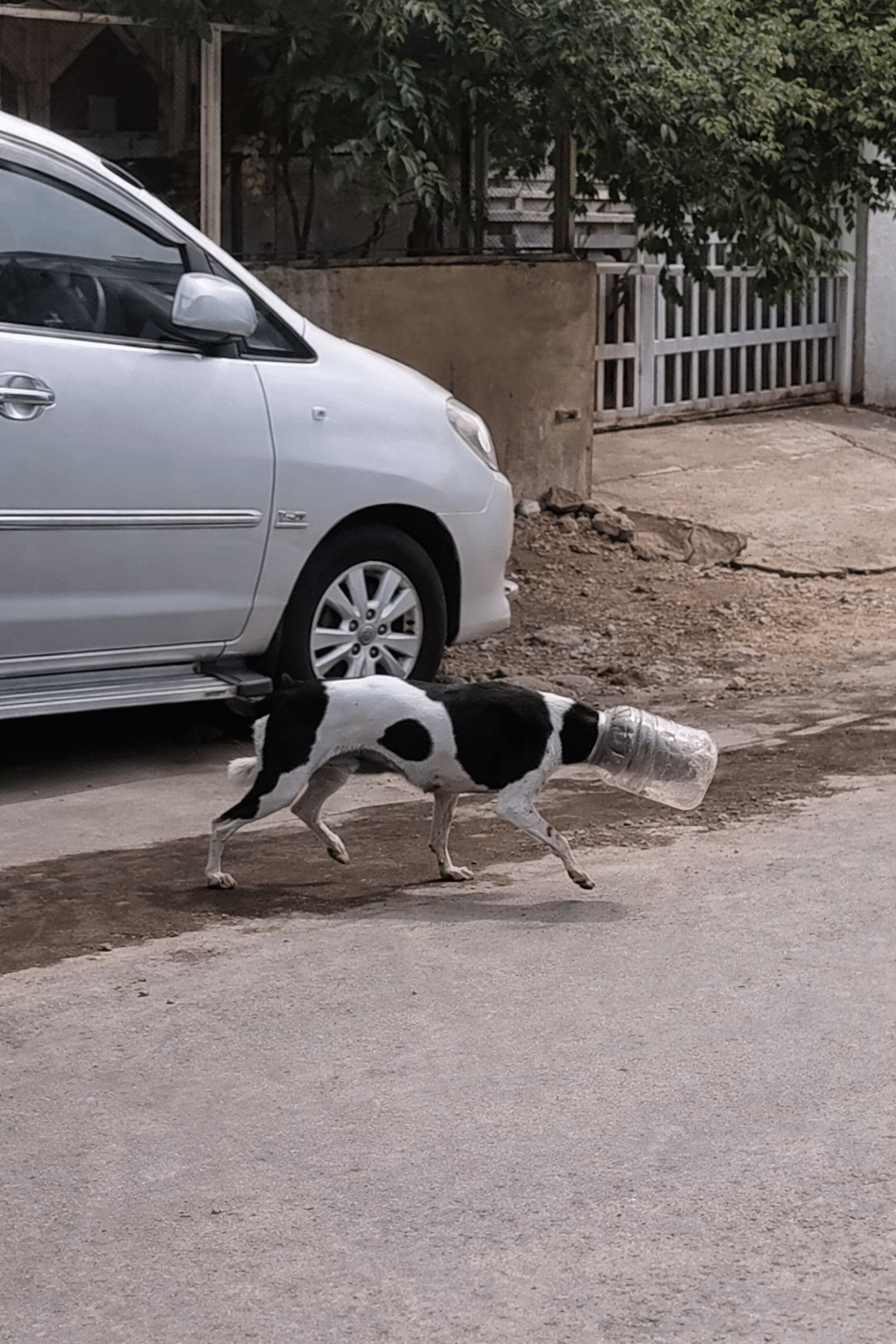
The yellow dog could not see where he was going.
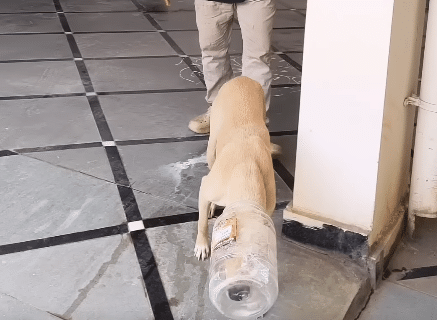
A large transparent plastic container had become trapped over his entire head, leaving him frightened, disoriented, and unable to understand what was happening around him.
He ran in circles.
Stumbled.
Changed direction again.
Every attempt to escape only carried the jar with him.
The container also prevented normal access to food and water, turning an ordinary piece of discarded plastic into an urgent danger.
Rescuers knew they needed to get close.
The problem was that the terrified dog wanted nothing to do with them.
He Ran Blindly Every Time Someone Approached
From a distance, the dog’s behavior looked chaotic.
He darted across the yard.
Spun around.
Then suddenly changed direction.
Once rescuers looked closer, the reason became obvious.
The transparent jar covered his head completely.
Although light could pass through the plastic, the dog could not navigate normally with the container surrounding his face and neck.
He was frightened enough that every approaching person caused him to move again.
That created a difficult situation.
The rescuers needed to restrain him before they could remove the jar.
But chasing him aggressively could make his panic worse.
So they kept trying to position themselves close enough to control his movement without causing additional injury.
Video: Rescuers Struggle to Reach a Dog With a Plastic Jar Trapped Over His Head
Catching Him Was the First Challenge
Several attempts passed before a rescuer could get close enough.
Each time the distance narrowed, the dog moved away again.
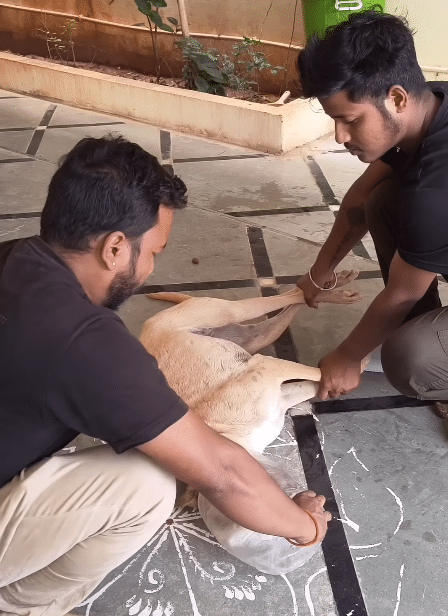
Eventually, one rescuer managed to secure him from behind and guide him carefully onto the ground.
That changed everything.
For the first time since the rescue began, the dog was no longer running blindly around the yard.
Other members of the team could now approach safely.
They held his body steady while examining how tightly the container was lodged around his neck.
It quickly became clear that simply pulling the jar upward would not work.
The opening was too tight.
Trying to force it over the dog’s head could have injured him.
The plastic would have to be broken instead.
The Jar Could Not Simply Be Pulled Off
The rescuers examined the container closely before beginning.
Hard plastic surrounded the dog’s head.
His skin was only a short distance beneath it.
That meant any tool used to break the material had to be controlled carefully.
One person kept the dog from moving suddenly.
Another positioned the tool against the plastic.
Rather than making one forceful strike, the team worked gradually.
A small crack.
Then another.
Each fracture weakened the container while allowing the rescuers to monitor how close they were getting to the dog underneath.
It was slower than simply smashing the jar.
But speed mattered less than precision.
The Plastic Finally Began to Split
As more cracks appeared, the rigid structure lost its strength.
The rescuers continued applying controlled pressure.
Piece by piece, the jar began separating.
Once the opening was large enough, they could start pulling sections away from the dog’s head.
They checked each broken edge carefully.
Sharp plastic near the neck could easily create another injury if handled carelessly.
So the pieces were removed one at a time until nothing remained around him.
Then, suddenly, the dog’s head was free.
For a Moment, He Simply Stayed Still
Immediately after the last piece came away, the dog did not need to fight against anything anymore.
The rescuers released their hold.
For a brief moment, he remained where he was.
Then he stood.
There was no container interfering with his movement.
No plastic surrounding his face.
No need to run blindly.
Within seconds, the dog moved freely across the yard.
The frantic circles that had defined the beginning of the rescue were gone.
He could see where he was going again.
And the team could finally watch him move without the dangerous jar following every step.
The Rescuers Were Not Finished With the Jar
After freeing the dog, the team turned their attention back to the broken container.
They did not simply leave it where it had fallen.
Instead, they crushed the remaining plastic further so that another animal would be less likely to become trapped in it.
It was a small final step.
But it addressed the same hazard that had created the emergency in the first place.
Discarded containers can be especially risky to animals searching for food.
A dog may push its head inside because of a smell or scraps left at the bottom.
Getting in can be easy.
Getting back out may not be.
For this dog, the opening had become a trap.
An Ordinary Piece of Trash Became an Emergency
There was nothing unusual about the plastic jar itself.
That is what makes situations like this easy to overlook.
It was the kind of object someone might discard without thinking about what could happen afterward.
But once the dog’s head became trapped, nearly every normal activity became harder.
Seeing clearly.
Eating.
Drinking.
Moving safely.
Even allowing rescuers to approach became difficult because he could not understand what was happening around him.
What looked like frantic behavior was an animal responding to a frightening situation he could not solve himself.
The rescuers solved it by doing the opposite of what panic demanded.
They slowed down.
Restrained him carefully.
And broke the plastic in controlled stages.
He Only Needed Someone to Get Close Enough
The entire rescue lasted because the dog could not remove the container on his own.
He could run.
Shake his head.
Try to escape.
None of those things changed the problem.
Human hands were needed to restrain him safely and break the plastic apart.
Once that happened, the transformation was immediate.
The same dog who had been stumbling through the yard could move normally again.
No long recovery sequence was needed in the footage.
No dramatic final treatment.
The danger disappeared when the last piece of plastic came away.
His story is a simple reminder that rescue does not always begin with illness or abandonment.
Sometimes it begins with something as ordinary as trash left where an animal can reach it.
And sometimes saving a life means nothing more complicated than noticing the danger—
and staying until it is gone.


