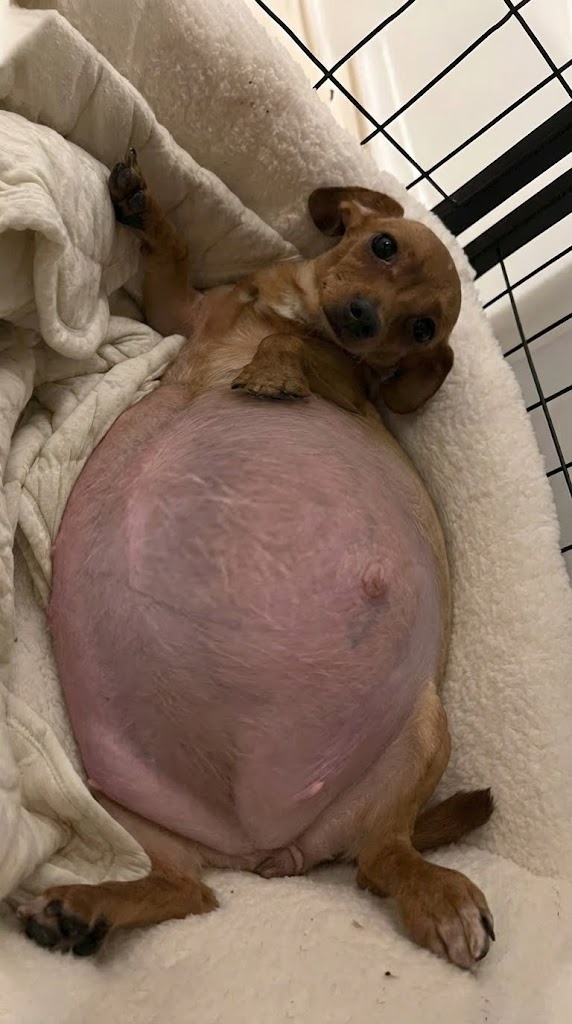
Lily was tiny.
When she reached the veterinary clinic, she weighed less than ten pounds, and her condition showed how much strain her body had already endured.
Her ribs were visible beneath a thin coat.
Fleas irritated her skin.
She appeared exhausted.
According to the original rescue account, Lily had come from a home affected by serious neglect, where her previous owner struggled with alcohol use.
But the most urgent problem was still hidden inside her.
Lily was pregnant.
And when veterinarians examined her more closely, they discovered that five fully developed puppies were waiting to be born.
Her labor had stalled.
For such a small, weakened dog, there was very little time to spare.
Five Puppies Were Too Much for Her Exhausted Body
The veterinary team quickly realized Lily was not simply approaching a normal delivery.
Something had gone wrong.
X-rays showed five puppies inside her small frame.
Her labor was no longer progressing properly, and her depleted condition made waiting increasingly risky.
Lily had very little physical reserve.
She was underweight.
Already exhausted.
And now her body was trying to complete a delivery it no longer seemed able to manage safely.
The team made the decision to perform an emergency C-section.
It was not a procedure that could be postponed until the following day.
Six lives were depending on what happened next.
Video: Lily Arrives Severely Weakened—Then Doctors Discover Five Puppies Still Inside
The C-Section Brought Five Puppies Into the World
The veterinary team prepared Lily for surgery.
Because of her small size and weakened condition, the procedure required careful monitoring.
Then the puppies began arriving.
One.
Then another.
Until all five had been delivered.
According to the rescue account, the litter included four males and one female.
All five were alive.
That was an enormous relief.
But Lily’s body had just undergone major surgery after already arriving in poor condition.
The puppies were safe for the moment.
Their mother was not yet out of danger.
Recovery Became Complicated Only Days Later
Several days after the C-section, a new problem appeared.
An infection developed around Lily’s surgical incision.
For a stronger dog, even that would require attention.
For Lily, whose body had already been pushed through pregnancy, stalled labor, surgery, and severe weakness, it was especially concerning.
Veterinarians placed drainage tubes near the affected area.
Antibiotics were administered.
The incision required repeated checks.
And Lily remained under close observation.
There was no shortcut through this stage.
Her body needed time to respond to treatment while also recovering from everything that had happened before surgery.
Lily Could Not Nurse the Puppies Herself
Another complication followed.
According to the original account, Lily was unable to produce enough milk to nurse her litter.
That meant the five puppies needed help from caregivers.
Bottle feeding became part of the daily routine.
Someone had to prepare the milk.
Feed each puppy.
Clean the bottles.
Then repeat the process again and again.
Lily remained close whenever possible.
She watched the puppies when they were brought near her.
Her tail sometimes moved as they approached.
The caregivers did not need to claim they knew exactly what she was thinking.
Her behavior showed something simpler.
She remained interested in her puppies even while her own body was still healing.
The Infection Slowly Began to Clear
The next stage of Lily’s story was much quieter.
Medication continued.
The drainage tubes remained in place until they were no longer needed.
Her incision was monitored.
And gradually, the infection began improving.
Then came other encouraging signs.
Lily’s appetite returned.
She became steadier on her feet.
She started responding more to the people around her.
As her strength increased, the fragile dog who had arrived at the clinic began showing more of her personality.
She accepted gentle touch.
Rested near other foster dogs.
And started initiating small interactions instead of simply lying still.
The change was gradual, but it was consistent.
Her Puppies Were Growing While Lily Rebuilt Her Strength
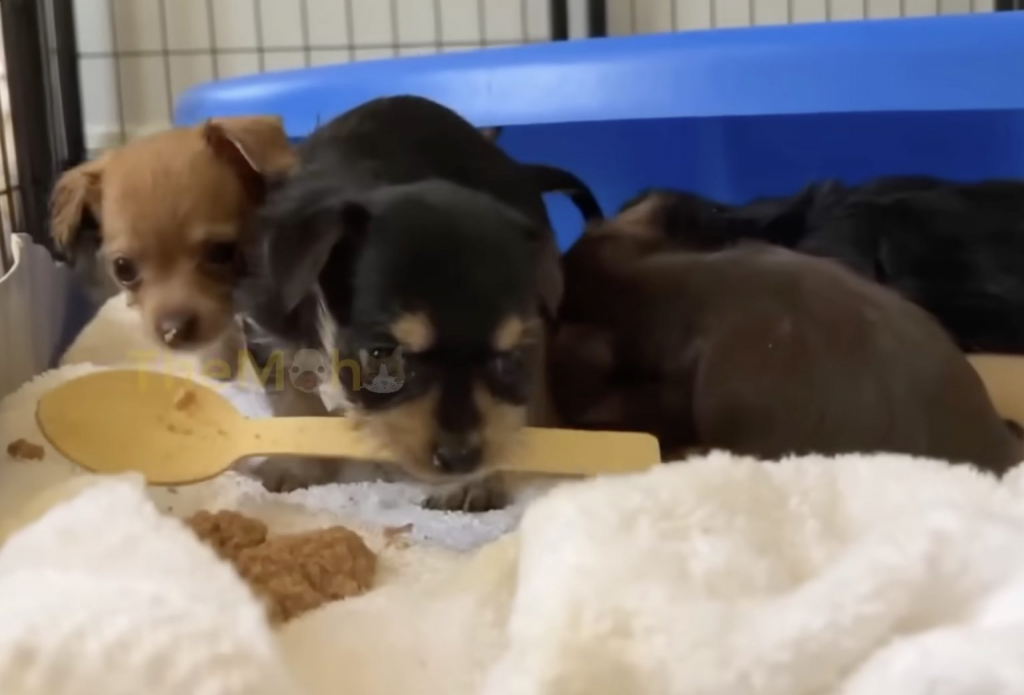
While Lily recovered, the five puppies continued developing.
Bottle feeding kept them nourished until they were old enough to transition toward more independent eating.
They became stronger.
More active.
More curious.
The emergency that had defined their first hours of life gradually gave way to ordinary puppy behavior.
For the rescue team, that meant the family was entering a completely different stage.
The puppies were no longer newborns requiring constant crisis-level attention.
Lily no longer needed intensive postoperative care.
Everyone could begin thinking about what would happen next.
One by One, the Puppies Found Homes
Eventually, the puppies became old enough for adoption.
Families were selected for each of them.
One by one, the litter left rescue care and entered homes of their own.
For Lily, that marked the end of a demanding chapter.
She had arrived carrying five puppies inside a body weighing less than ten pounds.
She had survived an emergency C-section.
Recovered from a postoperative infection.
And remained near her litter even when she could not nurse them herself.
Now all five puppies were safe enough to begin separate lives.
There was only one question left.
Where would Lily go?
Lily Found a Family Too
Lily did not remain without a home.
A family chose her.
The new environment offered things that had been uncertain in her earlier life.
Regular meals.
A warm place to sleep.
Predictable routines.
Other dogs nearby.
People who expected her to stay.

As time passed, Lily became more active.
She ran across the grass.
Played.
Stayed close to the people around her.
The tiny dog who had entered the clinic exhausted and heavily pregnant was now healthy enough to enjoy ordinary days.
Less Than Ten Pounds Was Still Enough to Begin Again
Lily’s story could easily be remembered only for how small she was.
Less than ten pounds.
Five puppies.
An emergency surgery.
Then an infection.
Those numbers make the beginning sound overwhelming.
But her recovery did not happen because one dramatic moment solved everything.
It happened because different people handled different parts of the problem.
Veterinarians delivered the puppies.
Caregivers managed the infection.
Volunteers bottle-fed the litter.
Families eventually adopted the puppies.
And another family gave Lily a permanent home.
Her body was small.
Her medical challenges were not.
But once the immediate crisis passed, Lily was given something much more ordinary—and much more important.
Time to recover.
A safe place to stay.
And a life in which she no longer had to carry everything alone.


