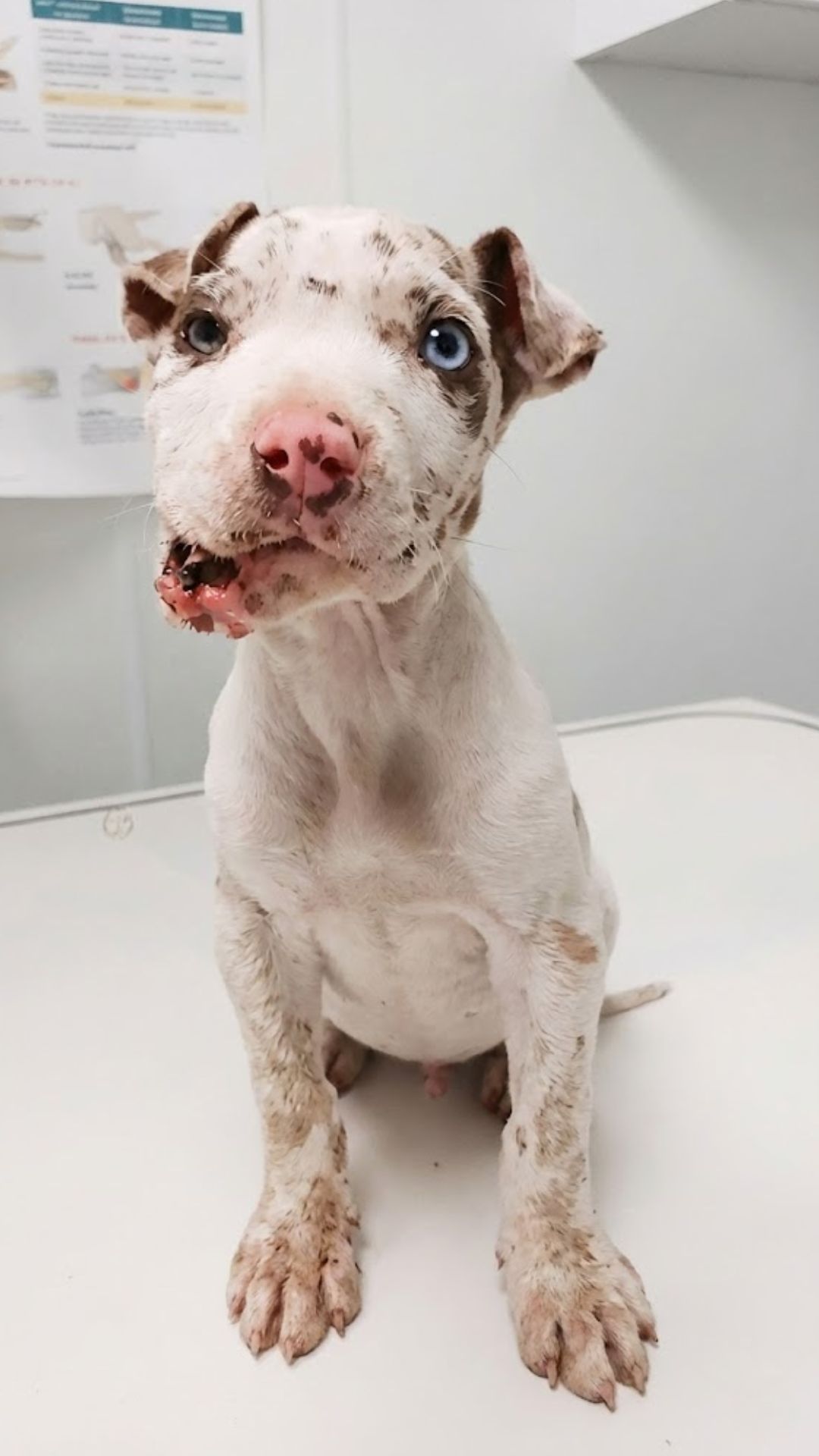
When the call came from Kern County Animal Shelter, the description was difficult to hear.
A dog had arrived with a devastating injury to his face.
Part of his jaw had been forced inward, leaving damaged bone loose inside his mouth. The tissue around it was infected, and the condition had progressed far beyond something that could be treated with simple medication.
The dog would later be known as Arrow.
At first, the team believed they were dealing with a recent emergency.
But once veterinarians began treating him, they discovered something even more concerning.
The injury had been there for weeks.
Arrow had been living with damaged, deteriorating bone and a severe infection for far longer than anyone initially realized.
Saving him would require an operation that permanently changed the way he looked.
But it also gave him the chance to live without the same source of pain.
The Damage Was Worse Than Anyone First Realized
According to the rescue, Arrow had suffered a severe blow to the face before arriving at the shelter.
The injury had pushed part of his jawbone inward.
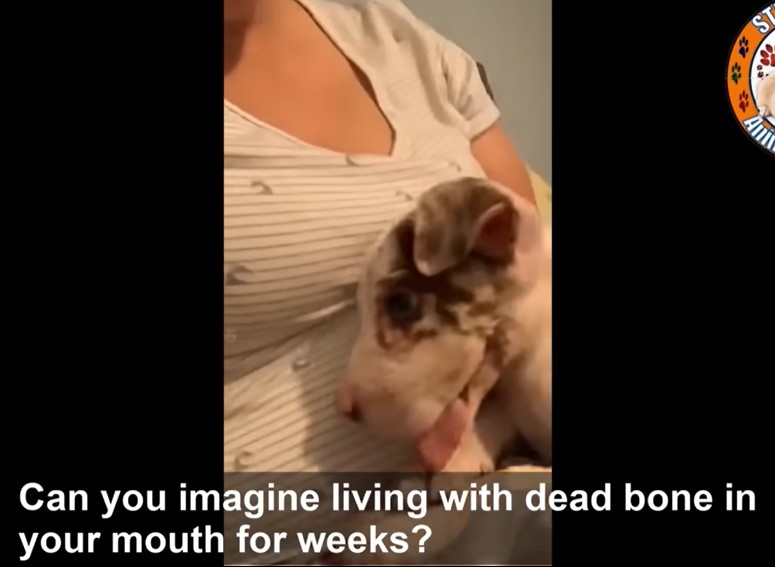
By the time he received medical attention, the affected bone had become badly compromised and infection had developed around it.
Once surgery began, veterinarians could see that the damage was not recent.
Arrow had apparently been coping with the injury for weeks.
That meant the surgical team had to think beyond simply repairing a fracture.
They needed to remove tissue and bone that could no longer safely remain.
The final decision was significant.
Arrow’s right upper jaw and right lower jaw had to be removed.
It was a major operation.
And when it was over, Arrow’s face would never look exactly the same again.
But the priority was not appearance.
It was giving him a safer, more comfortable future.
Video: Arrow’s First Step Forward After Major Jaw Surgery
Seven Days Later, the First Signs of Improvement Appeared
The early days after surgery were closely watched.
Arrow needed time to adjust to a mouth that now worked differently.
There were questions about eating.
Questions about healing.
Questions about whether the infection had truly been brought under control.
Then came the first encouraging changes.
Within about seven days, the strong odor associated with the infection had disappeared.
Arrow also began eating soft food successfully.
That small detail mattered enormously.
Removing part of both the upper and lower jaw meant he had to relearn how to handle food comfortably.
Yet he adapted.
His caregivers described him as eating extremely well despite everything his body had just been through.
The surgery had altered the structure of his face.
But it had not prevented him from moving forward.
His Tongue Became Part of the Face Everyone Remembered
Because part of Arrow’s lower jaw was gone, his tongue no longer sat entirely inside his mouth.
It began hanging slightly to one side.
That became one of his most recognizable features.
To strangers, his appearance might have seemed unusual.
To the people caring for him, it simply became Arrow.
The protruding tongue gave his face a permanently playful expression.
Photos of him often made it look as though he were smiling.
But the important change was not cosmetic.
He was able to eat.
He was able to drink.
He was no longer carrying the same infected bone inside his mouth.
For a dog whose treatment had required such an extensive operation, those ordinary abilities became meaningful milestones.
The goal had never been to make him look exactly as he had before.
The goal was to help him live comfortably in the body he had now.
Recovery Lasted Far Longer Than One Surgery
Arrow’s operation was only the beginning of his journey.
Healing from a major facial procedure required time.
So did rebuilding strength.
So did adjusting to a new routine.
His caregivers continued monitoring him as the weeks passed.
Food had to suit his needs.
His mouth needed to heal properly.
And his comfort had to remain the priority.
The days slowly turned into months.
Arrow became stronger.
His personality became easier to see.
The dog who had first arrived in serious medical distress began experiencing ordinary parts of life that had nothing to do with treatment.
Attention.
Toys.
Rest.
Regular meals.
Safe places to sleep.
Then, after 230 days, another major change arrived.
Arrow found a permanent home.
Day 230 Brought the Home He Had Been Waiting For
Adoption changed the rhythm of Arrow’s life again.
He was no longer moving from one stage of medical recovery to the next.
Now he had a household of his own.
A familiar bed.
People who knew his needs.
A routine that repeated every morning and every night.
His physical differences did not make him less wanted.
They simply became part of who he was.
Birthdays came.
Toys accumulated.
The dog who had once been defined by emergency treatment now had a life filled with things far more ordinary.
And that was exactly the point.
His story no longer revolved around surgery.
It revolved around home.
On Day 800, Arrow Met Someone New
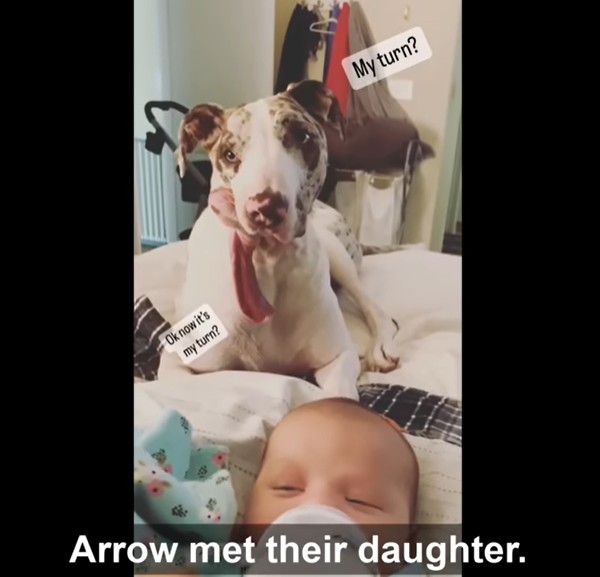
Around Day 800, Arrow’s family welcomed a newborn daughter.
For the household, it was another major transition.
New sounds.
New smells.
New routines.
A very small person suddenly became part of Arrow’s world.
His family introduced them carefully.
Arrow’s behavior around the baby was gentle and attentive.
He spent time near her.
He watched.
He stayed close.
As she grew, their connection became part of everyday family life.
The dog whose early story had been shaped by injury was now appearing in photographs beside a child who knew him simply as part of the family.
There was no need to describe him as “fixed.”
Arrow was not becoming a different dog.
He was simply being given new experiences to place alongside the difficult ones that had come before.
By Day 1650, Their Bond Had Become Part of Daily Life
Years continued to pass.
By approximately Day 1650, Arrow and the little girl had spent a significant part of their lives growing up alongside one another.
The baby he had first met as a newborn was now older.
Arrow remained close.
Their shared life was made of ordinary moments.
Time together around the house.
Quiet companionship.
Play.
Rest.
Family routines.
Those moments may not look dramatic from the outside.
But they reveal how far Arrow’s life had moved from the emergency that first brought him into rescue.
He was no longer the dog known only for a damaged jaw.
He was someone’s companion.
Someone’s familiar face at home.
And part of a child’s earliest memories.
Arrow’s Face Changed — But His Life Became Much Bigger
Arrow’s story began with a medical crisis that required an extraordinary decision.
Damaged bone had remained in his mouth for weeks.
Infection had taken hold.
And removing the right upper and lower portions of his jaw was necessary to give him a chance to recover.
That operation permanently changed his appearance.
His tongue now hangs outside his mouth.
His face is unmistakably different.
But none of those changes prevented him from building a full life.
He learned to eat again.
He recovered from infection.
He spent 230 days moving through treatment and care before finding a home.
He welcomed a newborn into that home.
And years later, he was still there as she grew.
Arrow’s story is not powerful because he “forgot” what happened.
There is no way to know exactly how a dog remembers painful experiences.
What we can see is what came afterward.
Medical care.
Recovery.
Adoption.
Routine.
Family.
And thousands of days that were no longer defined by the injury that nearly ended his story.
Arrow lost part of his jaw.
He did not lose the chance to live.
And in the end, that became the part of his journey that mattered most.


