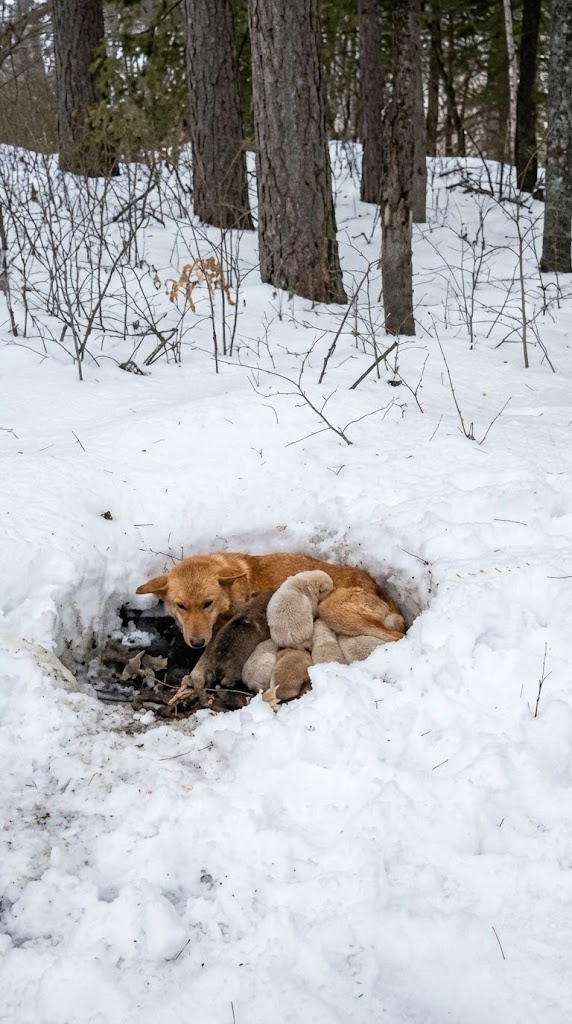
The snowdrift looked like part of the landscape.
Nothing about it suggested that a family was hiding inside.
But beneath the packed snow near a wooded area in northwestern Minnesota, a mother dog had made a small hollow for herself and six young puppies.
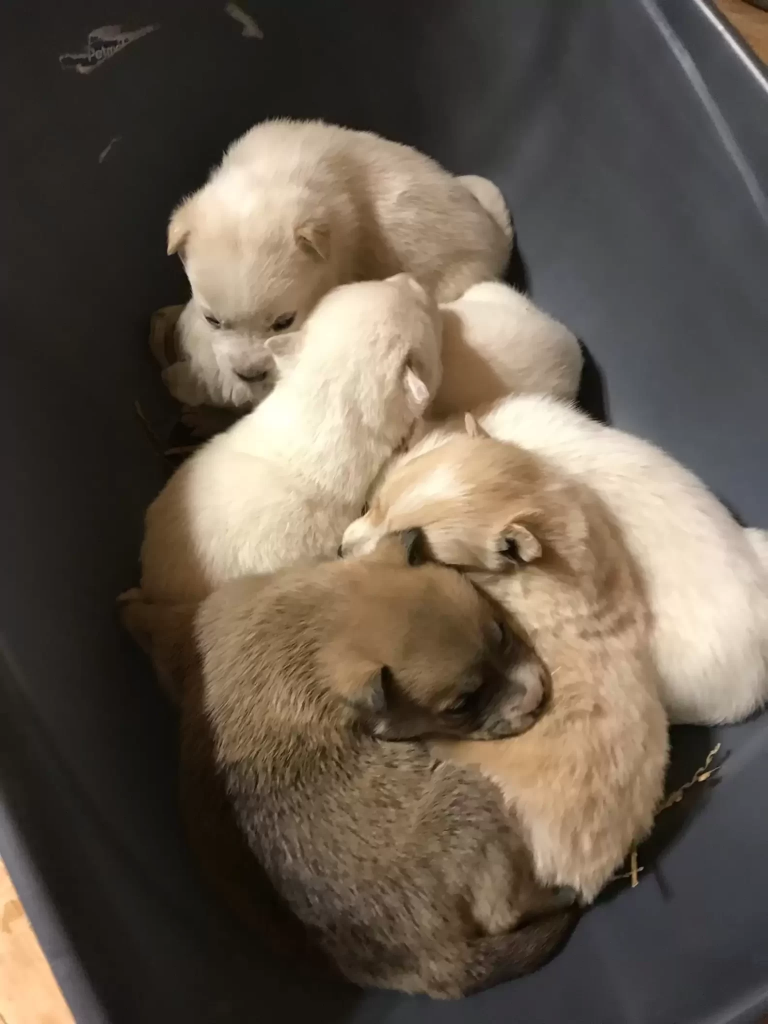
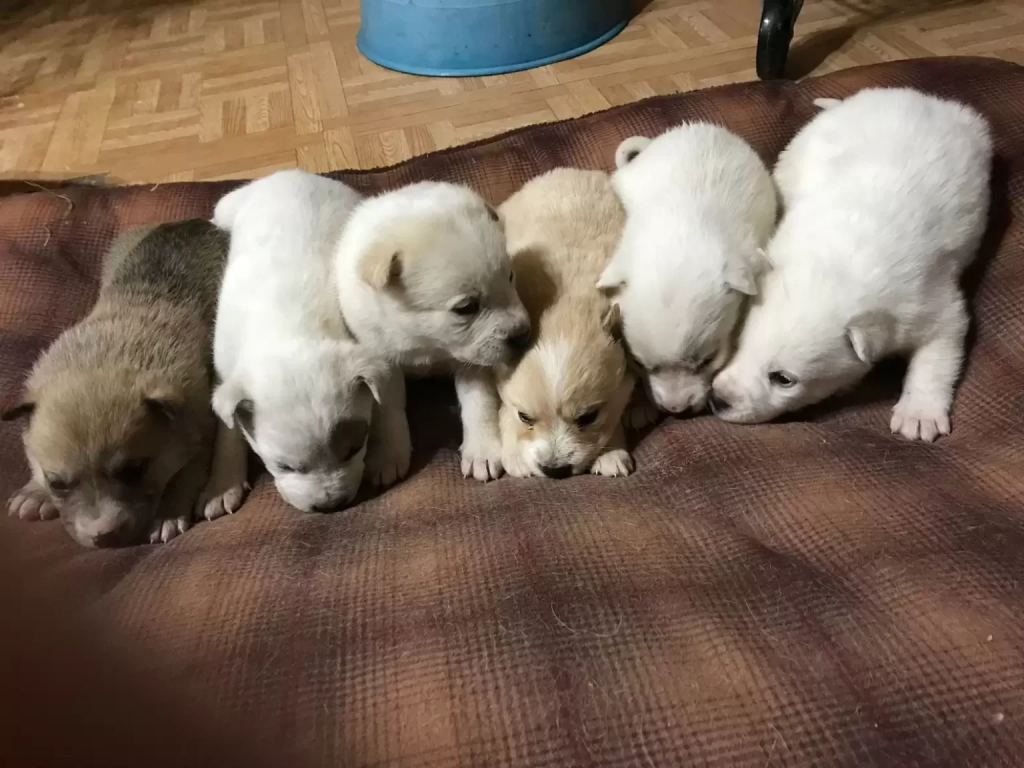
The puppies were only about three weeks old.
Their mother was thin.
Her body had been pushed hard by the cold and lack of food.
And according to the rescue account, she was no longer producing enough milk for the litter.
Still, all six puppies were alive when someone finally found them.
The Snowdrift Had Become Their Only Shelter
Minnesota winters can be unforgiving.
For a nursing mother with no dependable food or shelter, the conditions were especially dangerous.
The original account says the dog had dug into a snowdrift near the trees, creating a hollow large enough for herself and the puppies.
Inside that narrow space, the litter stayed close to her body.
There was no heated shelter.
No dry bedding.
No regular food source.
Just packed snow around them and a mother whose own condition was deteriorating.
Video: A Mother Dog and Six Puppies Are Found Sheltering Inside a Snowdrift
A Passing Family Noticed Movement Near the Snow
According to the source, a local family noticed something unusual while driving through the area.
At first, the movement near the snowbank could have been wildlife.
Then they looked more closely.
There was a dog.
And beneath her were puppies.
The mother appeared extremely thin and cold.
The puppies were small enough that prolonged exposure could quickly become dangerous.
The family gathered the dogs, wrapped them in blankets, and transported them to Red Lake Rosie’s Rescue.
The snowdrift had kept them partially sheltered.
Now they needed warmth, food, and medical attention.
The Mother Arrived Exhausted and Underweight
At the rescue, staff could see how much the experience had taken from her.
She was painfully thin.
Her coat still carried signs of the snow and cold.
And despite her own condition, she remained attentive to the puppies.
The rescue named her Snowbelle.
The puppies were warmed gradually and placed on a feeding schedule.
Snowbelle received food, rest, and a dry place where she could lie with the litter without fighting the weather.
For the first time in the story, survival no longer depended on a hole in the snow.
Once She Was Warm and Eating, Her Milk Returned
One of the biggest concerns was feeding the puppies.
The rescue account says Snowbelle had stopped producing enough milk before she was found.
Her own body simply did not have enough resources.
After arriving at the shelter, that began to change.
With regular meals, warmth, hydration, and rest, Snowbelle started producing milk again.
The puppies were able to nurse.
That gave the family another layer of support while the litter continued growing.
It was not a sudden transformation.
It was a basic biological response to finally having enough food and stability.
Six Puppies Grew Strong Enough for Homes of Their Own
Over the following weeks, the puppies changed quickly.
They gained weight.
Became more active.
Started playing with one another.
And eventually reached the stage when adoption could begin.
Applications came in.
One by one, the puppies left for homes.
The litter that had once been packed together inside a snowdrift was no longer dependent on their mother for survival.
Snowbelle, however, remained in rescue.
Her next chapter would take longer.
She Was Transferred and Given a New Name
To give her another opportunity for adoption, Snowbelle was transferred to Pet Projects in Nerstrand, Minnesota.
There, she was renamed Asha.
The move placed her in a setting where the focus could shift from nursing puppies to helping her adjust to everyday life around people.
According to the source, Asha was timid when she arrived.
She was unfamiliar with a leash.
Indoor routines were new.
And she approached many interactions cautiously.
There was no indication that she was aggressive.
She simply needed time.
Six Weeks of Routine Changed Her Again
Asha’s progress came through repetition.
Regular meals.
Leash practice.
Gentle interaction.
Predictable routines.
Over about six weeks, the source says she gained approximately six pounds.
Her coat looked healthier.
Her posture became more relaxed.
She started enjoying walks.
Then she began approaching familiar people for affection.
Small behaviors that once seemed uncertain became ordinary.
A wagging tail.
Standing closer.
Leaning into touch.
The dog who had once needed a snowdrift for shelter was learning how to live in a completely different environment.
Her Puppies Had Homes — Asha Was Still Waiting
By the end of the original story, all six puppies were doing well in homes of their own.
Asha had not yet been adopted.
She was healthier.
More confident.
And increasingly comfortable around people.
But she still needed someone willing to choose the adult dog after the puppies were gone.

That part of the story is important because rescue does not always end at the same time for every animal in a family.
The puppies moved on quickly.
Their mother needed longer.
The Snow Was Only the First Part of Her Story
Asha’s rescue began with a scene that could easily have been missed.
A snowbank.
A little movement near the trees.
A mother dog curled around six puppies.
Someone stopped long enough to investigate.
That decision led to Red Lake Rosie’s Rescue.
Warmth.
Food.
The return of her milk.
Six puppies growing strong enough for adoption.
And eventually, Asha’s transfer to Pet Projects, where she continued learning how to live around people.
The source ends before her permanent home is confirmed.
So her story is not complete there.
But one thing had already changed completely.
Asha no longer needed to dig into snow just to keep her puppies alive.


