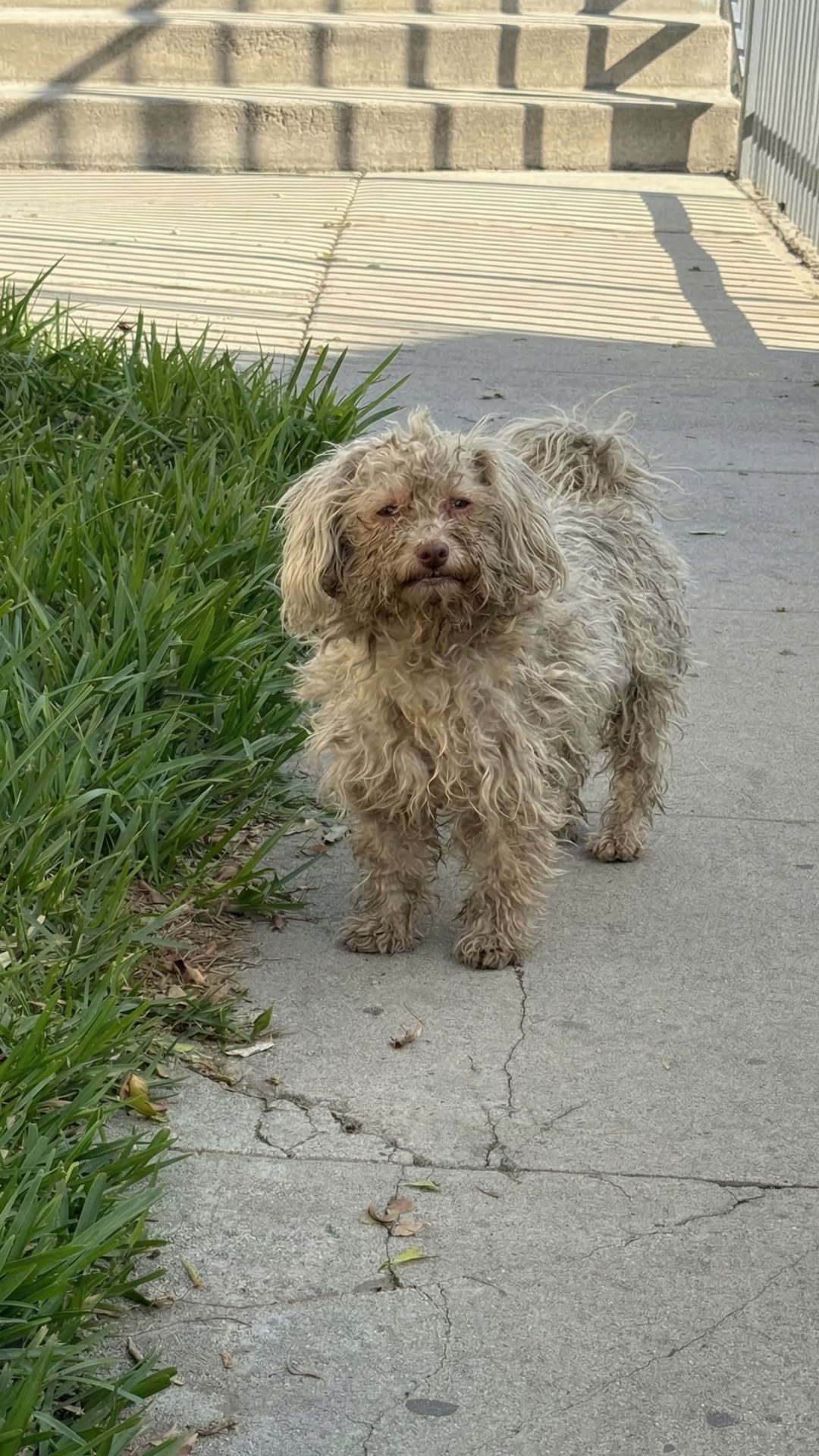
For more than a month, the small dog kept appearing in the same neighborhood.
He was easy to recognize.
His coat had grown into thick, dirty mats that covered much of his body. He moved cautiously whenever people came near, keeping enough distance to escape if he felt threatened.
Neighbors sometimes left food and water for him.
Still, the dog did not wander far.
Again and again, he returned to one particular house.
Not because someone there was feeding him.
Not because it had once been his home.
Behind the fence lived another dog.
And for reasons no one could fully know, the frightened little stray seemed determined to remain close.
Even when he was pushed back outside, he returned to the same place.
Night after night.
Until someone finally called for help.
The Little Dog Who Wouldn’t Leave the Fence
By the time a Good Samaritan contacted Suzette Hall, founder of Logan’s Legacy 29, the dog had reportedly been roaming the neighborhood for more than a month.
His physical condition showed how difficult that time had been.
The coat that should have protected him had become a burden.
Long sections of fur had tangled together into dense mats, trapping dirt and pulling against his skin whenever he moved.
But neighbors had noticed something else.
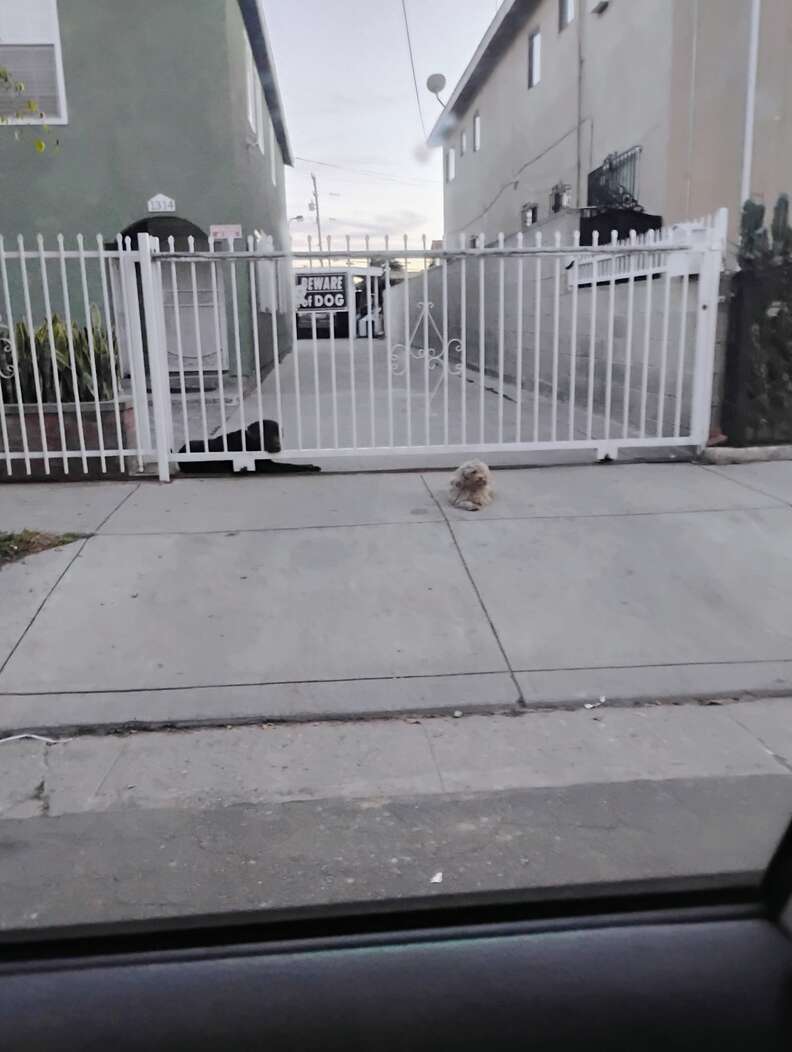
The stray spent much of his time near a fenced yard.
Inside that yard lived another dog.
The two appeared interested in one another, and the little stray repeatedly positioned himself as close to the fence as possible.
Sometimes he reportedly slipped through the gate.
He seemed drawn to the dog on the other side.
The homeowners, however, did not want him there.
According to the rescue account, he was repeatedly kicked or forced back out of the property.
Still, he kept returning.
He would settle again outside the fence.
Close enough to see the other dog.
Close enough, perhaps, for the unfamiliar street to feel a little less empty.
Whatever the exact reason, that location had clearly become important to him.
And it was there that rescuers would eventually have to reach him.
VIDEO: Tucker Kept Returning to One Fence — Even After He Was Repeatedly Turned Away
Neighbors Could Feed Him, But They Couldn’t Get Close
Several people in the neighborhood had already tried to help.
The problem was fear.
Tucker—though he did not have that name yet—was wary of human contact.
If someone approached directly, he moved away.
Trying to grab him could easily have sent him running into traffic or disappearing into another part of the neighborhood.
So people adapted.
Food was placed where he could reach it.
Water was left nearby.
Then people stepped back.
This kept him fed, but it did not solve the larger problem.
His coat continued getting worse.
He remained outside.
And every day he spent loose carried new risks.
Eventually, the call reached Hall.
By then it was already late.
She still decided to make the drive.
The trip took more than an hour.
Her goal was simple:
Find the dog.
Get close enough to secure him.
Bring him somewhere safe.
But frightened dogs rarely make rescue easy simply because help has arrived.
The First Rescue Attempt Ended Behind a Locked Gate
When Hall reached the neighborhood that night, the little dog reacted exactly as people feared he might.
He panicked.
Instead of remaining near the sidewalk, he squeezed through the gate into the yard where his canine companion lived.
Then he moved deeper into the property.
For Tucker, the yard may have felt like the safest place available.
For Hall, it created a new problem.
The homeowners were not there.
The gate was locked.
She could see where the dog had gone, but she could not legally or safely reach him.
There was no quick solution.
Trying to frighten him back toward the street could have made things worse.
Waiting outside indefinitely would not guarantee he came out.
Eventually, Hall had to make the difficult decision to leave for the night.
The dog she had driven more than an hour to rescue was still there.
Still outside.
Still beyond reach.
But she was not abandoning the attempt.
She planned to return early the next morning.
This time, she would bring equipment designed for a dog who was too frightened to be approached by hand.
The Next Morning, Tucker Was Still There
Hall made the long drive again.
When she arrived, she found the little dog near the same fence.
He had not wandered far.
That gave her another chance.
This time, she brought a humane dog trap.
For fearful strays, a trap can allow rescuers to secure an animal without chasing, grabbing, or cornering them.
The challenge is convincing the dog to enter.
Hall positioned the trap and began using food.
Tucker stayed cautious.
He watched her movements and maintained distance.
She did not force the situation.
Food was tossed closer.
Then closer again.
The smell drew his attention.
Hunger competed with fear.
Eventually, Tucker began following the trail.
One cautious step.
Then another.
He approached the trap.
Stopped.
Considered it.
Then moved farther inside.
Finally, his whole body crossed the threshold.
The door closed.
After more than a month loose in the neighborhood, Tucker was secured.
The moment may have looked frightening to him.
But for the first time, no one had to chase him.
No one had to push him out of anywhere.
He was being taken somewhere people intended to care for him.
Under the Matted Coat Was a Dog Who Needed Relief
Tucker was brought to a veterinary clinic for care.
One of the most immediate problems was obvious.
His coat had to come off.
The mats were too severe to simply brush through.
They were thick.
Dirty.
Tight against his body.
As groomers carefully worked with clippers, pieces of the neglected coat began falling away.
Section by section, Tucker’s actual shape emerged underneath.
For dogs with severe matting, removing that weight can make ordinary movement significantly more comfortable.
Hall later described the change with obvious relief, saying she could hardly imagine how good Tucker must feel after the mats were removed.
Then she added something more personal:
She was sure he felt “like a million bucks,” because that was what she believed he was worth.
Once the worst of the coat was gone, Tucker received a warm bath.
Weeks of dirt disappeared.
The dog who had looked almost buried inside his own fur began to look smaller, cleaner, and softer.
The physical change was dramatic.
But what happened afterward may have mattered just as much.
Tucker was given somewhere quiet to rest.
That Night, No One Was Going to Chase Him Away
After his grooming and bath, Tucker settled into a kennel.
It was not yet a permanent home.
But it was indoors.
There was bedding beneath him.
Food and water were available.
People knew where he was.
For more than a month, Tucker’s routine had depended on whatever the neighborhood offered him that day.
A little food left outside.
A quiet corner.
The fence he repeatedly returned to.
Now the night required far fewer decisions.
He did not have to search for somewhere to lie down.
He did not have to watch people passing on the sidewalk.
He did not need to work his way through a gate simply to stay near another dog.
He could curl up.
And sleep.
For a rescue animal, safety often looks surprisingly ordinary.
A closed door.
A clean blanket.
A bowl that will be refilled.
No one asking the dog to move somewhere else.
For Tucker, that ordinary night represented an enormous change.
By Morning, He Barely Looked Like the Same Dog
The next day made the transformation even clearer.
Without the heavy mats, Tucker’s face was easier to see.
His body was no longer hidden beneath dirty, tangled fur.
The frightened street dog neighbors had watched for weeks now looked like a small companion waiting for the next part of his life to begin.
But rescue had not instantly erased his caution.
That was never the expectation.
A dog who avoided people for more than a month would still need patience.
A foster or adopter would need to give him time to learn a new routine.
Still, the hardest part was over.
Tucker was no longer loose.
His physical discomfort had been addressed.
He had veterinary support.
And the people around him were now making decisions based on what would help him rather than on how to make him leave.
At the time his story was shared, Tucker was looking for a foster or permanent home.
That meant his ending had not yet been written.
But it also meant he finally had choices that had not existed on the street.
The Fence Was No Longer the Only Place He Could Return To
There is something difficult to forget about the way Tucker kept returning to that same yard.
People could drive him away.
The gate could close.
He could end up back on the sidewalk.
Still, he returned.
The rescue account cannot tell us exactly what Tucker understood about the dog living behind the fence.
We cannot know whether he thought of that dog as a friend in the same way people would use the word.
What we can see is simpler.
He repeatedly chose to remain close.
When much of the neighborhood frightened him, that location appeared familiar enough to keep drawing him back.
Then one night, a rescuer drove more than an hour to reach him.
The first attempt failed.
So she returned the next morning.
A trail of food led Tucker into a humane trap.
Clippers removed the coat that had been weighing on him.
Warm water washed away weeks of dirt.
And that evening, the dog who had spent so long outside one particular fence finally slept somewhere that belonged to his rescue—not to someone who wanted him gone.
Tucker still needed a family.
But he no longer needed to keep returning to the same sidewalk in order to find companionship.
For the first time in more than a month, the next place he stayed could be somewhere that wanted him there.


