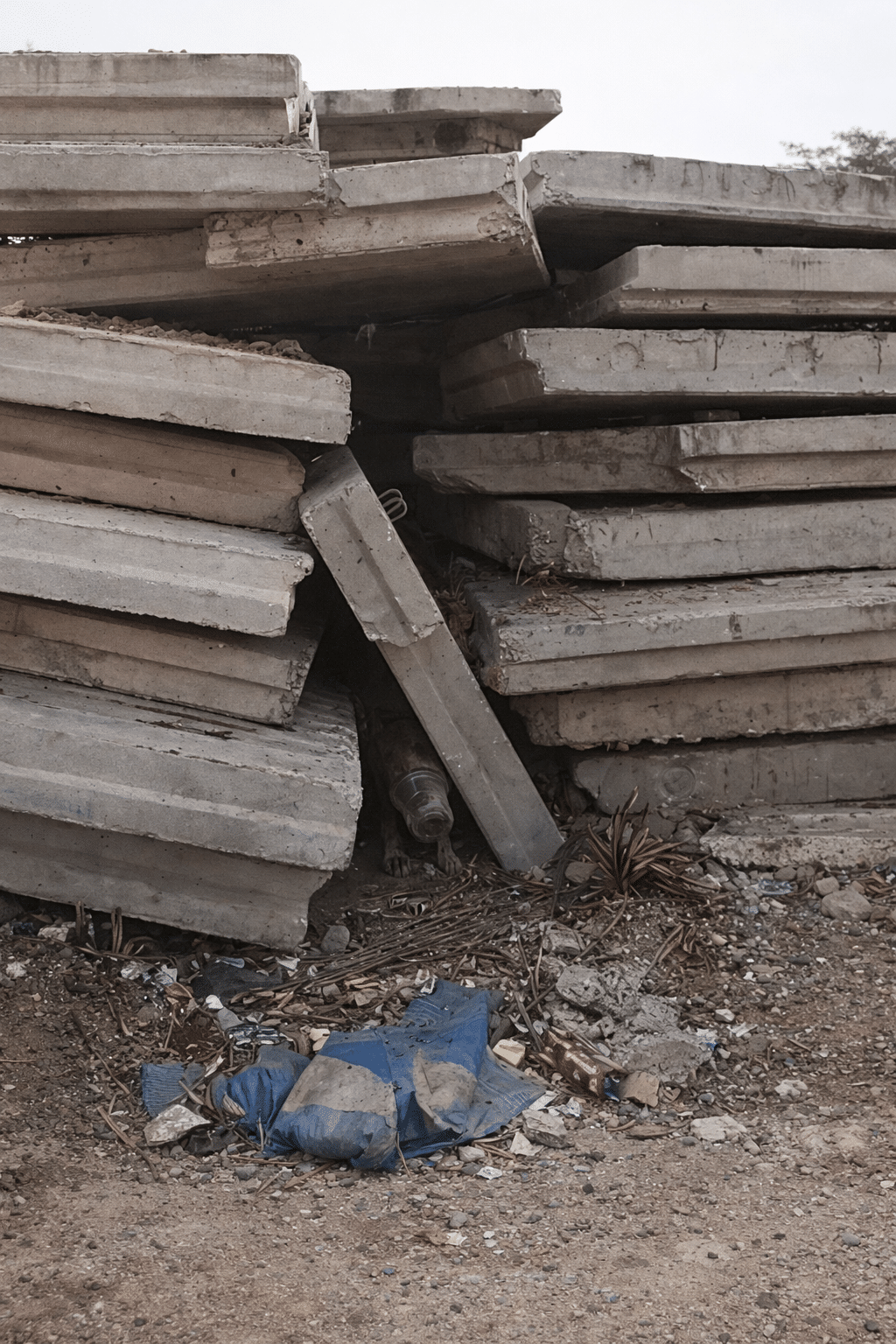
At first, there was only movement among the rubble.
A brown stray dog was picking his way across a construction area covered with broken concrete, loose stones, and discarded debris.
But something was terribly wrong.
Where his face should have been, there was only plastic.
A large container—commonly called a “Dabba” in India—had become stuck completely over the dog’s head.
He could not see the uneven ground beneath his paws.
He could not easily search for food or water.
And every frightened movement carried him deeper into an area filled with sharp edges, unstable slabs, and places where rescuers could not simply reach down and grab him.
Then the dog did what frightened animals often do when people approach.
He hid.
Still wearing the plastic container, he squeezed beneath heavy concrete slabs and disappeared into the rubble.
Now the rescuers had two problems.
They had to catch him.
And then they had to remove the Dabba without hurting him.
The Container Had Turned the Construction Site Into a Maze
The dog’s surroundings were difficult even for an animal with normal vision.
Broken slabs lay at different angles.
Loose pieces of concrete shifted underfoot.
Narrow spaces between the debris created hiding places where a frightened stray could quickly disappear.
For this dog, the danger was greater.
The plastic jar covered his entire head.
He had to navigate by instinct, sound, and whatever limited awareness remained through the container.
Every step across the construction site could send him into another obstacle.
Food was another concern.
With the Dabba trapped around his head, eating or drinking normally would have been extremely difficult.
And the longer the container remained stuck, the greater the risk that exhaustion, dehydration, or another accident could follow.
When the rescue team arrived, they did not find a dog waiting calmly in the open.
He had already pushed himself beneath the concrete slabs.
The same hiding place that may have made him feel protected from approaching people now made the rescue far more complicated.
No one could safely crawl in after him.
The rubble was unstable.
And chasing him blindly could send him deeper into the site.
The team needed another way.
VIDEO: His Head Was Completely Trapped Inside a Plastic “Dabba” — Then He Hid Beneath the Rubble
Reaching Him Meant Crossing the Rubble First
One rescuer carefully moved across the construction site carrying a long-handled rescue net.
Every step had to be deliberate.
The surface was uneven, and large pieces of concrete were stacked around the area.
A fall could injure the rescuer.
A sudden noise could also frighten the dog into moving farther beneath the slabs.
So the team first worked on locating exactly where he had hidden.
They looked between the concrete pieces.
Watched for movement.
Listened.
Finally, they spotted him.
The dog remained beneath the slabs with the large plastic container still covering his head.
Getting close enough to remove it directly was impossible.
The rescuers would first need him in an open area where they could control his movement.
That created a delicate balance.
They had to encourage the dog out.
But they could not frighten him so badly that he ran blindly across the dangerous construction site.
One rescuer positioned himself where the dog might emerge.
Another prepared the net.
Then they began coaxing him away from the rubble.
The Hardest Part Was Getting Him Into the Open
The dog eventually moved.
Slowly at first.
He came away from the shelter of the concrete slabs and stepped into a clearer section of ground.
The Dabba still covered his head.
His movements remained uncertain.
This was the moment the rescuers had been waiting for.
If he ran back beneath the concrete, the entire process might have to begin again.
So the rescuer holding the net acted quickly.
The net came down around the dog.
For a moment, he struggled.
That reaction was expected.
He was already frightened and unable to understand why people were surrounding him.
Now he was inside another unfamiliar object.
But the purpose of the net was not to punish or restrain him unnecessarily.
It created a controlled space.
Without it, the dog could have bolted while rescuers were trying to remove the jar.
That could have caused injury to him or forced the team to chase him through the rubble again.
Inside the net, his movement could finally be managed safely.
The rescue had reached its most important stage.
Now they could attempt to remove the Dabba.
Pulling Straight Back Wasn’t Enough
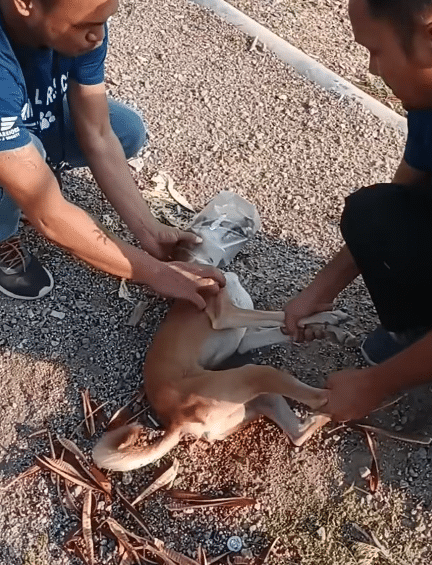
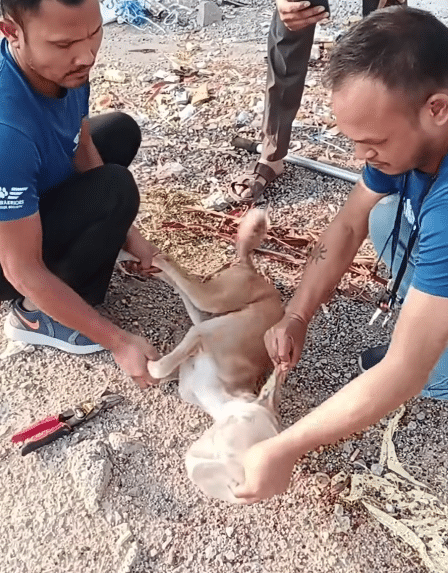
Two rescuers worked together.
One focused on keeping the dog stable.
The other took hold of the plastic container.
At first glance, it might seem that removing a jar from a dog’s head should require only one strong pull.
But the Dabba was tightly wedged.
Forcing it straight backward could scrape the skin around the dog’s neck or cause unnecessary pain.
So the rescuer did not yank.
Instead, he began rotating the container.
A small twist.
Then another.
The dog moved inside the net while the second rescuer kept him from turning suddenly.
Again, the Dabba was rotated.
It still did not come free.
The container had likely gone on more easily than it could come off.
That is part of what makes discarded jars and containers so dangerous for stray animals.
A dog may push its head inside while searching for food.
Once the wider part of the head passes through the opening, pulling back can become much more difficult.
Now the rescuers had to reverse that process without knowing exactly how tightly the plastic was pressing against him.
So they continued slowly.
Twist.
Pause.
Adjust.
Try again.
Then the Dabba Finally Began to Move
After several careful attempts, the container shifted.
Only slightly.
But enough.
The rescuer adjusted his grip and continued rotating it.
The plastic moved farther toward the front of the dog’s head.
Another controlled twist followed.
Then, suddenly, the resistance gave way.
The Dabba slid free.
For the first time since rescuers had arrived, the dog’s face was completely visible.
No plastic in front of his eyes.
No rigid container around his head.
Nothing preventing him from seeing the people and ground around him normally again.
The rescuers did not hold him longer than necessary.
The problem they had come to solve was over.
They removed the net.
And the dog immediately reacted.
He got to his feet.
The Moment the Net Opened, He Ran
There was no long recovery scene described in the footage.
No dramatic pause.
Once the rescuers released him, the brown dog stood and moved away.
Then he ran.
Across the open construction area.
Away from the people.
Away from the rubble where he had been hiding.
Within seconds, he was putting distance between himself and the place where the rescue had happened.
For the team, seeing him move normally was its own kind of confirmation.
Before the rescue, every step had been made with his head trapped inside plastic.
He had navigated debris without being able to see properly.
He had hidden beneath concrete while still carrying the container around his head.
Now there was nothing obstructing him.
The dog did not remain for affection.
He did not need to.
He was a stray animal suddenly given back the ability to move freely.
So he used it.
And the rescuers watched him disappear from the site.
But before they left, there was still one thing they wanted to do.
They Made Sure the Same Dabba Could Never Trap Another Animal
The plastic container remained on the ground.
To most people, it would have looked like ordinary waste.
A jar.
A discarded household object.
Something easy to overlook.
But everyone at the construction site had just seen what that object could become.
For a stray dog searching for scraps, an open container can seem like an opportunity.
There may be food residue inside.
A smell worth investigating.
The animal pushes its head through the opening.
Then suddenly cannot reverse the movement.
A piece of trash becomes a trap.
Instead of leaving the Dabba intact, the rescuers crushed it.
The plastic broke under their feet.
It could no longer hold the shape that had trapped the dog.
It was a small final action.
But it prevented the same object from creating the same emergency again.
The dog had already run away.
There was no reward ceremony.
No permanent adoption revealed at the end.
Just an empty piece of rubble where he had been hiding—and a crushed plastic container that would never cover another animal’s head.
A Simple Piece of Plastic Had Nearly Taken Away Everything He Needed
The rescue itself lasted only part of a day.
But the danger had started with something people throw away every day.
A container.
For the dog, it changed almost everything about how he could function.
Sight became difficult or impossible.
Searching for food became harder.
Drinking normally became difficult.
Navigating traffic, construction debris, or other animals became far more dangerous.
And because he was frightened by approaching humans, helping him required rescuers to solve the situation without being able to simply walk up and take the Dabba off.
First, they had to locate him beneath the concrete.
Then encourage him into the open.
Then secure him with a net.
Only after that could they begin the slow twisting process that finally released his head.
Every stage depended on patience.
Rush the dog out of hiding, and he might run deeper into the rubble.
Miss with the net, and he might disappear again.
Pull the plastic too aggressively, and the rescue itself could cause injury.
So the team worked through the problem one step at a time.
Until the container moved.
Until his face appeared.
Until the net opened.
Then the dog did the one thing he had been trying to do from the beginning.
He left.
The Rubble Was Empty When the Rescue Was Over
The most memorable image at the beginning of the rescue was difficult to forget.
A brown dog among gray concrete.
His entire face hidden inside an oversized plastic jar.
Unable to see the people approaching him, he pushed himself beneath the slabs and tried to disappear.
By the end, that hiding place was empty.
The Dabba was empty too.
And then it was crushed.
Somewhere beyond the construction site, the dog was moving again without plastic around his head.
The source does not tell us where he went next.
It does not give him a name.
It does not end with a family waiting to adopt him.
And it does not need to.
For this rescue, the outcome was simpler.
A stray animal had become trapped by something humans discarded.
Someone noticed.
Rescuers came.
They crossed the rubble, brought him into the open, secured him safely, and worked the container loose without resorting to force.
Then they released him.
A few seconds later, the dog who had arrived in the story unable to see where he was going was running across open ground with nothing covering his face.
Behind him lay the object that had trapped him.
Broken.
Empty.
And unable to follow.


