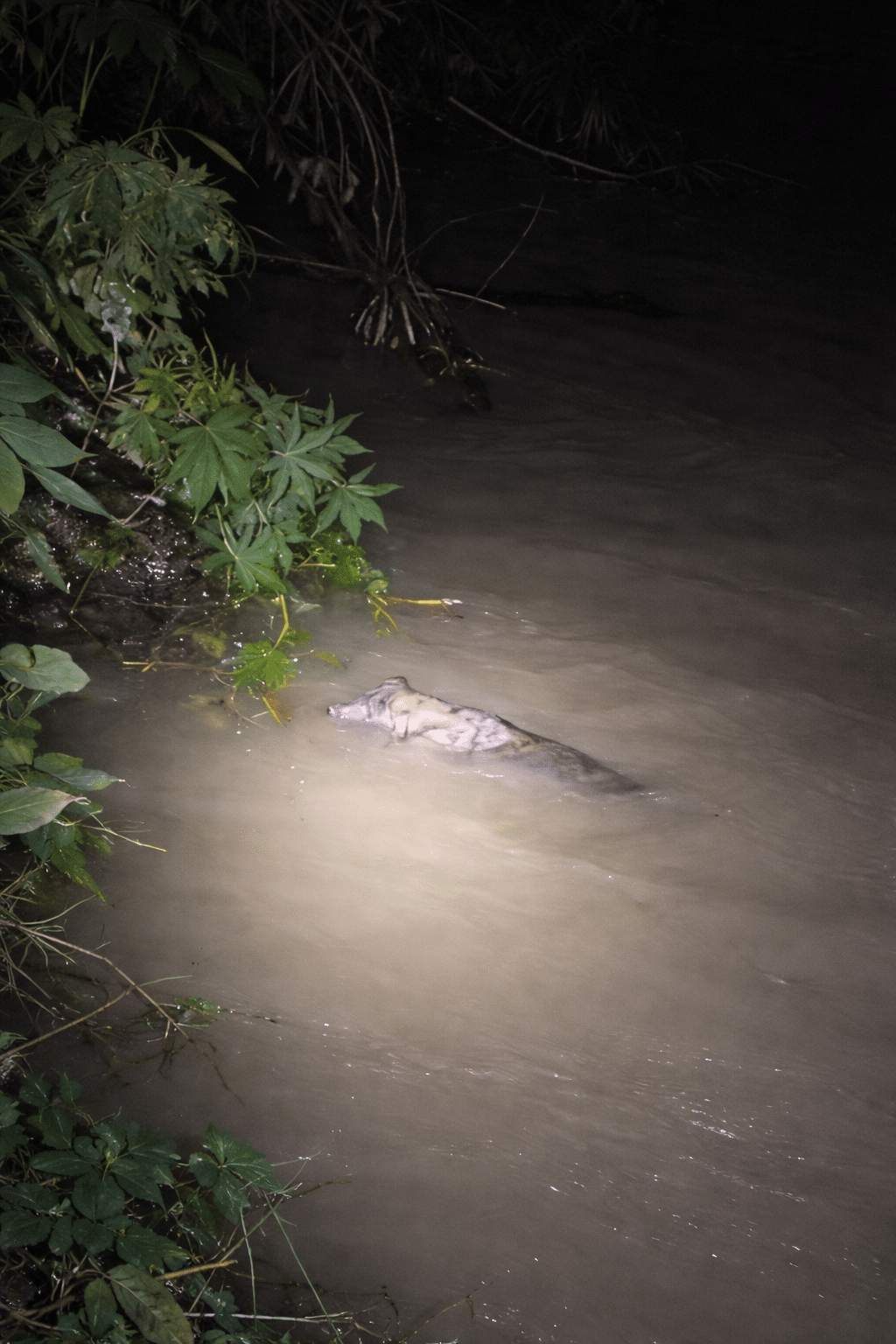
The river was almost impossible to see clearly in the darkness.
What could be heard was enough.
Water rushed through the Musi River with enormous force, carrying mud, branches, and debris downstream as flood levels continued to rise.
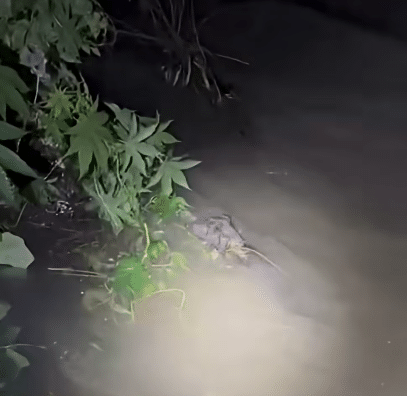
Near the bank, something small was caught among a cluster of vegetation.
A dog.
His soaked body was pressed against branches and tangled grass, the only barrier keeping him from being carried farther into the current.
Every surge of water pushed against him.
There was no dry ground within reach.
No safe path back to shore.
And the branches supporting him did not look strong enough to hold forever.
By the time rescuers arrived, the little dog was still there.
Still wet.
Still clinging to the same fragile patch of vegetation.
Getting him out, however, would mean entering the flood themselves.
The Branches Were the Only Thing Between Him and the Current
The dog had become trapped close to the riverbank, but “close” did not mean easy to reach.
Floodwater moved rapidly through the area.
Thick bushes and branches separated the bank from the animal.
The current pushed hard against everything in its path.
From higher ground, rescuers could see the dog caught near the vegetation.
What they could not do was simply walk over and pick him up.
One wrong step could put a rescuer into the same dangerous current.
So the team began preparing before anyone moved toward the water.
Life jackets were secured.
Ropes were brought into position.
A rescue net was prepared.
One member of the team would go down toward the dog.
The others would remain above, controlling the safety line.
It was a rescue that depended on everyone doing their part at the same time.
VIDEO: A Small Dog Was Clinging to Branches in the Flood — Then Rescuers Entered the Musi River
One Rescuer Was Tied to the Team Above
Before entering the water, the rescuer had a safety rope secured around his waist.
The other end remained with his teammates on higher ground.
That connection mattered.
The current was strong enough that moving without protection would have added another emergency to the one already unfolding below.
Once the rope was checked, the descent began.
The rescuer moved carefully down toward the flooded section.
Each step had to be tested.
Mud, submerged debris, and rushing water made the footing uncertain.
The team above kept tension on the line.
Too much could restrict movement.
Too little could leave the rescuer without enough support if he lost balance.
The dog remained near the branches.
From his position, he had nowhere else to go.
The rescuer continued toward him.
The Water Reached His Waist
Once he entered the flooded section, the force of the current became much clearer.
Water rose around the rescuer’s waist.
It pushed against his legs as he moved sideways toward the dog.
The branches that had helped hold the animal near the bank also made the approach more difficult.
They created obstacles.
They snagged at the surrounding water.
And they left only limited space for the rescuer to position himself safely.
Still, he continued.
One careful step.
Then another.
Above him, the team maintained control of the rope.
The distance between rescuer and dog gradually closed.
When he was finally close enough, there was another challenge.
The dog could not be allowed to slip free and fall back into the current during the lift.
The rescue net would be needed.
Getting Close Was Not the Same as Getting Him Safe
The dog was soaked and appeared exhausted from remaining in the flood.
The rescuer approached without sudden movement.
A frightened animal can react unpredictably when someone enters its limited space, particularly in an environment as chaotic as fast-moving water.
In this case, the dog offered little resistance.
The rescuer reached him.
Then carefully lifted the small body away from the branches.
For the first time, the dog was no longer depending on vegetation to remain above the current.
But holding him in two arms while standing in waist-deep floodwater was not a safe way to return to shore.
So the next step happened immediately.
The dog was placed inside the rescue net.
The net gave him support and reduced the risk of him slipping back into the river while the team began moving upward.
Once he was secured, the rescuer signaled to the people above.
Now they could begin pulling both of them back toward solid ground.
The Team Pulled Them Up Together
The return had to be controlled.
The flood was still moving beneath them.
The net carrying the dog could not be allowed to swing freely or drop into the strongest part of the current.
The rescuer also had to maintain his footing as the rope helped guide him upward.
So the team moved slowly.
The line tightened.
The rescuer began climbing toward the bank.
The dog remained inside the net.
Little by little, both moved farther from the water.
The current that had surrounded them began dropping lower.
Then the rescuer reached solid ground.
Hands immediately moved forward to help.
The dog was lifted clear.
The net was set down safely.
For the first time since the rescue had begun, the little animal was completely out of the flood.
But the effects of being soaked in cold water were still obvious.
Once He Was on Land, the Shivering Continued
The dog’s coat was saturated with muddy river water.
Water dripped from his fur.
His body continued trembling after he reached the bank.
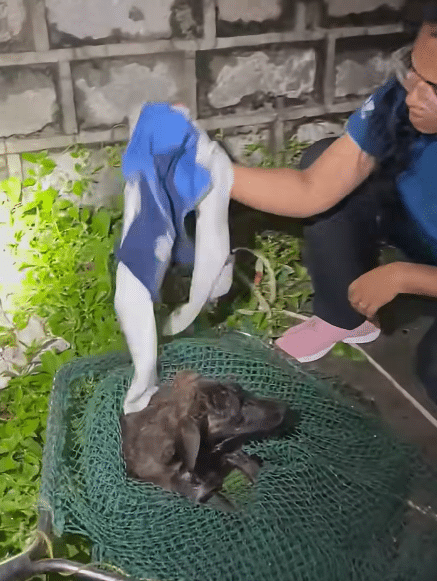
The rescuers immediately began drying him.
Warm towels were wrapped around his body.
Hands worked gently through the wet fur.
The goal was simple.
Get him dry.
Get him warm.
Keep him stable.
There was no need for dramatic movement now.
The dangerous part of the rescue had happened in the river.
On land, the work became quieter.
A towel.
A blanket.
Someone holding him securely.
Someone else checking that he was responding normally after the ordeal.
Gradually, the dog began settling in the rescuers’ arms.
The water was behind him.
The branches were behind him.
The next priority was getting him somewhere he could be examined properly.
The Rescue Continued Beyond the Riverbank
Once the dog was warm enough to be moved, rescuers wrapped him securely and prepared for transport.
He was placed inside a rescue vehicle.
The source indicates that the next step was a care center where veterinary staff could assess his condition after the flood exposure.
That part mattered.
A dog can appear relatively stable after being removed from water while still needing evaluation for exhaustion, cold exposure, swallowed water, or injuries hidden beneath wet fur.
The footage does not describe a dramatic diagnosis afterward.
What it clearly shows is the transition.
From floodwater—
to rescuers’ hands.
From rescuers’ hands—
to towels and blankets.
Then from the riverbank—
to a vehicle headed toward care.
For an animal who had been unable to leave a cluster of branches on his own, every one of those movements required someone else.
Minutes Earlier, His Entire World Had Been Water
The rescue is easy to remember because the contrast is so sharp.
At the beginning, the little dog had almost nothing solid beneath him.
A few branches.
Tangled grass.
Fast-moving floodwater pressing around his body.
The people watching from shore could see how close he was.
But they still needed ropes and safety equipment before anyone could reach him.
One rescuer entered the water.
The team above held the line.
The dog was lifted from the vegetation.
A net kept him secure.
Then everyone worked together to bring him back up.
There was no single heroic gesture that completed the rescue.
It was a sequence of careful choices.
Secure the rope.
Enter slowly.
Reach the dog.
Lift him.
Use the net.
Pull together.
Dry him.
Move him to care.
Each step reduced the danger a little more.
By the End, the Branches Were Empty
When the operation was over, the patch of vegetation beside the Musi River was empty.
The dog was no longer there.
No small body pressed against the branches.
No soaked fur surrounded by muddy water.
No need to keep holding on.
Instead, he was wrapped in warmth and being taken away from the flood.
The source does not give us a long adoption story afterward.
It does not need to.
This rescue ends with something more immediate.
A dog who could not reach safety by himself was reached by people willing to enter dangerous water with the right equipment and a plan.
Only moments earlier, the branches had been everything keeping him from being swept farther downstream.
Then the team arrived.
And by the time they left the riverbank, the dog no longer needed to hold on to anything at all.


