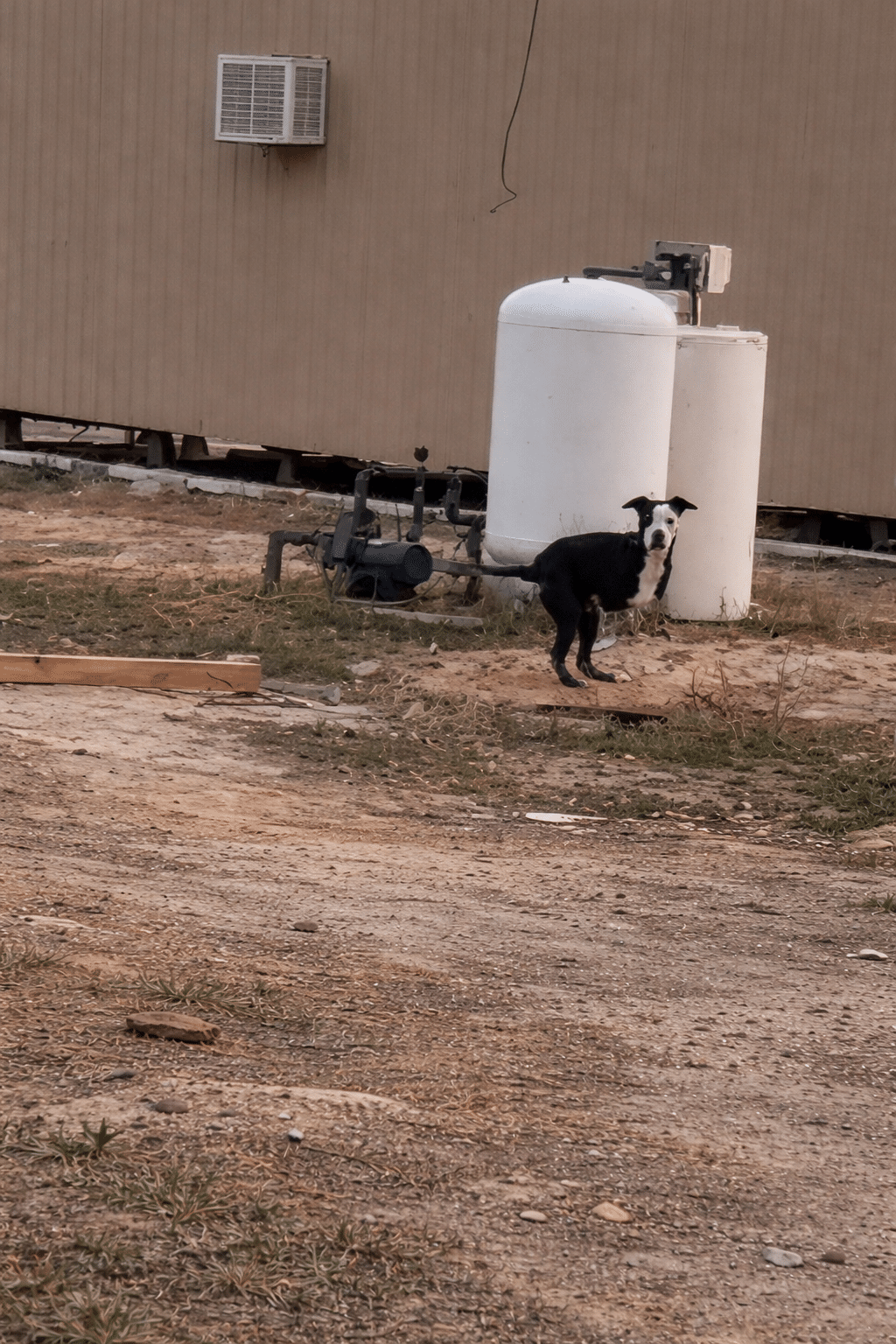
The rescuer expected fear.
Maybe hesitation.
Maybe a small dog who had learned to keep his distance from people.
Instead, Joey came rushing forward.
He had no front legs.
Every movement required him to balance his body in a way most dogs never have to think about. Yet the moment he saw someone approaching, Joey did not retreat.
He moved toward them as quickly as he could.
His tail wagged.
His eyes stayed fixed on the person ahead.
There was something almost impossible to ignore about the sight.
According to the rescue account, Joey had suffered severe mistreatment earlier in life, leaving him without both of his front legs.
No one could undo what had already happened.
But Joey seemed determined not to let it decide what happened next.
The Little Dog Who Still Ran Toward People
Joey’s physical condition made him vulnerable.
Without his front legs, even ordinary movement demanded extra effort.
Standing required balance.
Moving forward meant shifting nearly all of his weight onto his hindquarters.
Simple things such as crossing a room, reaching a bowl, or exploring outside were much more complicated than they would be for most dogs.
Yet what immediately stood out was not what Joey could not do.
It was how he responded to people.
He did not hide when someone came near.
He did not react defensively.
Instead, he actively sought attention.
He wanted to be close.
He showed excitement when spoken to.
And when the person who would eventually rescue him first approached, Joey moved toward them with such enthusiasm that the decision to help him became almost immediate.
The rescuer understood that Joey needed more than temporary safety.
He needed a home environment where people could learn what worked for his unique body.
A place where every surface, doorway, meal, and daily routine could be adjusted around him.
So instead of sending Joey into an already busy shelter system, the rescuer brought him home.
VIDEO: Joey’s Journey From Injury to Joy — Running Again With His Wheelchair
A Home Gave Him Something a Shelter Could Not
For Joey, the new environment changed many things at once.
There was a soft place to sleep.
People nearby.
Food arriving regularly.
And perhaps most importantly, time.
No one expected him to immediately adapt to a new life.
His body had learned to function without two limbs, but that did not mean movement was easy or comfortable.
The household began watching how Joey navigated.
Where did he struggle?
What surfaces made him slip?
How long could he move before becoming tired?
What kind of support would give him greater freedom without causing new problems?
Those questions gradually shaped the next stage of his care.
Joey was already remarkably resourceful.
He could push himself forward.
He could reposition his body.
He could get surprisingly far using only his hind legs and determination.
But everyone wanted more for him than simply getting by.
They wanted Joey to explore without exhausting himself.
To move comfortably.
To go outside.
To play.
To follow his family from one room to another without every journey becoming difficult.
That meant finding a mobility solution built around Joey rather than forcing Joey to adapt to something unsuitable.
Prosthetic Legs Seemed Like the Answer at First
Veterinarians and specialists began exploring options.
One possibility was prosthetic limbs.
For some animals, prosthetics can provide additional support and help redistribute weight.
The idea seemed promising.
Joey began practicing.
Sessions required patience.
He had to learn where to place the prosthetics.
How to balance differently.
How to coordinate movement using equipment his body had never known before.
Joey tried.
Again and again.
The people working with him could see how willing he was to participate.
But effort alone could not make the prosthetics right for his body.
Over time, problems appeared.
Areas of irritation developed.
Swelling followed.
Instead of giving Joey comfortable freedom, the devices were creating discomfort.
The team did not want mobility to come at the cost of pain.
So they stopped.
It was disappointing.
But it was not failure.
They had learned something important about what Joey needed.
The goal was never to make him look like a four-legged dog.
The goal was to help him move comfortably as Joey.
That realization led them toward another idea.
A wheelchair.

The First Wheelchair Was Not Perfect Either
A canine wheelchair seemed better suited to Joey’s needs.
Instead of attaching artificial limbs to his body, a cart could support his front end while allowing his strong hind legs to provide propulsion.
But finding the right setup was not as simple as ordering one and fastening it on.
Joey’s body proportions mattered.
The height of the frame mattered.
The angle of support mattered.
Even small differences could affect whether he moved naturally or struggled against the equipment.
Several adjustments were needed.
A cart that sat too high could alter his balance.
One that sat too low could restrict movement.
Straps needed to support him without rubbing sensitive areas.
The wheels needed to move freely while still giving him enough stability to turn.
So the team tested.
Adjusted.
Watched.
Then adjusted again.
Joey remained patient through the process.
Sometimes he moved a few feet and stopped.
Sometimes a setup clearly did not feel right.
Those attempts gave the caregivers useful information.
Eventually, they arrived at a configuration that seemed different from everything before it.
Joey was placed into the wheelchair.
His hind paws touched the ground.
He shifted his weight.
Then he moved.
Once the Cart Fit, Joey Did Not Want to Stop
At first, Joey took a few controlled steps.
The wheelchair rolled forward with him.
He paused.
Then tried again.
Something had changed.
His body was supported.
His front end no longer had to drag or compensate in the same way.
His hind legs could simply do what they did best.
Push.
Within moments, hesitation disappeared.
Joey began moving faster.
Then faster again.
He crossed the yard.
Turned.
Explored.
And once he understood that the wheels would follow wherever his hind legs carried him, his entire approach seemed to change.
The little dog who had spent so much of his life adapting to physical limitations suddenly had speed.
He could follow people.
He could investigate new places.
He could move across open ground without stopping every few moments to rebalance his body.
For the family watching, it was difficult not to smile.
Joey did not appear interested in treating the wheelchair as medical equipment.
To him, it simply meant movement.
And movement meant freedom.
Home Life Became One Adventure After Another
As Joey became comfortable using the wheelchair, it stopped being something unusual.
It became part of his everyday life.
He learned how to navigate familiar spaces.
He rolled through rooms.
He followed members of the family.
He appeared whenever something interesting was happening.
And gradually, the household adjusted around him just as naturally as Joey had adjusted to them.
He was no longer viewed primarily as the dog missing two legs.
He was Joey.
Playful.
Curious.
Social.
And often moving much faster than people expected.
The family included two children who quickly became part of his routine.
One of them occasionally slipped Joey small treats.
The younger child enjoyed spending time beside him, sometimes dressing him in little outfits and reading near him before bed.
Joey seemed perfectly content to be included in whatever the family was doing.
His wheelchair did not isolate him from household life.
It did the opposite.
It allowed him to participate more fully.
If the family moved into another room, Joey could follow.
If something happened outside, he could investigate.
If play began, he could join.
The wheels that had originally been introduced as a mobility aid became the thing that expanded his world.
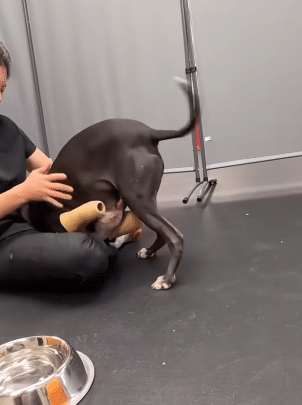
They Started Calling Him Their Little Prince
There was something about Joey’s personality that made him difficult to overlook.
He liked attention.
He liked being included.
And he quickly learned that the people around him were willing to accommodate his needs.
Before long, the family affectionately began treating him like their “little prince.”
The nickname fit.
Joey had his routines.
His favorite people.
His comfortable places to rest.
His wheelchair waiting when he wanted to move.
And family members always paying attention to where he was headed next.
The home that had originally been intended as a place of rescue became something far more permanent.
Joey belonged there.
Not because people felt sorry for him.
Not because his disability made him inspirational.
But because his personality had woven itself into everyday family life.
He waited for familiar voices.
He enjoyed attention from the children.
He moved confidently through spaces he now recognized as his own.
Eventually, the idea of Joey leaving stopped making sense.
The temporary rescue had become a forever home.
His Missing Legs Became Only One Part of Who He Was
Joey’s story could easily be told only through what happened to his body.
Two front legs lost.
Prosthetics attempted.
A wheelchair fitted.
But focusing only on those details would miss much of what made his journey meaningful.
Joey did not spend his days behaving as though his life was defined by loss.
Once given the right support, he simply adapted.
He learned.
He played.
He developed routines.
He formed relationships.
He moved through his home with confidence.
The wheelchair did not make Joey whole.
He was already a whole dog.
It simply gave his body a more comfortable way to do the things his personality was already asking him to do.
Follow.
Explore.
Play.
Be close to his family.
That distinction mattered to the people around him.
They did not spend every day thinking about what Joey was missing.
They spent their days responding to the dog in front of them.
A dog who knew exactly when treats might appear.
A dog who enjoyed company.
A dog who could roll through the house with surprising speed.
A dog who had become deeply loved.
Joey Found More Than a Way to Move Again
Perhaps the most striking part of Joey’s story happened before the wheelchair ever arrived.
It happened during that first meeting.
A small dog with no front legs saw a person approaching.
And instead of moving away, Joey went toward them.
No one could know exactly what he remembered from earlier in his life.
No one could say why he remained so open to human contact after everything the rescue account said he had endured.
They could only respond to what Joey showed them.
Trust.
Interest.
A desire to connect.
That first decision to move toward someone began everything that followed.
A home instead of a shelter.
Veterinary care.
Prosthetic trials.
A different plan when those prosthetics caused problems.
Wheelchair fittings.
The first successful run across the yard.
Children waiting for him at home.
Bedtime stories.
Treats.
And a family that eventually could not imagine giving him up.
Joey’s life did not become meaningful because he overcame a disability.
It was meaningful before anyone ever built him a wheelchair.
What changed was that people finally gave him the support needed to live that life more freely.
Today, Joey still has only two legs.
He still needs equipment to move across many surfaces comfortably.
Those facts have not changed.
Almost everything else has.
Once, his future was uncertain.
Now he knows where he sleeps.
Who feeds him.
Who calls his name.
Which children will sit beside him.
And where his wheelchair takes him when he decides it is time to explore.
The little dog who once rushed toward a stranger on two legs eventually found exactly what he had been running toward.
Not pity.
Not a perfect body.
A family.
And a place where he could simply be Joey.


