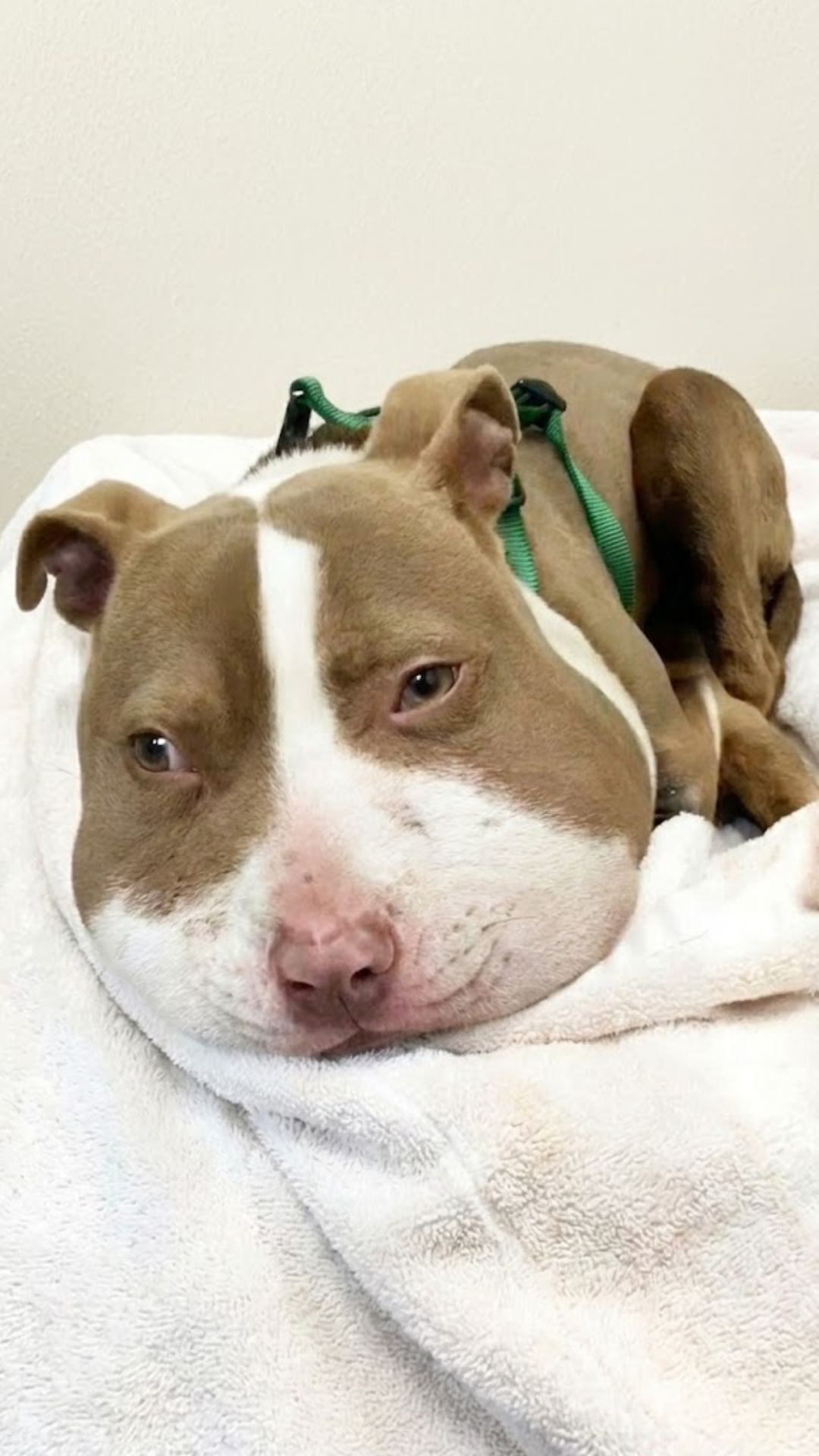
She had no voice anyone could hear.
No bark.
No cry loud enough to carry down the street.
But Mika still found a way to ask for help.
The tiny dog wandered through the neighborhood with a badly swollen face and a strip of fabric buried deep around her neck.
The material had tightened as her body changed, cutting into the skin and creating dangerous pressure around the neck and head.
By the time people began noticing her, the swelling had become impossible to ignore.
Yet Mika kept moving.
She approached homes.
Stopped near doors.
And according to the rescue account, she repeatedly made contact with doors as though trying to attract someone’s attention.
She could not explain what was wrong.
She could only keep showing up.
Eventually, one of those quiet attempts was seen.
And that was enough to change everything.
A Security Camera Captured the Dog No One Had Been Able to Help
The rescue began with footage from a home security camera.
A colleague reviewing the recording noticed a small animal near the front entrance.
At first, the figure was difficult to understand.
Then the dog turned toward the camera.
Her head was severely swollen.
Something was clearly wrong.
The footage was sent to rescuers along with a simple question:
Could someone help her?
The answer was immediate.
Yes.
Once Mika was located in person, the severity of the situation became even clearer.
The fabric around her neck was not resting on top of the coat like an ordinary collar.
It had become embedded into the tissue.
The surrounding area showed signs of serious damage and infection.
The swelling in her head suggested that normal circulation and drainage had been badly disrupted.
Mika needed veterinary treatment quickly.
This was not something that could be solved by simply cutting away a visible strap on the street.
The material had become part of a much deeper injury.
VIDEO: A Silent Plea for Help — The Tiny Dog Who Knocked on Doors to Save Her Own Life
The Fabric Had Disappeared Into Her Neck
At close range, it was difficult to see where the material ended and Mika’s injured tissue began.
Over time, the band had tightened deeply enough that skin had grown and swollen around parts of it.
The damage explained much of what rescuers had seen from a distance.
Her face looked disproportionately large.
Her eyes were surrounded by swelling.
Even breathing and vocalizing appeared difficult.
The odor around the wound also suggested that some tissue had been badly compromised.
Mika remained physically weak.
But she allowed rescuers to handle her.
They moved carefully, knowing that unnecessary pressure around the neck could make her condition worse.
There was no safe way to remove everything without veterinary intervention.
She was transported to the Veterinary Specialty Center, where the surgical team began preparing for what would become a long procedure.
The goal sounded simple.
Remove the embedded material.
The reality was far more complicated.
Surgeons Spent Six Hours Freeing Her Neck
Anesthesia itself carried risk because Mika was already fragile.
But leaving the material in place was not an option.
Once surgery began, the team discovered how deeply the problem had progressed.
The fabric had become embedded within damaged tissue.
Removing it required more than cutting one section and pulling.
The surgeons had to work slowly around the neck, freeing trapped material while avoiding unnecessary damage to healthy structures nearby.
Areas of compromised tissue also had to be addressed.
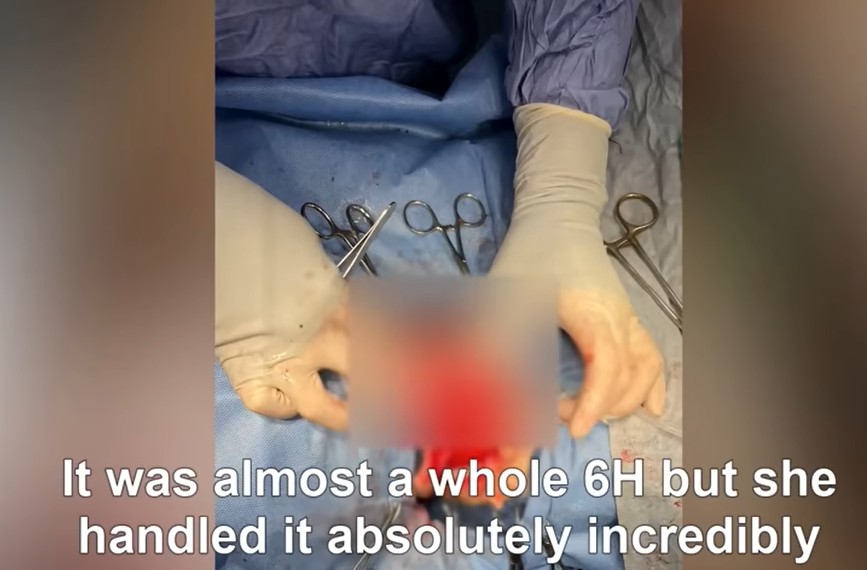
According to the rescue account, the operation lasted approximately six hours.
Throughout that time, the team worked piece by piece.
Section by section.
Until the restraint that had been cutting into Mika’s body was finally gone.
For the first time since she had been found, nothing was tightening around her neck.
But surgery was only the first part of recovery.
The swelling and tissue damage still needed time and additional care.
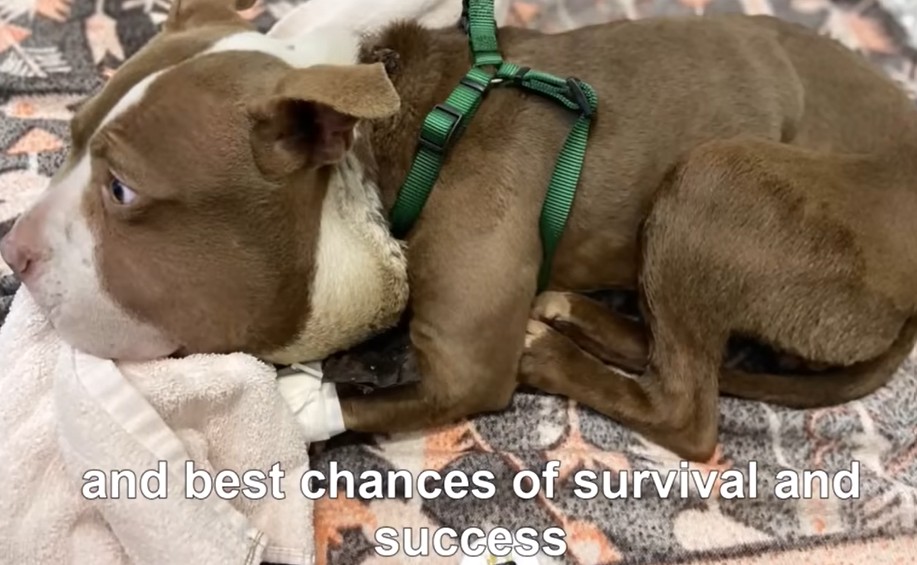
Hyperbaric Oxygen Therapy Became Part of Her Recovery
After surgery, Mika received supportive treatment that included Hyperbaric Oxygen Therapy, or HBOT.
The treatment places a patient in a chamber where oxygen is delivered under increased pressure.
In Mika’s case, the medical team used it as part of her recovery plan while damaged tissue healed and swelling was monitored.
The physical change did not happen instantly.
Her face remained swollen.
The surgical area needed close observation.
She needed rest.
Medication.
Nutrition.
And careful handling.
But gradually, the enormous swelling began to decrease.
The shape of her face became easier to recognize.
Her eyes appeared less compressed.
The pressure that had surrounded her head and neck was no longer being maintained by the embedded band.
For caregivers, watching that change was one of the clearest signs that Mika had finally moved beyond the emergency stage.
She had survived the surgery.
Now she needed to learn what life felt like without pain controlling every movement.
Mika Began Showing More of Her Personality
During the earliest part of recovery, Mika remained cautious.
That was not surprising.
She had gone through transport, examinations, anesthesia, surgery, and treatment in a completely unfamiliar environment.
The people around her did not expect immediate affection.
Instead, they let interaction happen slowly.
Then the small changes began.
A tail movement.
Interest in a familiar caregiver.
A gentle lick against a hand.
More energy around feeding time.
At moments, Mika even made small playful movements.
Those behaviors mattered because they showed that she was becoming more engaged with her surroundings.
She was no longer simply enduring treatment.
She was beginning to participate in daily life.
Caregivers could see preferences emerging.
She sought attention.
Responded to voices.
And seemed increasingly comfortable when familiar people came near.
Mika did not need anyone to describe what she was feeling for the change to be visible.
Her behavior was already telling the story.
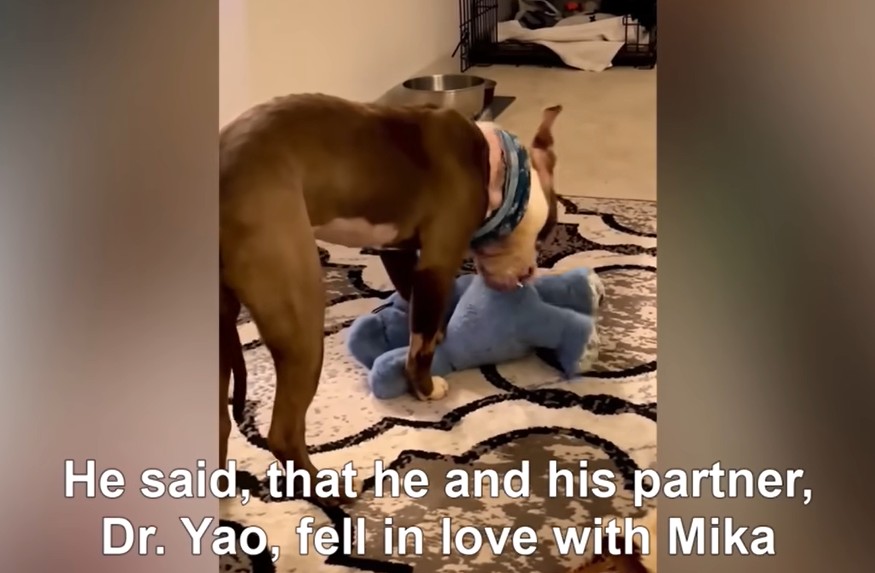
Two Surgeons Became More Than the People Who Saved Her
Most rescue cases eventually move toward adoption.
Mika’s took an unexpected turn.
During the long surgery and recovery period, two of the veterinarians involved in her care—Dr. Miranda and Dr. Yao—became deeply attached to her.
They had seen her at one of the most vulnerable points in her life.
They had spent hours working to free her neck.
Then they watched her heal.
Watched the swelling decrease.
Watched her become more responsive.
And somewhere during that process, their relationship with Mika changed.
They contacted the rescue team with a question.
Could they adopt her?
For Mika, that meant she would not have to leave the people who had already become part of her new routine.
The surgeons who had helped save her life would also become the family responsible for the days that came afterward.
The answer was yes.
Mika had knocked on many doors before receiving help.
Now she finally had one that was hers.
Three Months Later, She Barely Looked Like the Same Dog
By three months after the rescue, Mika’s appearance had changed dramatically.
The severe swelling was gone.
Her face had returned much closer to its natural shape.
Her surgical wounds had healed significantly.
And instead of moving through neighborhoods searching for attention, she now had a predictable daily routine.
Mika often accompanied her new family to the clinic.
There, she became a familiar presence around staff and visitors.
At home, she shared her space with two other dogs.
Those companions introduced her to another side of life.
Playing.
Following one another through the house.
Resting together.
Learning routines from animals already comfortable in their environment.
Mika still had moments of uncertainty outdoors.
Certain situations could make her hesitant.
When that happened, her family stayed close and helped her settle.
Confidence did not arrive all at once.
It grew from repetition.
Going outside.
Coming home safely.
Meeting people.
Returning to familiar arms.
Then doing it again another day.
The Little Dog Who Could Not Call Out Finally Had People Listening
The most memorable part of Mika’s story may be how she tried to help herself.
She could not explain what had happened to her neck.
She could not point to the fabric buried beneath swollen tissue.
And according to the rescue account, even making normal sounds had become difficult.
Still, she kept approaching homes.
Kept appearing at doors.
Kept putting herself where someone might eventually notice.
One security camera finally did.
That recording led to a message.
The message reached rescuers.
Rescuers brought her to veterinarians.
And veterinarians spent six hours removing what Mika could never have escaped on her own.
What followed was not one sudden miracle.
It was surgery.
Hyperbaric oxygen treatment.
Wound care.
Observation.
Trust built slowly.
Then adoption.
Mika’s life changed because a chain of people responded when the previous person passed her story forward.
A camera saw her.
Someone asked for help.
Someone answered.
And two of the people who helped save her eventually gave her a permanent home.
Mika Does Not Have to Knock Anymore
Today, Mika no longer has to move from house to house hoping someone notices.
She knows where she belongs.
There are people who recognize her footsteps.
Dogs waiting inside.
Meals that arrive every day.
Hands she knows.
Places where she can sleep without wondering what happens next.
The door she once needed someone to open is no longer a symbol of uncertainty.
It leads home.
Her story began with a tiny dog trying to communicate without a voice.
She had no dramatic rescue signal.
No way to explain the emergency around her neck.
She simply kept going until someone saw enough to understand that she needed help.
That may be why Mika’s story stays with people.
Sometimes an animal’s plea is loud.
Sometimes it is a bark heard across a street.
And sometimes it is much quieter.
A shadow on a security camera.
A small paw near a door.
A dog returning again because she has nowhere else to ask.
Mika kept knocking.
Eventually, someone answered.
And now she never has to knock for help again.


