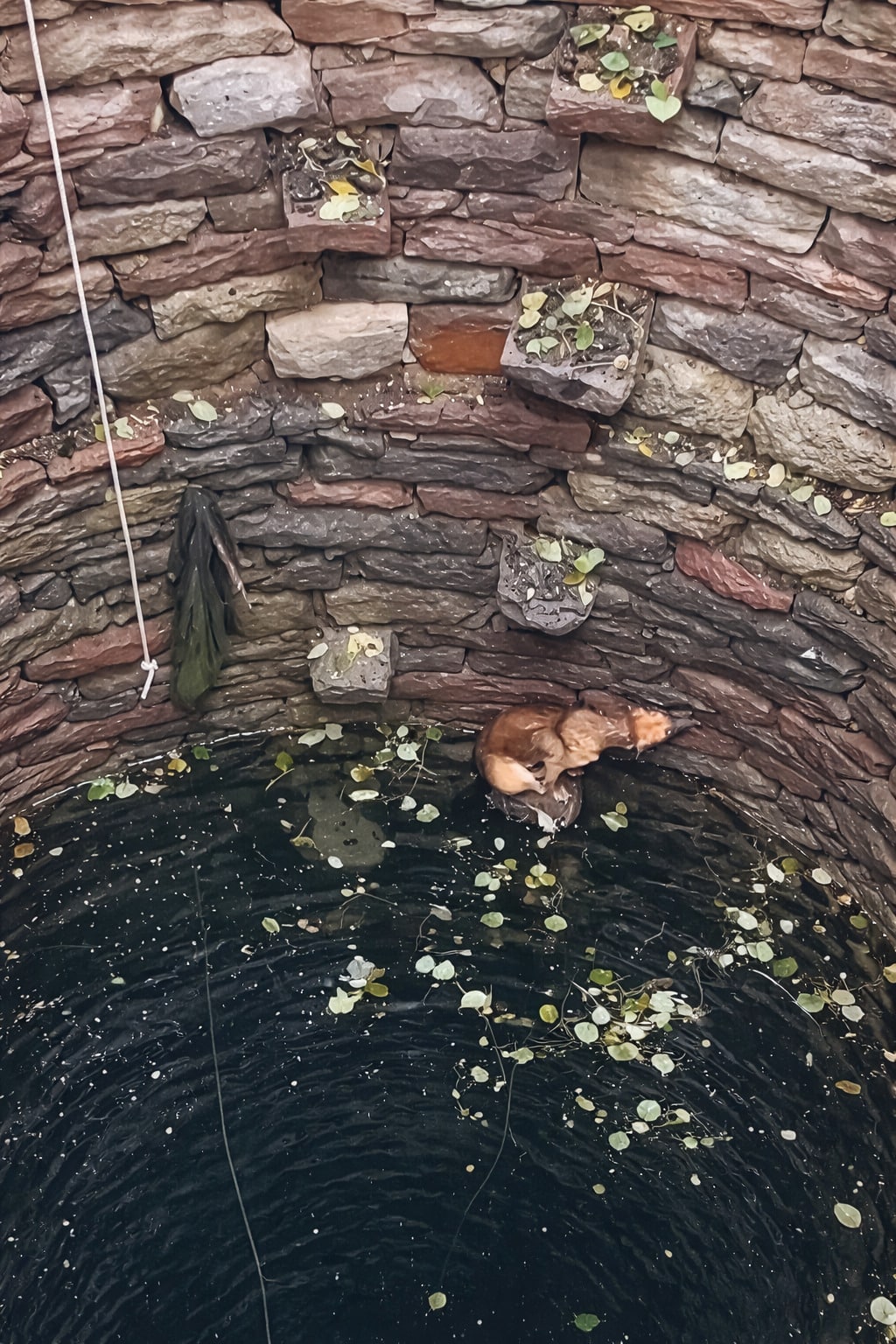
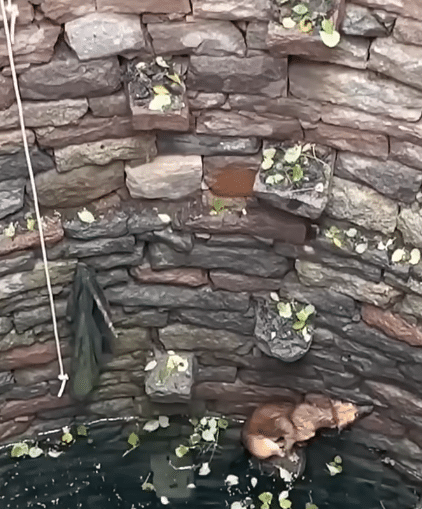
From above, the well looked old and ordinary.
Weathered bricks.
Rough stone.
A dark opening descending far below the surface.
But at the bottom, something was moving.
A brown dog was trapped inside.
Water covered much of the floor of the well, leaving only a small patch of dirt and stone just above the waterline.
That narrow space had become the dog’s only place to rest.
He could not climb the steep walls.
He could not reach the people standing far above him.
And if he slipped from the small ledge beneath his paws, he would end up back in the cold water.
So he stayed almost completely still.
Waiting at the bottom of a place he could never escape alone.
There Was Almost Nowhere for Him to Stand
The well was narrow and deep.
Its walls offered no obvious path upward.
At the bottom, the dog had managed to position himself on the little dry ground available beside the water.
It was barely enough.
He looked tired.
His posture remained cautious.
There was little room to move without risking a fall.
From the opening high above, rescuers could see the problem clearly.
Reaching him would not be as simple as lowering a rope and hoping he could hold on.
Someone would have to descend.
The dog would need to be secured properly.
And the rescuer would have to work inside a confined space while the team above controlled every movement of the rope system.
The situation required patience more than speed.
One mistake could frighten the dog.
One sudden movement could send him into the water.
So the team from Animal Warriors Conservation Society (AWCS) began preparing a controlled rescue.
VIDEO: From a Deep Well to Freedom — The Rescue of a Trapped Dog
One Rescuer Prepared to Go Down
The team studied the well before anyone entered.
A rescuer put on protective equipment.
A blue helmet covered his head.
A safety harness was secured around his body.
In his hands was a large green rescue net.
Several members of the team remained above ground, managing the ropes that would control the descent.
Then the rescuer moved toward the opening.
Slowly, the rope system began lowering him.
Foot by foot, he descended into the well.
The daylight above grew farther away.
The walls narrowed around him.
Below, the dog remained on his small patch of ground.
The people at the top kept their attention fixed on the rope.
Their job was just as important as the person going down.
He needed enough slack to move.
Enough tension to remain supported.
And complete control during the return trip upward.
The Dog Had Nowhere to Run
When the rescuer reached the bottom, the dog was only a short distance away.
In most rescue situations, a frightened animal may try to escape.
Here, there was almost nowhere to go.
The wall stood behind him.
Water surrounded the small area under his paws.
The rescuer avoided rushing forward.
He stayed calm.
Moved carefully.
And gave the dog enough time to remain settled.
The green net was gradually brought into position.
The goal was to support the dog securely enough for the ascent without creating unnecessary panic.
There was no dramatic struggle.
No sudden chase.
Just a rescuer working in a tight space while a frightened dog watched every movement.
Then the net was ready.
The dog was guided inside.
Once he was safely supported, the rescuer signaled upward.
The hardest part of the rescue was about to begin.
The Team Above Began Pulling
The ropes tightened.
The rescuer and the dog began moving upward.
Slowly.
The green net remained close to the rescuer as they rose through the narrow shaft.
Above them, several people worked together to manage the rope.
No one rushed.
Every section of the climb had to remain controlled.
The walls passed beside them.
The small patch of ground disappeared below.
Then the water.
Then the darker lower section of the well.
With each pull, the opening above grew closer.
For the dog, it was the first time since becoming trapped that he was moving toward the surface.
Not by climbing.
Not by struggling against the wall.
But because a team of people had built a safe way out.
Hands Reached Over the Edge as They Reached the Top
When the rescuer neared the opening, more members of the team stepped forward.
The final section required careful coordination.
The net had to clear the edge of the well.
The dog had to remain supported.
The rescuer still needed room to maneuver.
Several hands reached toward the equipment.
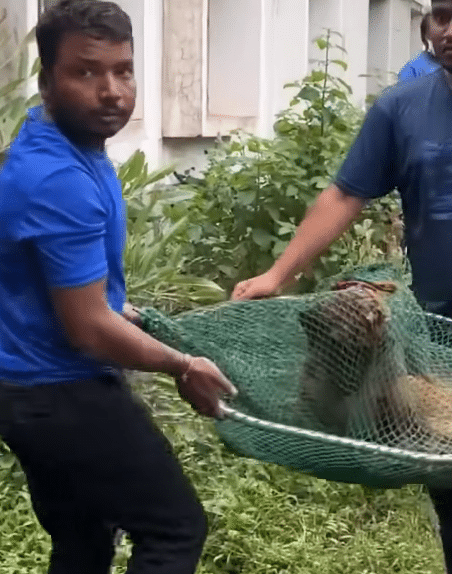
The green net came over the top.
Then it was lowered onto solid ground.
For the first time since the rescue began, the dog was no longer suspended above the well.
The team opened the net.
The brown dog stepped out.
His fur looked damp from the humid, wet environment below.
But he could stand.
Then he walked.
After the long drop, the water, and the uncertainty of the rescue, that simple movement answered one of the biggest questions everyone had been carrying.
He had made it out.
One Word Appeared on the Screen: “Freedom”
There was no need for a long explanation once the dog was on the ground.
The contrast was enough.
Minutes earlier, he had been confined to a tiny strip of earth beside water at the bottom of a deep shaft.
Now there was open ground beneath his paws.
Grass.
Air.
Space to move in any direction.
On the video, a single word appeared.
“Freedom.”
It fit the moment.
Not because anyone could know exactly how the dog understood what had happened.
But because his physical situation had completely changed.
The walls were gone.
The water was behind him.
There was no ledge to balance on.
No deep shaft surrounding him.
The dog could simply walk.
He Crossed the Grass on His Own
The final part of the rescue was almost quiet compared with everything before it.
The dog moved slowly across a grassy area near the well.
No net held him now.
No rope was attached.
One of the rescuers knelt beside him and gently touched his back.
The dog remained calm.
He stood on solid ground while the rescue team stayed nearby.
The video ended with another short message.
“Back to life.”
The phrase captured the visual change clearly.
From the bottom of a well to open ground.
From being unable to escape to being able to walk away.
Nothing about the rescue required exaggeration.
The scene itself already showed enough.
A dog had been trapped in a place he could not leave.
A team arrived.
Someone went down.
And together, they brought him back up.
The Rescue Worked Because Every Person Had a Role
The most visible person in the rescue was the man who entered the well.
But he did not do it alone.
Someone prepared the rope.
Others controlled the descent.
People watched from the opening.
More hands were ready when the net reached the top.
The rescue succeeded because every part of the process connected.
The rescuer below depended on the team above.
The dog depended on all of them.
It was a reminder that animal rescue is often less dramatic than it appears from the final video.
Behind a few minutes of footage are practical decisions.
Equipment.
Communication.
Patience.
And people willing to put themselves in the right position to help safely.
The Well Was Deep — But Help Still Reached Him
At the beginning of the video, the dog’s entire world had been reduced to a tiny patch of ground.
A little dirt.
A little stone.
Water beside him.
Walls around him.
And daylight far overhead.
He could not climb out.
He could only remain where he was and avoid slipping.
Then ropes appeared from above.
A rescuer descended.
A green net reached the bottom.
And the same narrow opening that had seemed impossibly far away became the route back to safety.
The dog eventually stepped onto grass under his own power.
That is the image the story leaves behind.
Not the dark bottom of the well.
Not the water.
Not the ledge.
A dog walking away from the place that had trapped him.
Sometimes rescue is not about changing an animal’s entire life in one moment.
Sometimes it is much simpler.
A life is stuck somewhere it cannot escape.
Someone sees it.
Someone finds a safe way down.
And someone brings that life back into the light.


