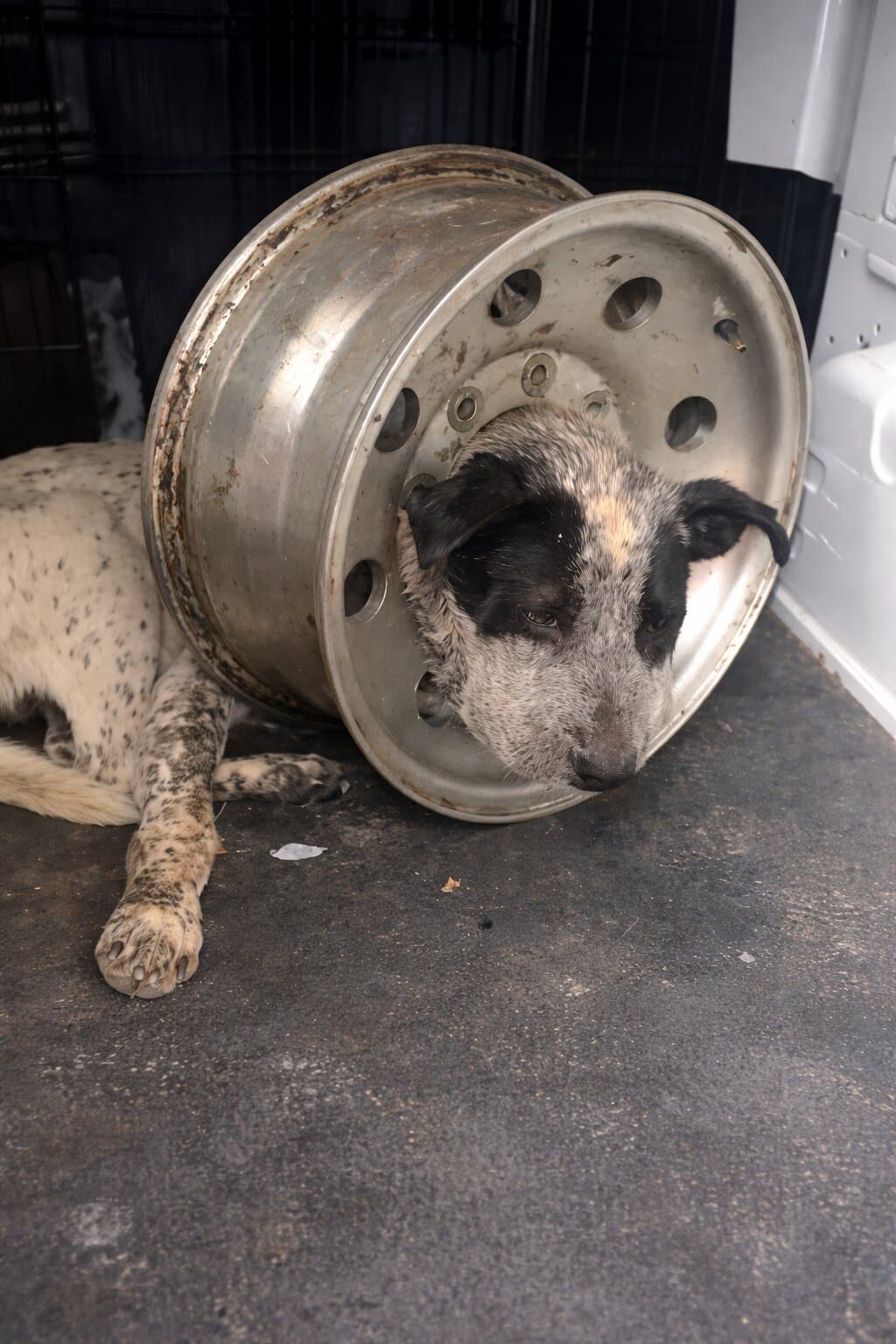
At first, it may have looked like a strange accident.
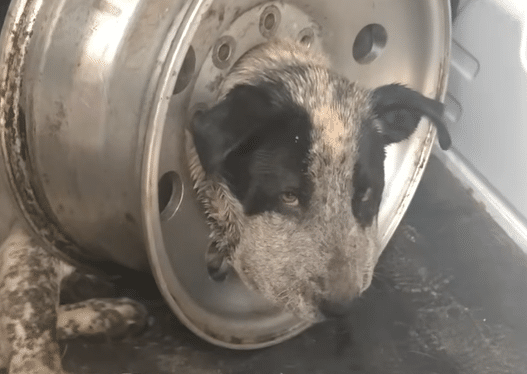
A dog with his head pushed through the center of an old metal wheel rim.
But by the time Pickles was found, the situation was no longer harmless.
The metal had trapped him completely.
His head could not move back through the opening.
The more time passed, the more swelling developed around his face and neck.
Pickles was exhausted.
Frightened.
And unable to solve the problem on his own.
Someone had to get the wheel off.
The difficulty was that the same heavy metal strong enough to trap him was also strong enough to resist the tools normally found inside a veterinary clinic.
What began as an unusual rescue quickly became a job requiring an entirely different kind of team.
The Wheel Had Become Too Tight to Pull Away
Pickles’ head had passed through the central opening of the metal rim.
Getting it back out was another matter.
The wheel was rigid.
There was almost no flexibility in the metal.
And as swelling increased, the opening around Pickles became even tighter.
Trying to pull the rim off by force could have injured him.
Leaving it in place was not safe either.
So Pickles was transported to a veterinary clinic, where the medical team could assess him and look for a controlled way to remove it.
The immediate challenge was obvious.
They needed to separate the metal without cutting Pickles.
That meant working extremely close to his head and neck.
Any sudden movement could make the situation more dangerous.
To keep him still and reduce stress during the procedure, the veterinary team placed Pickles under anesthesia.
Then they tried the equipment available at the clinic.
The wheel barely moved.
VIDEO: Pickles the Dog — The Rescue From a Metal Wheel Trap
The Clinic’s Tools Were Not Strong Enough
Veterinary staff tried to find a safe cutting point.
But the metal rim was simply too thick.
The equipment normally used for medical procedures was not designed for something built to support the weight and impact of a vehicle.
They could not risk improvising.
A weak tool slipping against the rim could injure Pickles.
A partially cut section of metal could bend inward.
So the team stopped before making the situation worse.
They needed equipment designed for heavy metal.
That realization led to an unusual phone call.
The local fire department was contacted.
Firefighters routinely train for rescues where people are trapped inside damaged vehicles.
Their equipment is designed to cut, spread, and bend material far stronger than anything a veterinary clinic would normally handle.
Soon, firefighters arrived at the clinic.
They brought specialized hydraulic rescue tools.
Among them was equipment commonly known as the Jaws of Life.
Now the challenge became turning a tool built for vehicle rescues into something precise enough to work inches away from a dog.
Firefighters Had to Cut the Rim Without Touching Pickles
The firefighters did not simply place the tool on the wheel and squeeze.
Every position had to be chosen carefully.
Pickles remained anesthetized while the veterinary team protected his body and monitored him.
The rescuers studied where the rim could be cut.
The thick metal needed to be opened enough to release pressure without allowing sharp edges to move toward Pickles.
The hydraulic equipment began working.
Metal resisted.
Then shifted.
A section was cut.
Another adjustment followed.
The process continued slowly.
There was no benefit in rushing.
The wheel had trapped Pickles for long enough.
The final rescue needed to be controlled.
According to the original account, firefighters and veterinary staff worked for more than an hour.
Then the metal finally gave way.
The rim opened.
For the first time since he had become trapped, nothing surrounded Pickles’ neck and head.
He was free.
Removing the Wheel Was Only the Beginning
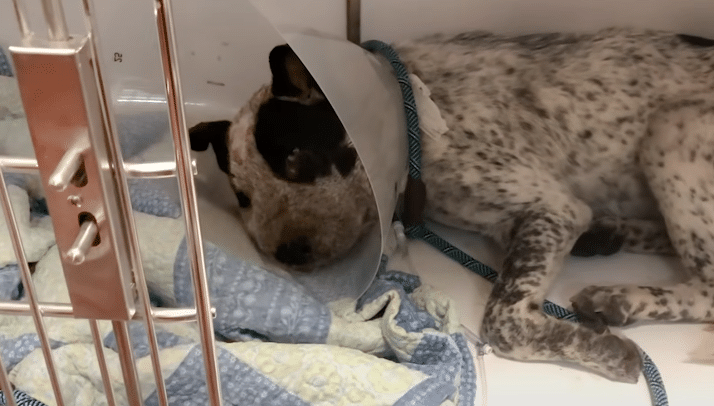
Once the metal was gone, attention returned entirely to Pickles.
The pressure around his head had been relieved.
But the swelling and physical stress from the ordeal still required monitoring.
The rescue had solved the immediate emergency.
Now Pickles needed somewhere quiet to recover.
That was when a volunteer named Kelly stepped forward.
She offered to foster him during the healing process.
Instead of moving from the clinic into another stressful environment, Pickles could recover inside a home.
For a dog believed to have spent much of his life outdoors, the new surroundings were unfamiliar.
Walls.
Furniture.
Soft places to sleep.
People nearby throughout the day.
Regular meals arriving without the need to search for them.
Everything required adjustment.
Kelly did not expect him to understand indoor life immediately.
She gave him time.
A Soft Bed Was Something Pickles Had to Learn
At first, ordinary household objects were new experiences.
Pickles explored cautiously.
He had to learn where he could rest.
Where food would appear.
Which sounds were normal.
Which people belonged there.
A soft bed might seem instinctively comfortable to us.
For a dog not accustomed to living indoors, even that could be unfamiliar.
So the transition happened gradually.
Meals came regularly.
The same people appeared each day.
Nothing forced Pickles to interact before he was ready.
As the stress of the rescue faded and his body recovered, his behavior began changing too.
He became more curious.
He started exploring rather than simply watching.
His posture became more relaxed.
The dog once immobilized by a piece of metal was beginning to move through a new environment entirely on his own terms.
His Personality Appeared Once the Emergency Was Over
During the rescue, there had been little opportunity to understand what Pickles was really like.
Everyone’s attention had been focused on one problem.
Get the wheel off.
Once that danger passed, a different dog began emerging.
Pickles showed interest in people.
He became playful.
He interacted well with other dogs.
He appeared increasingly comfortable with attention.
The fear surrounding the metal rim stopped defining every moment of his day.
Instead, his routine began filling with ordinary things.
Eating.
Resting.
Exploring.
Following people.
Meeting other dogs.
Those details may sound small compared with a fire department using hydraulic equipment to free him.
But they were the part that showed the rescue had actually worked.
Saving Pickles was not only about removing metal from around his head.
It was about giving him enough safety afterward to become a dog whose days no longer revolved around emergencies.
The Wheel Rim Was Not Thrown Away
When Pickles had fully moved beyond the worst part of the ordeal, the rescue team made an unusual decision.
They kept the metal wheel rim.
It had once represented everything dangerous about the situation.
Pickles had been trapped inside it.
The swelling around his head had grown while he remained stuck.
Veterinary tools had been unable to cut through it.
Firefighters had spent more than an hour working to get it open.
Yet after the rescue, the rim became something different.
Members of the team signed it.
The object that had once trapped Pickles became a record of the people who worked together to free him.
Veterinary staff.
Firefighters.
Rescuers.
Different people with different skills, all connected by the same problem.
One dog needed out.
And no single person had all the tools required to do it alone.
Teamwork Was What Finally Opened the Metal
Pickles’ rescue worked because the veterinary team knew when their own equipment had reached its limit.
That decision mattered.
Trying harder with the wrong tool could have made the rescue more dangerous.
Instead, they asked for help.
The firefighters arrived with equipment designed for heavy metal.
The veterinary staff provided the medical knowledge needed to protect and monitor Pickles.
Kelly provided the quiet foster environment needed once the emergency ended.
Each part of the rescue solved a different problem.
The clinic stabilized him.
The fire department freed him.
The foster home helped him recover.
It is easy to focus on the dramatic moment when the rim finally split.
But that moment was only possible because several people understood where their role ended and someone else’s expertise began.
Pickles No Longer Has to Carry the Story of the Wheel Everywhere He Goes
The metal rim will probably always be the first image many people associate with Pickles.
A dog’s head trapped inside a heavy wheel.
Firefighters standing nearby.
Hydraulic equipment cutting through steel.
But that was only one part of his life.
Afterward came something quieter.
A home.
A volunteer willing to give him time.
Other dogs to meet.
Rooms to explore.
Meals that arrived every day.
And enough stability for his actual personality to become visible.
Pickles recovered into an affectionate, social dog who enjoyed being around people and other animals.
The wheel remained with the rescuers.
Pickles moved on.
That difference is what gives the object its meaning now.
Once, the rim was attached to him and he could not escape it.
Today, it sits somewhere else, covered in signatures.
Pickles does not need to carry it anymore.
His life is no longer about being the dog trapped inside a piece of metal.
He is simply Pickles.
Safe.
Free to move.
And surrounded by people who came together when one set of tools was not enough.


