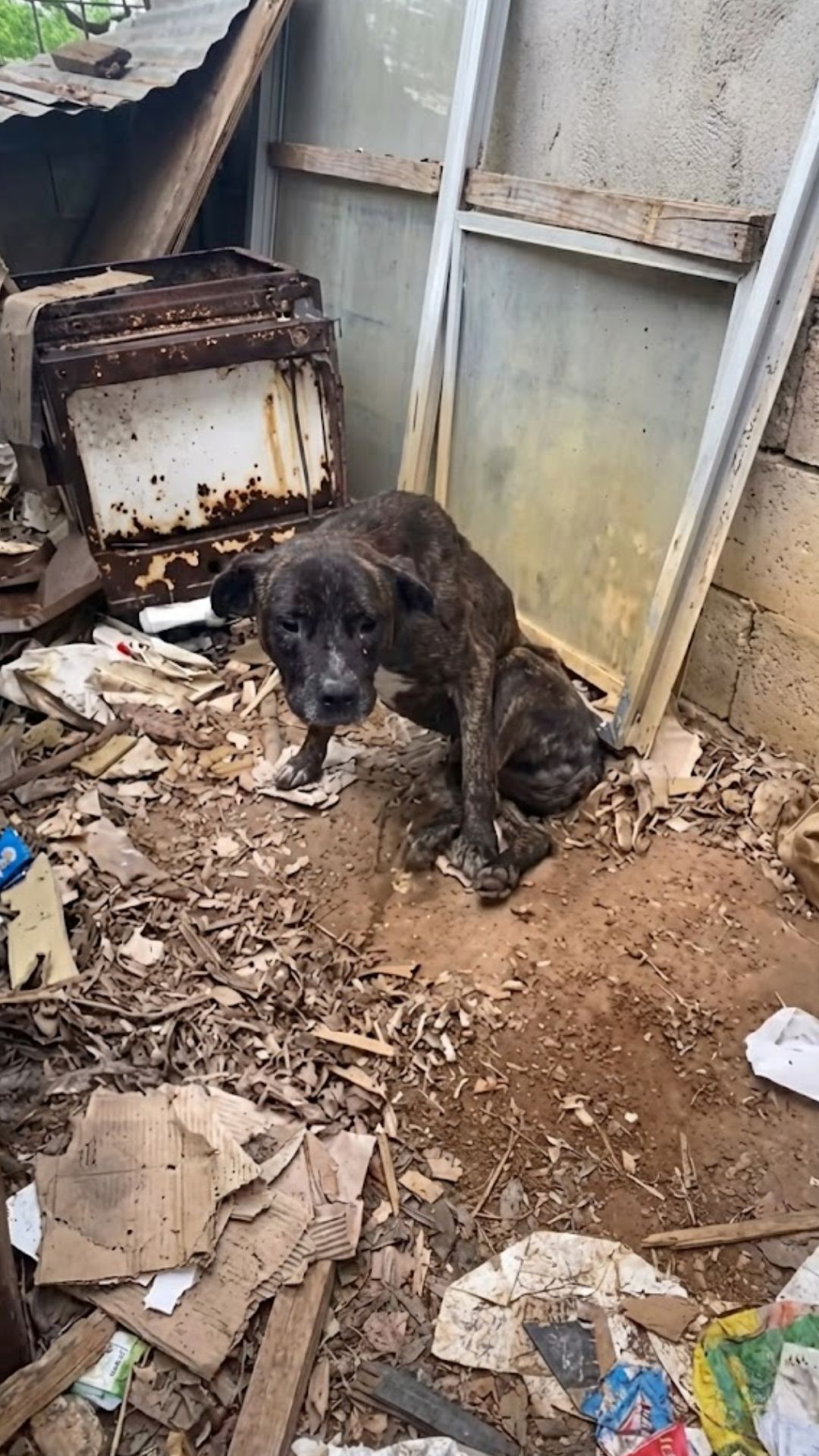
At first, there was only movement among the rubbish.
A scrap collector working near a garbage dump noticed something shifting between broken pieces of debris.
Then a dog appeared.
He was not walking.
He was pulling himself forward with his front legs while both hind legs dragged uselessly behind him.
His name would later be Herschel.
At that moment, he was simply an injured dog trying to cross ground that should have been impossible for him to navigate.
Every few inches required another pull from his front legs.
His rear body followed without support.
Dust clung to his coat.
Pieces of rubbish surrounded him.
Yet when he noticed someone nearby, Herschel did not disappear deeper into the dump.
He moved toward the person.
Slowly.
Painfully.
One pull at a time.
The people who reached him immediately understood that something was seriously wrong.
But they had no idea that the biggest mystery of Herschel’s story was still waiting to be discovered.
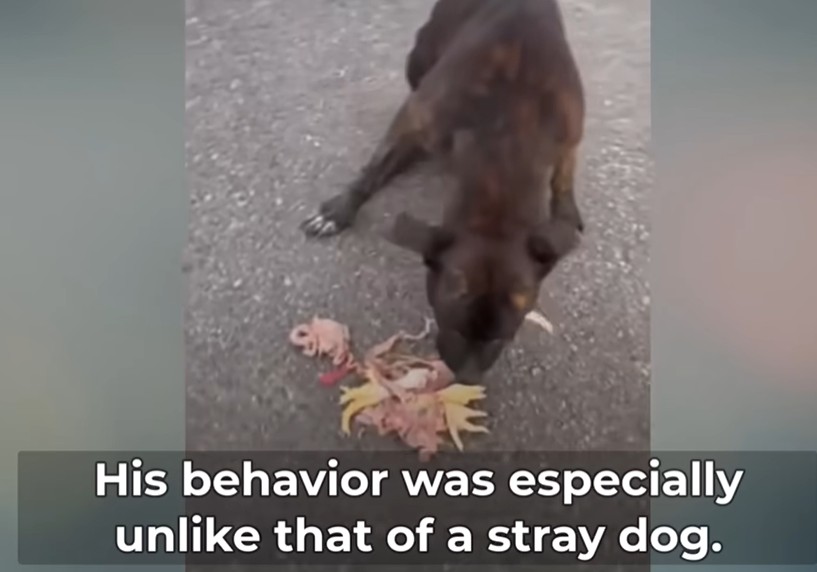
Because only two weeks earlier, someone had filmed a dog who looked exactly like him.
And in that video, he was standing on all four legs.
He Could Not Walk Away, So He Pulled Himself Toward Help
Approaching Herschel required care.
A badly injured dog can react unpredictably when frightened or touched, especially when the source of the pain is unknown.
But Herschel remained remarkably still as rescuers moved closer.
His back legs offered almost no useful movement.
His front legs were doing all the work.
When he attempted to reposition himself, he dragged the rest of his body behind him.
There was no question that he needed veterinary attention immediately.
The rescuers lifted him carefully, supporting his body as evenly as possible to avoid worsening whatever injuries were hidden beneath the surface.
For the first time since he was discovered among the rubbish, Herschel no longer had to pull himself anywhere.
He was carried.
At the clinic, the team began examining the dog who had somehow survived long enough to reach them.
His condition was far more complicated than a simple leg injury.
And the X-rays would soon reveal why.
VIDEO: Paralyzed in a Garbage Dump, Herschel Dragged Himself Toward Help—Then Doctors Gave Him Just a 10% Chance
The X-Rays Revealed Damage Far Beyond His Hind Legs
The veterinary team examined Herschel carefully and ordered imaging.
The results were serious.
His femur was fractured.
His spine was also fractured.
And the spinal cord had been severely compressed.
Those findings explained why Herschel had been dragging his back legs.
The problem was not simply weakness.
His spinal injury had affected the communication between his nervous system and the lower part of his body.
For any dog, spinal trauma of that severity can change life instantly.
For Herschel, it meant that the simple act of standing had become impossible.
The doctors also believed the injuries were relatively recent.
That created an immediate question.
What had happened to him?
There was no reliable witness.
No confirmed account of an accident.
No clear evidence showing exactly how the injuries occurred.
The rescue team could only speculate.
Perhaps he had been struck by a vehicle.
Perhaps something else had happened.
Without evidence, there was no responsible way to know.
Then, three days after Herschel arrived at the clinic, a message appeared on Instagram.
Someone had seen the rescue story.
They believed they had something important.
A video.
Two Weeks Earlier, Herschel Appeared to Be Walking Normally
The footage had reportedly been recorded only about two weeks before Herschel was found.
When the rescuers watched it, the contrast was startling.
A dog strongly resembling Herschel was standing on a street.
His hind legs were supporting him.
He walked toward a young girl.
His tail moved as he approached.
He appeared to be asking for food.
There was no obvious sign of the catastrophic spinal injury that would later leave him crawling through a garbage dump.
If the dog in the footage was indeed Herschel, then the timeline was painfully short.
Approximately fourteen days.
Two weeks between a dog walking normally and a dog unable to use his hind legs.
The video answered one question.
Herschel had not necessarily lived with this disability for years.
But it created an even bigger one.
What happened during those missing days?
No one could say with certainty.
The rescue team did not have enough evidence to determine whether Herschel had suffered a traffic accident, another type of trauma, or something caused intentionally.
What mattered immediately was not solving the mystery.
It was deciding whether anything could still be done for his spine.
The answer from the surgeon was cautious.
And difficult.
The Surgeon Put His Chance of Walking Again at Around 10%
After reviewing Herschel’s condition, the veterinary team discussed the possibility of surgery.
The spinal damage was severe.
According to the rescue account, the surgeon estimated that Herschel had only about a 10% chance of walking again, even with an operation.
Ten percent did not mean recovery was impossible.
But it made clear how uncertain the outcome would be.
Spinal surgery also carried significant risk.
The area involved was delicate.
Any procedure near an already damaged spinal cord required careful planning and precision.
The team had several things to consider.
Herschel’s overall health.
His ability to tolerate surgery.
The extent of the compression.
The possibility that nerve function might never return.
There was no guarantee.
But Herschel was alert.
He followed activity around him.
He continued trying to shift his body despite being unable to use his rear legs normally.
The rescuers decided to proceed.
The goal was not to promise a miracle.
It was to give him the best realistic chance available.
The surgical team worked carefully to address the spinal damage.
When Herschel eventually woke from anesthesia, everyone watched for movement.
There was no immediate dramatic change.
His hind legs still did not function normally.
He still could not stand.
But he had made it through the operation.
Now came the part that no surgeon could complete for him.
Recovery.
Surgery Did Not Make Him Walk—It Gave Rehabilitation a Chance
The days after surgery required patience.
Herschel needed rest while the surgical area healed.
His position had to be managed.
His comfort had to be monitored.
And his body needed time before anyone could know how much neurological function might return.
Progress after spinal trauma is rarely measured in dramatic daily changes.
Sometimes it begins with something almost invisible.
A muscle contracting.
A paw reacting differently.
A leg holding tension for a fraction of a second longer.
For Herschel, the early period remained difficult.
He could not simply stand up and leave his kennel.
He depended on caregivers for movement and support.
The dog who had once walked through the streets now had to wait while his nervous system and muscles were given time to respond.
The rescue team visited him consistently.
Familiar people became part of his daily routine.
Meals arrived.
Hands helped reposition him.
Care continued whether there was obvious improvement that day or not.
That consistency mattered because spinal rehabilitation can be frustratingly slow.
A dog may appear unchanged for days before showing a tiny new response.
Then that response may disappear again.
Progress does not always move in a straight line.
Herschel’s caregivers understood that.
They kept going.
Eventually, he became strong enough to begin more structured rehabilitation.
By day 62, physiotherapy had become a regular part of his recovery.
On Day 62, Herschel Began Learning How to Use His Body Again
Around the 62nd day, Herschel was receiving physiotherapy approximately twice a week.
One of the most important tools in his rehabilitation was an underwater treadmill.
Water changes the way weight is carried.
For an animal with weakness or neurological injury, buoyancy can reduce stress on the joints while allowing muscles to practice controlled movement.
For Herschel, it provided an environment where his hind legs could begin working without bearing his full body weight.
At first, the sessions were difficult.
His muscles had weakened during weeks of limited mobility.
Movements that once happened automatically now required enormous effort.
The rehabilitation team supported him carefully.
Herschel’s paws touched the moving surface beneath the water.
His legs attempted to follow.
Some movements were inconsistent.
Others were barely noticeable.
But repetition mattered.
Again.
And again.
And again.
The goal was not speed.
It was connection.
Encouraging muscles to respond.
Encouraging the nervous system to repeat useful patterns.
Helping Herschel rebuild strength around whatever neurological function remained.
Then the team began noticing small changes outside the treadmill as well.
A toe moved.
A leg responded.
Eventually, Herschel managed to support himself for a brief moment.
It lasted only seconds.
But a dog who had arrived dragging both hind legs had now held his own body upright.
That changed the mood of the entire recovery.
A Toe Twitch Became a Stand—Then Came One Unsteady Step
The first movements were easy to miss.
There was no sudden moment when Herschel leapt to his feet.
Instead, the progress came in pieces.
A small twitch.
A slightly stronger response.
A paw being placed more correctly.
Then the ability to maintain balance for a few seconds.
His caregivers celebrated these moments, but they also remained cautious.
Neurological recovery can fluctuate.
One good day does not guarantee the next will be better.
So the rehabilitation continued.
Hydrotherapy.
Assisted standing.
Muscle strengthening.
Repeated practice.
Herschel sometimes needed help supporting his weight.
His hind legs did not move with the same ease they once had.
But the important change was that they were moving.
Then came the moment everyone had been hoping for.
Herschel stood.
He shifted his weight.
And he took a step.
It was shaky.
His balance was uncertain.
His rear legs did not move smoothly.
But it was a step made under his own power.
For a dog once given roughly a 10% chance of walking again, one imperfect step carried enormous meaning.
Still, the team did not stop.
One step needed to become two.
Two needed to become a short walk.
And a short walk needed to become something Herschel could use in daily life.
By Day 120, the Dog Who Had Crawled Through Garbage Was Walking Again
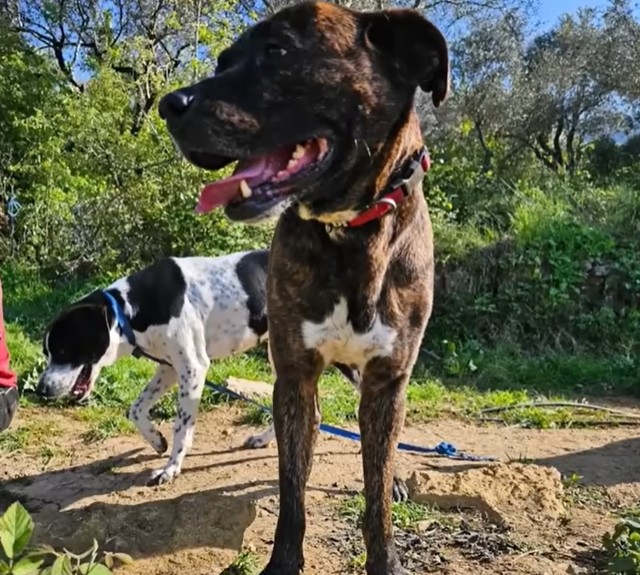
Approximately four months after Herschel was found, the change was remarkable.
Day 120 arrived.
Herschel could walk.
His gait was not perfectly normal.
There was still stiffness.
One leg appeared to lag slightly behind at times.
But he was standing on all four limbs and moving forward without dragging his rear body across the ground.
It was difficult to reconcile this dog with the one first seen among the rubbish.
Back then, his front legs had carried nearly everything.
Now his hind legs were participating again.
The veterinary team evaluated his recovery.
According to the rescue story, his improvement was described as being close to 90%.
That number was especially striking because of where the process had begun.
A roughly 10% chance.
Severe spinal compression.
A fractured femur.
Two hind legs that could not support him.
Months later, Herschel was walking.
But the outcome had not come from determination alone.
It was the result of many things working together.
Surgery.
Veterinary monitoring.
Pain management.
Physiotherapy.
Hydrotherapy.
Time.
And people willing to continue even when the early odds were poor.
Herschel had done the physical work his body demanded.
The humans around him had created the conditions that allowed that work to matter.
The Two Missing Weeks Remained a Mystery, but Herschel Kept Moving Forward
One part of Herschel’s story never received a clear answer.
The two weeks between the earlier video and his discovery at the garbage dump.
The rescue team could see the before.
A dog standing on all four legs.
And they could see the after.
A dog with severe spinal and femoral injuries dragging himself across the ground.
What happened between those moments remained unknown.
There was no confirmed evidence identifying a person responsible.
No verified account of a collision.
No explanation that could be presented as fact.
In the beginning, that mystery was difficult to ignore.
But as Herschel recovered, it became less central to his daily life.
His world was no longer defined only by the event that injured him.
There were rehabilitation sessions.
Walks.
Other dogs.
People he recognized.
Food waiting for him.
Places to rest.
The story began changing from a question about what happened to Herschel into something more immediate.
What could Herschel do now?
The answer continued expanding.
Stand.
Walk.
Explore.
Play.
And eventually, run in his own imperfect but determined way.
Powder Became Part of the Life Herschel Almost Never Reached
Today, Herschel shares his life with another rescued dog named Powder.
The two spend time together.
They play.
They run.
And after active days, they rest near one another.
Herschel’s movement still carries evidence of what happened to his spine.
His gait may appear slightly stiff.
One leg does not always move as smoothly as the others.
But those differences seem small compared with the condition in which he was found.
There is a particular power in watching him move now.
Not because his recovery erased everything.
It did not.
His body still tells part of the story.
But movement itself has become something Herschel was once unlikely to regain.
Every ordinary walk is a reminder of the months spent rebuilding that ability.
Every playful moment with Powder sits in sharp contrast to the image of him pulling himself through discarded rubbish.
Herschel did not need to become physically perfect for his rescue to be successful.
He needed enough mobility to live comfortably and participate in the world around him.
He got far more than anyone could confidently promise at the beginning.
Herschel’s Miracle Was Built One Small Movement at a Time
It is tempting to describe Herschel’s recovery as a miracle.
The numbers certainly make the story feel that way.
A surgeon estimating only around a 10% chance of walking.
A dog eventually reaching what veterinarians described as close to 90% recovery.
But between those two numbers were 120 days that should not be overlooked.
There was surgery.
There were days without visible progress.
There were repeated physiotherapy sessions.
There was an underwater treadmill.
There were weakened muscles that had to become strong again.
There was one toe twitching before an entire leg could support him.
There was standing before walking.
There was one uncertain step before there were many.
That is what Herschel’s transformation actually looked like.
Not one impossible moment.
Hundreds of small ones.
And perhaps the most important happened before any surgery or rehabilitation began.
It happened at the garbage dump.
Herschel saw someone nearby.
He could not run toward them.
He could barely move at all.
So he used the only legs that still worked and pulled himself forward.
Someone noticed.
Someone stopped.
And someone decided that a dog crawling through rubbish was not something to walk past.
Four months later, that same dog was walking again.
Today, Herschel no longer needs to drag himself toward the possibility of help.
He has people around him.
He has Powder beside him.
And when he wants to go somewhere, he can stand on his own four legs and move toward it.
The two missing weeks may never be explained.
But they no longer get to write the ending of Herschel’s story.


