Tom Hudson had already spent days paddling through the remote backcountry of Manitoba when a sound stopped him in the middle of the river.
A bark.
It was faint.
So faint that for a moment, he wasn’t sure he had heard it at all.
Tom was traveling alone by canoe across Canada, documenting the journey for his YouTube channel, What In The World. Out there, surrounded by water, reeds, forest, and long stretches without another person in sight, unusual sounds carried differently.
He paused.
Then he heard it again.
A weak bark came from somewhere along the muddy riverbank.
Tom could have continued downstream.
Instead, he turned the canoe around.
He paddled toward the sound, pushed closer to the reeds, and began searching the shoreline.
At first, all he could see was mud, fallen branches, and thick vegetation.
Then a patch of white appeared against the dark bank.
It moved.
Tom edged closer.
And suddenly he understood what he was looking at.
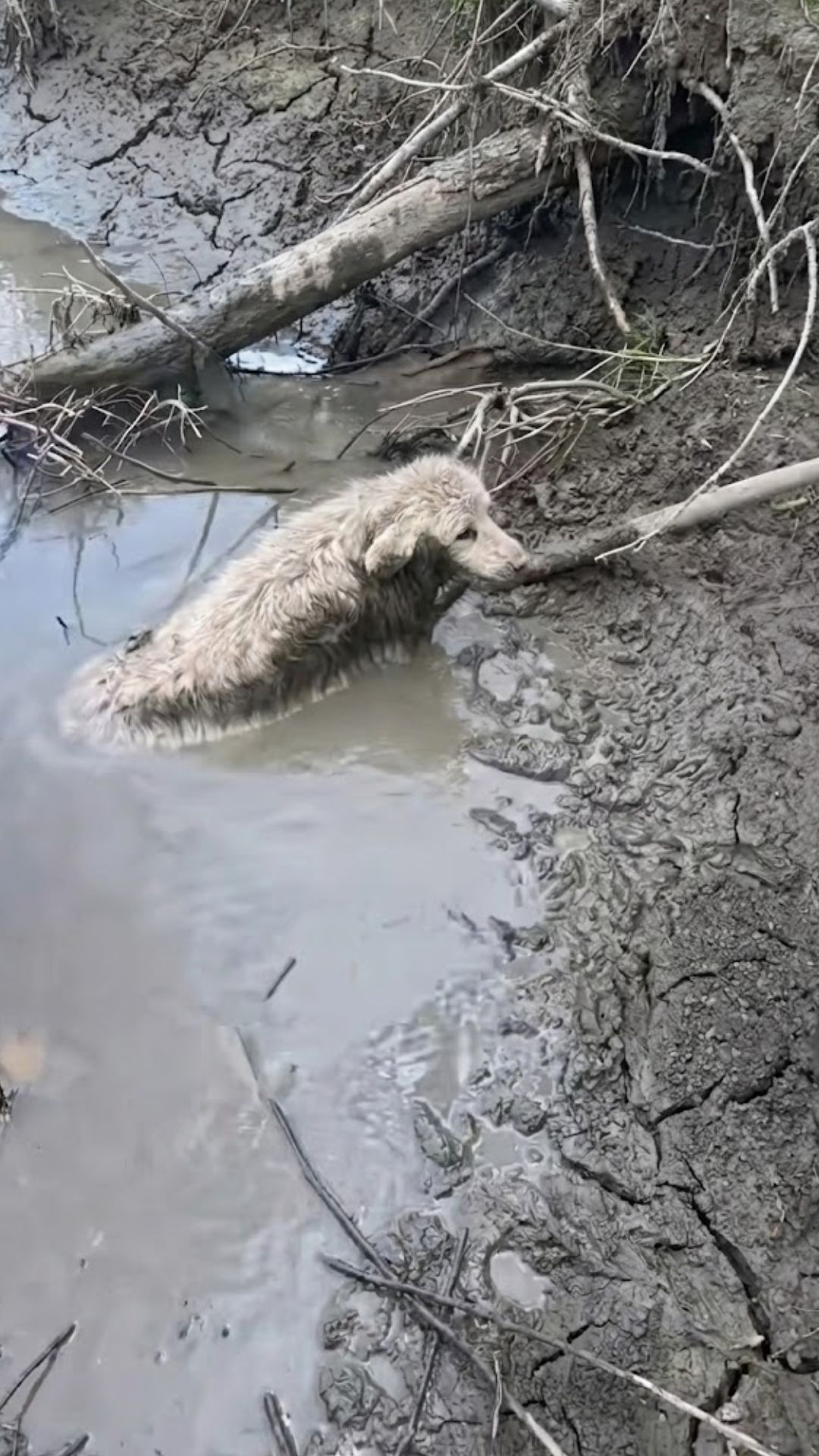
A large white dog was trapped beside the river.
Half of her body was in the water.
A fallen log pinned her in place.
And she could no longer free herself.
Her name was Ivy.
She was 14 years old.
And her family had been looking for her for two days.
Half Submerged in Cold Water, Ivy Could Barely Move
The closer Tom came, the worse the situation looked.
Ivy was a Great Pyrenees, a large breed normally covered in thick white fur.
But almost nothing about her looked white anymore.
Her coat was saturated with dark river mud.
Wet fur clung heavily to her body.
Her hindquarters were trapped low in the bank, while part of her body remained exposed to the cold water.
A fallen log made the position even more difficult.
Every attempt Ivy had made to free herself appeared to have pushed her deeper into the soft mud.
By the time Tom found her, she was exhausted.
Her hind legs offered little useful movement.
Her body shook from the cold.
She no longer had the strength to climb out on her own.
Tom spoke gently as he approached.
He needed Ivy to remain calm.
A frightened dog of her size could make a difficult rescue even more dangerous, especially in unstable mud.
But Ivy did not lash out.
She watched him.
She allowed him to come closer.
Tom now faced a problem he had not expected when he began paddling that morning.
He was alone.
He had no rescue team.
No specialized equipment.
Only a canoe, his own strength, and a large senior dog stuck in mud beside a remote riverbank.
VIDEO: A Faint Bark Led Him Into the Swamp—Where He Found 14-Year-Old Ivy Trapped Beneath a Log
The Mud Was Holding Her Almost as Tightly as the Log
Tom first tried to determine whether Ivy could be freed from the canoe.
The angle was wrong.
She was too low in the mud, and he could not generate enough leverage from inside the boat.
Eventually, there was only one realistic option.
He would have to get out.
The moment Tom stepped from the canoe, his boots sank deep into the riverbank.
The mud reached toward his knees.
Each movement required effort simply to remain balanced.
Now he understood how difficult Ivy’s situation had become.
The same mud that made his own steps unstable had been holding an exhausted 14-year-old dog for hours.
Tom worked his way toward her.
He positioned himself as carefully as possible and tried to lift.
Ivy barely moved.
The mud had formed a strong seal around her body.
He adjusted his grip.
Pulled again.
Still not enough.
He needed to free her without worsening any injuries she might already have.
There was also the risk that Tom himself could slip, lose balance, or become stuck.
So he worked slowly.
One movement at a time.
He loosened Ivy from the mud.
Shifted her weight.
Tried again.
Little by little, the bank released its grip.
Tom Had One More Problem: Getting a Great Pyrenees Into a Canoe
Freeing Ivy from the mud did not automatically make her safe.
She was still weak.
And she was far too exhausted to climb into the canoe by herself.
Tom now had to lift a large, waterlogged dog over the side of a relatively small boat while standing in unstable mud.
Her soaked coat made her even heavier.
He positioned the canoe as close as he could.
Then he wrapped his arms around Ivy.
He lifted.
Her body rose only slightly.
Tom reset his footing.
He tried again.
This time, he managed to bring more of her weight upward.
The edge of the canoe was finally within reach.
With another effort, Ivy came free.
Tom guided her over the side.
She landed inside the canoe.
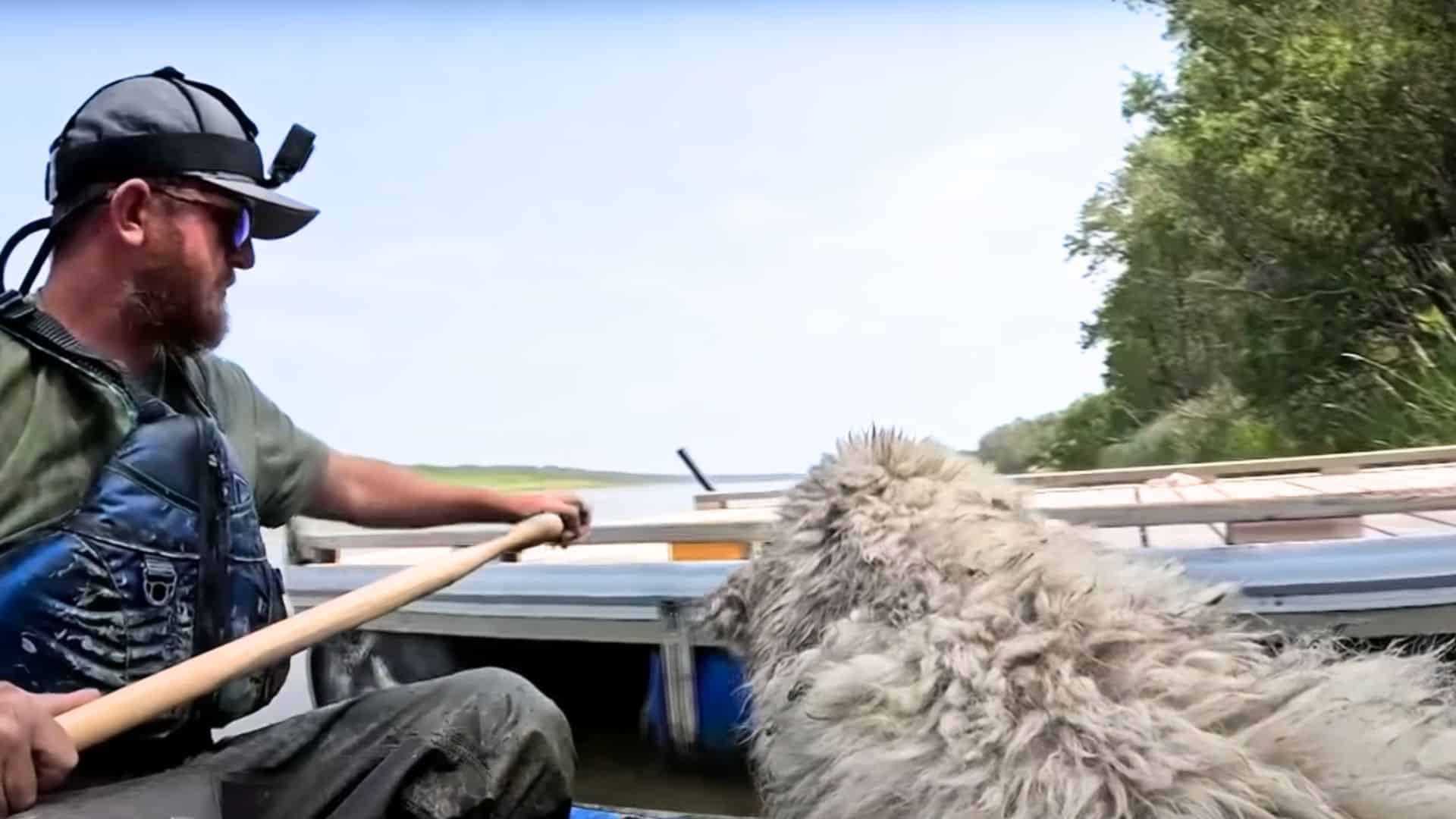
For the first time in nearly two days, according to her family, the dog was no longer trapped.
She did not stand.
She simply remained in the bottom of the boat, wet, muddy, shivering, and exhausted.
But she was out.
Tom climbed back into the canoe.
The rescue itself had succeeded.
Now another question became urgent.
Where had Ivy come from?
A Trail Along the River Became the Only Clue
Tom did not know the dog.
He did not know whether there were homes nearby.
And in such remote country, simply choosing a direction and paddling could lead nowhere.
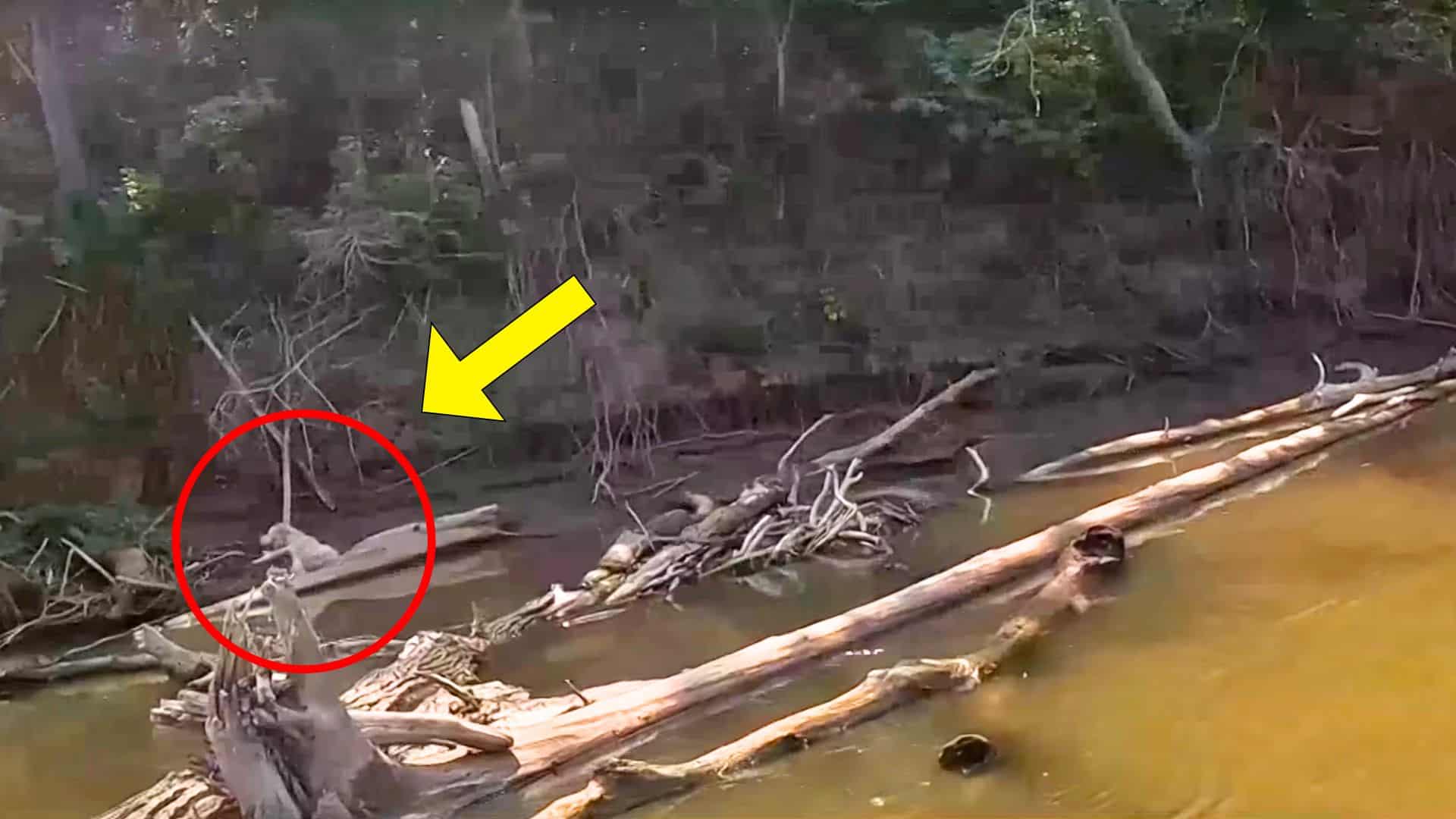
Then he noticed something along the bank.
Paw prints.
They appeared to lead away through the brush and along the river.
Tom began following the shoreline, watching for anything that might indicate where Ivy belonged.
He paddled upstream.
The canoe moved slowly with the exhausted dog inside.
About 300 yards from the place where Ivy had been trapped, Tom spotted something different.
A dock.
It was the first meaningful sign of people nearby.
He pulled the canoe toward shore and climbed out.
A house stood beyond the riverbank.
Tom approached and knocked.
A couple answered.
Their names were Tom Stait and Janine.
Hudson quickly explained what had happened.
He had found a large white dog.
She had been stuck in the mud beside the river.
The reaction was immediate.
The dog was theirs.
Her name was Ivy.
And she had been missing for two days.
Ivy’s Family Had Already Spent Two Days Searching
Tom Stait and Janine had been looking everywhere they could think to look.
They searched the woods.
They called Ivy’s name.
They checked around the property and nearby areas.
But the section of riverbank where Ivy had become trapped was difficult to access and hard to see.
She could be only a short distance away and still remain hidden.
That explained why no one had reached her sooner.
For nearly two days, Ivy had been stuck close to home without any clear way of making herself visible.
Eventually, her barking reached the one person paddling through the area.
The timing mattered.
Ivy was already exhausted when Tom found her.
Her body had spent an extended period exposed to cold water.
She could not walk normally.
And each additional hour in the mud would have made her condition more dangerous.
Now, however, her family finally knew where she was.
The search was over.
Tom had not only found Ivy.
He had brought her back.
The Dog Who Came Home Barely Looked Like Herself
Ivy was too weak to simply walk from the canoe into the house.
Her family and Tom helped move her carefully.
Warmth became the immediate priority.
She was given water.
Food was prepared.
Blankets were brought.
But one enormous reminder of the ordeal still covered nearly every part of her.
Mud.
Her Great Pyrenees coat was designed to be thick and insulating.
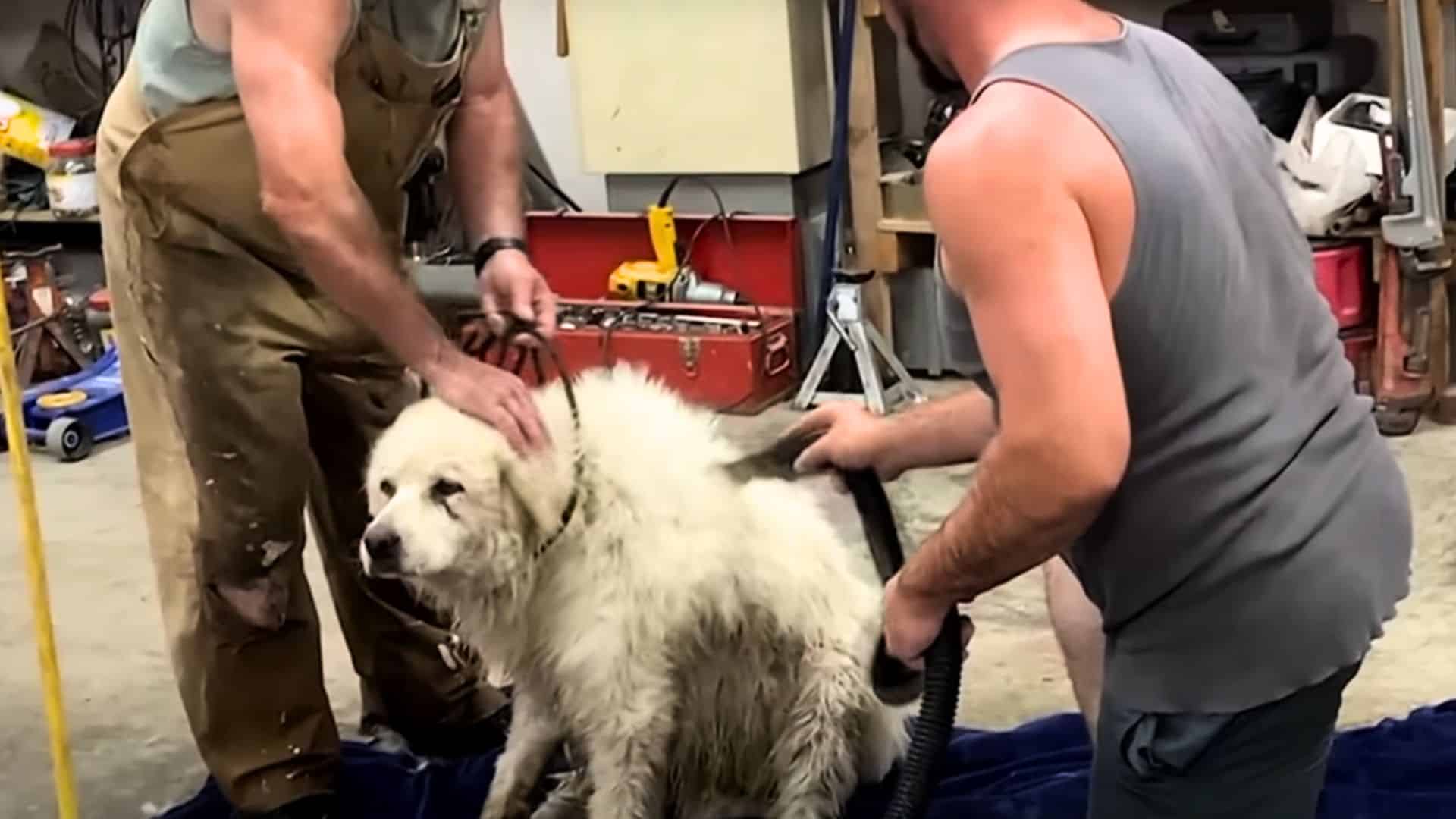
Now that same dense fur held layers of wet river sludge.
Simply allowing it to dry would not be enough.
The mud had worked deep into her coat.
Tom could have left after returning Ivy home.
Instead, he stayed.
Together with the family, he began helping clean her.
Water ran dark as the river mud loosened.
Sections of white fur gradually appeared again.
Bit by bit, the animal who had looked almost unrecognizable at the riverbank began looking like Ivy.
The process also gave everyone time to absorb what had happened.
Only hours earlier, Tom had been traveling alone.
The Staits had still been searching for a missing dog.
And Ivy had still been stuck in the mud.
Now all three parts of the story had converged in one house.
Tom Came Looking for an Adventure and Ended Up at a Family Dinner
The Stait family asked Tom to stay the night.
After days of wilderness travel, the unexpected invitation brought his journey indoors for a while.
They shared dinner.
They talked about Ivy.
They talked about the strange sequence of events that had brought a solo canoeist past exactly the right stretch of river at exactly the right time.
It was an extraordinary coincidence.
Had Tom been farther from shore, he might not have heard the bark.
Had the wind or water been louder, the sound could have disappeared.
Had he assumed it came from somewhere else and continued paddling, Ivy would have remained trapped.
Instead, he stopped.
The choice added hours and physical effort to his journey.
But it also returned a missing senior dog to her family.
For the Staits, Tom was no longer simply a stranger traveling through Manitoba.
He was the person who had followed a faint sound into the mud and brought Ivy home.
The Next Morning, Ivy Was Resting in Her Favorite Place Again
By morning, Ivy’s surroundings could not have been more different from the riverbank.
She was clean.
She was warm.
She was with her family.
And according to the account, she settled beneath the family truck—a favorite resting place.
The image was remarkably ordinary.
That was what made it so meaningful.
There was no fallen log.
No freezing water.
No mud holding her hindquarters.
No need to bark toward an empty river.
Just Ivy resting somewhere familiar.
Her ordeal had taken a physical toll, and an older dog would still need time to recover from that kind of exhaustion.
But she had reached home.
For Tom, the journey continued.
He returned to his canoe.
The remote river stretched ahead again.
His expedition across Canada had not changed its destination.
But one section of that journey would now be remembered for something completely unexpected.
Not a difficult portage.
Not a spectacular landscape.
A dog.
Viewers Had One Suggestion for the Canoe That Carried Ivy Home
Tom had been documenting his expedition for What In The World, so the rescue eventually reached viewers far beyond Manitoba.
People watched him hear the bark.
They watched him approach the mud.
They saw the difficulty of freeing Ivy and getting her into the canoe.
And they saw the moment her family learned she had been found alive.
Soon, viewers began making the same suggestion.
Tom should name his canoe Ivy.
The idea was fitting.
That canoe had begun the day simply carrying an adventurer through the Canadian wilderness.
By the end of it, the little boat had also carried a 14-year-old Great Pyrenees out of a place she could not escape by herself.
Whether or not the name became permanent, the suggestion captured why the story resonated with so many people.
Ivy had been nearly invisible from the river.
Only a faint bark revealed where she was.
And one person decided that faint sound was worth investigating.
Sometimes the Most Important Part of a Journey Is the Moment You Stop
Tom Hudson’s rescue of Ivy did not begin with a planned search.
No one had called him.
He did not know a dog was missing.
He had never met the Stait family.
He was simply paddling.
Then he heard something.
The easiest choice would have been to continue.
A bark in the distance did not necessarily mean trouble.
Stopping meant turning the canoe.
Leaving the river route.
Pushing through muddy ground.
Taking on a situation he had no preparation for.
Tom stopped anyway.
That decision led him to Ivy.
It led Ivy out of the mud.
And it led a family to the dog they had spent two days trying to find.
Sometimes rescue begins with expertise and equipment.
Sometimes it begins with something much smaller.
A sound.
A second look.
A person willing to investigate instead of assuming everything is fine.
Ivy’s bark was faint.
But it reached the right ears.
And because Tom listened, a 14-year-old dog trapped beside a remote Manitoba river got to return to her favorite resting place instead of disappearing into the wilderness.


