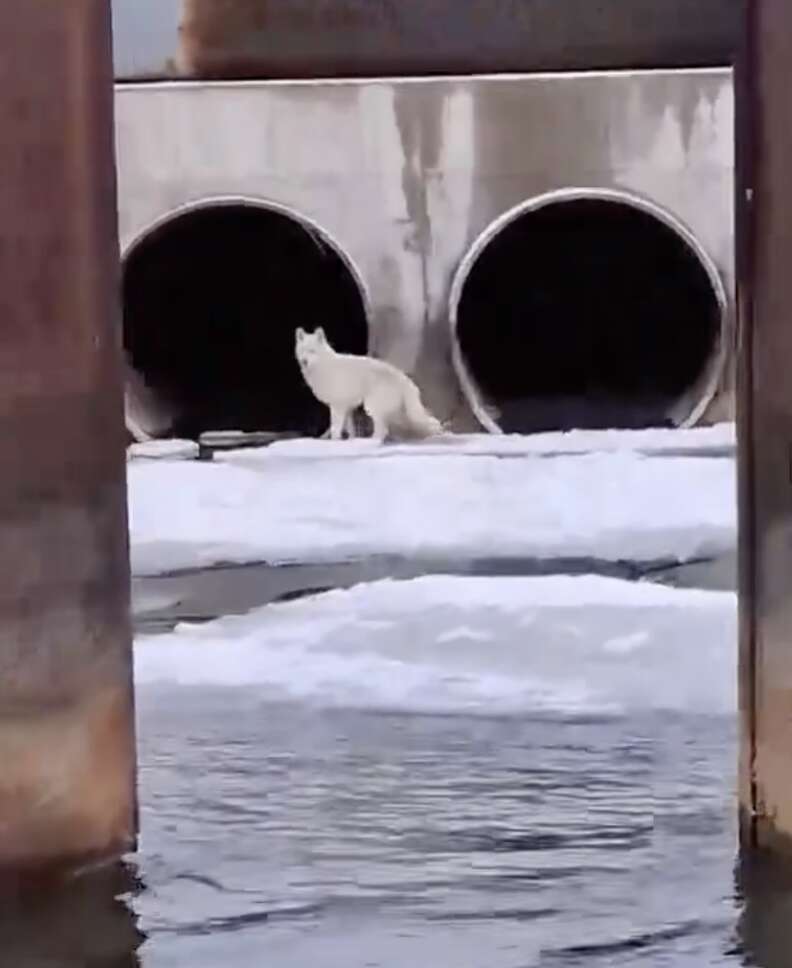
At first, it looked like a white animal moving across the ice.
From a small fishing boat on the Detroit River, Cedric and Walter could not immediately tell what they were seeing.
The animal was pale against the frozen landscape.
Lean.
Quiet.
Alone beneath a bridge where broken sheets of ice shifted across dark winter water.
For a moment, the fishermen wondered if it might be a wolf.
Then they moved closer.
The animal turned toward them.
That was when the scene began to make sense.
This was not a wild animal passing through.
It was a dog.
A white Siberian Husky.
And he was trapped.
The dog paced along a narrow section near a concrete culvert, surrounded by barriers he could not overcome.
Behind him rose tall concrete walls.
In front of him, the Detroit River moved between slabs of ice.
Cedric and Walter had gone out expecting an ordinary winter fishing trip.
Instead, they had found a dog with no obvious way back to land.
The Fishermen Could See Him—but They Could Not Reach Him
The men guided their boat closer, hoping there might be a simple way to bring the Husky aboard.
There wasn’t.
The winter conditions made every movement difficult.
Wind pushed across the river.
Water shifted unpredictably between the bridge supports.
Broken ice reduced the space in which the boat could safely maneuver.
The dog remained near the culvert.
Even a breed known for handling cold weather has limits, and this Husky had already spent an unknown amount of time exposed to freezing temperatures.
From the boat, the fishermen could see him clearly enough to understand the danger.
But they could not get close enough to safely pull him aboard.
Trying to force the boat into the narrow area could put both the dog and the fishermen at greater risk.
They needed another approach.
So instead of leaving and hoping someone else would notice, they called for help.
The call eventually reached The KARENS, a volunteer group known locally for assisting dogs in dangerous situations.
What had begun as two fishermen spotting a strange white shape on the ice was quickly becoming a much larger rescue effort.
VIDEO: Fishermen Spot a White “Wolf” on the Ice—Then Realize a Husky Is Trapped With No Way Out
The River Had Turned a Small Shelf of Ice Into a Trap
Once rescuers learned exactly where the dog was stranded, the problem became clearer.
The Husky was caught in an area beneath the bridge that was extremely difficult to access from land.
A concrete wall roughly 12 feet high blocked one side.
The river blocked the other.
Fencing and restricted areas made approaching from above complicated.
The dog could move within the small area where he had become stranded, but there was no obvious path to safety.
Rescuers believed he may have reached the area when more of the river surface was frozen.
If the ice later broke apart as temperatures shifted, he could have been left isolated on what remained.
That was only a theory.
No one had witnessed how he arrived there.
What mattered was that he could not get himself out.
The KARENS began gathering equipment.
Ladders would be needed.
People capable of working around freezing water would be needed.
And because darkness was approaching, every hour mattered.
By the time rescuers reached the area and assessed the conditions, they faced another difficult reality.
A safe attempt would not be possible immediately.
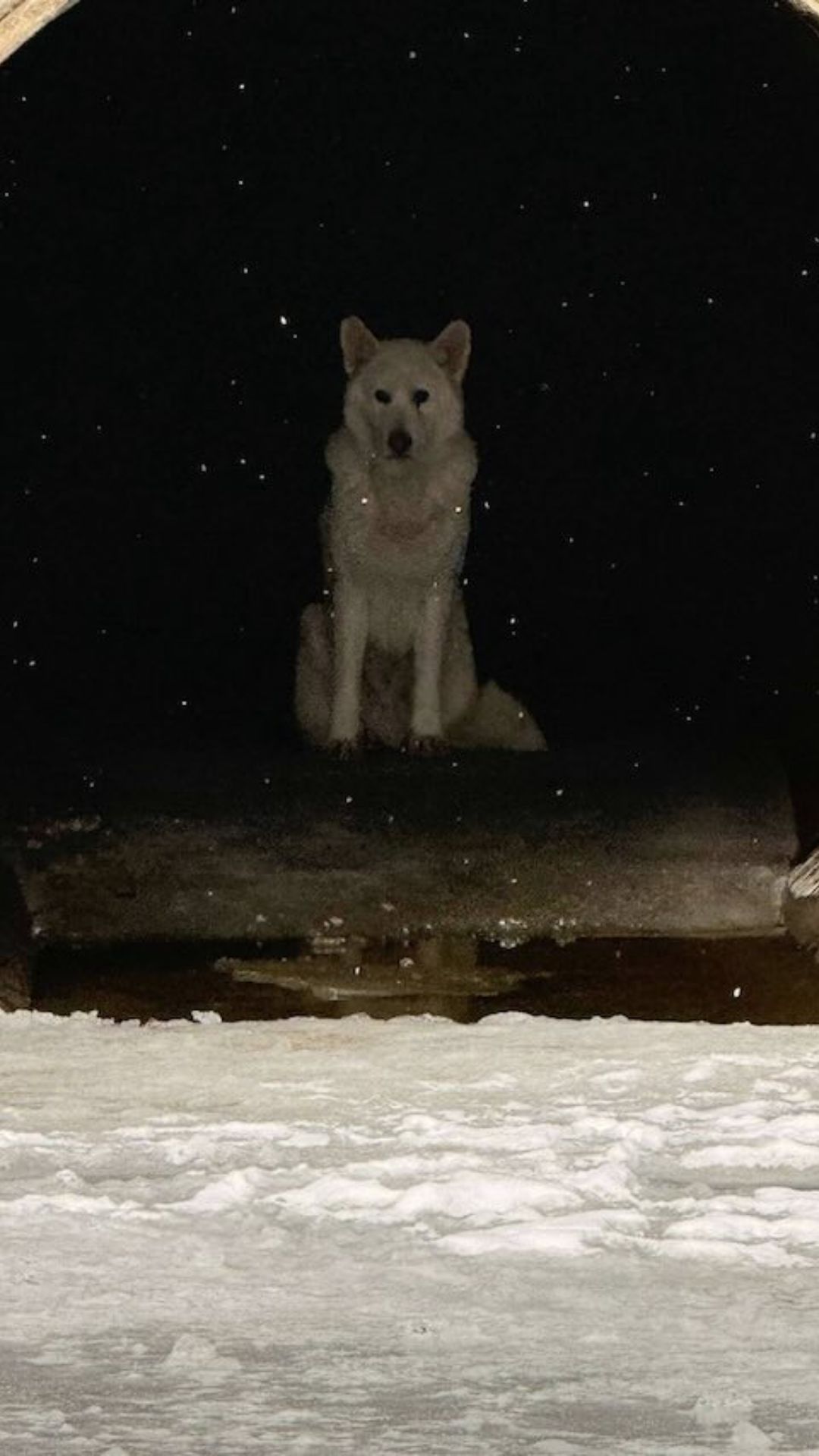
At 6°F, They Had to Leave Him There for One More Night
The temperature dropped to approximately 6°F (-14°C).
The dog curled tightly against the cold.
For the rescuers, the decision was painful but practical.
Attempting a complicated river rescue in darkness, with limited visibility and unstable access, could result in someone falling into the water or losing control of the situation entirely.
They needed daylight.
That meant the Husky would have to remain there overnight.
The rescue team left knowing he was still stranded.
They could not know exactly how long he had already been exposed.
They could not know how much strength he had left.
And there was no guarantee that he would still be in the same condition by morning.
All they could do was prepare.
The dog did what many animals do in extreme cold.
He curled his body tightly, reducing the surface area exposed to the wind.
From a distance, his white coat blended into the frozen surroundings.
The scene looked almost peaceful.
It wasn’t.
The river below remained dangerous.
The air remained bitterly cold.
And the dog had nowhere warmer to go.
By morning, however, he would no longer be facing the river alone.
By Daylight, a Full Rescue Team Had Gathered at the River
The next morning, the riverbank looked completely different.
The KARENS had called for additional support.
Members of the Michigan Humane Society arrived.
So did the Detroit Fire Department and local police.
The rescue now involved people with different skills and equipment working toward the same goal.
Get the dog off the ice safely.
Thermal protective gear was prepared for anyone who might need to enter or work close to the freezing water.
A long ladder was positioned against the concrete structure to create a route down toward the culvert.
Everything had to be deliberate.
One mistake could put a rescuer into the river.
A sudden movement could frighten the dog and cause him to bolt toward unstable ice.
So the team moved slowly.
One by one, rescuers descended.
When they finally reached the area, the dog was still there.
He had survived the night.
But he was frightened and exhausted.
According to Michigan Humane’s Lish Dorset, rescuers believed the dog had likely been stranded for at least 24 hours.
Now came the most delicate part.
Getting close enough to secure him.
The Dog Was Nervous, but Exhaustion Had Taken Away Most of His Options
The Husky had no reason to understand what the people climbing toward him intended to do.
He had spent hours surrounded by cold water, concrete, wind, and ice.
Now unfamiliar people wearing heavy protective gear were entering the small space where he had been trapped.
The team avoided rushing him.
They kept their movements controlled.
The dog remained nervous.
But he was also tired.
His options were limited.
Rescuers used a catch pole to secure him safely.
The equipment allowed them to maintain control without requiring someone to grab directly at a frightened dog’s face or collar.
Once he was secured, the team began moving him toward the ladder.
The process was slow.
The Husky had to be guided and lifted without allowing him to slip back toward the water.
Below them was the freezing river.
Above them was the top of the concrete wall.
Step by step, they brought him upward.
At last, the white dog who had spent the night trapped beneath the bridge reached solid ground.
No ice separated him from help anymore.
No wall stood between him and warmth.
The immediate danger was over.
But no one yet knew what the cold had done to his body.
Wrapped in Blankets, the “Wolf” Finally Became Gordie
Once the dog was safely away from the river, rescuers wrapped him in warm blankets.
He was shivering.
He was hungry.
And after prolonged exposure to winter conditions, medical evaluation was essential.
The team transported him for veterinary care.
There were several obvious concerns.
Hypothermia.
Frostbite.
Injuries that might have occurred before or during his time on the ice.
The medical examination brought surprisingly encouraging news.
Aside from being very cold and hungry, the Husky had avoided major injury.
No broken bones were reported.
No severe trauma was found.
Considering where he had spent the previous night, that outcome was remarkable.
The rescue team gave him a name.
Gordie.
The name was connected to the bridge near where he had been discovered.
At first glance, some people had assumed Gordie was a relatively young Husky.
Then the veterinary examination revealed another surprise.
His teeth suggested he was not a young dog at all.
Gordie was estimated to be around eight years old.
A senior dog had somehow ended up alone on the frozen Detroit River.
And the mystery of how he got there remained unsolved.
The Medical Exam Answered One Question and Created Several More
Gordie’s age changed the way rescuers looked at his story.
An eight-year-old Husky was unlikely to have simply appeared from nowhere.
Had he once lived in a home?
Had he become separated from a family?
Had he been roaming for an extended period before reaching the river?
The rescue account did not provide definitive answers.
There was no reliable information explaining how Gordie reached the bridge or how long he had been outside before fishermen noticed him.
That uncertainty made speculation easy.
But the rescuers focused on what they could confirm.
Gordie was alive.
He had survived the cold.
He had escaped serious physical injury.
And he now had people making sure he did not need to survive another night outside.
For the first time since Cedric and Walter saw the white figure on the ice, no one had to wonder whether Gordie would make it through the next few hours.
He was warm.
He had food.
He could rest.
And there were professionals monitoring his condition.
That was enough for the mystery to wait.
His Recovery Was Mostly About Ordinary Comforts
There was no dramatic surgery in Gordie’s recovery.
No long orthopedic rehabilitation.
After the danger of the river, what he needed most was surprisingly simple.
Warmth.
Food.
Rest.
A safe environment.
His trembling eased as his body temperature improved.
He ate.
He slept on blankets instead of ice.
And gradually, the physical stress of his ordeal began to fade.
Chantal Rzewnicki of The KARENS summed up the change simply:
Gordie was warm.
Gordie was safe.
Those words might sound ordinary.
After the previous 24 hours, they meant everything.
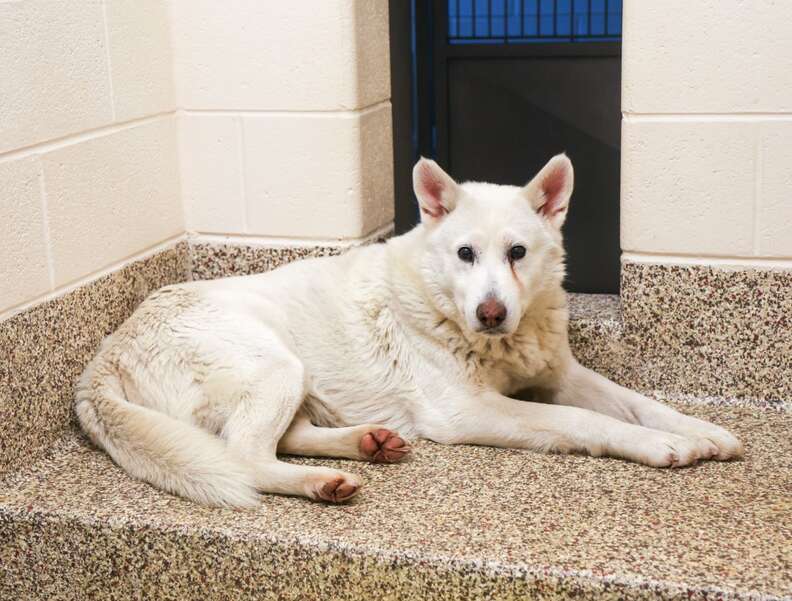
Photographs of Gordie afterward showed a calm white Husky sitting inside the shelter.
The river was gone from the background.
The broken ice was gone.
The concrete culvert was gone.
The only thing left from that morning was the dog himself.
Older than people first assumed.
A little tired.
But alive.
It Took Fishermen, Volunteers, Humane Officers, Firefighters, and Police to Bring One Dog Home From the Ice
No single person rescued Gordie alone.
Cedric and Walter began the chain of events by noticing him.
They could have mistaken the white shape for wildlife and continued fishing.
Instead, they looked again.
When they realized he was a trapped dog, they tried to reach him.
When that proved unsafe, they called for help.
The KARENS responded.
When the rescue exceeded what one volunteer group could safely manage, more organizations joined.
Michigan Humane brought animal-handling experience.
Firefighters helped with access and the hazardous environment.
Police assisted at the scene.
Rescuers wearing protective equipment descended the concrete wall.
Someone secured Gordie.
Others helped bring him up the ladder.
Then veterinary staff took over.
Each person handled one part of the problem.
Together, those parts became a rescue.
That cooperation mattered because Gordie’s location allowed very little room for improvisation.
The river was too cold.
The walls were too high.
The ice was too unstable.
Good intentions alone would not have been enough.
It took patience, equipment, and people willing to coordinate instead of rushing.
Gordie’s Story Began With Someone Looking Twice
The first version of Gordie that Cedric and Walter saw was little more than a white shape in the distance.
Maybe a wolf.
Maybe another wild animal.
Something that belonged to the frozen landscape.
A second look changed everything.
They noticed where he was standing.
They noticed that he could not leave.
They noticed that the animal on the ice needed help.
That second look eventually brought an entire rescue team to the Detroit River.
It carried Gordie from freezing concrete to warm blankets.
It revealed that the “young stray” was actually an older Husky.
And it gave a senior dog another chance before the winter river could decide his fate.
There are still unanswered questions.
No one can say with certainty why Gordie was on the ice.
No one knows exactly where he had been before the fishermen spotted him.
Those parts of his story may remain unknown.
But the ending of that day is clear.
Gordie did not spend another night beneath the bridge.
He did not have to curl himself against the wind and hope the remaining ice would hold.
He was carried over the wall.
Wrapped in blankets.
Fed.
Examined.
And given a safe place to sleep.
Sometimes rescue begins with specialized training.
Sometimes it begins with a phone call.
And sometimes it begins when two fishermen look across a frozen river, notice something that does not seem quite right—
and decide it is worth getting closer.


