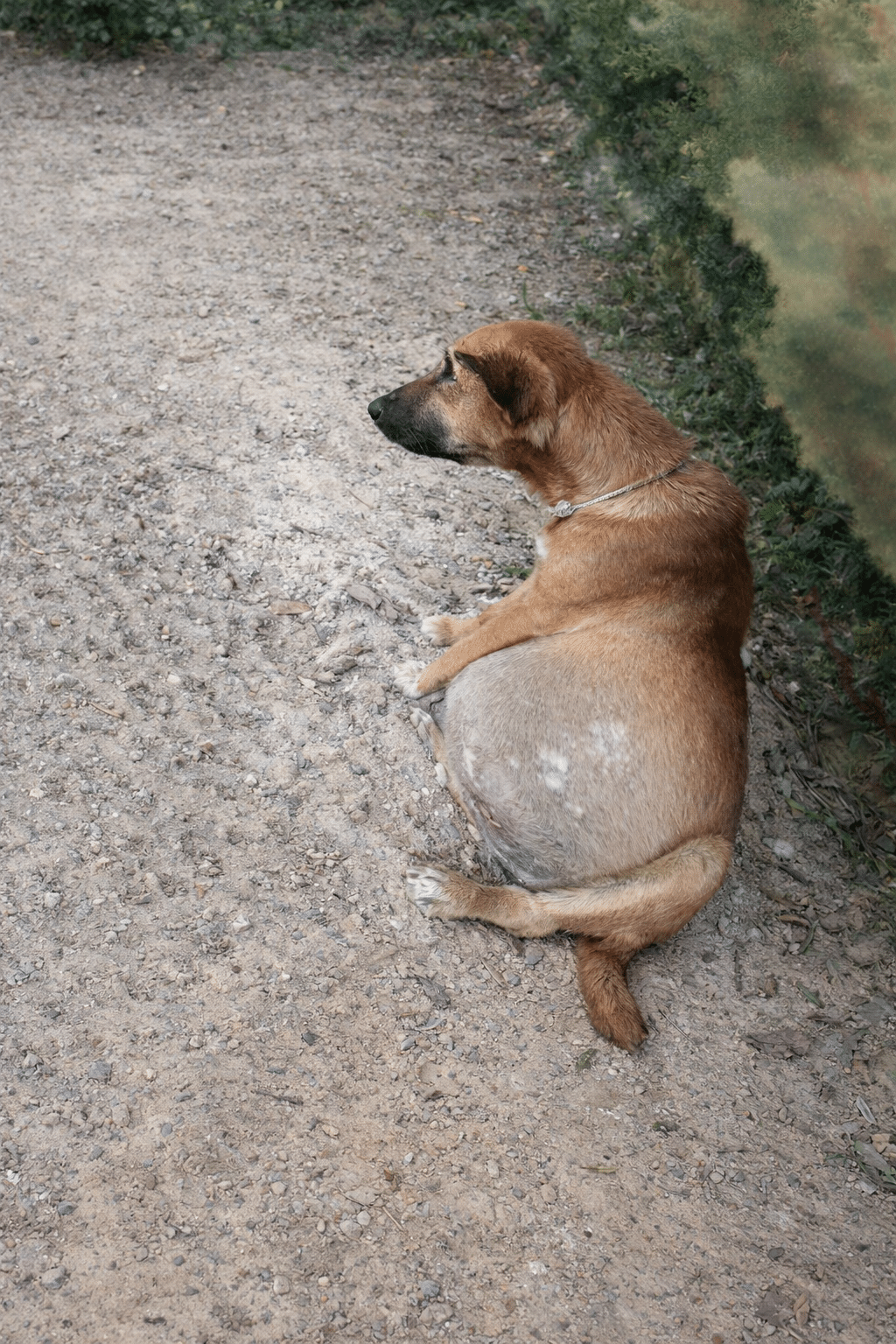
By the time rescuers reached Nong Kiew, his body looked as though it had been carrying far too much for far too long.
He was tied behind a house.
His frame was thin.
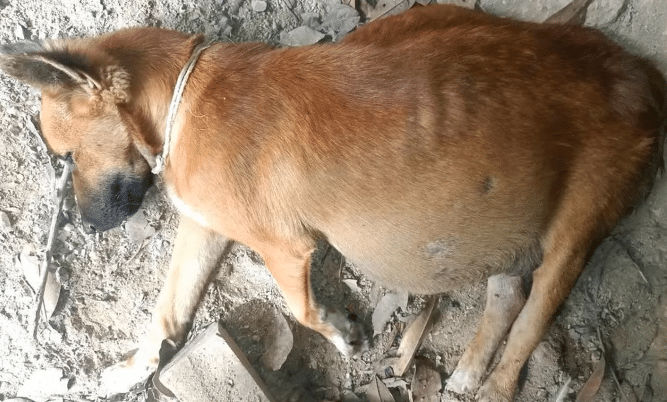
But his abdomen was enormously swollen, stretched tight with fluid that made the rest of his body appear even more fragile.
Standing required effort.
Breathing looked uncomfortable.
A wound had also formed across the swollen area of his belly.
There was no way to know from appearance alone how much damage had already been done internally.
What rescuers could see was enough.
Nong Kiew needed medical help immediately.
They lifted him as gently as possible and placed him inside a cardboard box for transport.
The box was simple.
But for Nong Kiew, it became the first step away from the place where he had been left suffering.
At the veterinary clinic, blood tests and examination quickly showed that the swelling was only one part of a much larger problem.
His Swollen Abdomen Was Hiding a Body Under Severe Strain
The veterinary team began with the basics.
Hydration.
Bloodwork.
Physical examination.
Nong Kiew was severely dehydrated.
His gums appeared pale, a sign consistent with anemia.
His white blood cell count was reported to be nearly three times higher than normal, indicating that his body was dealing with significant inflammation, infection, stress, or another serious underlying process.
But the most visually obvious problem remained his abdomen.
Fluid had accumulated inside it to a dangerous degree.
That pressure affected far more than appearance.
A distended abdomen can make movement uncomfortable.
It can interfere with normal breathing.
It can place additional strain on a body already weakened by illness.
Veterinarians needed to relieve some of that pressure.
At the same time, they wanted to understand what had caused the fluid to build up in the first place.
According to the rescue account, the medical team suspected that repeated contraceptive injections given over time had contributed to serious complications.
The exact medical chain was described cautiously.
What was clear was that Nong Kiew now needed treatment for the consequences.
The team began draining the accumulated fluid gradually.
There would be no instant cure.
His body was too fragile for that.
VIDEO: Nong Kiew Arrived With a Dangerously Swollen Belly—Then 40 Days of Treatment Changed Everything
Draining the Fluid Was Only the Beginning
Removing some of the abdominal fluid helped reduce pressure.
But Nong Kiew’s condition required much more than a single procedure.
He needed supportive treatment while his body adjusted.
His dehydration had to be corrected.
His blood values needed monitoring.
The wound on his abdomen required attention.
And the veterinary team needed to watch how his digestive system responded as treatment continued.
For the first few days, progress remained uncertain.
Nong Kiew was weak.
His appetite was inconsistent.
He spent much of his time resting.
The swelling was still obvious even after treatment began.
Caregivers monitored him closely.
How much was he drinking?
Was he keeping food down?
Was his breathing becoming easier?
Was the abdomen reducing?
Each answer mattered.
Then, on the fourth day, the situation became more concerning.
Nong Kiew began vomiting.
Soon, severe diarrhea followed.
For an already dehydrated and weakened dog, losing more fluid could become dangerous very quickly.
On Day 4, His Recovery Suddenly Became More Complicated
The veterinary team ordered additional tests.
They needed to rule out serious intestinal disease and understand why Nong Kiew’s digestive system had deteriorated.
Fortunately, according to the rescue account, testing did not show the dangerous intestinal infection they had feared.
That was encouraging.
But Nong Kiew was still sick.
So the treatment plan was adjusted.
Antibiotics were included.
Medication was used to control nausea.
Supplements were given to support his anemia.
Diuretics became part of the effort to reduce ongoing fluid accumulation.
The team also continued monitoring his hydration carefully.
This part of recovery was less dramatic than the initial rescue.
There was no single moment when everything changed.
Instead, improvement depended on dozens of small medical decisions made over several days.
A medication adjusted.
A meal tolerated.
A night without vomiting.
A little less fluid in the abdomen.
By day 7, the team changed Nong Kiew’s food to a special nutritional formula designed to be easier on a weakened digestive system.
That change would become another important part of the recovery.
A Special Diet Helped His Body Begin Catching Up
Food had to do more than fill Nong Kiew’s stomach.
His body needed nutrition it could actually process.
After days of gastrointestinal trouble, the veterinary team could not simply offer rich meals and hope for the best.
The new diet was selected to support digestion while still providing enough energy for recovery.
Gradually, Nong Kiew began tolerating food better.
The vomiting stopped.
His diarrhea improved.
He began drinking water more normally.
And the enormous abdomen started looking slightly less tense.
The change was not dramatic from one hour to the next.
But comparing one day with the next, caregivers could finally see movement in the right direction.
Nong Kiew’s breathing also appeared calmer as some of the pressure decreased.
Then came a small moment that everyone noticed.
On the ninth day, someone called his name.
His tail moved.
On Day 9, Nong Kiew Began Responding Differently
The tail wag was brief.
But it arrived after days dominated by medical procedures, weakness, vomiting, diarrhea, and rest.
More importantly, it was not the only positive change.
Nong Kiew began eating on his own again.
He drank without difficulty.
His breathing had become steadier.
When caregivers approached, he seemed more attentive to what was happening around him.
These were practical signs that his condition was improving.
A dog who eats independently requires less feeding assistance.
A dog who drinks normally is better able to maintain hydration.
A dog who responds to voices is engaging more with the environment around him.
None of these behaviors guaranteed a complete recovery.
But together, they gave the veterinary team something they had not had at the beginning.
Momentum.
The swollen abdomen continued reducing.
His body was no longer spending every moment managing the same level of physical pressure.
And within less than a week, Nong Kiew reached another milestone.
This one required his whole body.
Day 15: The Dog Who Had Struggled to Stand Walked Outside
Fifteen days after treatment began, Nong Kiew stood.
Then he walked.
His steps were careful.
There was no reason to rush him.
His muscles had weakened during illness, and his body was still recovering from dehydration, anemia, digestive problems, and prolonged abdominal swelling.
But he could move under his own power.
The veterinary staff accompanied him outside for a short walk.
For a dog who had arrived struggling just to remain upright, those few steps carried enormous meaning.
He looked more alert.
His posture was stronger.
The abdomen no longer dominated his entire silhouette in the same way.
Movement itself seemed easier now that he was not carrying the same amount of fluid.
The walk remained short.
Rest was still part of treatment.
But after days of measuring progress through bloodwork, medication, appetite, and bowel movements, the team could finally see improvement in a way anyone could understand.
Nong Kiew was walking again.
The Difference Became Difficult to Ignore by Day 40
Recovery continued for several more weeks.
Nong Kiew kept eating.
His body gained strength.
His coat improved.
The swelling continued decreasing.
By approximately day 40, photographs showed a dog dramatically different from the one first transported in a cardboard box.
His abdomen had returned much closer to a normal appearance.
His body looked stronger.
His coat appeared thicker and healthier.
He moved with far more confidence.
And when familiar caregivers approached, his tail wagged more readily.
The transformation was significant.
But it had not happened because of one miracle treatment.
It came from sustained veterinary care.
Fluid management.
Medication.
Digestive support.
Nutrition.
Monitoring.
Rest.
And time.
Every day had added something.
By day 40, those small improvements had accumulated into a completely different picture.
Support From Strangers Helped Keep His Treatment Going
Nong Kiew’s care required resources.
Veterinary examinations.
Medication.
Special food.
Repeated monitoring.
Ongoing treatment.
Those things cost money.
According to the rescue account, supporters contributed donations that helped cover his medical expenses.
For Nong Kiew, those people may never have been physically present in the clinic.
But their help still became part of his recovery.
A donation could become medication.
Food.
Another veterinary visit.
Another day of treatment when stopping early might have placed his progress at risk.
Rescue often looks like the person physically lifting an animal from danger.
But the work continues long after that moment.
Someone cleans.
Someone feeds.
Someone monitors bloodwork.
Someone pays for treatment.
And someone else shares the story so that help can continue arriving.
Nong Kiew benefited from all of those pieces working together.
Forty Days Earlier, He Could Barely Stand Behind a House
The contrast is difficult to miss.
At the beginning, Nong Kiew was tied behind a house with a severely distended abdomen and little strength.
He was dehydrated.
His gums were pale.
His white blood cell count was dramatically elevated.
A wound had developed across the swollen area.
Even standing required effort.
Four days into treatment, vomiting and diarrhea created another medical setback.
The recovery could easily have moved in the wrong direction.
Instead, the veterinary team adjusted.
By day 7, his diet had changed.
By day 9, he was eating independently and responding when people called him.
By day 15, he could walk outside.
By day 40, he looked almost like another dog.
That timeline is what makes Nong Kiew’s story powerful.
Not because his condition vanished overnight.
Because it didn’t.
His body needed weeks of consistent care to rebuild what illness and neglect had taken away.
Today, the enormous swollen belly is no longer the first thing people see.
They see a stronger dog.
A healthier coat.
Steadier movement.
A tail that responds when familiar people approach.
Nong Kiew’s past remains part of his story.
But it is no longer the part deciding what each day looks like.
Once, he could barely stand.
Now, when someone calls his name, he can get up—
and walk toward them.


