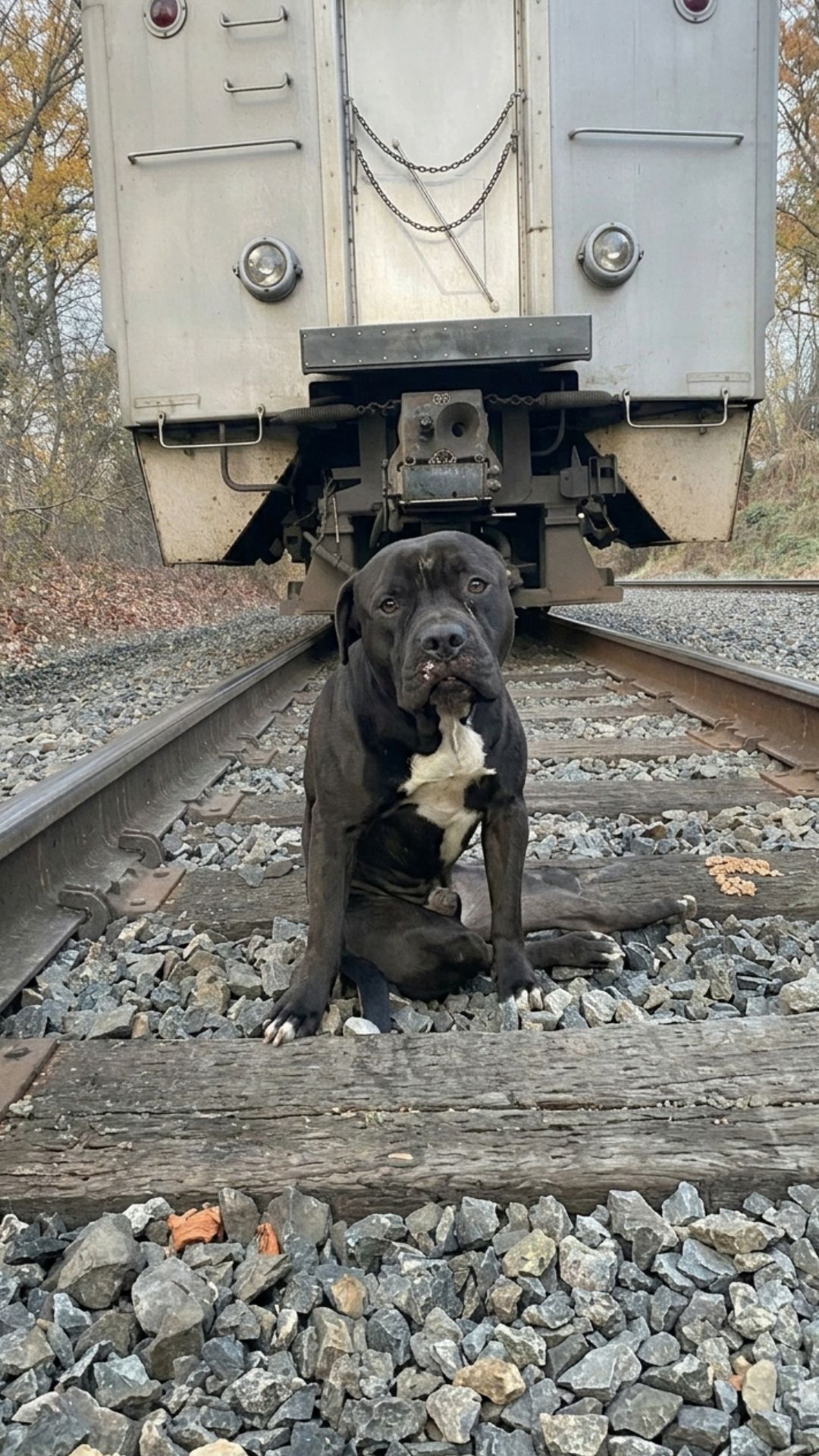
The first thing rescuers saw was a dog lying between two steel rails.
He wasn’t resting there.
He couldn’t get up.
His hind legs lay motionless behind him while his front half remained pressed against the gravel of an active railway line in Montgomery County, near Philadelphia.
Then came an even harder detail to understand.
According to the rescue account, the dog had been there for approximately 48 hours.
Trains were still using the tracks.
Whenever the vibration of another approaching train traveled through the rails, the dog reportedly did the only thing his injured body allowed.
He flattened himself against the ground.
Lowered his head.
And waited.
Then thousands of pounds of steel passed over and around the place where he lay.
Again.
And again.
Somehow, he survived long enough for someone to notice him.
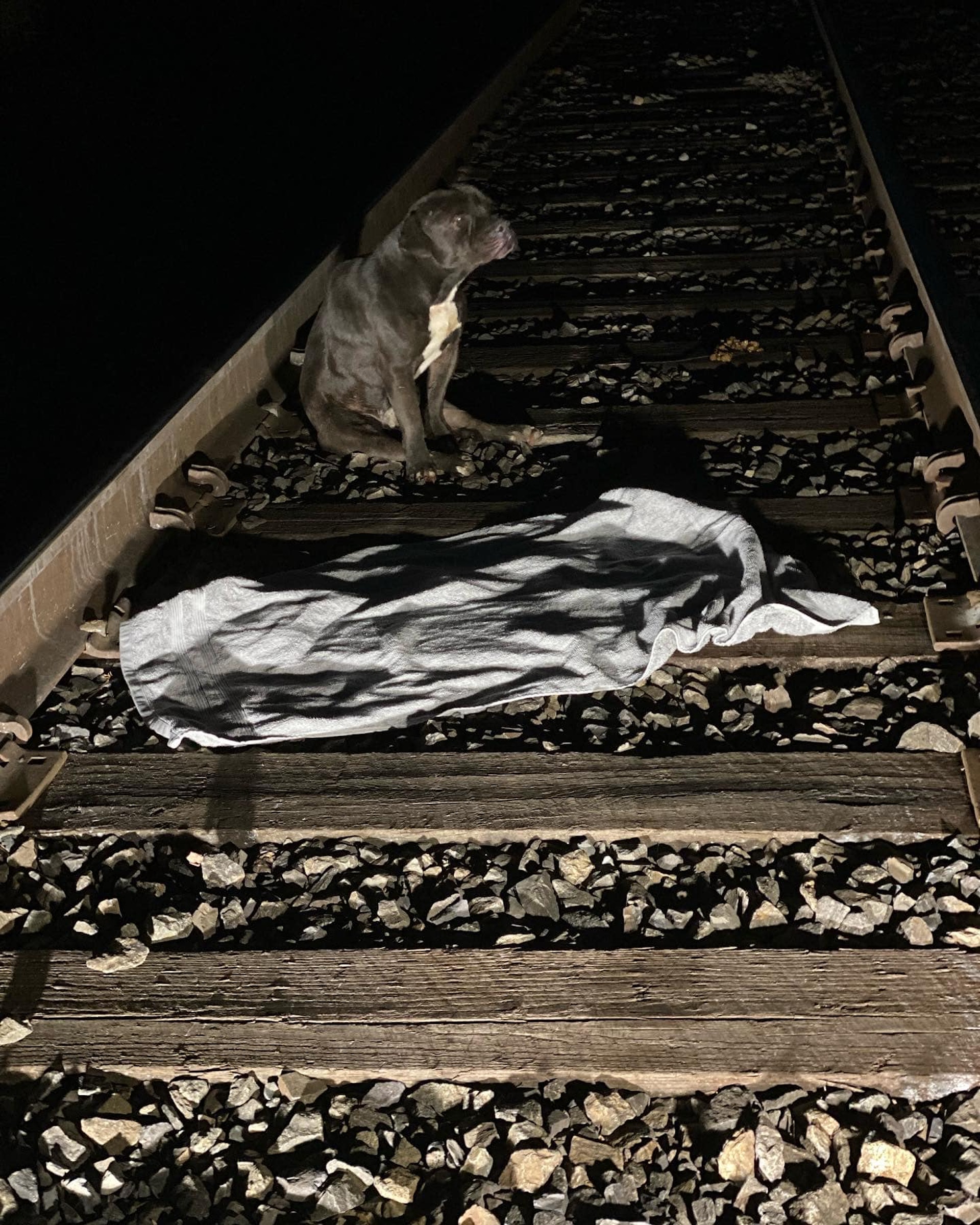
And when rescuers finally reached the tracks, they discovered something beside him that made the story even more difficult to explain.
He Could Move His Front Half—but His Hind Legs Would Not Follow
Members of Philly Rescue Angels responded after the dog was reported on the railway.
They approached carefully.
Active tracks are dangerous even before an injured animal is added to the situation.
The dog was exhausted.
His body was covered with abrasions.
Several teeth were damaged.
And when he tried to reposition himself, his rear legs did not respond normally.
The rescuers could immediately see that this was not a dog who could simply be lifted to his feet and walked away.
He needed to be removed from the tracks with his spine supported as carefully as possible.
They worked around him slowly.
Then they noticed two objects lying nearby.
A collar.
And a leash.
According to the rescue account, both appeared to have been unclipped.
The discovery raised an obvious question.
How had the dog ended up there?
Had he been injured somewhere else?
Had a train caused the trauma?
Had someone brought him near the tracks?
The scene alone could not provide a definitive answer.
What rescuers did know was much simpler.
The dog was badly hurt.
And he had somehow survived two days in one of the most dangerous places imaginable.
VIDEO: Paralyzed Between Active Train Tracks, Lucky Survived Nearly 48 Hours Before Help Reached Him
The X-Rays Revealed Why He Could Not Stand
The dog was rushed to an emergency veterinary hospital.
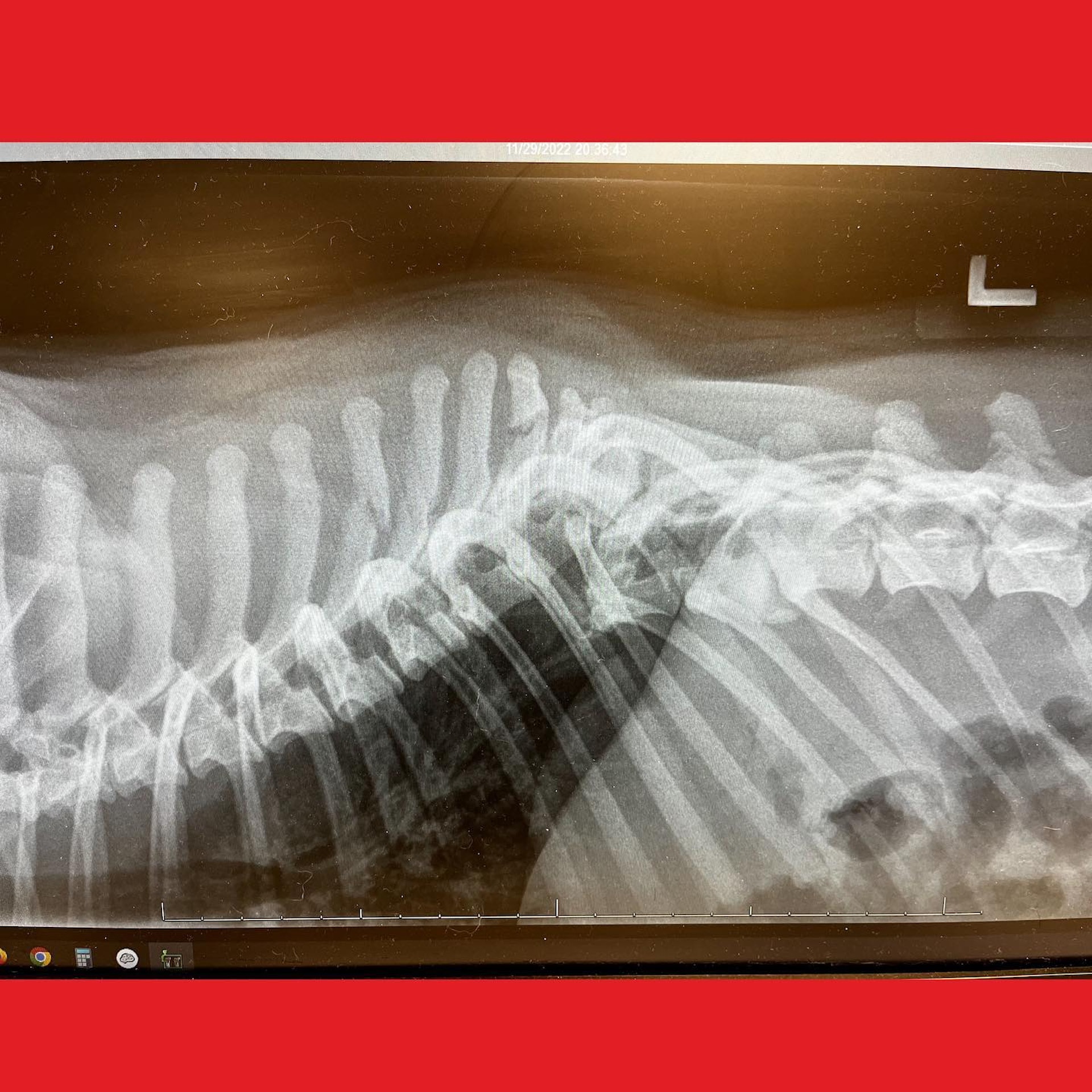
Imaging quickly confirmed that the situation was even more serious than rescuers had feared.
His spine had suffered catastrophic trauma.
According to the rescue account, the spinal cord had been completely severed.
Veterinarians described the fracture as exceptionally severe.
That finding explained the paralysis in his hindquarters.
It also meant that the possibility of normal walking returning was extremely poor.
But paralysis was not the only danger.
The veterinary team was concerned about myelomalacia, a potentially fatal condition in which severe spinal cord injury can progress and damage additional sections of the cord.
That risk changed the conversation.
This was no longer simply a question of whether the dog would walk again.
The concern was whether the neurological damage might continue progressing.
The medical team discussed prognosis carefully.
Euthanasia was presented as one possible humane option given the severity of the injuries and uncertainty ahead.
Then one rescuer looked at the dog lying in front of her and made a different decision.
Her name was Sidara Son.
The Dog From the Tracks Was Given a Name: Lucky
Sidara had been involved in getting the dog off the railway.
Now she was involved in deciding what came next.
No one could promise that treatment would restore his hind-leg function.
No one could guarantee that complications would not develop.
But the dog remained alert.
He responded to the people around him.
And after surviving the tracks long enough to reach veterinary care, Sidara wanted to give him a chance at treatment.
The rescue team named him Lucky.
The name carried obvious meaning.
Forty-eight hours on active tracks.
Severe spinal trauma.
Passing trains.
And somehow, a heartbeat still present when help finally arrived.
But luck alone would not carry him through what came next.
Lucky’s spine needed surgical stabilization.
And the operation would be extensive.
More Than Six Hours of Surgery Stabilized His Shattered Spine
Lucky underwent a complex spinal procedure lasting more than six hours.
The goal was not to promise that his paralysis would disappear.
It was to stabilize the damaged spine and give the rest of his body the best possible chance to recover safely.
Surgeons installed two metal plates along the injured area.
The procedure required careful work around already devastated spinal structures.
Hour after hour passed.
Then the operation ended.
Lucky made it through anesthesia.
When he began waking, the rescuers watched closely.
His hind legs were still paralyzed.
That had not changed.
But his condition had been stabilized enough for the next stage to begin.
Recovery.
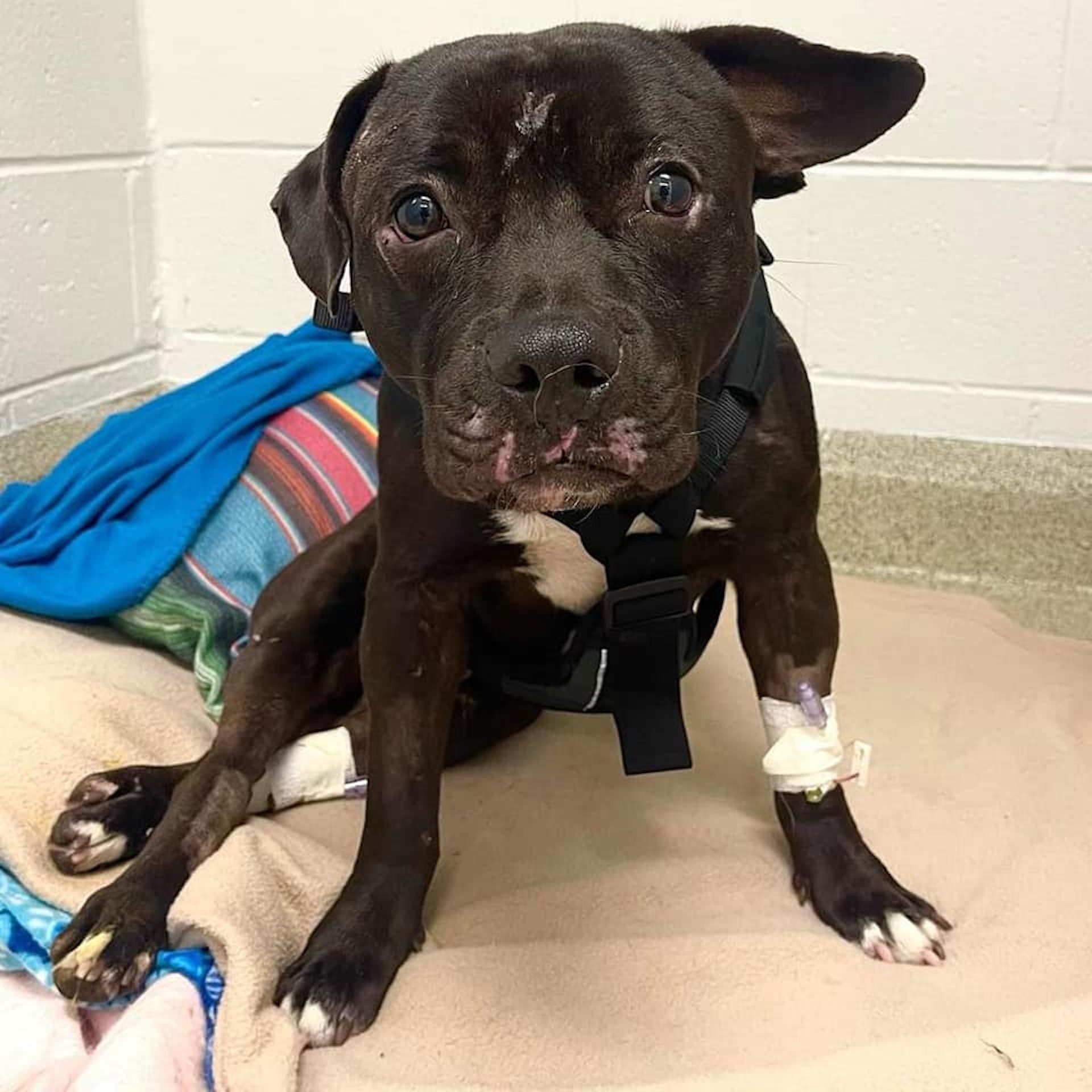
According to those caring for him, Lucky remained gentle around the people handling him.
He even licked the hands of caregivers during his early recovery.
That behavior became one of the details people remembered most about him.
His body had been through enormous trauma.
Yet he continued accepting contact.
Now he needed somewhere equipped for the demands of caring for a paralyzed dog.
Medical Foster Care Gave Lucky Time to Adjust
Lucky was placed with experienced medical foster Kimberly Price Astringer.
This part of his rescue was far less dramatic than the railway or surgery.
But it was essential.
A paralyzed dog requires practical daily support.
Movement has to be managed.
Skin must be monitored.
Positioning matters.
Rehabilitation exercises may need to be repeated consistently.
And the animal needs time to adjust to a body that no longer moves the way it once did.
Kimberly provided that environment.
Lucky began settling into foster life.
He chewed bully sticks.
He played with soft toys.
He rested somewhere warm.
Those small routines changed the rhythm of his days.
For a while, Lucky’s life had been measured by approaching trains and emergency medical decisions.
Now there were quieter things to focus on.
Meals.
Rest.
Toys.
Therapy.
Familiar people.
The fact that his hind legs remained paralyzed did not mean recovery had stopped.
It meant recovery needed a different definition.
Laser Therapy and Daily Exercises Built Strength Where He Still Had It
Lucky began a long rehabilitation program.
His treatment included laser therapy, strength work, and daily physical therapy.
Because his spinal injury was so severe, the goal was not simply to wait for his hind legs to begin functioning normally.
Therapy also helped maintain the parts of his body he could use.
His front legs became especially important.
They would need to support more of his weight.
His shoulders and upper body needed strength.
Caregivers worked with him regularly.
Stretching.
Supported movement.
Controlled exercise.
Repetition.
Lucky’s paralysis remained part of his life.
But the rest of his body continued adapting.
Eventually, the rescue team introduced something that would dramatically expand how far he could move.
A wheelchair.
The Wheelchair Did Not Make Lucky Walk Again—It Let Him Move Forward
Lucky was fitted with a custom mobility cart.
The wheels supported his hindquarters while allowing his front legs to pull him forward.
At first, the equipment required adjustment.
Harness positioning mattered.
Balance mattered.
Lucky needed to understand how his movements affected the wheels behind him.
Then he began moving.
Forward.
Across the ground.
Farther than he could have traveled dragging his hind body.
Caregivers noticed his excitement during wheelchair sessions.
His tail moved.
He became more animated.
Soon, the cart was no longer simply medical equipment.
It was how Lucky explored.
He could move through outdoor spaces.
Follow people.
Approach other dogs.
Choose a direction and keep going.
The spinal injury had permanently changed how his body worked.
But the wheelchair gave him back an important part of independence.
Mobility.
The rescue team could now begin thinking about something that had once seemed very far away.
A permanent home.
Finding a Home for a Paralyzed Dog Was Another Kind of Challenge
Lucky had survived the railway.
He had survived surgery.
He had adapted to foster care.
He had learned to use wheels.
But adoption still required finding someone prepared for the realities of his condition.
A paralyzed dog may need more daily assistance than an able-bodied animal.
Wheelchair use requires routine.
Medical needs can continue.
The home environment may need adjustments.
The adopter has to understand that love alone does not replace practical care.
Philly Rescue Angels began looking for the right person.
Someone who saw Lucky as a dog first and a medical case second.
But while that search continued, one person kept returning to the story from the very beginning.
Sidara Son.
The rescuer who had been involved when Lucky came off the tracks.
The person who had supported giving him a chance when his prognosis looked so difficult.
Eventually, Sidara realized something.
Lucky did not need to keep searching for his person.
He had already found her.
The Rescuer Who Fought for His Treatment Became His Family
Sidara officially adopted Lucky.
The temporary relationship became permanent.
For Lucky, it meant that the person connected to one of the worst days of his life would also be part of everything that followed.
He joined a household with canine companions.
He had people familiar with his medical history.
He had his wheelchair.
He had routines.
He had somewhere to return after every outing.
The railway no longer defined his daily environment.
Instead of gravel and steel rails, Lucky had beds, toys, people, and other dogs around him.
His paralysis did not disappear.
His spine did not return to the condition it had been in before the injury.
That was not the ending his story required.
Lucky’s success was not measured by whether he eventually stood on four legs again.
It was measured by whether he could live safely, comfortably, and actively with the body he had.
And he could.
Lucky Survived the Tracks—but His Second Chance Was Built Afterward
It is easy to focus only on the first 48 hours.
A paralyzed dog.
Active train tracks.
The vibration of approaching trains.
A body pressed flat against gravel.
Those details are extraordinary.
But Lucky’s real transformation took much longer.
Someone noticed him.
Philly Rescue Angels responded.
His spine was evaluated.
A difficult medical decision had to be made.
Surgeons spent more than six hours stabilizing him.
Two metal plates were installed.
Kimberly Price Astringer provided medical foster care.
Therapists worked with his body.
A wheelchair gave him mobility.
And Sidara Son ultimately gave him a permanent home.
The collar and leash found beside the tracks may always leave unanswered questions about how Lucky ended up there.
The rescue account cannot tell us with certainty what happened before he was discovered.
But everything after that moment is much clearer.
Lucky did not remain between the rails.
He did not become defined only by paralysis.
He learned another way to move.
Another way to explore.
Another way to live.
Once, when a train approached, all Lucky could do was make himself as small and flat as possible.
Today, when he wants to go somewhere, he lifts himself into his wheels—
and moves toward it.


