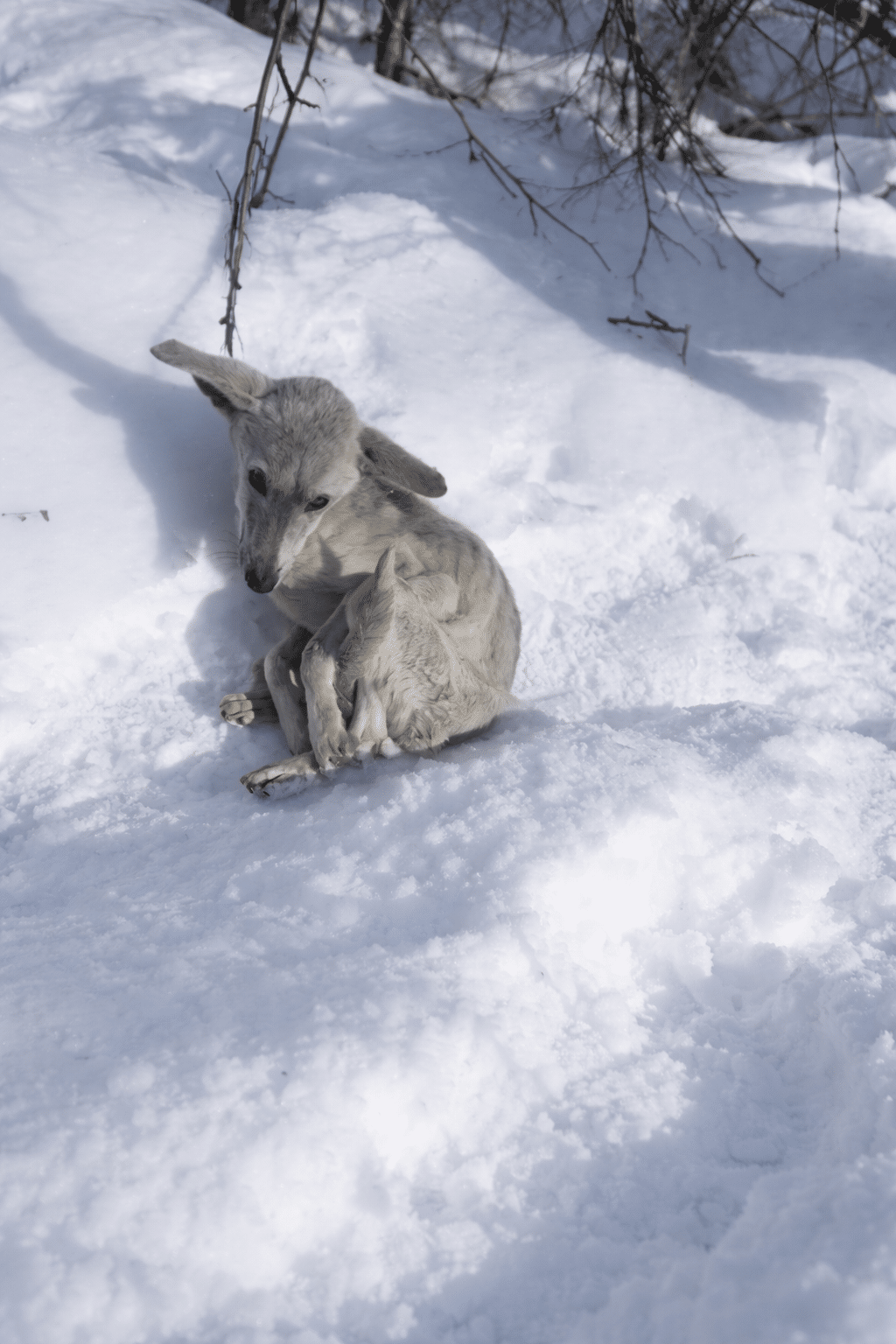
The snow around Izya was almost perfectly still.
Nothing moved except the small dog curled tightly against the frozen ground.
His body was painfully thin.
His muscles had wasted away.
And every breath disappeared into air so cold that nighttime temperatures had fallen to –21°C.
Izya was not wandering because he had lost his way.
According to the rescuers who came for him, his owner had deliberately left him outside and initially refused to surrender him, saying the dog was being “taught a lesson.”
For Izya, there was no lesson to understand.
There was only cold.
Hunger.
And a body quickly running out of strength.
Getting him away from that place would require negotiation before his owner finally agreed to let him go.
When rescuers lifted Izya from the snow and carried him toward their vehicle, they knew they had arrived dangerously late.
What they did not yet know was how much damage weeks or months of poor care had already left behind.
In the Snow, Izya Had Almost Nothing Left to Give
From a distance, Izya looked small.
Up close, the seriousness of his condition was impossible to miss.
His ribs stood out beneath his skin.
There was almost no muscle protecting his frame.
He appeared exhausted before anyone even attempted to move him.
The cold made everything worse.
A well-fed, healthy dog has far more ability to maintain body temperature than one whose body has already been depleted.
Izya had very little reserve left.
He trembled as he lay in the snow, pulling his legs close beneath himself in an attempt to conserve warmth.
Rescuers wanted to remove him immediately.
But there was another obstacle.
His owner initially would not release him.
According to the rescue account, the man insisted that Izya was outside because he was “teaching him a lesson.”
The rescuers continued negotiating.
They understood that arguing indefinitely would not help the dog lying in dangerous temperatures.
Eventually, an agreement was reached that included payment, and Izya was surrendered.
There was no dramatic goodbye.
The man walked away.
Izya went with the rescuers.
Whatever circumstances had placed him in the snow, they were finally behind him.
Now the question was whether his body could recover from them.
Video: Izya Was Left Outside in –21°C—The Moment Rescuers Finally Carried Him Away
The Clinic Revealed How Close He Was to Collapse
At the veterinary clinic, Izya could finally be examined properly.
His appearance already suggested severe nutritional deprivation.
Testing confirmed just how serious it had become.
Izya was critically malnourished.
His body had lost substantial muscle.
Bloodwork showed severe anemia associated with prolonged starvation.
There was also evidence of an older leg injury that had healed poorly, leaving a lasting scar.
The injury was not the most urgent problem that day.
But it revealed something important.
Izya’s suffering had not begun with one freezing night.
His body carried signs of problems that had been present much longer.
For the veterinary team, the immediate priorities were stabilization, nutrition, hydration, and warmth.
The rescue account noted that outdoor temperatures had been falling to around –21°C at night.
For a dog as depleted as Izya, continued exposure could have become life-threatening very quickly.
He had reached help at a point when his body had very little left to rely on.
But rescuing him from the snow did not mean the danger had passed.
A severely malnourished animal cannot simply be given unlimited food and expected to recover overnight.
His system needed time.
Everything would have to happen gradually.
Even Food Had to Be Given Carefully
Izya was hungry.
But feeding him required a plan.
His caregivers divided food into small, frequent portions so his weakened digestive system would not be overwhelmed.
Supplements were introduced.
Probiotics became part of his recovery routine.
IV fluids helped support his body while he slowly regained stability.
The process looked almost ordinary from the outside.
A small meal.
Rest.
Another small meal later.
Medication.
Monitoring.
Then repeat.
But for Izya, every one of those routines was rebuilding something his body had been missing.
Calories became energy.
Hydration supported circulation.
Regular meals slowly replaced the uncertainty of hunger.
Still, physical recovery told only part of the story.
The people caring for Izya began noticing how strongly he reacted to the world around him.
A sudden sound could make him lower himself toward the ground.
Unexpected movement made him tense.
On his early walks, he sometimes stopped abruptly and seemed unable to continue.
The rescuers did not claim to know exactly what Izya remembered or expected in those moments.
They could only respond to what they observed.
He was afraid.
So they changed the way they approached him.
Voices became softer.
Movements became slower.
If Izya stopped, they waited.
If he needed distance, they gave him room.
There would be no forcing him through fear simply because people wanted to see progress faster.
Trust would have to develop the same way his body was recovering.
One small experience at a time.
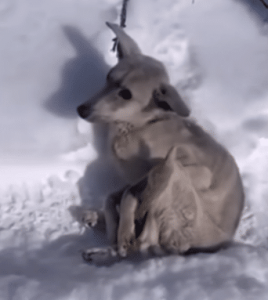
Day Sixteen Brought a Sign No Blood Test Could Measure
By the sixteenth day, Izya’s medical results were beginning to move in a better direction.
His bloodwork had improved.
His appetite was stronger.
His posture looked different.
He began holding his head higher instead of remaining constantly withdrawn.
Those changes were encouraging.
Then something happened that was much smaller than a laboratory result but perhaps even more memorable to the caregivers around him.
Izya’s tail moved.
It was not a wild wag.
He did not suddenly rush toward everyone in the room.
The movement was cautious.
Brief.
Almost tentative.
But it happened.
For a dog who had spent his first days reacting to unfamiliar sounds and movement with visible fear, that tiny gesture suggested a shift.
He was beginning to engage differently.
He started watching people with more curiosity.
He tolerated gentle touch for longer periods.
The outside world no longer seemed to make him freeze quite as often.
No one treated that tail wag as proof that Izya had forgotten everything that came before.
Healing rarely works that way.
He was still cautious.
Still recovering.
Still learning.
But for the first time, his caregivers could see that safety was becoming something he might begin to expect rather than something that appeared only briefly.
Recovery Meant Teaching His Body and Mind the Same Lesson
Izya’s body needed nourishment.
His behavior needed consistency.
The two forms of recovery happened side by side.
Each day brought more predictable routines.
Meals arrived.
Water was available.
People checked on him.
Walks happened without punishment.
A hand touching his back did not become something frightening.
A door closing did not mean he had been abandoned outside again.
Over time, those patterns began replacing uncertainty.
Izya gained weight gradually.
His strength improved.
His coat started looking healthier.
Movement became easier.
But there were still difficult moments.
A sudden sound could bring back hesitation.
New surroundings sometimes made him cautious.
The caregivers did not interpret those reactions as failure.
They simply slowed down.
That patience mattered because Izya had no way to understand promises.
No one could explain to him in words that the cold nights were over.
He could only learn from repetition.
Tonight, there was a warm place to sleep.
Tomorrow, there would still be food.
The person who walked away would come back.
The hand reaching toward him would stop if he became uncomfortable.
Bit by bit, predictability replaced fear.
And while Izya’s body was rebuilding muscle, his behavior began showing something just as important.
He was becoming willing to participate in life around him again.
Fifty Days Later, Izya Left the Clinic
Nearly two months after his rescue, another major milestone arrived.
After 50 days, Izya was considered ready to leave the clinic and continue life in a home.
The car ride was quiet.
Izya watched through the window, alert to everything changing around him.
A dog does not understand the concept of adoption the way people do.
For him, another car journey was simply another unfamiliar event.
Then the vehicle stopped.
What waited outside looked nothing like the place where rescuers had found him.
There was a garden.
Space to move.
A home with a soft bed indoors.
And people who understood that Izya might need time before he behaved like a dog who had always known safety.
His new family did not demand immediate affection.
They did not surround him or expect him to explore everything at once.
They allowed him to observe.
To rest.
To learn the new environment at his own pace.
That approach mirrored everything that had helped him recover at the clinic.
No pressure.
No punishment.
Just consistency.
For Izya, it was another transition.
But this time, he was entering a place designed to keep him rather than send him away.
Even the Cats Became Part of His New World
There were already cats living in Izya’s new home.
At first, he kept his distance.
He watched them cautiously.
They were unfamiliar animals in an unfamiliar place, and there was no reason to expect instant friendship.
So once again, no one rushed him.
Izya was allowed to observe.
Shared rooms became normal.
The cats moved around him.
Izya began understanding their routines.
Tension gradually faded.
Curiosity took its place.
Those ordinary interactions became another sign of how much his world had expanded.
Not long before, Izya’s daily life had been reduced to survival in the cold.
Now he had household routines.
A garden.
A bed.
Other animals nearby.
People who noticed when he needed space.
He was no longer spending every ounce of energy simply keeping himself alive.
That gave him room to discover preferences.
Relationships.
Play.
Comfort.
The things that make a dog’s life more than survival.
His new family did not erase his past.
They simply gave him enough stability that the past no longer had to shape every reaction.
The Dog From the Snow Slowly Became Harder to Recognize
As time passed, Izya continued changing physically.
His coat became thicker and healthier.
His body filled out.
The skeletal outline that had been so visible when rescuers first found him began disappearing beneath restored weight and muscle.
His movement grew steadier.
Outside in the garden, he could run across grass rather than curl himself against frozen ground.
But perhaps the clearest transformation could be seen in how he responded to his surroundings.
His eyes were not constantly searching for the next threat.
Sudden sounds did not control every moment.
He had learned where his bed was.
Where meals came from.
Who belonged in his home.
The freezing night that nearly ended his life was becoming something behind him rather than something repeated.
That distinction is important.
Izya’s rescue did not give him a new personality.
It gave him an environment in which his personality had room to appear.
The cautious dog could become curious.
The dog who froze during early walks could move with more confidence.
The animal who had been left exposed to –21°C weather could choose a warm place to sleep indoors.
None of those changes happened because someone demanded that Izya “move on.”
They happened because day after day, his circumstances became safer.
Winter Became a Season Instead of a Sentence
Izya’s story began with an image that is difficult to forget.
A painfully thin dog lying in deep winter cold.
His body weakened by prolonged malnutrition.
His blood showing the effects of starvation.
A badly healed old injury still visible on his leg.
And an owner who, according to rescuers, initially resisted surrendering him.
At that moment, the future was extremely uncertain.
Yet the transformation that followed was built from very ordinary things.
Warmth.
Small meals.
Fluids.
Medication.
Quiet voices.
Short walks.
Time.
On day sixteen, a cautious wag.
After fifty days, a new home.
Then a garden.
A soft bed.
Resident cats who slowly became part of everyday life.
The difference between Izya’s first photograph and his later life can look dramatic.
But the path between those two points was not dramatic at all.
It was repetitive.
Consistent.
Patient.
That is often what recovery really looks like.
One meal does not repair severe malnutrition.
One kind touch does not erase fear.
One warm night cannot immediately teach a dog that he will never be left in the cold again.
But enough meals can rebuild a body.
Enough gentle experiences can change expectations.
Enough safe nights can turn vigilance into rest.
Izya survived temperatures around –21°C when his body was already dangerously depleted.
That is part of his story.
But survival is no longer the most important thing about him.
Now he has somewhere to go when the weather turns cold.
People who notice whether he has eaten.
A place where he can sleep without being exposed to the elements.
A garden where his legs carry him through grass rather than snow.
Winter still comes.
The temperature still drops.
But for Izya, cold weather no longer determines whether he will be safe.
It is simply weather outside a home where someone is waiting for him.
Once, he was left in the snow as though his suffering were part of a punishment.
Today, he knows something entirely different.
Warmth returns tomorrow.
Food returns tomorrow.
And when night falls, there is a place where he belongs.


