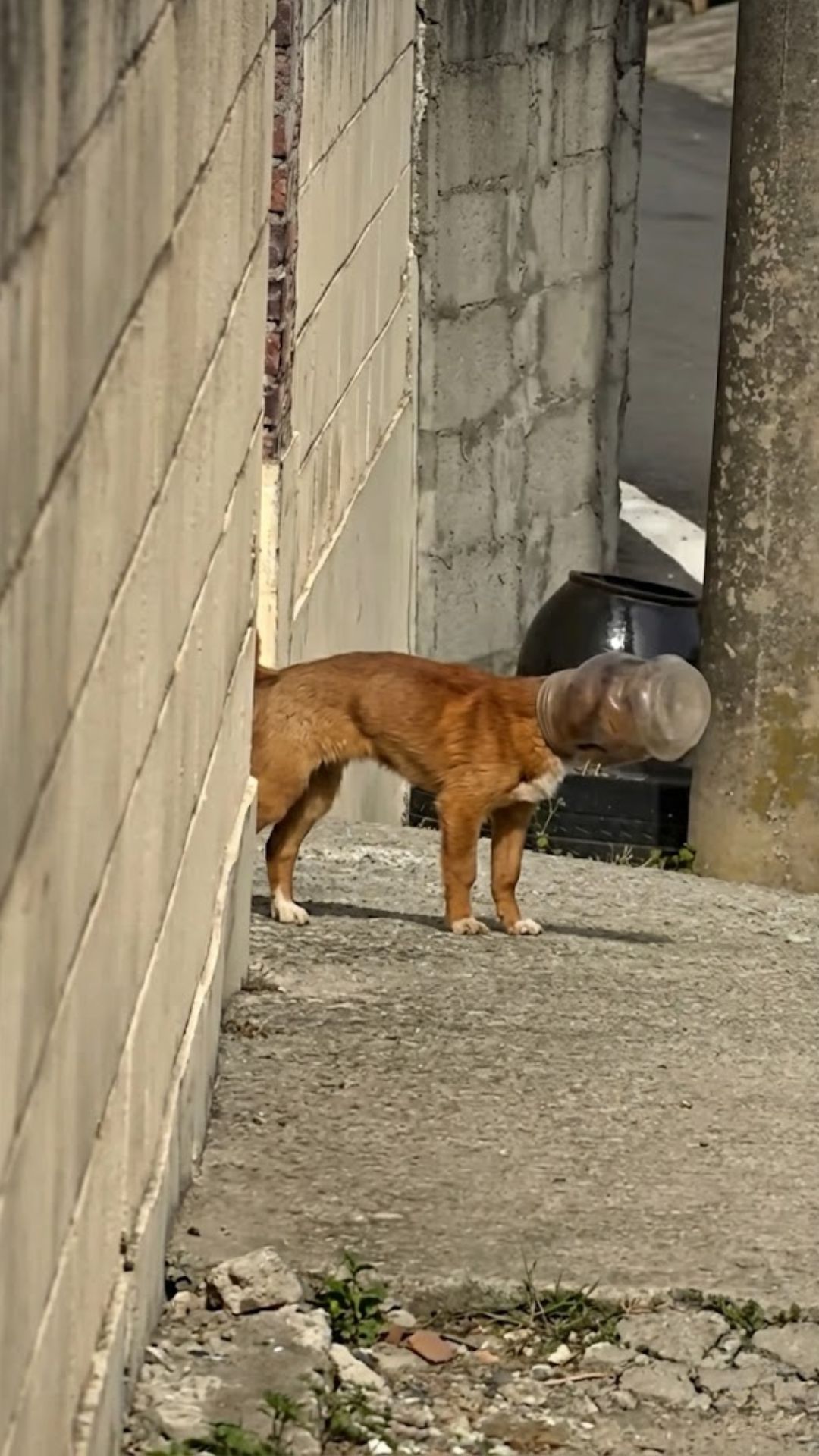
For nearly three weeks, Sandy could see the world clearly.
He could see food on the ground.
He could see puddles after the rain.
He could see other dogs moving freely beside him.
But a hard plastic container around his head turned all of those ordinary things into something unreachable.
Whenever Sandy lowered his face toward food, the plastic struck the ground first.
Whenever he tried to drink, the rim stopped him.
And every day, the stray dog became a little thinner.
A little weaker.
A little slower.
By the time rescuers finally caught him, Sandy had reportedly been trapped that way for 21 days.
His body had survived far longer than anyone expected.
But the damage those weeks had caused was only beginning to reveal itself.
Hunger May Have Been What Trapped Him
No one could know exactly how the container ended up over Sandy’s head.
The most likely explanation was painfully simple.
Hunger.
A discarded plastic jar may have contained food or smelled strongly enough to attract a stray dog searching for something to eat.
Sandy likely pushed his head inside.
Getting in was easy.
Getting back out was not.
The opening caught around his neck.
The container stayed in place.
And suddenly, an object that had once held food became a barrier between Sandy and everything he needed to survive.
He could still walk.
So he wandered.
He searched the same streets he had known before.
But his ability to feed himself had changed completely.
Scraps remained visible through the transparent plastic.
Sandy could approach them.
He could smell them.
He could lower his head.
Then the container hit the pavement.
The food remained just beyond reach.
Day after day, his body began consuming its own reserves.
Weight disappeared.
Muscle followed.
Yet Sandy kept moving.
Video: Sandy Spent 21 Days With His Head Trapped in Plastic—And Couldn’t Reach Food or Water
Even Water Became Almost Impossible to Reach
Food was not Sandy’s only problem.
The container also prevented him from drinking normally.
People who saw him in the neighborhood noticed moisture collecting inside the plastic.
Sandy’s breath created condensation against the inner surface.
According to the account of his rescue, he licked that moisture when he could.
It was far from enough.
But during a period when lowering his head into a normal water source was nearly impossible, even those small droplets may have mattered.
The image was difficult for rescuers to forget.
A dog walking through streets where water might be nearby…
while depending on moisture trapped inside the same object causing his suffering.
The clear plastic allowed Sandy to see the world.
It did not allow him to participate in it normally.
And as the days passed, his physical condition continued deteriorating.
Rescuers knew the container needed to come off.
The challenge was getting close enough.
Boksil Stayed Beside Him
Sandy was not always alone.
Another stray dog named Boksil remained near him.
The two moved through the area together.
They rested near one another.
Their companionship offered Sandy something familiar during an otherwise frightening period.
But there was a painful difference between them.
When Boksil found something to eat, she could lower her head.
Sandy could only try.
When she found water, she could drink.
Sandy’s container remained in the way.
Even ordinary dog behavior became difficult.
The plastic interfered when he tried to move close to another dog.
It knocked against surfaces when he lowered his head.
It separated his face from the world around him.
Still, Boksil continued staying nearby.
For rescuers watching Sandy become thinner, her presence made the situation even more striking.
He had companionship.
What he did not have was time.
The longer the jar stayed in place, the less strength Sandy had left to escape, eat, drink, or protect himself.
Something had to change.
The Humane Trap Finally Closed Behind Him
Rescuers had been following Sandy’s movements and trying to find a safe way to catch him.
Approaching directly was difficult.
A frightened stray can run even when badly weakened.
And chasing Sandy could have caused him to use energy his body could no longer afford to waste.
So the team prepared a humane trap.
Food was placed inside.
Then they waited.
Dark clouds gathered.
Rain began falling across the streets.
Sandy approached cautiously.
Perhaps hunger made the food impossible to ignore.
Perhaps exhaustion reduced his willingness to keep running.
No one could know exactly what made the difference.
But Sandy stepped inside.
Then the door closed.
After 21 days of being impossible to reach safely, he was finally contained.
The trap did not mean he was completely safe yet.
But it gave rescuers the opportunity they had been waiting for.
They could finally remove the plastic.
The Face Behind the Plastic Appeared Again
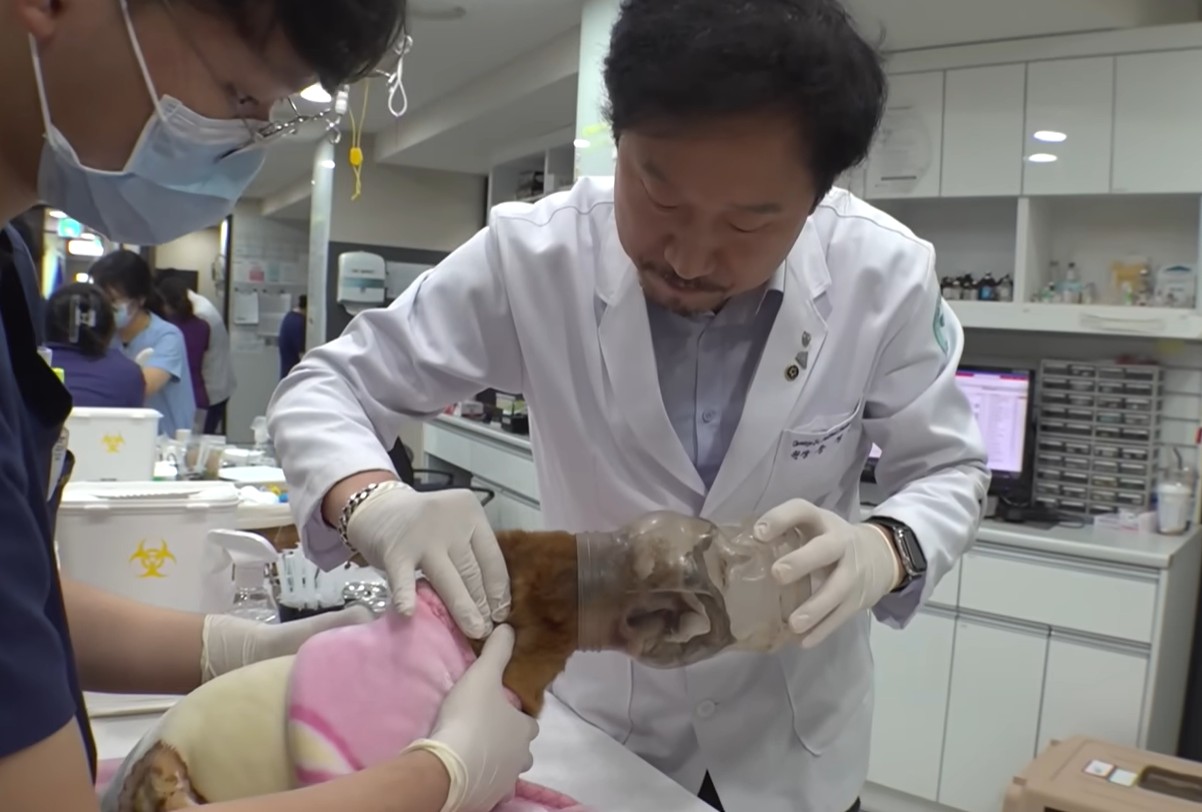
At the veterinary clinic, the team began removing the container carefully.
They cut through the plastic slowly.
There was no reason to rush and risk injuring Sandy after everything he had already endured.
Piece by piece, the container loosened.
Then it came away.
For the first time in nearly three weeks, Sandy’s face was completely uncovered.
He could lower his head without a plastic wall striking the floor.
He could reach food.
He could drink.
He could move normally around objects without the container colliding with everything around him.
Interestingly, the outside of his head did not show the kind of severe wounds rescuers might have expected after such prolonged entrapment.
But internally, the story was different.
Sandy was severely dehydrated.
Veterinary examination showed that his kidneys were under significant strain.
There was almost no remaining fat around his abdomen.
His body had used nearly every reserve it had to keep functioning.
The plastic had been removed in minutes.
Recovering from what those 21 days had done would take much longer.
Eating Again Was Not as Simple as Filling a Bowl
Once the container was gone, everyone wanted the same thing.
Let Sandy eat.
But his physical condition meant that care still needed to be thoughtful.
A dog weakened by prolonged lack of food and water cannot always return immediately to ordinary feeding routines.
His body needed time to adjust.
There was also another problem.
Sandy was frightened.
The veterinary clinic was unfamiliar.
The people were unfamiliar.
The freedom of having nothing around his head was unfamiliar.
After the immediate treatment, Sandy often remained curled toward the corner of his kennel.
The jar was gone.
But the behavior he had developed while surviving with it did not disappear instantly.
His caregivers did not pull him out or insist that he interact.
They gave him space.
Then one person tried something very simple.
Treats were placed in a line leading away from his safe corner.
Not all at once in a bowl.
One piece.
Then another a short distance farther away.
Then another.
Sandy watched them.
For the First Time in Weeks, He Lowered His Head and Nothing Stopped Him
At first, Sandy hesitated.
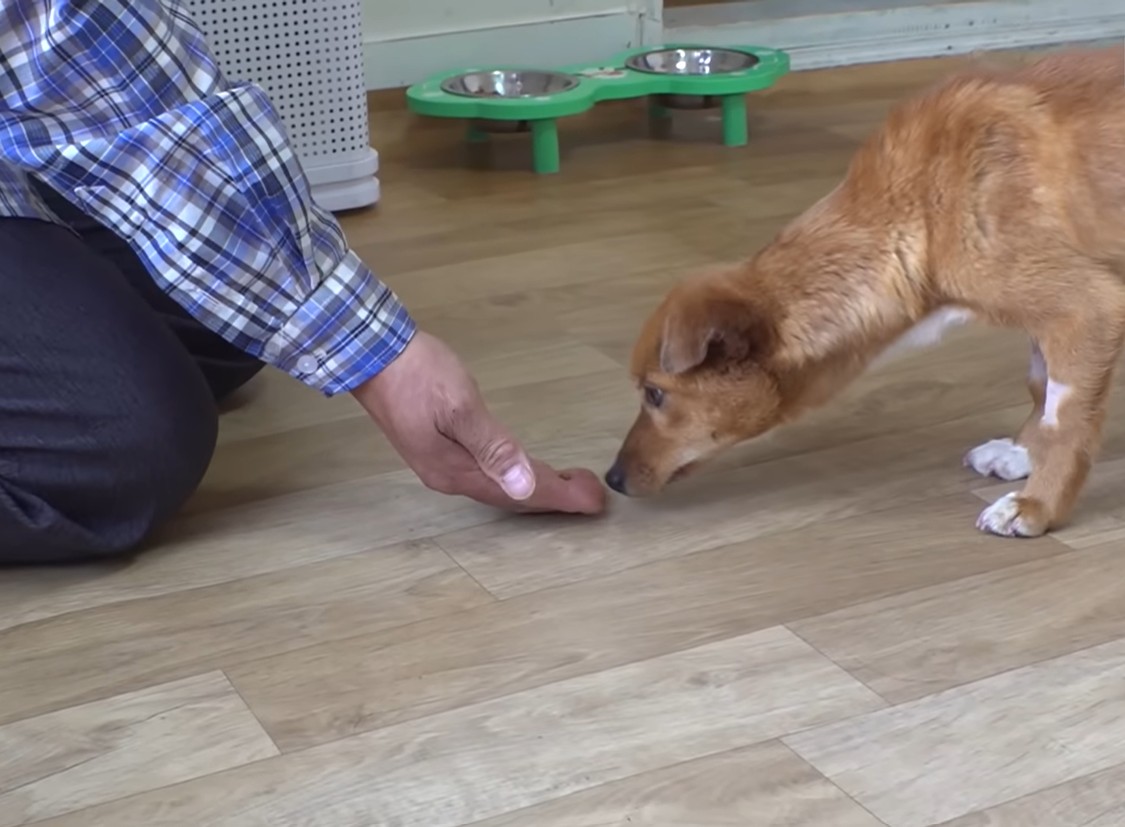
He stretched his neck toward the nearest treat.
Paused.
Then moved closer.
His head lowered.
Nothing struck the floor.
There was no plastic wall.
No hard rim around his neck.
He could simply reach the food.
Sandy ate the first treat.
Then noticed the next one.
One step forward.
Another lowered head.
Another piece of food.
His guardian remained nearby without forcing him to continue.
The treats formed a quiet path out of the kennel.
Sandy followed.
Slowly.
Cautiously.
The trembling that had marked so much of his early behavior began to ease as he realized that each movement brought another safe experience.
Eventually, he reached the person waiting at the end of the trail.
Then he sat nearby.
It was a small scene.
No running.
No dramatic celebration.
Just a dog who had spent weeks unable to lower his head toward food finally discovering that the barrier was gone.
For Sandy’s caregivers, that was more than enough.
The Jar Was Removed Quickly—Trust Took Longer
Sandy’s physical freedom came in one clear moment.
The plastic was cut away.
His emotional adjustment was slower.
For three weeks, basic movements had ended in frustration.
Lower the head.
Hit plastic.
Move closer to food.
Fail to reach it.
Try to drink.
Fail again.
Repetition shapes behavior.
Now Sandy needed different repetitions.
Lower the head.
Food is there.
Move forward.
Nothing hurts.
Approach a person.
No one forces you.
Try again tomorrow.
These new experiences gradually replaced the patterns that had developed while he was trapped.
The people caring for Sandy understood that the goal was not simply to prove he had survived.
It was to help him feel comfortable enough to live normally again.
That required patience.
Safe food.
Fresh water.
Medical follow-up.
Gentle contact.
And time to discover that he no longer needed to organize every movement around the hard plastic surrounding his head.
His Story Changed the Moment the Barrier Came Off
For 21 days, Sandy lived inside a transparent boundary.
He could see food but could not reach it normally.
He could see water but struggled to drink.
He could see Boksil beside him but could not move and interact the way he once had.
The world had remained visible.
Access to it had disappeared.
Then rescuers managed to catch him.
The jar came off.
But perhaps the most meaningful moment came afterward, when Sandy lowered his head toward a treat and found nothing in the way.
That ordinary movement represented everything that had changed.
He could eat.
He could drink.
He could move without the container striking the ground.
He could approach people at his own pace.
Sandy’s recovery still required care.
The dehydration and strain on his kidneys were serious.
His body had lost nearly all of its reserves.
There was no reason to pretend three weeks of starvation disappeared the moment the plastic was removed.
But one enormous obstacle was finally gone.
Sandy had a path forward.
A trail of treats eventually led him out of his kennel.
A caregiver waited at the other end.
And for perhaps the first time in weeks, Sandy discovered that lowering his head no longer ended in frustration.
The world was still there.
Only now, he could finally reach it.


