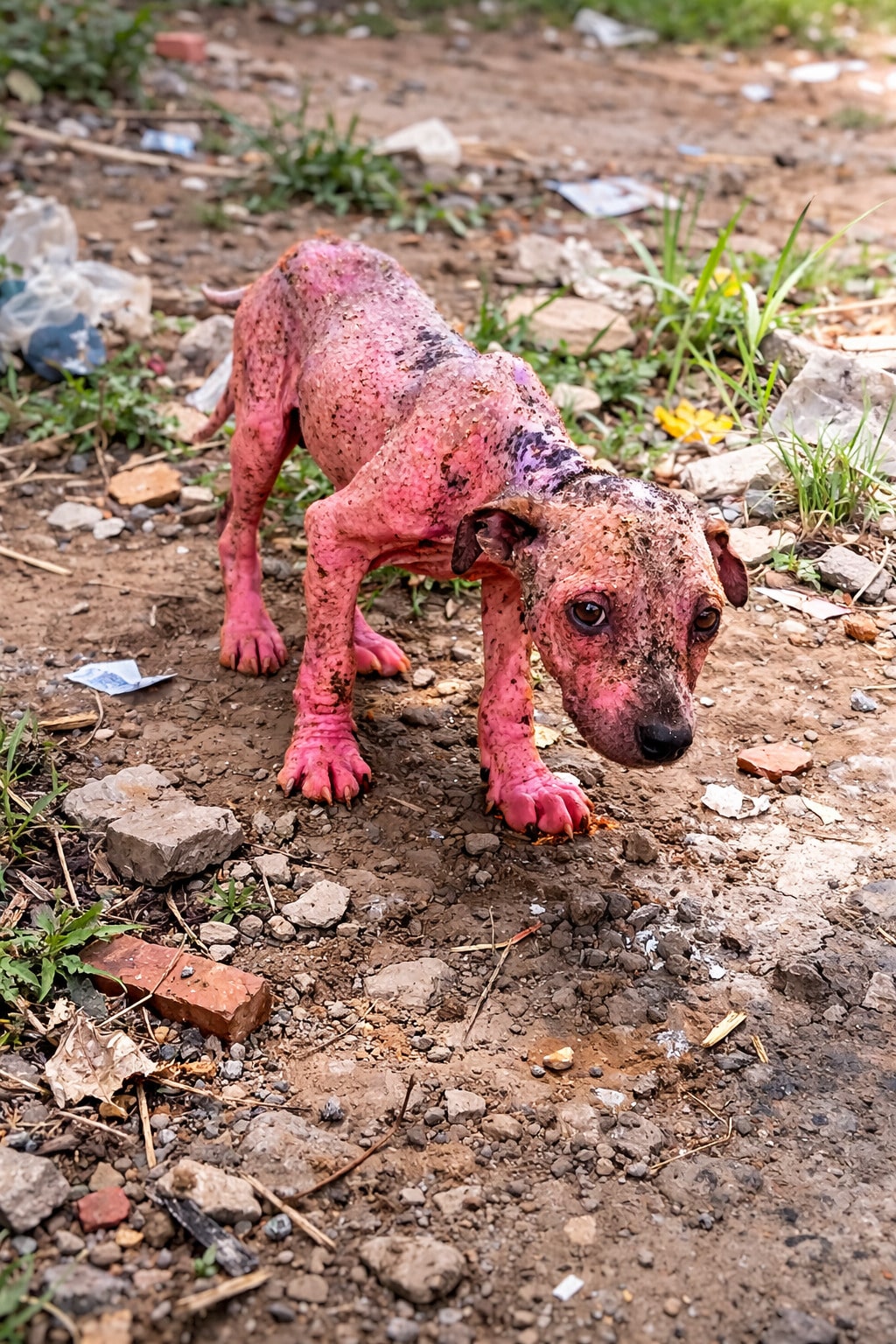
From a distance, Paulo was almost impossible to separate from the debris around him.
Plastic bags shifted in the wind. Broken furniture lay scattered across the ground. In the middle of it all, a tiny hairless puppy moved carefully from one pile of garbage to another, searching for anything he could eat.
His body offered little protection from the world around him.
There was no fur covering his skin.
His small frame was painfully thin, his exposed skin red and inflamed, and ticks clung to his ears and body. Each day meant walking across dirt and sharp debris simply to find enough scraps to survive.
Yet when rescuers finally came close, Paulo did something they did not expect.
He did not run.
He looked toward them.
And his tiny tail began to move.
The Puppy Living Between Mountains of Garbage
The landfill had become Paulo’s entire world.
He wandered among piles of discarded food, plastic, damaged household items, and whatever else people had thrown away. There was no soft place to sleep and no regular meal waiting for him.
When hunger became strong enough, he searched through the trash.
That was how he stayed alive.
Up close, rescuers could see how badly his body had been affected.
His skin was completely exposed. Large areas appeared red and irritated, while other sections had become dry, thickened, or flaky. Between his toes were painful-looking lesions caused by his advanced skin condition.
Ticks had attached themselves around his ears and across his body.
And beneath all of it was an extremely small puppy who had been trying to survive without dependable care.
But there was another part of Paulo’s story that made his discovery even more difficult to understand.
According to a man who lived near the landfill, Paulo had not always been a stray.
He remembered seeing the puppy arrive.
Not on foot.
In a car.
Video: From Hairless and Starving in a Landfill to His First Healing Bath — Paulo’s Turning Point
He Had Tried to Follow the Car That Left Him Behind
The local man told rescuers what he had witnessed.
Someone had driven Paulo to the landfill and let him out.
Then the person got back into the vehicle.
Paulo apparently did not understand what was happening.
The little dog tried to get back inside.
But the door closed.
The car pulled away.
And Paulo was left behind among the garbage.
There was no way for rescuers to know exactly how long he had been surviving there. What they could see was the condition his body had reached by the time help arrived.
He had learned to search for food wherever he could find it.
He had learned to sleep surrounded by waste.
And he had somehow continued approaching people rather than completely avoiding them.
That became clear when rescuers moved toward him.
Paulo did not disappear deeper into the landfill.
He watched them carefully.
Then his tail moved gently from side to side.
There was caution in his body, but there was also willingness to remain close.
For the people who had come to save him, that small wag was enough.
They carefully lifted Paulo away from the place where he had been surviving and carried him toward their vehicle.
For the first time in a long while, he would not have to search the garbage for his next meal.
This Car Ride Was Taking Him Somewhere Safe
Considering what rescuers had been told about Paulo’s abandonment, no one knew how he would react when they placed him inside another car.
He could have panicked.
He could have struggled.
Instead, Paulo remained remarkably calm.
He rested his tiny paws against the seat and looked around the unfamiliar interior.
His mouth opened slightly as he settled into place.
There was no frantic attempt to escape.
No desperate scratching at the door.
The dog who had reportedly watched one vehicle disappear from his life was now quietly riding in another.
Only this time, the destination was different.
The rescuers were taking him to a veterinary clinic.
Paulo seemed exhausted, but he allowed the people around him to handle him without aggression. For such a small animal who had been surviving under difficult conditions, his gentle behavior immediately stood out.
Still, no one yet understood how fragile his condition truly was.
That became clear at the clinic.
The scale was one of the first indications.
Paulo weighed only 1.5 kilograms.
Underneath the Red Skin Was a Body Running Out of Strength
The veterinary examination revealed several problems that required immediate attention.
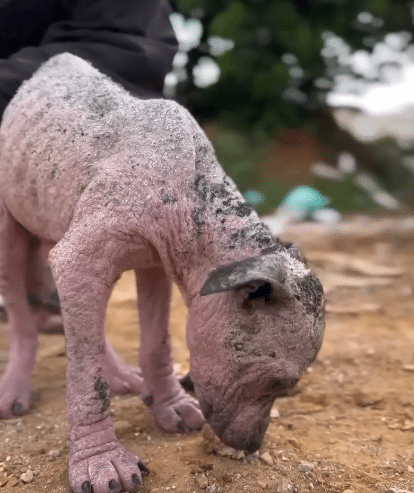
Paulo was severely malnourished.
He was anemic.
His body was weak.
And the condition of his skin had advanced far beyond ordinary irritation.
Without a protective coat, large portions of Paulo’s skin were exposed to sunlight, dirt, insects, and the rough environment of the landfill. The surface was inflamed and cracked in places.
Lesions had developed between his toes.
Ticks covered parts of his ears and body and appeared to have been feeding on him for some time.
His tiny frame showed how little nutrition he had been receiving.
Living at the dump had required Paulo to focus on only one thing: making it through another day.
At the clinic, that changed.
He no longer had to survive alone.
Now the goal was to help his body recover.
The veterinary team created a treatment plan that included supportive care, specialized treatment for his skin, proper nutrition, and regular medicated baths.
There would be no instant transformation.
Paulo’s body needed time.
But the following day, one of the first steps began.
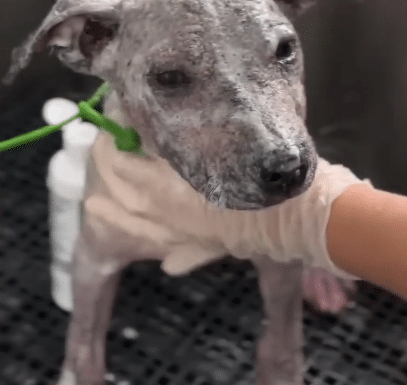
He was given a medicated bath.
And once again, his reaction surprised everyone.
His First Bath Revealed Just How Gentle He Was
For a dog with irritated, damaged skin, being touched and washed could easily have been uncomfortable.
The veterinary staff handled Paulo carefully.
He stood quietly while they worked.
He did not snap at them.
He did not attempt to fight his way free.
He simply allowed the people around him to help.
The bath was not being given for appearance.
It was part of his treatment.
Medication and careful cleaning helped address the painful skin condition that had affected nearly his entire body.
Every two days, Paulo received another therapeutic bath.
His skin was treated.
His nutrition was monitored.
Supportive care helped his weakened body begin rebuilding the strength it had lost.
And between treatments, the staff began discovering the personality hidden beneath Paulo’s difficult appearance.
He was affectionate.
Patient.
And surprisingly trusting.
The little puppy who had arrived without a single patch of fur quickly became someone the clinic staff looked forward to seeing.
Then one person became especially attached to him.
The clinic’s security guard had been watching Paulo throughout his recovery.
Eventually, watching was no longer enough.
He decided Paulo should have something the puppy had been missing for far too long.
A home.
The Man Who Watched Over the Clinic Chose Paulo
For Paulo, recovery now came with an unexpected promise.
When he was healthy enough, he would not be returning to the landfill.
He would not be released somewhere unfamiliar.
And he would not have to wait indefinitely for someone to notice him.
The clinic’s security guard wanted to adopt him.
It was a simple decision that completely changed the direction of Paulo’s future.
While veterinary staff continued treating his body, the puppy was also becoming familiar with the person who intended to care for him after treatment ended.
There were regular meals now.
People spoke gently to him.
Hands that approached his body were there to clean wounds, provide medication, or offer affection.
Paulo began reacting to this new environment.
At one point, he barked with excitement.
The sound was small.
His body was still recovering, and he remained far from the healthy dog everyone hoped he would become.
But the changes were beginning.
Soon, they could be seen directly on his skin.
Fourteen Days Later, Tiny Patches of Fur Began to Appear
Paulo’s transformation did not require months before the first visible improvements appeared.
After approximately two weeks of treatment, his body already looked different.
The angry redness that once covered much of his skin had begun to fade.
Healthy pink areas appeared.
Inflammation decreased.
The cracked surface of his skin started closing.
Then came one of the most encouraging signs.
Fur.
At first, it appeared only in tiny patches across areas that had begun healing.
For a puppy who had arrived completely hairless, even those small patches represented significant progress.
Paulo was also gaining weight.
His legs appeared steadier.
His steps became stronger.
He began moving with more confidence instead of navigating the world with the fragile movements of a severely malnourished puppy.
There was still work ahead.
Advanced skin problems do not disappear after a few baths, and a body weakened by poor nutrition requires continued care.
But Paulo was no longer trying to recover while searching through garbage.
He had medical attention.
He had regular food.
And most importantly, he had somewhere to go when treatment was finished.
The Landfill Was No Longer Waiting for Him
There is something especially powerful about Paulo’s story because his transformation began with such a small moment.
A tiny puppy stood among mountains of trash.
Rescuers approached.
And instead of disappearing, his tail moved.
No one could know what Paulo understood about that encounter.
No one could know whether he remembered the car that had reportedly left him there or whether he recognized that this new group of people intended to help.
What could be seen was much simpler.
He allowed them close.
He entered their vehicle.
He accepted treatment.
He stood patiently through repeated medicated baths.
He ate.
He gained weight.
His damaged skin slowly began healing.
And fourteen days later, fur was beginning to return.
The puppy who once searched through garbage for enough food to survive was now being watched over by people who knew his name.
Paulo’s Recovery Is Still Being Written
Paulo did not become completely healthy overnight.
His skin still needed continued treatment.
His body still needed proper nutrition and time to rebuild.
The effects of severe neglect cannot simply be washed away with one bath or erased by one good meal.
But the most important part of Paulo’s life had already changed.
He no longer slept in a landfill.
He no longer depended on discarded scraps.
He no longer had to move between piles of garbage looking for whatever might keep him alive another day.
There was now someone expecting him.
Someone who had chosen to make him part of a home.
Perhaps that is what makes Paulo’s journey stay with people.
His rescue was not defined by one dramatic miracle.
It was built from small acts.
Someone noticed him.
Someone approached carefully.
Someone placed him in a car and took him somewhere safe.
Veterinary workers treated his damaged skin again and again.
And one man looked at a tiny, hairless puppy recovering inside the clinic and decided that Paulo should never have to wonder where he belonged again.
Once, a car reportedly brought Paulo to a landfill and drove away without him.
The next car carried him in the opposite direction.
Away from the garbage.
Away from hunger.
And toward the first real chance he had been given to heal.


