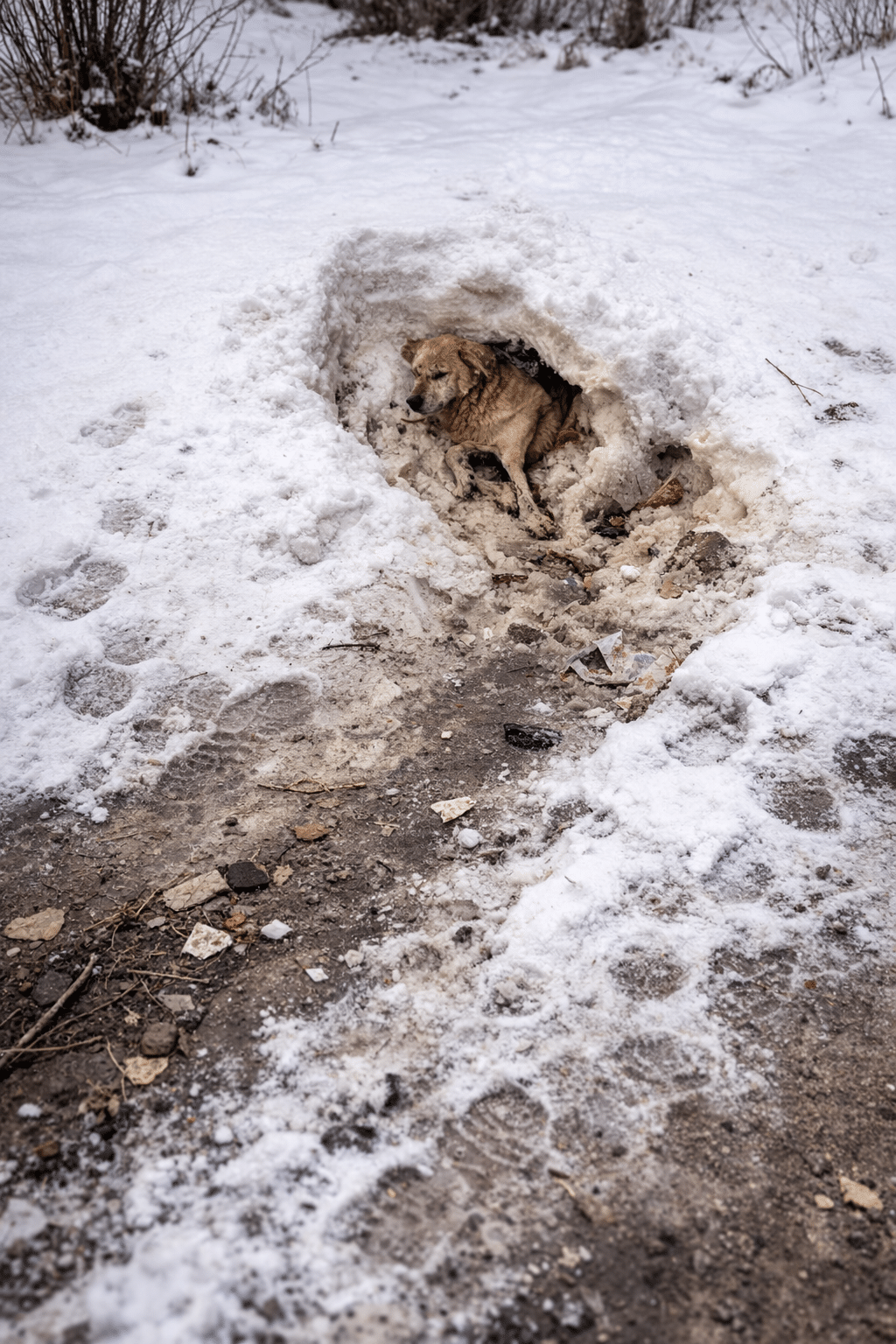
For several days, Mishka lay inside a deep pit of frozen snow with no way to climb out.
He could not stand.
He could not run.
His body had become stiff from the cold, and when rescuers finally reached him, they initially feared exposure alone might explain why he could barely move.
Then the X-rays came back.
His pelvis was shattered.
Multiple lead bullets were visible inside his body.
And one of them was positioned dangerously close to his spine.
Suddenly, Mishka’s inability to stand had a much more complicated explanation.
The veterinary team could not promise that he would walk normally again.
They could not even solve everything with one operation.
Instead, his second chance would have to be built slowly.
Through pain control.
Rehabilitation.
Water therapy.
Mobility support.
And hundreds of days in which progress was measured one movement at a time.
Day 1 — He Was Lifted From the Snow, But He Still Couldn’t Stand
By the time rescuers reached Mishka, he had reportedly been trapped in the frozen pit for three or possibly four days.
The snow around him had become part of his confinement.
His body was unable to lift itself free.
When rescuers pulled him out, they immediately saw that something was seriously wrong.
Mishka was not simply exhausted.
His hindquarters could not support him.
His body had become rigid from cold and immobility, and even after reaching safety, he was unable to rise onto all four feet.
At first, severe exposure seemed like the most obvious concern.
But the veterinary examination revealed injuries that went far beyond the cold.
X-rays showed significant pelvic fractures.
Several lead bullets were scattered through Mishka’s body.
One was sitting close to his spine.
That location made his case especially delicate.
The team now faced two problems at once.
Mishka needed relief from the pain and stabilization from the trauma he had endured.
But he also needed a long-term plan for a body that could no longer move normally.
Pelvic surgery was considered.
After evaluating the risks, however, the veterinary team decided that attempting an operation could potentially create additional complications.
So they chose a different approach.
Mishka would receive intensive pain management and carefully supervised physical rehabilitation.
The goal was not to force him onto his feet immediately.
It was to protect what function remained, prevent further muscle loss, and give his body time to heal.
Video: From a Frozen Pit to His First Steps on Grass — Mishka’s Turning Point
Day 10 — His First “Steps” Happened With Wheels Beneath Him
For the first several days, Mishka remained under close observation.
His treatment required consistency around the clock.
Pain medication helped keep him comfortable enough for rehabilitation.
Caregivers monitored his condition carefully.
And even though his legs could not yet carry him normally, the team did not want prolonged immobility to weaken his muscles even further.
By approximately Day 10, they introduced assisted mobility training.
Mishka was supported with a harness.
A wheelchair helped carry the part of his body that could not yet support itself.
For many dogs, walking may be instinctive and effortless.
For Mishka, movement had become a rehabilitation exercise.
Every session required support.
Every attempt had to be controlled.
He was learning how to move through the world differently while his body tried to recover.
The wheelchair was not a sign that everyone had given up on his legs.
It was a tool that allowed him to move while preserving strength and giving damaged structures more time to heal.
No one could say how much mobility he would regain.
The bullet near his spine remained.
The pelvic injuries were severe.
Progress could not be predicted simply by counting days.
But Mishka kept participating.
Even when movement was awkward.
Even when his body needed assistance.
Even when the path ahead was uncertain.
Days 16–38 — The First Important Changes Were Small
Recovery did not suddenly accelerate after Mishka began using mobility equipment.
Some days brought visible improvement.
Others looked much the same as the day before.
That became part of the process.
The people caring for Mishka learned to notice smaller signs.
He became more responsive.
He interacted more with the people around him.
His behavior appeared increasingly relaxed as the clinic environment became familiar.
Then came one particularly important development.
Mishka was able to relieve himself independently.
For his veterinary team, this was much more than an ordinary daily function.
It suggested that neurological function was still present and that his body was beginning to regain control in an area that had caused serious concern.
It did not mean his recovery was complete.
But it gave the team another reason to continue.
As Mishka stabilized, he was transferred to Yuna Veterinary Center, where specialists could provide more advanced rehabilitation.
There, his routine became even more structured.
Mobility exercises were adapted to his condition.
Sometimes he worked indoors with supportive devices.
Sometimes he went outside, including into the snow.
The environment changed.
The goal did not.
Keep him moving safely.
Preserve and rebuild muscle.
Help his body relearn functions that injury had taken away.
The process demanded repetition.
Mishka could not skip directly from paralysis to running.
He had to rebuild movement through dozens of smaller stages.
Rehabilitation Became His New Daily Routine
At the veterinary center, Mishka’s life began following a rhythm very different from the days before he was rescued.
Treatment.
Rest.
Supported exercise.
More rest.
Another session.
Every part of the routine had a purpose.
His pelvis needed time.
His muscles needed stimulation.
And the neurological pathways responsible for movement needed every opportunity to function.
Mishka continued using mobility aids when necessary.
The wheelchair allowed him to move without forcing his entire weight through injured structures.
The harness helped caregivers support him when he attempted movements that his body could not yet complete independently.
Progress was not measured by dramatic leaps.
It appeared in details.
A leg positioned more naturally.
A little more weight transferred through his feet.
A steadier posture.
A slightly longer exercise session.
Those changes could seem almost insignificant when viewed one by one.
But rehabilitation works through accumulation.
One controlled movement becomes ten.
Ten become hundreds.
Over weeks and months, repeated effort begins changing what a weakened body is capable of doing.
For Mishka, one form of therapy would soon become especially important.
Water.
Days 40–110 — Water Gave Him a Safer Way to Relearn Walking
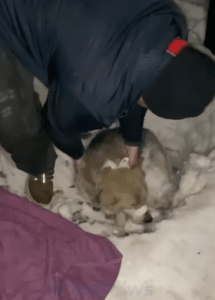
Hydrotherapy became a central part of Mishka’s rehabilitation program.
Specialists began working with him on an underwater treadmill, sometimes called an aqua track.
For an animal recovering from serious pelvic injuries, water offered an important advantage.
Buoyancy helped support part of Mishka’s body weight.
That reduced the load placed on his injured pelvis while still allowing him to move his legs.
Inside the water, he could practice the motion of walking without carrying the same full weight he would have on dry ground.
The sessions were closely supervised.
Mishka did not simply enter the water and suddenly begin walking normally.
He had to work.
Step after step.
Session after session.
His caregivers watched his posture and movement, helping him maintain a controlled rhythm.
Gradually, the exercises began producing visible results.
By Day 72, his movements had become steadier.
That was significant.
The dog who could not rise when he was pulled from the snow was now showing increasing control of his own legs.
There was still a long distance between steadier movement and independent walking.
But his body was responding.
The rehabilitation continued.
Then came Day 110.
A milestone no one could guarantee on the first day.
Mishka went outside onto grass.
And this time, there was no wheelchair beneath him.
Day 110 — Mishka Walked Across Grass on His Own Legs
His first independent walk did not look like the effortless movement of a dog who had never been injured.
It was slow.
Careful.
Measured.
But Mishka was doing it himself.
His paws touched the grass.
His legs supported him.
And one step followed another.
For the people who had watched him through the previous months, the moment carried the weight of everything that had come before it.
The frozen pit.
The shattered pelvis.
The bullets.
The wheelchair.
The harness.
The rehabilitation sessions.
The underwater treadmill.
The days when no one knew whether his legs would ever support him again.
Now Mishka was walking.
There was no need to exaggerate the moment.
The reality was enough.
A dog who had once been unable to stand was crossing grass on his own four legs.
His gait was not perfect.
His recovery was not finished.
And the bullet close to his spine had not simply disappeared.
But his body had regained something rescuers had been afraid he might have lost permanently.
Independent movement.
That single achievement changed the next stage of his recovery.
The question was no longer only whether Mishka could stand or walk.
Now the team could begin helping him become stronger.
Days 130–360 — Strength Returned Through Ordinary Life
After the breakthrough on grass, Mishka still needed months of continued recovery.
Walking once did not mean his muscles were fully restored.
The long period of immobility had weakened his body considerably.
He needed repetition, conditioning, and time.
As the months passed, Mishka entered foster care.
That transition gave him something rehabilitation equipment alone could not provide.
Routine.
He had familiar surroundings.
Regular meals.
A place to rest.
People who could observe him every day.
And opportunities to move in ways that were not always part of a formal therapy session.
Slowly, his body continued changing.
His muscles became fuller.
His coat grew thicker.
His movements became more confident.
He began showing more energy and curiosity.
The dog whose early days had revolved almost entirely around treatment was beginning to experience more ordinary parts of life.
Walking outside.
Spending time with other dogs.
Exploring.
Resting.
Moving because he wanted to move, not only because it was part of rehabilitation.
For a dog recovering from severe injuries, those ordinary activities became another form of progress.
Month after month, Mishka continued improving.
Then winter returned.
Almost one full year had passed since he had been found unable to move in the snow.
But this time, the snow meant something completely different.
Day 360 — The Dog Once Frozen in Snow Ran Across It
By Day 360, Mishka was no longer the motionless dog rescuers had lifted from the frozen pit.
He was outside again.
Snow stretched across the open landscape.
Other dogs moved nearby.
And Mishka ran.
Not in a wheelchair.
Not suspended in a rehabilitation harness.
On his own legs.
His body carried him across the same kind of winter landscape that had once trapped him.
The contrast was remarkable.
Nearly a year earlier, rescuers had found him unable to stand.
His pelvis was fractured.
Bullets remained inside his body.
One lay close to his spine.
No veterinarian had been able to promise that he would return to normal movement.
Now Mishka was running beside other dogs.
The bullet near his spine was still present.
His past had not vanished.
But it no longer determined everything his body could do.
The rehabilitation team had not created this result through one dramatic procedure.
There had been no single morning when Mishka woke completely healed.
The transformation had required hundreds of days.
Pain management.
Supported mobility.
A wheelchair.
Harness work.
Neurological monitoring.
Hydrotherapy.
Muscle conditioning.
Foster care.
And more repetition than anyone could count.
Day 360 simply made all those earlier days visible.
Mishka’s Recovery Was Built From Hundreds of Small Attempts
It can be tempting to look only at the beginning and end of Mishka’s story.
A dog trapped in snow.
Then a dog running one year later.
Placed side by side, those images almost look like a miracle.
But the 358 days between them matter just as much.
Mishka’s recovery was not one miracle.
It was a process.
On Day 1, he could not stand.
By Day 10, he was learning to move with a wheelchair and supportive harness.
During Days 16 through 38, small neurological and behavioral improvements began appearing.
He was transferred for more advanced rehabilitation.
Hydrotherapy became a major part of his treatment.
By Day 72, his movements were becoming steadier.
On Day 110, his feet carried him independently across grass.
Then came months of conditioning, routine, foster care, and increasing strength.
Finally, on Day 360, he ran.
Every stage depended on the stage before it.
The wheelchair did not represent failure.
It allowed movement when independent walking was not yet possible.
The underwater treadmill did not produce an instant transformation.
It created an environment where Mishka could practice safely.
The first walk on grass did not mean rehabilitation was over.
It proved that continued rehabilitation was worth pursuing.
Even the quieter days mattered.
The days when Mishka simply ate, rested, exercised, and repeated the same movements again.
That consistency gradually rebuilt what injury had taken away.
One Year Earlier, He Couldn’t Rise From the Snow
Mishka’s story began in a place where his body had almost completely stopped cooperating with him.
He had reportedly spent days trapped in freezing conditions.
He could not climb out.
He could not stand.
And once veterinary imaging revealed the fractures and bullets inside him, the path ahead became even more uncertain.
There was no guarantee that the dog carried from that snow pit would ever run again.
So his caregivers focused on what they could do next.
Control his pain.
Protect his body.
Prevent unnecessary muscle loss.
Help him move with assistance.
Watch for signs of returning function.
Introduce more advanced rehabilitation when he was ready.
Use water to reduce stress while strengthening his legs.
Celebrate the first independent steps without assuming the work was finished.
Then keep going.
By the time Mishka reached Day 360, those decisions had accumulated into a life that looked completely different.
The snow was no longer something surrounding a body that could not escape.
It had become open ground beneath running paws.
Mishka’s journey is a reminder that recovery does not always arrive as one dramatic turning point.
Sometimes it looks like a dog taking another supported step when yesterday’s step was difficult.
Sometimes it looks like wheels carrying him until his own legs become strong enough.
Sometimes it looks like months in rehabilitation before a few careful steps across grass.
And sometimes, nearly one year after everyone first wondered whether he would stand again, it looks like a dog running freely through the snow.
Mishka did not return to his feet in a day.
It took 360 days of treatment, repetition, patience, and care.
But the dog once unable to rise from a frozen pit eventually did something no one could promise at the beginning.
He ran.


