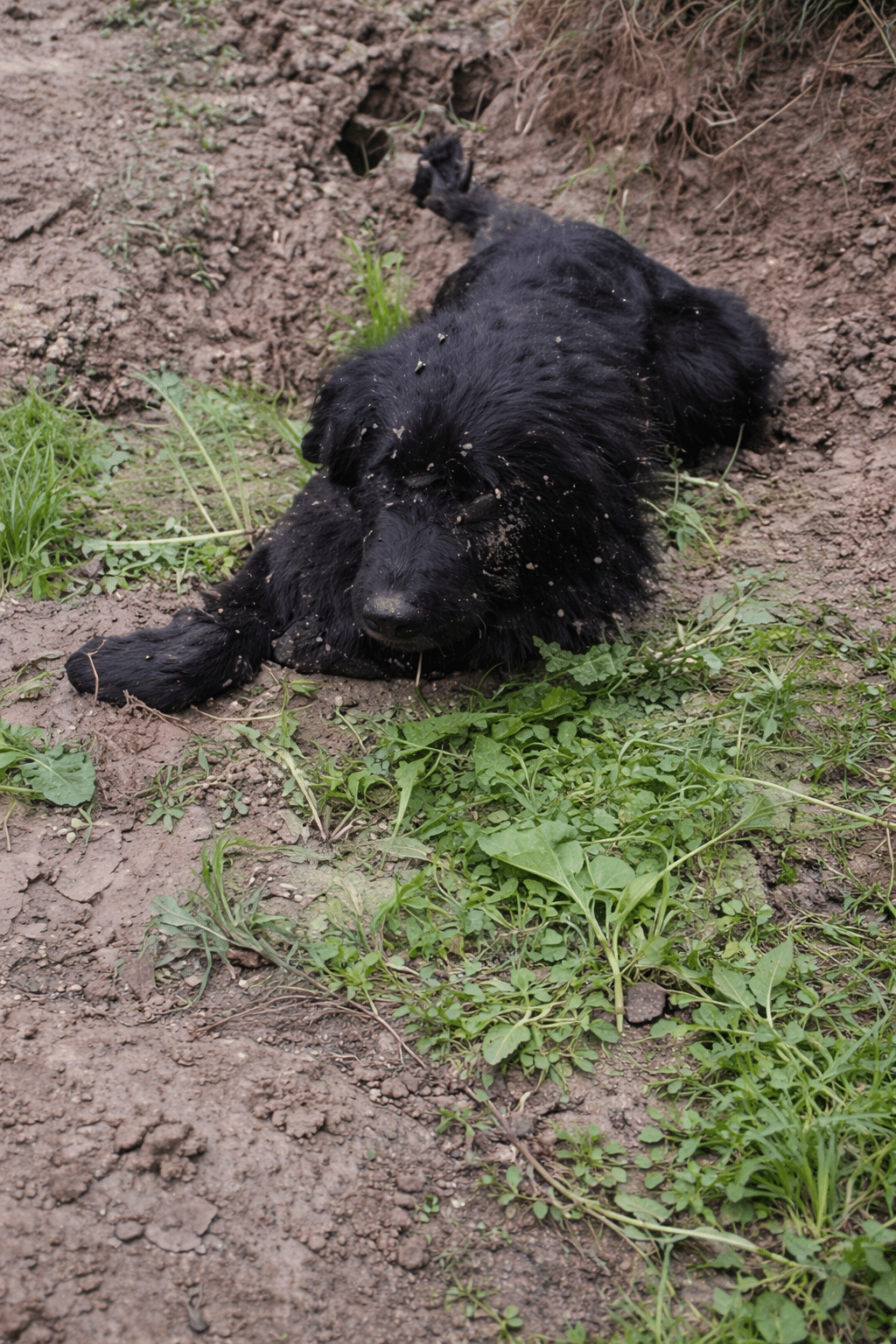
Natasha nearly walked past him.
Hidden beneath thick bushes, Dark was little more than a small black shape against the dirt. He did not bark when she approached.
He did not try to escape.
He barely moved at all.
His body was painfully thin, his temperature had dropped dangerously low, and several untreated wounds covered his fragile frame. Flies gathered around him, and some of the injuries had already become badly contaminated.
At first, simply keeping him alive seemed difficult enough.
Then the veterinary team in Stavropol took X-rays.
The images revealed something no one was prepared to see.
Dark had fractures affecting all four legs.
He could not stand.
He could not walk away from danger.
He had been lying alone in the bushes with a body that could no longer carry him.
Yet somehow, he was still breathing.
What followed would take two major surgeries, blood transfusions, another operation months later, and nearly 180 days of rehabilitation.
But Dark’s recovery began with something much smaller.
Someone noticed him.
Day 1 — The Puppy Who Couldn’t Move From the Bushes
When Natasha first saw Dark, his condition immediately suggested that he had been there for some time.
He was severely underweight.
His body felt cold.
His movements were almost nonexistent.
The wounds on his skin required immediate attention, but rescuers quickly realized there was another problem.
Whenever Dark attempted to reposition himself, his legs could not support him normally.
There was no meaningful attempt to stand.
He remained close to the ground, dependent on the people around him to move him somewhere safe.
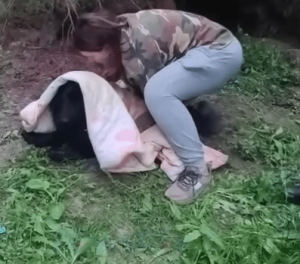
Natasha carefully lifted him from the bushes.
There was no struggle.
Dark simply allowed himself to be carried.
At the veterinary clinic in Stavropol, the team began stabilizing him while investigating why he could not stand.
X-rays provided the answer.
Multiple fractures affected all four limbs.
The injuries were complex enough that recovery would require more than splints and rest.
Dark needed surgery.
But his physical condition created another problem.
He was already weak from malnutrition, shock, low body temperature, and the stress his body had endured.
Operating too aggressively or attempting to repair everything at once could place even more strain on him.
The veterinary team therefore chose a staged approach.
First, stabilize him.
Then repair what they safely could.
And hope his small body remained strong enough for the next step.
Video: From Motionless and Broken to Standing Again — Dark’s Turning Point
Days 9 and 13 — Two Surgeries Gave His Legs a Chance
Dark’s first several days were focused on keeping his condition stable enough for treatment.
His caregivers cleaned and treated his wounds.
He received nutrition.
His body temperature was monitored.
Pain management helped keep him comfortable while the veterinary team prepared for surgery.
On Day 9, Dark underwent the first major procedure.
Four days later, on Day 13, surgeons operated again.
Two substantial surgeries in such a short period would have been demanding for any dog.
For Dark, whose body had arrived severely depleted, the challenge was even greater.
Blood transfusions were needed during the recovery process to help stabilize him.
The team watched him closely.
There was no certainty that repairing the fractures would immediately translate into useful movement.
Bones needed time to heal.
Muscles weakened by immobility needed to rebuild.
And Dark’s entire body had to recover from the condition in which he had been found.
For several days afterward, progress was measured quietly.
He ate.
He rested.
His vital signs remained monitored.
His wounds received continued care.
And the people around him waited for some indication that his legs might eventually support him again.
That indication came sooner than expected.
On Day 17, Dark did something that had been impossible when he arrived.
He pushed himself upward.
Day 17 — Dark Stood on All Four Legs
The movement was unsteady.
His legs trembled beneath him.
His balance was far from normal.
But he was upright.
For the first time since Natasha had lifted him from the bushes, Dark was standing on all four legs.
No one treated the moment as proof that his recovery was complete.
It was not.
The fractures were still healing.
His muscles remained weak.
His body could not yet tolerate normal activity.
But standing meant the veterinary team could now see that the repaired limbs were capable of supporting him, even if only briefly.
Dark lowered himself again.
Then the rehabilitation continued.
Five days later, another milestone arrived.
On Day 22, he began taking small steps independently.
They were slow and cautious.
Each movement required concentration.
Dark placed one paw forward, shifted his weight, and followed with another.
There was none of the effortless motion expected from a healthy puppy.
Walking had become something his body needed to relearn.
But he was moving.
By Day 28, Dark was able to walk slowly around the rescue center’s yard.
That change was especially meaningful because he was no longer limited to a hospital bed or treatment area.
There was open ground around him.
Other dogs nearby.
New smells.
New sounds.
And for the first time, Dark could begin exploring them under his own power.
Days 28–40 — Movement Slowly Became Curiosity
As Dark’s legs strengthened, the changes in his behavior became easier to notice.
At first, walking was entirely functional.
A few steps.
A pause.
Another attempt.
But as his balance improved, Dark started paying more attention to the world around him.
He cautiously approached other dogs.
He watched activity in the yard instead of remaining focused only on his own discomfort.
His body was still healing, yet his environment was becoming interesting again.
Around Day 40, caregivers noticed another small change.
Dark’s tail moved.
It was not a dramatic moment.
There was no sudden burst of running or playing.
Just a tail wag.
But it showed how different his life had become from the day Natasha found him completely still beneath the bushes.
Dark was now responding to familiar people.
He was showing interest in his surroundings.
He was beginning to participate in life rather than simply enduring treatment.
Still, recovery from fractures as severe as his rarely follows a perfectly smooth path.
The veterinary team knew complications could appear even after significant progress.
And several weeks later, they did.
Day 72 — Progress Paused When His Bones Needed More Help
By Day 72, Dark had already accomplished far more than seemed possible during his first examination.
He could stand.
He could walk.
He could explore the yard.
But healing bones do not always recover exactly as expected.
Complications developed that required the veterinary team to intervene again.
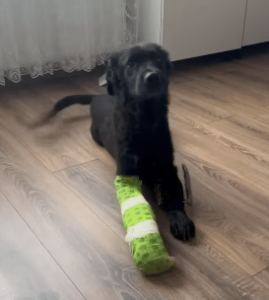
Dark needed another surgery.
The procedure was performed to address damaged structures associated with the earlier fractures and help reduce persistent discomfort.
For Dark, it meant another period of medical treatment just as his life had begun to feel more active.
Progress slowed.
Activity had to be controlled again.
Caregivers returned to careful monitoring while his body recovered from another operation.
These periods can make rehabilitation difficult.
A dog gains strength.
Movement improves.
Then a medical complication requires rest and another procedure.
Some of the progress appears to stop.
But stopping temporarily is not the same as returning to the beginning.
Dark still had the strength he had built.
He still had people caring for him.
And after surviving the original injuries and two earlier surgeries, he continued through another stage of recovery.
Within days, his life would change in a completely different way.
Not because of another medical procedure.
Because someone wanted him to come home.
Day 74 — Dark Left the Clinic With a Family
Around Day 74, Dark had become stable enough to begin the next phase of his life outside the clinic.
A family stepped forward to care for him.
For months, nearly every part of Dark’s routine had revolved around veterinary treatment.
Medication.
Wound care.
Surgery.
Rest.
Short walks.
Monitoring.
Now he entered a home.
Medical care did not suddenly stop.
His family continued following treatment instructions, monitoring his condition, and adjusting medications when needed.
Routine procedures, including neutering, were also incorporated into his longer-term health care.
But Dark now had something beyond clinical recovery.
He had ordinary days.
A familiar place to sleep.
People he saw every morning.
A home he returned to after going outside.
These changes brought their own challenges.
Dark had spent a significant part of his young life injured and unable to protect himself.
New environments could still make him cautious.
That became especially noticeable around Day 110.
Day 110 — His Legs Were Stronger, But New Places Still Made Him Hesitate
By Day 110, Dark had made substantial physical progress.
His legs carried him far more reliably.
He could move independently.
But unfamiliar outdoor environments sometimes caused him to become hesitant.
He would slow down.
Pause.
Observe before moving forward.
There was no way to know exactly what Dark associated with those places or what he remembered from the period before his rescue.
His family did not force an explanation onto his behavior.
They simply responded to what they could see.
Dark needed time.
So they gave it to him.
If he hesitated, they stayed close.
If a new environment seemed overwhelming, they allowed him to explore gradually.
There was no requirement that he immediately behave like a dog who had never experienced severe injury or abandonment.
Physical recovery had happened through small, repeated exercises.
Confidence could grow the same way.
One safe walk.
One quiet afternoon outside.
One unfamiliar place explored without anything bad happening.
Then another.
Gradually, Dark adapted to the world beyond his new home.
And only five days later, another important physical milestone arrived.
Day 115 — For the First Time, Pain No Longer Controlled Every Movement
By approximately Day 115, Dark’s chronic discomfort had improved significantly.
His posture changed.
His steps became steadier.
He no longer appeared to protect his body with the same constant tension.
And his family began noticing another difference.
Dark could rest deeply.
He stretched out instead of remaining tightly positioned.
He slept comfortably for longer periods.
The puppy once unable to move beneath the bushes could now choose where he wanted to lie down and settle there without his injuries dominating every moment.
That freedom allowed more of his personality to emerge.
He became increasingly playful.
Toys became interesting.
Moving around the house was ordinary rather than an exercise.
His family no longer saw only a patient recovering from catastrophic fractures.
They saw a young dog becoming comfortable in his own home.
But Dark still had another two months of change ahead of him.
By the time he reached Day 180, the contrast with the first photograph would be difficult to believe.
Days 150–180 — The Broken Puppy Became a Healthy Young Dog
During the final stretch of Dark’s documented recovery, the physical transformation became unmistakable.
He had gained healthy weight.
The thin, fragile frame that Natasha had lifted from the dirt filled out.
His black coat became smooth and healthy.
The legs that once contained multiple fractures now carried him naturally through daily life.
Dark chased toys.
He walked through the house without assistance.
He stretched comfortably across the sofa.
At night, he curled up near his family.
Those moments were not medically dramatic.
No surgery was taking place.
No emergency team was standing nearby.
Nothing needed to be rescued.
And that was exactly what made them meaningful.
Dark had reached a point where his life no longer revolved around crisis.
He could simply be a dog.
Play.
Sleep.
Explore.
Follow his people from room to room.
Rest when he wanted.
His family continued watching his health, but the frightened and severely injured puppy from Day 1 was no longer the dog they saw every time they looked at him.
By Day 180, Dark belonged to a completely different world.
Dark’s 180 Days Were Built One Milestone at a Time
It is easy to place two images beside each other and call Dark’s transformation miraculous.
One shows a motionless puppy hidden beneath bushes.
The other shows a healthy black dog relaxing inside a home.
But the days between those images tell the more important story.
On Day 1, Dark could not stand.
X-rays showed fractures affecting all four legs.
On Day 9, surgeons performed the first major procedure.
On Day 13, he underwent another.
Blood transfusions helped support his weakened body.
On Day 17, he stood.
On Day 22, he took independent steps.
By Day 28, he was walking slowly around the yard.
Around Day 40, his tail began wagging.
On Day 72, complications required another operation.
Two days later, his next chapter began with a family.
Around Day 110, they helped him work through hesitation in unfamiliar environments.
By Day 115, his physical comfort had improved dramatically.
And between Days 150 and 180, Dark finally began living like the healthy young dog his injuries had almost prevented him from becoming.
No single one of those moments created his recovery.
They depended on each other.
The surgery mattered.
So did the transfusions.
The first attempt to stand mattered.
So did the quiet days of rest that followed.
Medical treatment rebuilt his body.
Consistency gave that body time to heal.
And a family gave him somewhere safe to use the life those treatments had helped return to him.
Once He Couldn’t Move — Now Dark Chooses Where He Wants to Go
Perhaps the strongest image in Dark’s story is not the moment he first stood.
It is what happened much later.
A black dog stretched across a sofa.
A toy waiting nearby.
Family members moving through the home around him.
Nothing about the scene looked extraordinary.
Yet six months earlier, Dark could not move himself out of a patch of bushes.
All four legs were injured.
His body was dangerously weak.
He depended entirely on someone noticing that small dark shape beneath the vegetation.
Natasha noticed.
Veterinarians acted.
Surgeons repaired what they could.
Blood donors helped support him.
Caregivers stayed through complications.
And eventually, a family took over the work of helping Dark build an ordinary life.
His recovery was never one dramatic leap from broken to healed.
It was 180 days of accumulated chances.
A chance to survive the first night.
A chance to make it through surgery.
A chance to stand.
A chance to take one step.
Then another.
A chance to recover when complications appeared.
And finally, a chance to belong somewhere permanent.
Once, Dark lay in the bushes without the ability to carry himself anywhere else.
Today, his legs take him toward toys, across the yard, through his home, and back to the people waiting for him.
For Dark, that may be the clearest measure of how far those 180 days carried him.


