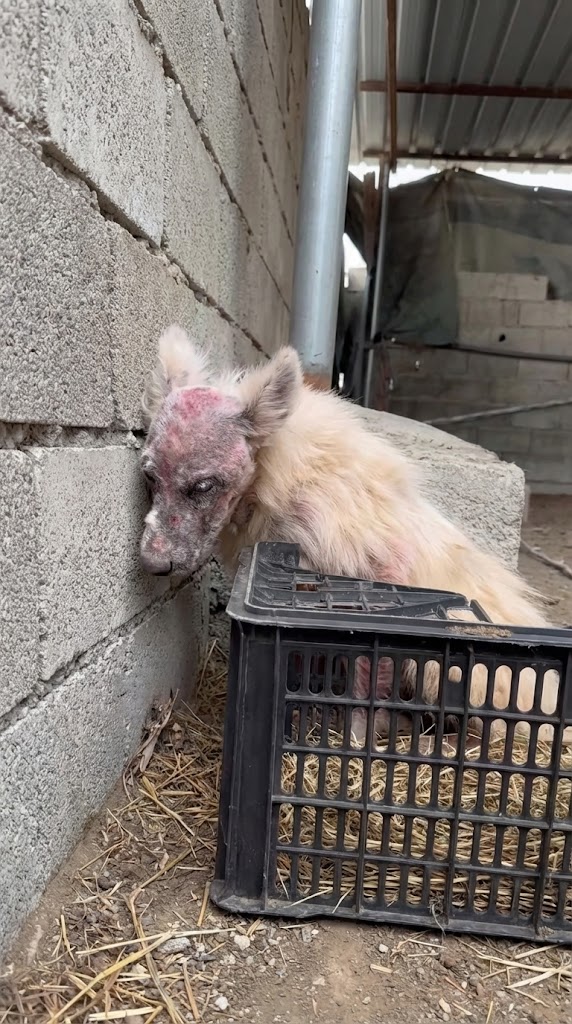
The rescuers smelled the enclosure before they clearly saw the dog inside it.
The rural property was quiet, but behind a wooden fence stood a dark sheep pen layered with waste and old debris.
Something pale moved near a post.
At first, it was difficult to understand what they were looking at.
Then the shape lifted its head.
It was a dog.
A Samoyed.
But almost nothing about him resembled the bright, thick-coated dog people normally picture when they hear that breed.
His fur had become hardened into heavy mats of dirt and waste.
A short chain kept him tethered to one spot.
His body was painfully thin.
And when he tried to shift his weight, one hind leg did not move normally.
The rescuers asked the owner about him.
The response was dismissive.
“He’s just a Samoyed.”
But the people standing outside that enclosure saw something very different.
They saw a dog who needed to leave immediately.
Behind the Fence, He Could Barely Move
The chain restricted how far the dog could travel inside the enclosure.
There was little opportunity to move freely, find a cleaner place to lie down, or simply walk away from the filth surrounding him.
His coat had absorbed much of that environment.
Instead of the white fur associated with a Samoyed, thick mats covered his body in dark, hardened patches.
The rescuers could also see how underweight he had become.
His frame was narrow.
His legs looked weak.
When he tried to stand properly, his injured hind leg made every movement more difficult.
The owner offered an explanation for the dog’s condition.
According to him, the dog had bitten a sheep.
He also admitted that he had beaten him.
The injured leg had never received proper veterinary treatment.
Food did not appear to be any better.
The dog survived on poor-quality scraps intended for livestock, while the water available to him was stagnant and green with algae.
The rescuers did not need an elaborate medical diagnosis to understand the urgency.
The dog was thin.
His leg was damaged.
His skin and coat were in poor condition.
And he remained attached to the same post that had limited his world for far too long.
They asked to take him.
The owner did not simply agree.
Instead, he named a price.
VIDEO: Chained in a Filthy Pen, He Was Left to Die for “Biting a Sheep”
The Rescue Became a Race Against the Owner’s Warning
The conversation quickly changed from concern to negotiation.
The rescuers wanted the dog surrendered.
The owner wanted money.
Then came a statement that made delaying even harder.
According to the rescue account, the owner warned them:
“If you don’t buy him today, you won’t see him tomorrow.”
The meaning was impossible to ignore.
The rescuers had come hoping to persuade someone to release a neglected animal.
Now they were facing a decision that felt much more immediate.
They could argue.
They could walk away and try another approach.
Or they could secure the dog’s release while they still had the opportunity.
They chose the dog.
The team paid what was demanded.
It was not how they wanted the rescue to happen.
But leaving without him was not an option they were willing to accept.
As the exchange ended, the owner delivered one final kick toward the chained dog.
For the rescuers, that moment only reinforced what they already knew.
The dog needed distance from that property.
Immediately.
They moved toward the post.
Then they reached for the chain.
When the Chain Came Off, Ash Had Almost No Strength Left
The metal restraint finally loosened.
For perhaps the first time in a very long while, the dog was no longer attached to the post.
Freedom did not immediately turn into running.
His body was too weak for that.
As rescuers supported him, he collapsed against them.
The injured hind leg could not bear weight normally.
His overall condition suggested that simple movement had become exhausting.
They carried him away from the enclosure and began the trip toward proper care.
Soon, he was given a name.
Ash.
At the rescue lodge, the team could finally examine him without the dirt, fencing, and chain obscuring what they were seeing.
The findings were concerning.
Ash was severely underweight.
His hind leg had sustained a fracture that had gone untreated.
His skin condition was advanced.
And the matted coat covering him was no longer something that could simply be brushed out.
The fur was trapping dirt and making it difficult to treat the irritated skin underneath.
The rescue team made the decision to shave it away.
For a Samoyed, whose thick white coat is one of the breed’s most recognizable features, the transformation was dramatic.
But appearance was not the priority.
The skin beneath that coat needed treatment.
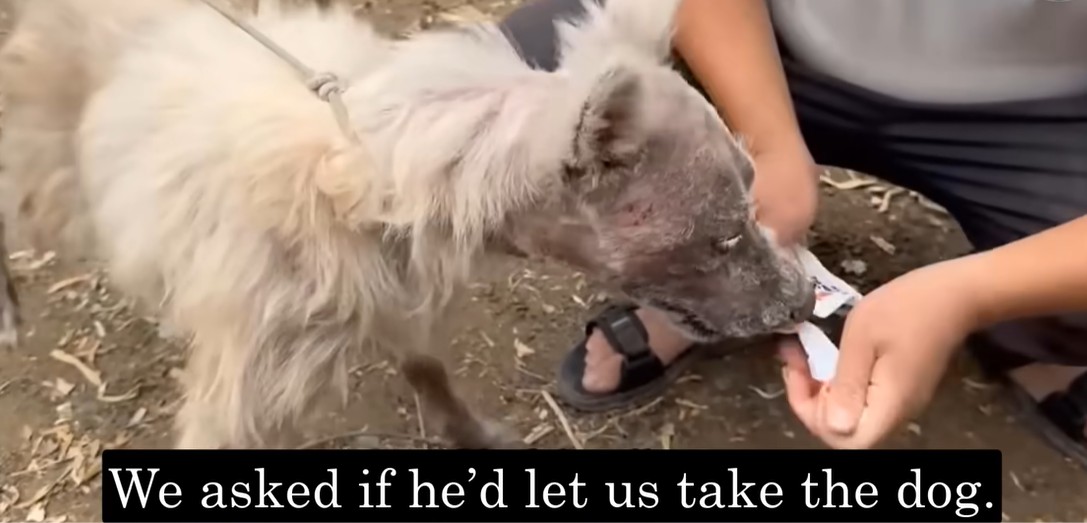
Under the Matted Fur, His Skin Needed Immediate Care
Once Ash’s coat was removed, caregivers could see the extent of the irritation underneath.
Large areas of skin were inflamed.
Some sections were darkened.
Others were cracked or sore from prolonged exposure to poor conditions.
The treatment plan had to address several problems at once.
His body needed nutrition.
His skin needed medication and cleaning.
His injured leg needed monitoring and support.
And after living in a restricted environment, his weakened muscles would also need time to recover.
Nothing about the process could be solved in a single afternoon.
Ash would require repeated care.
Caregivers cleaned his skin carefully.
Medication was applied where needed.
Meals were provided in manageable portions so his body could begin rebuilding strength.
And every day, people approached him for another round of treatment.
For a dog whose previous experiences with human handling had included violence, the rescue team did not know how he would react.
Ash surprised them.
He did not snap at the hands treating him.
He did not fight through every cleaning session.
Instead, he often remained calm and allowed caregivers to work.
At times, he even leaned toward gentle contact.
Those observable behaviors became important signs that Ash was becoming more comfortable with the people now responsible for him.
Recovery Was Built Through the Same Routine Every Day
There was no instant turnaround.
Ash woke each morning still thin.
His skin still needed attention.
His injured leg did not suddenly become normal.
So the rescue team repeated the process.
Food.
Medication.
Cleaning.
Rest.
Gentle movement when he could manage it.
Then the same routine again.
Slowly, the changes began stacking up.
Regular meals helped his body regain weight.
His weakened frame started filling out.
The irritated skin responded to treatment.
And without the heavy mats pulling across his body, the medical team could monitor healing much more closely.
Ash also became increasingly relaxed around familiar caregivers.
Hands approached him without striking.
Voices stayed calm.
Meals appeared consistently.
The same people returned again and again.
For the first time in the story rescuers knew about him, touch was being used to help rather than punish.
Ash did not need to understand that in human terms.
His behavior showed the difference.
He stayed close.
He accepted care.
And gradually, his body began looking stronger.
Then, around the twentieth day, another change appeared.
White fur.
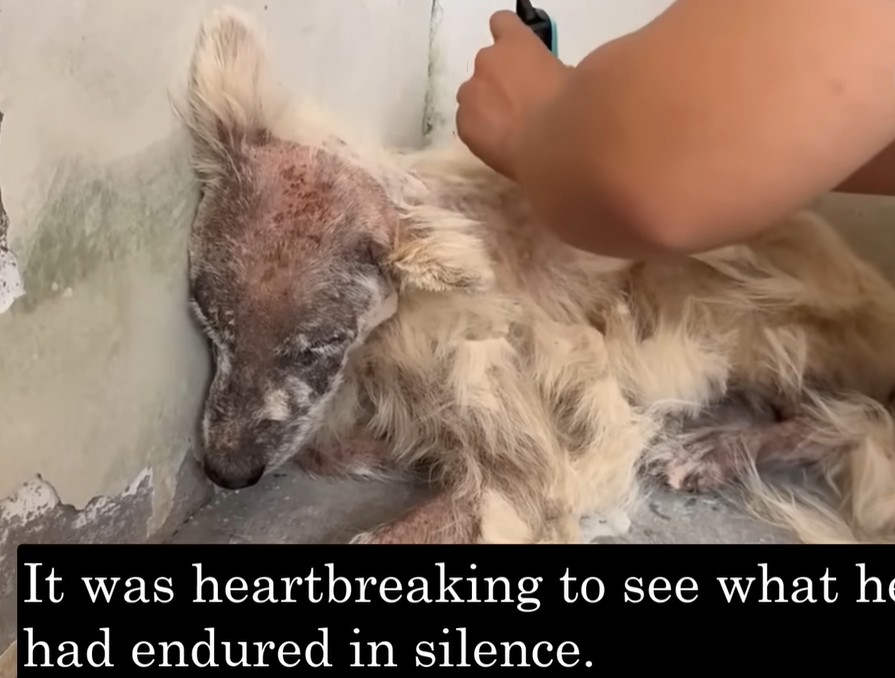
Around Day 20, His White Coat Began Coming Back
At first, the new hair was easy to miss.
Small white strands began pushing through areas of skin that had started healing.
For a dog who had arrived hidden beneath dark mats of dirt and waste, the returning coat made the transformation especially visible.
More white fur appeared.
His skin looked healthier.
His body was no longer quite as hollow.
And his legs began carrying him with greater confidence.
Walking had once been difficult.
Ash had trembled and struggled to support himself.
Now his steps became steadier.
He started moving farther.
Then the pace changed again.
Walking became a cautious trot.
Later, Ash began running.
The difference was striking.
The dog who had once been restricted by a short chain could now cross open ground under his own power.
There was no post stopping him after a few steps.
No filthy enclosure defining the limit of his world.
He could choose where to go.
And as his strength improved, Ash also began spending time around other rescued dogs.
The open space allowed him to do something that had once been physically impossible.
Explore.
Open Fields Replaced the Short Chain
For Ash, freedom became visible in movement.
He could walk across the rescue grounds.
He could approach another dog.
He could turn around and head somewhere else.
He could rest in a clean area rather than wherever the chain happened to allow.
Those ordinary choices carried extra weight when compared with the enclosure where he had been found.
His body continued to strengthen.
The white coat grew back gradually.
And the Samoyed hidden beneath the neglect became easier to recognize.
But the rescue team did not treat his improved appearance as the end of the story.
Ash still needed time.
His leg had experienced a serious untreated injury.
His body had gone through prolonged undernourishment.
Skin recovery required continued attention.
And finding a permanent family was another step entirely.
So Ash remained at the lodge.
There, he had steady meals.
Medical care.
Space to move.
Other dogs nearby.
And people who knew his history well enough to give him time rather than demand immediate perfection.
The contrast with his old environment could hardly have been greater.
Ash Became More Than the Condition He Was Found In
The first photographs of Ash are difficult to separate from the circumstances surrounding them.
The chain.
The matted coat.
The filthy pen.
The weak hind leg.
The extremely thin frame.
But as his recovery continued, those details stopped defining every image.
Instead, people saw a white dog moving through open space.
A dog interacting with caregivers.
A dog whose body had enough strength to trot and eventually run.
That change matters because rescue is not only about removing an animal from one bad location.
It is also about what happens after.
Ash needed medical attention.
He needed repeated skin treatment.
He needed proper nutrition.
He needed time for his weakened body to rebuild.
And he needed the opportunity to experience a routine in which the people around him were predictable.
The chain could be removed in minutes.
Recovering from everything that happened while he wore it took much longer.
That part of the story unfolded slowly.
And in many ways, it is still unfolding.
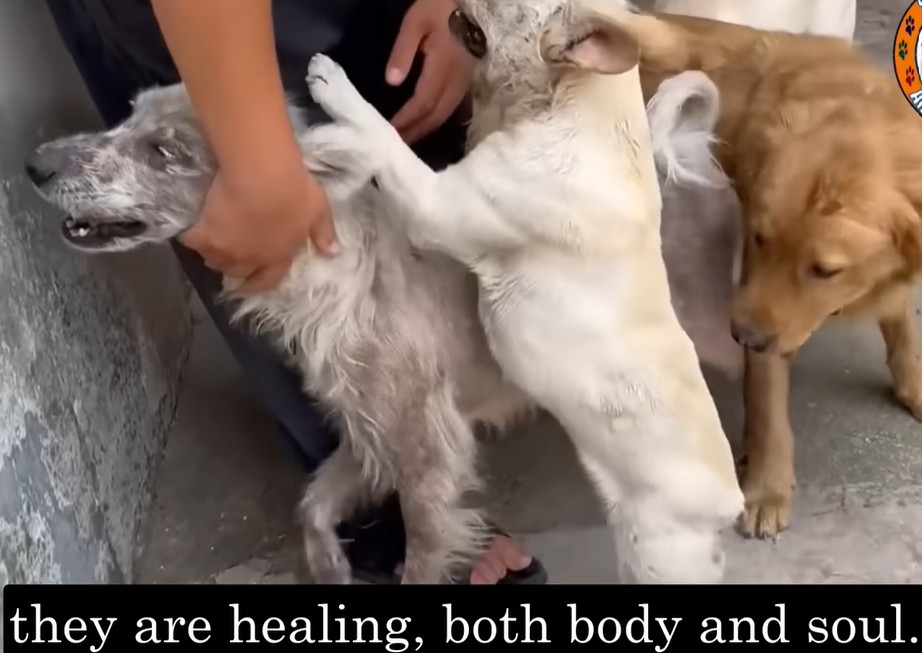
He Is Safe Now — But His Final Chapter Has Not Been Written Yet
Today, Ash remains at the rescue lodge.
He is no longer tied to a post.
He no longer relies on spoiled livestock scraps for food.
His drinking water is clean.
His skin receives care.
His body has regained significant strength.
And the white coat that had once disappeared beneath layers of neglect has begun returning.
He has space around him now.
Room to walk.
Room to run.
Room to choose where he wants to rest.
But there is still one thing missing.
A permanent family.
Ash’s rescuers are waiting for people who understand that adoption is not only about choosing a beautiful Samoyed.
It is about choosing Ash.
A dog with a history.
A dog who has already been through medical treatment and a long recovery.
A dog who may still need patience as he adjusts to another unfamiliar environment.
What he needs now is not pity.
He needs consistency.
The kind of home where meals arrive every day.
Where outdoor time ends with someone opening the door and welcoming him back inside.
Where gentle hands remain gentle.
And where being valued never depends on what he can provide.
He Was Never “Just a Samoyed”
Perhaps the most memorable words in Ash’s rescue story came before the chain was removed.
“He’s just a Samoyed.”
But Ash’s recovery shows exactly why the word “just” never belonged there.
He was not valuable because Samoyeds are recognizable.
He was not worth saving because a healthy white coat would eventually make him beautiful again.
He mattered while he was still dirty.
While he was painfully thin.
While his leg was injured.
While most of his coat had to be shaved away.
Before anyone knew whether he would run.
Before anyone knew whether his white fur would return.
The rescue team did not have to wait for the transformation to decide his life mattered.
They decided that while he was still chained to the post.
Everything after that came one step at a time.
The negotiation.
The payment.
The chain falling away.
The first treatment.
The careful meals.
The skin slowly healing.
Tiny white hairs appearing around Day 20.
Walking without the same trembling.
Then trotting.
Then running through open fields.
Ash’s story did not change because someone discovered that the neglected dog was secretly valuable.
It changed because people refused to accept the idea that his suffering mattered less.
Once, a short chain determined how far Ash could move.
Today, he walks into the sunlight on his own four legs.
And while he waits for the family that will make his rescue complete, one thing is already certain.
He was never “just” anything.


