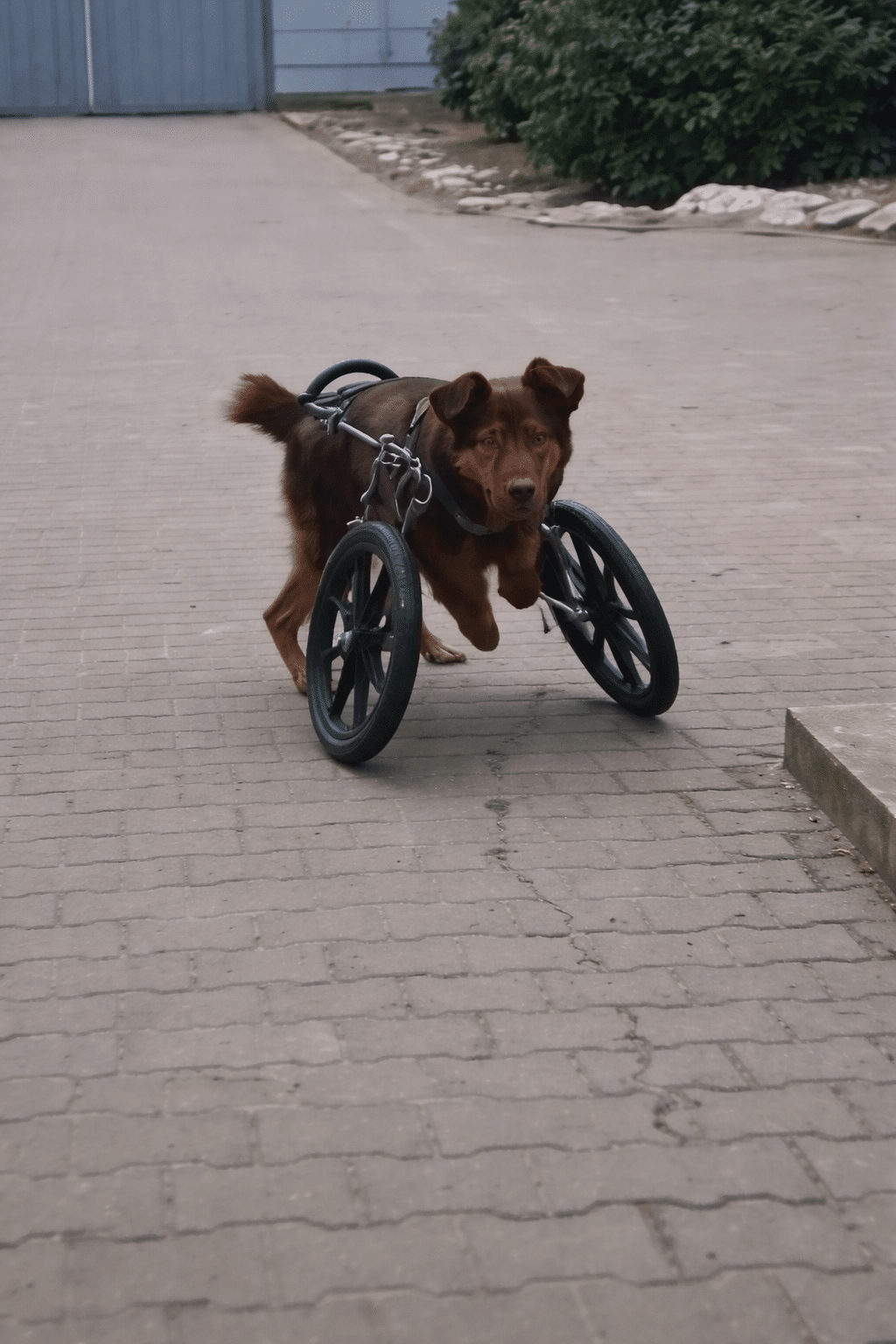
The accident changed Jack’s body in seconds.
After being struck by a train, both of his front legs were so badly injured that they could not be saved.
For a small dog already struggling with the immediate trauma, survival came first.
There was no time to think about running again.
No time to imagine sidewalks, snow, other dogs, or any of the ordinary things that once required four working legs.
Rescuers had one goal:
Keep Jack alive.
He was stabilized.
His injuries were treated.
Surgeons removed the tissue that could not be saved while protecting as much healthy function as possible.
Then came the quieter part of rescue.
Medication.
Wound care.
Rest.
Waiting.
Jack survived the accident.
But another question remained.
How would a dog with no front legs move through the world again?
First, Jack Had to Survive What the Train Had Done
When rescuers reached Jack, his condition was critical.
The trauma had affected both front limbs so severely that there was no realistic way to preserve them.
His body was weak.
His breathing was shallow.
The medical team had to stabilize him before anything resembling rehabilitation could begin.
Emergency treatment focused on the immediate dangers.
His injuries were cleaned.
Pain was managed.
The surgical team addressed the damage that could not be repaired.
For Jack, losing both front legs created an entirely new set of physical challenges.
A dog normally places substantial weight through the front of the body.
Those limbs help with balance.
They help absorb impact.
They guide turning and stopping.
Without them, even basic movement would require a completely different strategy.
But none of that mattered during the earliest days.
Jack needed to recover from surgery first.
The pace was slow.
Caregivers checked his wounds repeatedly.
Medication was administered according to schedule.
He spent long periods resting while his body adjusted to the enormous physical change.
There was no dramatic transformation yet.
Only a small dog healing one day at a time.
Video: From Train Tragedy to Racing Through Snow — Jack’s Second Life on Wheels
Survival Was Only the Beginning
Once Jack’s wounds began healing, the challenge changed.
He had survived.
Now he needed a way to live independently.
Without front legs, simply dragging himself across the ground would place enormous strain on the rest of his body.
It could cause discomfort.
It could damage skin.
And it would severely limit where Jack could go.
His rescuers began looking for another solution.
That solution came in the form of a custom mobility device.
A wheelchair was built specifically around Jack’s body.
Unlike the more familiar carts designed to support paralyzed hind legs, Jack needed support at the front.
The device had to carry the portion of his body that his missing limbs could no longer support while still allowing his hind legs to provide forward movement.
Balance was critical.
If the frame sat incorrectly, Jack could tip.
If the wheels were positioned poorly, turning would become difficult.
If the support points placed too much pressure on his body, he would not be comfortable enough to use it.
The goal was not simply to attach wheels to a dog.
It was to create a system that would let Jack move safely.
When the device was finally ready, another phase of his recovery began.
He had to learn how to use it.
His First Time on Wheels Was Anything but Smooth
The first session did not look effortless.
Jack was suddenly standing in a frame that changed how his weight was distributed.
Two wheels now supported the front of his body.
His hind legs remained responsible for propulsion.
Everything felt different.
When he tried to move, he hesitated.
His body wobbled.
The wheels responded differently from paws.
Jack had to learn how far he could lean.
How much force to use with his hind legs.
How to stop without pitching forward.
How to turn without losing balance.
At times, he moved only a short distance before stopping.
Then the caregivers adjusted him.
They checked the positioning of the wheelchair.
They encouraged another attempt.
The early movements were awkward.
That was expected.
Using a mobility device is a learned skill.
Jack had spent his earlier life moving with four legs.
Now the mechanics of every step had changed.
His hind legs had to generate more of the forward motion.
His core had to help keep his body aligned.
The wheelchair needed to follow without pulling him off balance.
So the training continued.
Not for hours at a time.
In manageable sessions.
A few movements.
A rest.
Then another attempt.
Slowly, the Wheels Stopped Feeling Unfamiliar
With repetition, Jack began understanding how the device responded.
The hesitation decreased.
His movements became more deliberate.
He learned how to push forward with his hind legs while keeping his body centered within the frame.
Turns became smoother.
Stopping became easier.
He began correcting small changes in direction without needing someone to reposition him.
What had initially looked like complicated rehabilitation gradually became movement.
Then movement became mobility.
Jack could decide where he wanted to go and make his way there.
That distinction mattered.
Before the wheelchair, moving without assistance had been extremely difficult.
With it, Jack began regaining something much larger than speed.
Choice.
He could move toward a person.
Follow another dog.
Explore a sidewalk.
Change direction.
Stop somewhere interesting.
Then continue.
The device was still visible beneath him.
But Jack’s attention increasingly appeared focused on the world ahead rather than on the equipment carrying his front end.
Then came another change.
He got faster.
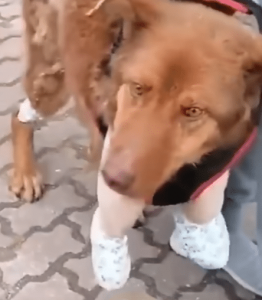
One Day, Jack Was No Longer Just Practicing — He Was Running
The early wheelchair sessions had been slow and cautious.
Eventually, that changed.
Jack pushed harder with his hind legs.
The wheels rolled faster.
His body stayed balanced.
And instead of simply moving from one spot to another, Jack began running.
The sight was striking.
A dog who had lost both front legs after a devastating accident was now moving at speed under his own power.
The wheelchair did not recreate the body Jack once had.
It gave him another way to use the body he still had.
That became especially visible when he was outside.
Open spaces allowed him to build momentum.
He could follow paths.
Travel farther.
And interact with the environment in ways that would have been extremely difficult without support.
No one needed to pretend that the accident had never happened.
Jack’s missing legs were still part of his life.
The wheelchair was still necessary.
But the loss no longer meant complete immobility.
Technology, rehabilitation, and practice had given him another route forward.
Snow Became One of the Best Places to See How Far He Had Come
Later footage of Jack looks dramatically different from the early days after his accident.
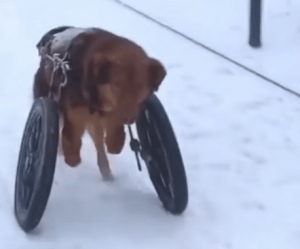
Snow covers the ground.
Other dogs move nearby.
And Jack rolls forward through the white landscape.
His wheels cut narrow tracks behind him.
His hind legs push steadily.
His ears remain alert as he moves.
At times, he keeps pace with dogs traveling on four legs.
He does not need to be carried across the entire outing.
He does not remain behind while everyone else explores.
He participates.
That is one of the most meaningful parts of his recovery.
Jack’s success is not measured by whether anyone can forget that he uses a wheelchair.
It is measured by what that wheelchair allows him to do.
Go outside.
Move beside other dogs.
Follow the people caring for him.
Explore new places.
Exercise.
And experience the kind of physical freedom that once seemed uncertain.
The snow makes the transformation especially easy to see.
After the accident, Jack’s body was almost completely dependent on human care.
Now he leaves tracks of his own.
The Other Dogs Began Treating Him Like Any Other Companion
Another important change appeared in Jack’s interactions with other dogs.
His unusual way of moving did not prevent him from participating socially.
On sidewalks and outdoor paths, he traveled alongside them.
If the group moved forward, Jack moved too.
If there was something interesting to investigate, he could approach it.
His wheels became part of the way he navigated the environment rather than a reason to remain isolated.
For the people watching, Jack’s disability remained visually obvious.
For the dogs around him, what seemed to matter was much simpler.
He was there.
He moved with them.
He explored with them.
He belonged to the group.
That ordinary participation represents a major difference from the earliest stage of his rescue.
At first, his life revolved around medical crisis.
Then wound healing.
Then rehabilitation.
Eventually, those things stopped occupying every moment.
Jack could spend more time simply being a dog.
His Wheelchair Did Not Restore His Legs — It Restored Independence
Jack’s story is not about pretending that loss can always be reversed.
His front legs did not grow back.
The accident permanently changed his body.
What changed afterward was how much that injury was allowed to limit his life.
A carefully designed mobility device addressed one of the biggest practical problems created by his amputations.
His front end needed support.
The wheelchair provided it.
His hind legs could still generate movement.
The design allowed him to use that strength.
Practice helped him improve balance.
Experience helped him learn steering.
Eventually, movement became natural enough that he could build speed.
That is what adaptive equipment can do when it is matched properly to an animal’s needs.
It does not erase disability.
It creates access.
For Jack, access meant reaching places he could not comfortably reach by dragging himself.
It meant spending time outdoors.
It meant exercising.
It meant following other dogs instead of watching them disappear ahead.
And perhaps most importantly, it meant having some control over his own direction again.
Jack’s Story Changed Because People Focused on What He Could Still Do
After an accident as severe as Jack’s, it would have been easy to focus only on what was gone.
Two front legs.
A completely altered gait.
A permanent disability.
But rehabilitation required a different question.
What function remained?
Jack still had strong hind legs.
He could still respond to the world around him.
He could still learn.
He could still move if his front body was supported correctly.
Those abilities became the foundation of everything that followed.
The surgeons kept him alive.
Caregivers helped him through wound healing.
Designers or rescuers created equipment suited to his new body.
Then Jack did the repetitive work of learning how to use it.
None of those pieces would have been enough alone.
Surgery without rehabilitation would have left him alive but severely limited.
A wheelchair without proper fitting would have been ineffective.
Equipment without practice would have remained unfamiliar.
Jack’s recovery required all of it.
Medical care.
Adaptation.
Repetition.
And time.
He Did Not Get His Old Life Back — He Built a Different One
There are two very different ways to look at Jack’s story.
One begins with loss.
A train accident.
Two front legs gone.
Emergency surgery.
A body permanently changed.
The other begins after that.
Healing.
A custom wheelchair.
A first awkward attempt.
Learning balance.
Learning turns.
Building speed.
Running through snow.
Moving beside other dogs.
Both parts are true.
Jack’s recovery does not erase what happened to him.
But the accident also does not describe everything that came afterward.
His life expanded again because people were willing to adapt the environment to the body he now had.
That is what makes the later images so powerful.
Jack is not shown sitting still while others live around him.
He is moving.
His hind legs drive him forward.
The wheels support what his missing front limbs once carried.
Snow moves beneath him.
Other dogs travel alongside.
And Jack chooses his own direction.
For a dog whose future once depended entirely on whether he would survive emergency treatment, that independence is enormous.
He lost both front legs.
He did not regain them.
But with medical care, patience, and the right support, Jack regained something else.
The ability to keep going wherever his wheels could take him.


