The cardboard box looked like something someone had thrown away.
Crushed at the edges.
Sitting alone on an empty stretch of land in Barranquilla.
There were no nearby footsteps leading toward it.
No one calling out.
No reason for anyone passing at a distance to look twice.
But inside was a three-month-old puppy.
His name would later be Vicente.
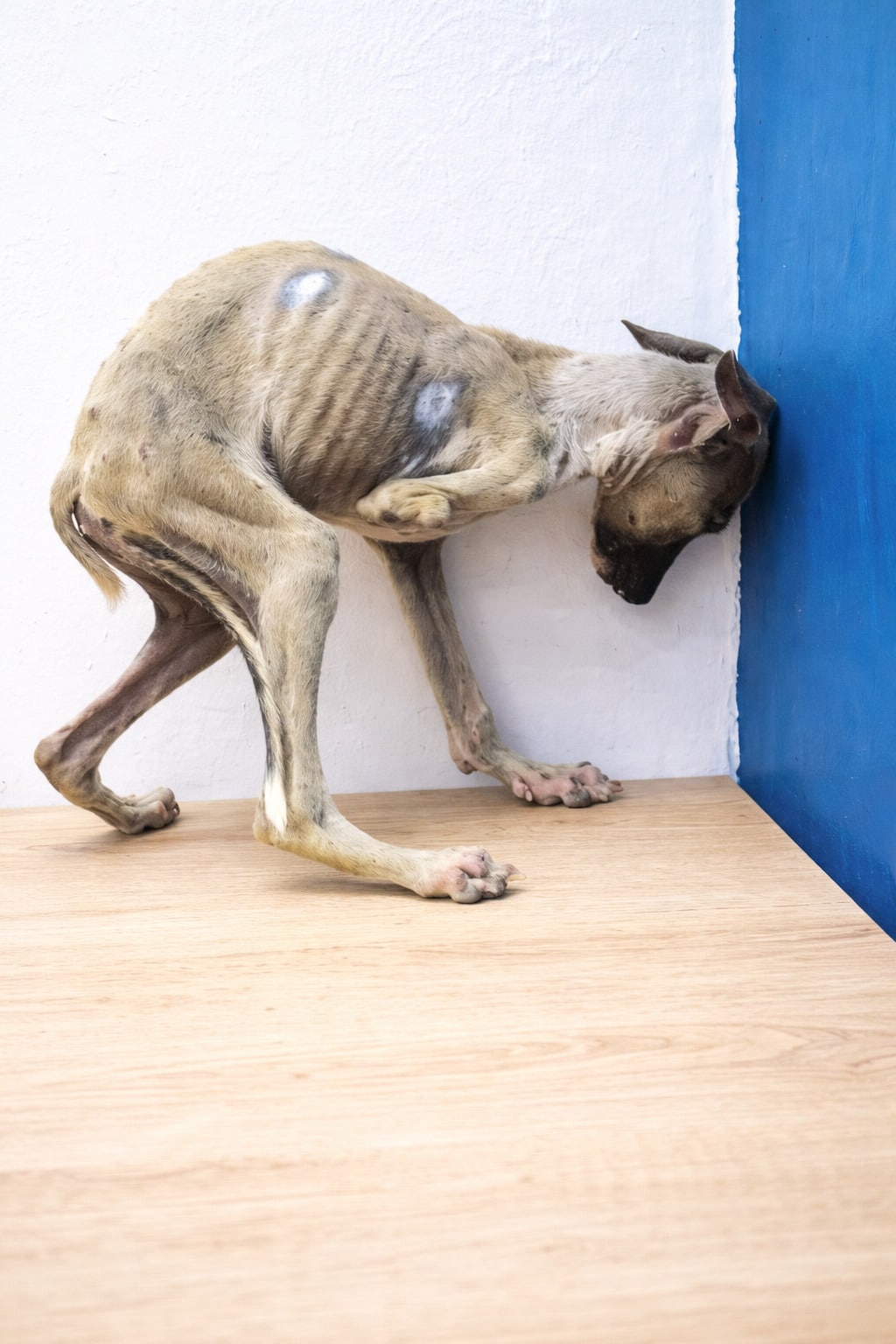
That day, he was painfully thin, covered in sores and parasites, and so weak that standing properly was difficult.
One of his front legs was already missing.
The injury was not fresh. It appeared to have happened earlier and healed without proper treatment, leaving his small body to adapt before he had even finished growing.
And still, Vicente was alive.
For rescuers, that was enough reason to begin.
Inside the Box Was a Puppy Barely Strong Enough to Move
Vicente was far too young to be facing life alone.
At approximately three months old, most puppies are still learning about the world through play, food, sleep, and constant movement.
Vicente’s reality looked very different.
His ribs were visible beneath thinning fur.
His body was covered in irritated areas and sores.
Parasites clung to his skin.
When he tried to reposition himself, his movements were weak and uneven.
The missing front leg made balance even more difficult.
There was no collar identifying him.
No person nearby.
No information explaining how long he had been inside the box or how he had reached such a condition.
The empty land surrounding him made the situation especially concerning.
Had no one noticed the box, Vicente could have remained there unseen.
Rescuers carefully lifted him out.
He did not have the strength for much resistance.
At that stage, the priority was not solving every problem immediately.
It was getting Vicente somewhere he could be examined, fed, cleaned, and protected.
The box had kept his small body off part of the bare ground.
It had not kept him safe.
Now someone finally could.
Video: Vicente’s Second Chance — From Abandonment to Hope
His Missing Leg Was Only One Part of the Medical Picture
Once rescuers could examine Vicente more closely, it became clear that the missing limb was not his only problem.
One of his front legs had been lost following an earlier injury that had not received proper treatment.
The remaining front limb now carried much more responsibility for supporting his weight.
For a healthy dog, adapting to three legs can be possible.
For Vicente, the challenge was greater because the rest of his body was already severely depleted.
Veterinary testing revealed multiple medical concerns.
He had a tick-borne disease.
He had intestinal worms.
He was anemic.
He was seriously malnourished.
A painful mass had also developed near his lip.
Each problem placed another demand on an already weakened puppy.
The anemia helped explain part of his lack of energy.
Parasites and intestinal worms competed with the nutrients his growing body desperately needed.
Malnutrition left him with little physical reserve.
And every attempt to walk had to account for a body that had already lost one supporting limb.
This was not a case that could be solved with one meal and a night of sleep.
Vicente needed structured veterinary care.
He was transported to a clinic in Santa Marta.
There, Dr. Lina took over his treatment.
Dr. Lina Began With the Problems His Body Could Handle First
Vicente’s treatment needed to be careful.
A severely weakened puppy cannot always tolerate aggressive intervention all at once.
His body needed nutrition, but food had to be introduced in a controlled way.
He needed medication for the infections and parasites affecting him.
He needed his wounds and skin monitored.
And he needed enough rest for his body to begin responding.
The rescue team gave him a name.
Vicente.
From then on, he was no longer simply the puppy from the cardboard box.
He was a patient with people tracking his progress.
Medication was carefully measured.
Small portions of nutrient-rich food were offered.
A soft blanket replaced the hard ground.
Instead of being left alone in an empty lot, Vicente now had people checking whether he ate, whether he rested comfortably, and whether his condition was improving.
At first, the changes were difficult to see.
He was still extremely thin.
Still weak.
Still cautious around touch.
But treatment does not always announce itself dramatically.
Sometimes progress begins with a puppy finishing a little more food than yesterday.
Vicente began doing exactly that.
His Appetite Was One of the First Signs That Treatment Was Working
As the days passed, Vicente started eating more consistently.
That mattered because nearly every part of his recovery depended on nutrition.
His young body needed calories to rebuild lost weight.
Protein was necessary for tissue repair.
His muscles needed support.
His immune system needed help while medications addressed infection and parasites.
Even the strength required to learn a new walking pattern depended partly on having enough energy.
Vicente’s appetite improved.
His overall appearance began changing slowly.
His eyes looked clearer.
He followed movement around the room more often.
The puppy who had seemed almost completely depleted inside the box was beginning to engage with his surroundings.
There was another challenge, however, that food and medicine could not solve on their own.
Vicente was cautious when people reached toward him.
He sometimes flinched.
The source does not tell us exactly what had happened to him before he was found, so no one could know precisely why he reacted that way.
Caregivers simply responded to the behavior in front of them.
They slowed down.
They avoided forcing unnecessary interaction.
And they allowed safe contact to become familiar through repetition.
Learning to Walk Meant Relearning Balance With Three Legs
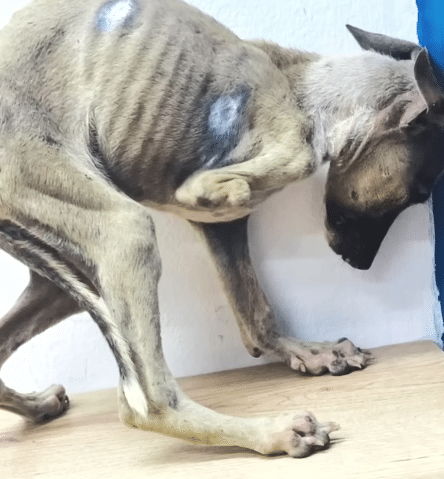
Vicente’s missing front limb changed the mechanics of nearly every step.
A dog normally distributes weight across four limbs.
With one front leg absent, the remaining front leg must take on a greater share of support.
That can be especially challenging for a puppy whose muscles are already weak from malnutrition and illness.
Caregivers used padding to help protect Vicente’s shortened limb area while he practiced moving.
At first, he stumbled.
His body had to find a new center of balance.
He needed to coordinate his remaining legs while protecting sensitive areas.
A few steps could require considerable concentration.
But he kept practicing.
Stand.
Shift weight.
Move one paw.
Correct balance.
Try again.
There was no dramatic moment when Vicente suddenly moved like a healthy adult dog.
His adaptation came through repeated attempts.
Each successful step taught his body something.
As his nutrition improved, he had more strength available.
As medication helped address the conditions weakening him, he could devote more energy to movement.
Slowly, the awkwardness began to lessen.
Vicente was not becoming a four-legged dog again.
He was learning how to use the body he had.
Curiosity Began Replacing Constant Caution
Physical improvement changed what Vicente was able to do with his days.
At first, most of his energy went toward resting and basic recovery.
Later, he began noticing more.
He found warm places in the sunlight.
He watched other dogs.
Initially, those interactions remained cautious.
Vicente observed from a distance rather than immediately joining them.
Then, gradually, he moved closer.
Short bursts of play appeared.
For a puppy, that was significant.
Play requires energy that Vicente simply had not possessed when he was found.
It also requires enough comfort to focus on something beyond immediate physical distress.
Vicente began showing both.
His caregivers noticed changes in how he responded to people too.
The puppy who had once flinched at an approaching hand became more willing to remain close.
Eventually, he began leaning into affectionate contact.
No one needed to claim exactly what Vicente was thinking.
His behavior told enough of the story.
He was interacting more.
Playing more.
Approaching more.
And withdrawing less.
His Medical Recovery Continued Long After the Box Was Gone
Getting Vicente out of the abandoned lot had taken only a short time.
Recovering from the condition in which he was found took much longer.
He still needed veterinary follow-up.
Vaccinations had to be completed.
Parasite control continued.
He was dewormed.
When he became medically ready, he was neutered.
Supplements were provided to support his developing bones and joints.
That last part was especially important for a young dog adapting to life with three legs.
His body would continue growing.
The remaining limbs and joints would need to support that growth differently.
Regular monitoring and appropriate nutrition could help give him the best possible foundation.
By the later stages of the documented rescue, Vicente was considered stable.
That did not mean every trace of his difficult beginning had disappeared.
His missing limb would always remain part of his physical reality.
His body had experienced serious illness and malnutrition at a very young age.
But the urgent crisis was no longer controlling every day.
Vicente had moved into a different phase.
Living.
Growing.
Learning.
The Puppy Who Once Flinched Could Now Rest in Someone’s Arms
One of the final images from Vicente’s journey is remarkably simple.
There is no operating room.
No dramatic rescue scene.
No cardboard box.
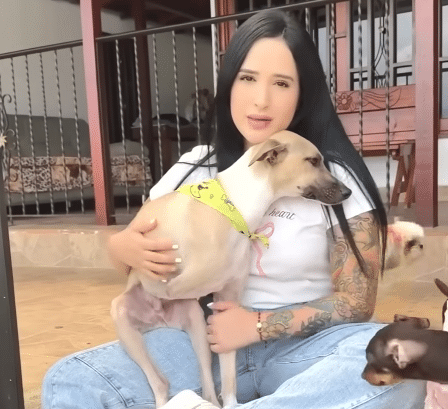
Vicente is resting in the arms of a young woman.
His body is supported.
He is not struggling to get away.
He appears calm enough to remain there.
That image matters because of how his story began.
When Vicente was first found, human contact sometimes made him flinch.
Now he could be held securely.
The source does not clearly establish that the woman shown became his permanent adopter, so it would be wrong to turn that image into an adoption story without evidence.
What the image does show is already meaningful.
Vicente had reached a point where close human contact could occur without the same visible fear.
He was no longer lying alone inside a damaged box.
Someone was holding him.
And this time, the hands around his body were there to support him.
Vicente’s Future Almost Disappeared in an Empty Lot
There was nothing remarkable about the place where Vicente was found.
That may be what makes the beginning of his story so troubling.
An empty stretch of land.
A discarded-looking cardboard box.
A puppy small enough to disappear inside it.
Had rescuers not looked closely, the box might have remained only another object in an abandoned space.
But someone did look.
And inside they found a three-month-old puppy with far more medical problems than his small body should have been carrying.
A missing front leg.
Tick-borne disease.
Intestinal worms.
Anemia.
Severe malnutrition.
A painful mass near his lip.
Skin problems.
Weakness.
There was no single treatment capable of fixing all of it at once.
So the people helping Vicente worked piece by piece.
Medication.
Food.
Parasite treatment.
Veterinary monitoring.
Padding for movement.
Practice walking.
Vaccination.
Deworming.
Neutering.
Supplements.
Time.
The transformation was built from those ordinary interventions.
Vicente Did Not Need a Perfect Body to Deserve a Future
Vicente will always move differently from a dog with four legs.
That is not the failure of his story.
His missing limb is simply part of the body he learned to use.
What mattered was giving the rest of that body a chance to become stronger.
When rescuers found him, his future was uncertain for reasons extending far beyond the amputation.
His illness needed treatment.
His anemia needed attention.
His nutrition needed rebuilding.
His growing body needed enough support to adapt safely.
And his cautious behavior needed patience rather than force.
Over time, Vicente began doing things that had seemed difficult to imagine when he was lifted from the cardboard box.
He walked.
He sought sunlight.
He watched other dogs.
Then he played with them.
He accepted affection.
Eventually, he could relax in someone’s arms.
None of those moments changed the fact that his beginning had been harsh.
They changed what came after it.
Vicente’s story is not powerful because a badly injured puppy suddenly became perfect.
It is powerful because perfection was never required.
At three months old, he was found in a place where he could easily have gone unnoticed.
Someone noticed.
Dr. Lina and the rescue team treated what they could treat.
Caregivers supported what could be strengthened.
And Vicente learned how to move forward with what remained.
Once, his entire world fit inside a crushed cardboard box on an empty lot.
Now that box is only the place where his rescue story began.


