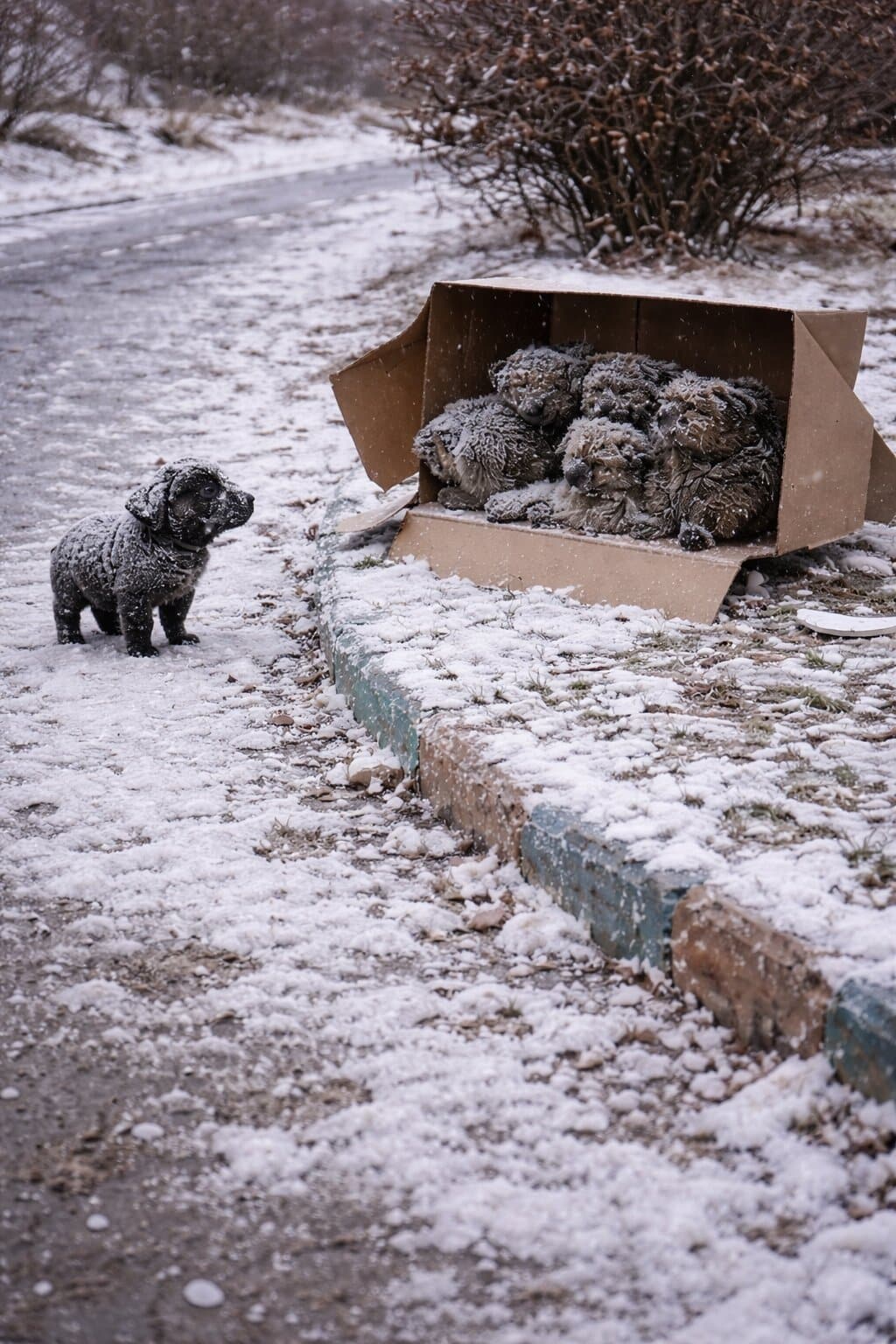
The cardboard box looked like something winter had already claimed.
Its sides were soaked.
The corners had begun collapsing.
Snow collected around it as the cold continued settling over everything nearby.
Then someone looked inside.
Four tiny puppies were pressed together in the damp cardboard, trying to share whatever warmth their small bodies still had.
Three barely moved.
The fourth did something different.
His tail moved.
Just a little.
Then again.
There was no way to know what the puppy understood about the person standing above the box.
But that small movement was enough to make one thing clear.
The box was not empty.
And the four lives inside it needed help immediately.
Four Puppies Were Barely Holding On Inside the Wet Cardboard
Once the puppies were lifted from the box, their condition became easier to see.
They were extremely weak.
Their bodies were cold.
Fleas covered their skin, taking even more from animals that already had almost no strength to spare.
Their eyes were swollen and irritated.
The puppies did not look like animals ready to play or explore.
They looked exhausted.
The cardboard box may have provided a small barrier from the snow beneath them, but it was soaked through and offered very little protection from the freezing weather.
There was no dependable source of warmth.
No regular food.
No clean bedding.
No one nearby caring for them.
The rescuers brought all four puppies indoors and arranged veterinary treatment immediately.
At that point, cold exposure was only one part of the problem.
Testing soon revealed something much more dangerous.
All four puppies were dealing with parvovirus.
For young dogs already weakened by exposure and poor condition, that diagnosis made the situation far more serious.
And even parvovirus was not the only medical issue they faced.
Video: From Snow and Silence to Safety — The Rescue of Lila, Nils, Martin, and Gray
The Veterinary Exam Revealed Several Problems at Once
The medical team began evaluating each puppy carefully.
Parvovirus was a major concern because young puppies can deteriorate rapidly when the disease affects an already fragile body.
But the examination also found extensive skin problems.
The puppies were suffering from fungal infections.
They also had mange.
Their skin was irritated and inflamed.
Fleas added another layer of discomfort and physical stress.
Their swollen eyes required attention as well.
This was not a situation where one medication would solve everything.
The puppies needed stabilization first.
They received intravenous fluids.
Urgent injections were administered as part of their treatment.
Their bodies needed hydration and medical support while the veterinary team addressed the infections and parasites affecting them.
Because the condition of their coats and skin made treatment difficult, portions of their fur had to be carefully removed.
Then came medicated bathing and continued skin care.
For four exhausted puppies who had only recently been pulled from freezing conditions, even necessary treatment had to be handled gently.
They had already been through enough.
In the Clinic, They Finally Received Names
During those first difficult days, the puppies were given names.
Lila.
Nils.
Martin.
Gray.
The names did not change their medical condition.
But they changed the way their story was told.
They were no longer simply four puppies found in a box.
Each one now had an identity that caregivers could follow through treatment.
Gray was the puppy whose tail had still been moving when rescuers first looked inside.
Now the team could track his progress separately from Lila’s, Nils’s, and Martin’s.
Medication schedules had to be followed carefully.
Food was introduced in controlled amounts.
Warmth became constant rather than something the puppies had to create by pressing together.
Their eyes were monitored.
Their skin received repeated treatment.
And because parvovirus can be so serious in young dogs, every change in appetite, energy, and response mattered.
The early days did not offer immediate reassurance.
Recovery took time.
But gradually, the puppies began giving caregivers small signs that treatment was helping.
The First Improvements Were Almost Easy to Miss
At first, progress did not look dramatic.
One puppy showed more interest in food.
Another lifted its head more quickly.
Their eyes began looking clearer.
They responded more consistently when caregivers entered.
These were small changes.
But compared with the nearly motionless puppies inside the snow-soaked box, they mattered.
Then curiosity started returning.
A toy placed nearby was no longer completely ignored.
One puppy nudged it.
Another watched.
Energy that had previously been used only for survival was slowly becoming available for something else.
The room also began filling with a sound rescuers had not heard much in the beginning.
Movement.
Small paws.
Puppies shifting around instead of remaining tightly pressed together.
And eventually, Gray was no longer the only one whose tail moved.
More tails began wagging.
The puppies were still recovering.
But they were beginning to behave more like puppies.
Their Skin Healed While Their Personalities Began to Appear
The medical work continued long after the first tail wags.
Mange and fungal infections do not disappear instantly.
The puppies still needed medication.
Medicated baths continued.
Their skin required time to calm and repair.
Then new fur began appearing.
At first, the growth was soft and thin.
Over time, it became healthier and more noticeable.
The irritated areas gradually improved.
Their coats started to look less like evidence of illness and more like the coats of growing young dogs.
Their bodies changed too.
Regular meals helped restore strength.
The puppies became more active.
Instead of lying quietly together for warmth, they began tumbling over one another.
They explored.
They played.
They responded to human voices.
The contrast with the beginning of the story became increasingly difficult to ignore.
The same four puppies who had once been found in a collapsing box in the snow were now moving around a warm indoor space with enough energy to create their own little chaos.
That kind of ordinary puppy behavior was exactly what their rescuers had hoped to see.
Gray’s Tail Was No Longer the Only One Moving
Gray’s small tail movement had been one of the first visible signs of life when the box was discovered.
Weeks later, the scene looked completely different.
Lila wagged.
Nils wagged.
Martin wagged.
Gray still did too.
But now those movements happened in a warm room rather than inside freezing cardboard.
They happened while food was available.
While caregivers were nearby.
While the puppies interacted with toys and one another.
There is no need to assign a complicated meaning to every wag.
The observable change is powerful enough.
At the beginning, three puppies were almost motionless.
Later, all four had enough strength to move, investigate, and respond to the people caring for them.
Their world had expanded beyond the inside walls of a damaged box.
And as their health stabilized, the next question became possible.
Where would each puppy go when treatment was finished?
Two Found New Homes — Two Stayed With the Rescuer
Eventually, the four puppies reached a point where their futures could extend beyond medical recovery.
Their paths did not all lead to the same place.
Gray and Lila were adopted.
They left rescue care for homes of their own, where the conditions surrounding them looked nothing like the snowy beginning of their story.
Warmth was dependable.
Food was regular.
People expected them to be there.
For Nils and Martin, the next chapter remained with the person who had been caring for them.
They stayed with their rescuer.
The final scenes show two healthy young dogs walking confidently alongside their human.
One particularly simple moment stands out.
They are outside in a garden, moving around while tomatoes are being gathered.
Nothing urgent is happening.
No one is rushing them to a veterinary clinic.
No snow is collecting on a cardboard box.
It is simply an ordinary day.
For puppies whose story began in a medical emergency, ordinary had become something remarkable.
The Ending Was Quiet — And That Made It Even More Powerful
There is an enormous distance between the first and final images of these puppies.
At the beginning:
A wet cardboard box.
Snow.
Four weakened bodies pressed together.
Fleas.
Swollen eyes.
Parvovirus.
Fungal infections.
Mange.
A tiny tail still moving.
At the end:
Healthy dogs.
Fuller coats.
Play.
Walks.
Homes.
A garden.
Sunlight.
That transformation was not created by the tail wag itself.
It came from everything that followed after someone noticed it.
The puppies were removed from the cold.
Veterinary treatment began.
Fluids were given.
Medication was administered.
Their skin was treated.
Food arrived consistently.
Caregivers monitored them through the dangerous early period.
Then the puppies did what growing animals are supposed to do when their bodies finally have enough support.
They recovered.
They played.
They grew.
A Snow-Soaked Box Became Only the Beginning of Their Story
It would have been easy to overlook that box.
From the outside, it looked like discarded cardboard breaking down in winter weather.
No one passing at a distance could immediately see four puppies inside.
That is part of what makes their rescue memorable.
Their lives were hidden inside something ordinary.
There were no loud cries described in the source.
No puppy running toward the road.
Just four small bodies in the cold.
And one visible tail moving.
Someone noticed.
That moment led to a clinic.
The clinic led to treatment.
Treatment led to recovery.
Recovery eventually led Gray and Lila into adoptive homes, while Nils and Martin remained with the rescuer who had become part of their daily lives.
The puppies did not survive because winter suddenly became less dangerous.
They survived because someone interrupted what was happening.
Today, the snow-soaked box is no longer their shelter.
Gray and Lila have homes of their own.
Nils and Martin walk beside the person who stayed with them.
And the little tail that once moved inside a freezing cardboard box is now only one small detail from the day four puppies were finally seen.


