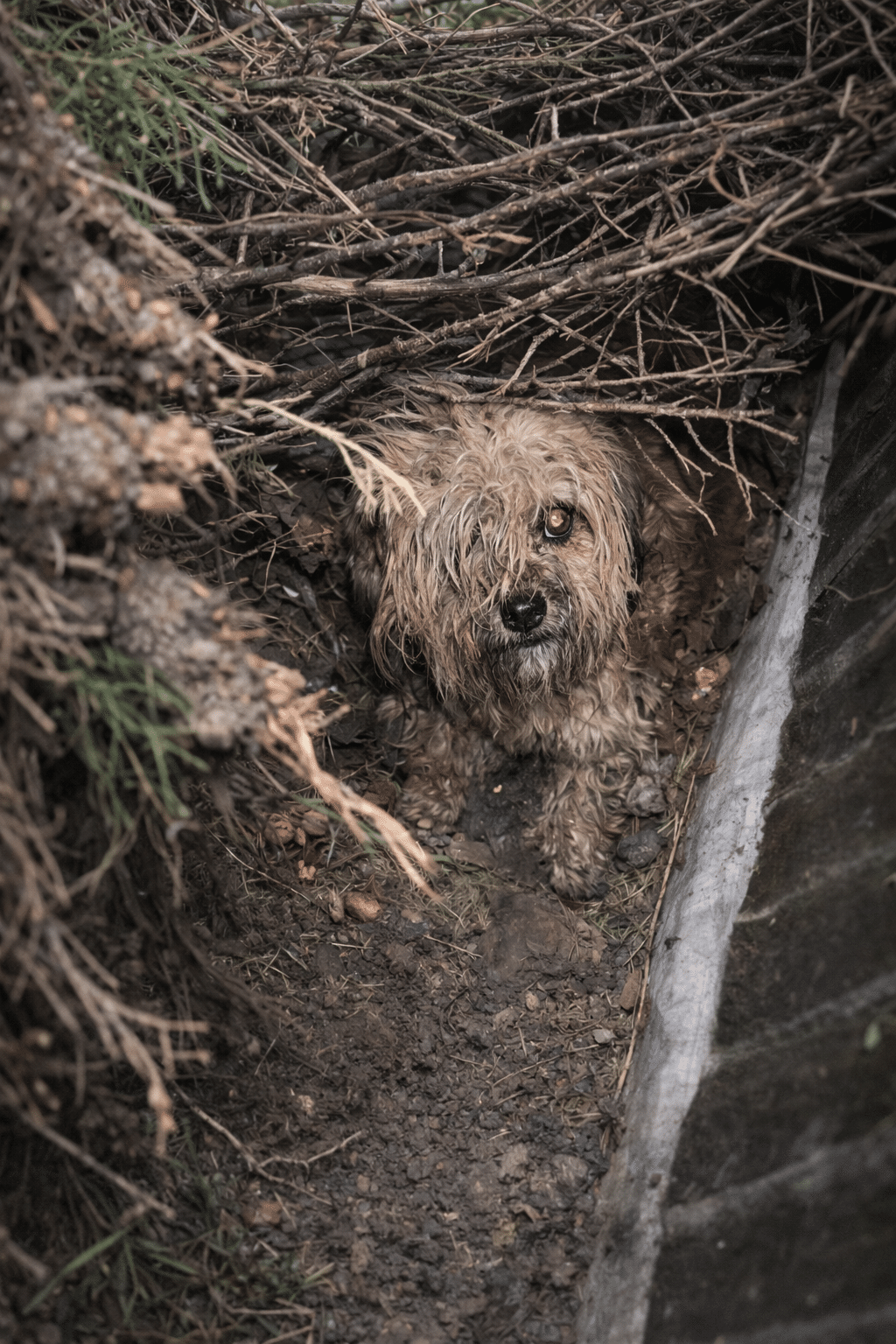
At first, there was almost nothing to hear.
Just a faint sound coming from somewhere inside the wind-battered bushes.
The rescuer stopped.
Listened again.
Then pushed aside the tangled branches.
Hidden underneath was a cluster of newborn puppies pressed tightly against one another, their tiny bodies trembling in the cold.
There was no proper shelter.
No blanket.
No warm bed.
Only dirt, branches, and the small amount of heat they could share between them.
Their mother was nowhere in sight.
For a few anxious moments, the rescuer could only wonder whether she would return.
Then movement appeared nearby.
A thin female dog approached cautiously.
Her coat was dirty and badly matted.
Her body looked worn down.
But the moment she saw a stranger standing near her puppies, she stopped.
Every part of her attention shifted toward the little bodies hidden in the bushes.
The rescuer did not move closer.
Instead, food was placed nearby.
Then a simple cardboard barrier was arranged around part of the nest to block some of the cold wind.
It was not a permanent solution.
But it was enough to begin.
The Mother Returned — And Watched Every Movement
The mother dog did not immediately trust the person who had discovered her puppies.
There was no reason to expect that she would.
She stayed cautious.
She watched from a distance.
When food was placed near the nest, she hesitated until the rescuer moved away.
Only then did she approach.
Her behavior made one thing clear: she was willing to remain close to her puppies, but human contact still required distance.
The rescuer respected that.
No attempt was made to grab her.
No one tried to force affection.
Instead, the first visit ended with something practical.
Food for the mother.
A small windbreak around the puppies.
And a plan to return.
That last part became the most important.
Because the next day, the rescuer came back.
Then again the day after that.
Warm meals appeared regularly.
Chicken.
Eggs.
Nourishing food meant to support a dog already using enormous amounts of energy to care for a large litter.
At first, the mother still waited for the human to leave before eating.
But consistency began changing the pattern.
Video: From a Windy Bush to a Three-Story Wooden Home — A Mother Dog’s Journey to Safety
Days 3–12 — Trust Was Built One Meal at a Time
There was no dramatic moment when the mother suddenly decided everything was safe.
Her progress happened gradually.
The rescuer appeared.
Food was placed down.
Nothing bad happened.
The rescuer returned the next day.
Again, nothing bad happened.
Over time, the mother’s body language began to soften.
She no longer seemed quite as tense when the familiar person approached.
She spent less time watching every movement from a distance.
She came closer to the food sooner.
Eventually, she allowed the rescuer to remain nearer while she ate.
These were small changes.
But for a mother caring for newborn puppies outdoors, they mattered.
The rescuer was becoming part of a predictable routine rather than an unfamiliar threat.
Then came another milestone.
The mother allowed gentle touch.
It did not erase all caution.
It simply showed that the distance between them had narrowed enough for hands to approach without sending her away.
That made the next stage possible.
Her coat needed attention badly.
Thick mats had formed across her body.
Dirt had collected inside them.
The tangled fur made it difficult to keep her skin clean and comfortable.
Once she was calm enough to be handled, the rescuer could finally help.
Beneath the Matted Coat Was a Completely Different Dog
The mother was brought in for a careful bath and grooming.
The process had to be slow.
Matted fur cannot always be brushed free without causing discomfort, so badly tangled sections were trimmed away.
Warm water removed layers of dirt.
The coat that had looked neglected and heavy gradually became cleaner and lighter.
Underneath, her appearance changed dramatically.
But the grooming mattered for more than looks.
Clean fur was easier to maintain.
Her skin could be monitored.
She could rest more comfortably while nursing her puppies.
And regular handling gave the mother another opportunity to experience human contact without being forced or harmed.
Afterward, she returned to her litter.
The puppies still depended almost entirely on her.
They were too young to care for themselves.
They needed warmth.
Milk.
Protection.
And constant attention.
To make that easier, the rescuer moved the mother and puppies closer to the doorway of the home.
The location allowed them to be watched more closely and protected more effectively.
The bushes had served as the first shelter.
They no longer needed to remain the only one.
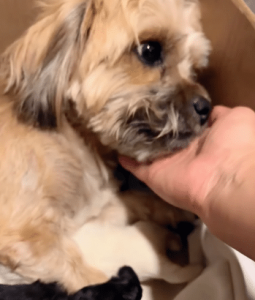
Days 13–39 — Feeding One Mother Meant Feeding an Entire Litter
Caring for nearly ten growing puppies placed enormous nutritional demands on the mother.
Every nursing session required energy from a body that had already arrived thin and depleted.
So her meals became a major part of the rescue plan.
Soft porridge was prepared with ingredients such as chicken, eggs, and pumpkin.
The goal was simple.
Give her enough nourishment to rebuild her own strength while continuing to feed her puppies.
Gradually, her body began responding.
Her frame filled out.
She appeared stronger when standing and moving.
Her coat improved.
And her behavior toward the rescuer became increasingly relaxed.
The cautious dog who once refused to eat until everyone moved away began greeting the familiar person differently.
Her tail wagged when the rescuer arrived.
She stayed closer.
She accepted affection.
Meanwhile, the puppies were changing almost every day.
Their eyes began to open.
Their legs became strong enough to support short, unstable attempts at walking.
Soon, the quiet nest was no longer quiet at all.
Tiny puppies began wobbling in different directions, bumping into one another and exploring whatever they could reach.
The family was no longer simply surviving the cold.
They were growing.
The Puppies Went From Shivering Together to Tumbling Over One Another
As the puppies became older, their dependence on their mother began changing.
Her milk naturally became less central to their diet.
The rescuer introduced soft porridge and goat milk to help them transition toward eating independently.
Mealtime quickly became messy.
Puppies stepped into bowls.
Pushed against one another.
Wandered away with food on their faces.
Then returned for more.
It was ordinary puppy chaos.
And compared with the first day in the bushes, ordinary felt extraordinary.
The newborns had once been almost completely helpless.
Now they were curious.
Noisy.
Mobile.
Their individual personalities became easier to notice as they played and explored.
The mother no longer had to supply every calorie they consumed.
That gave her body more opportunity to recover too.
Her condition continued improving while the puppies grew stronger.
But as the litter became bigger and more active, the temporary setup near the doorway was no longer enough.
The rescuer needed something more permanent.
Something built specifically for a family that was rapidly outgrowing every small space around them.
Days 47–77 — The Cardboard Windbreak Became a Three-Story Wooden Home
In the beginning, protection had meant pieces of cardboard arranged around a bush.
Weeks later, that temporary barrier was replaced by something far more substantial.
A wooden shelter was built for the dogs.
Not just a simple box.
A three-story wooden structure designed to give the growing puppies space while providing protection from rain and access to sunlight.
The contrast was difficult to miss.
The family had started beneath tangled branches, exposed to wind and cold.
Now they had a structure created specifically for them.
Inside, another part of growing up began.
Routine.
The puppies started learning where to sleep.
Where to eat.
And eventually, where they were expected to relieve themselves.
Potty training brought the predictable accidents.
Confusion.
Repeated guidance.
Then gradual improvement.
No one expected a litter of young puppies to understand everything immediately.
The same principle that had helped their mother applied to them too.
Consistency.
Show them.
Repeat.
Give them time.
Their world was becoming organized in a way the bushes could never have provided.
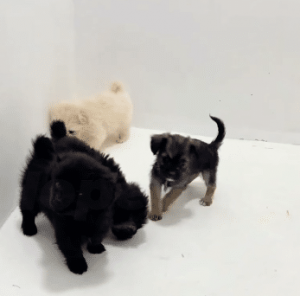
Their Mother No Longer Looked Like the Dog Who First Returned to the Bushes
By this stage, the mother’s transformation was easy to see.
Her coat had grown fuller and healthier.
The thinness that had marked her early days had softened.
She stood more confidently.
She moved around the puppies without the same visible exhaustion.
And when the rescuer approached, the interaction looked completely different from that first meeting.
There was no immediate retreat.
No long wait before approaching food.
The mother had become affectionate and familiar with the person who had continued showing up.
Her puppies reflected the same change in environment.
They raced around.
Played with one another.
Chased patches of sunlight.
Tumbled across the wooden floor.
The cold bush where their story began no longer had anything to offer them.
They had outgrown it physically.
And their new life had outgrown it in every other way too.
The Puppies Were Growing Toward Homes of Their Own
The documented story ends before every puppy’s final placement is shown.
What is clear is that the plan was to find carefully selected homes for them as they became ready.
That future required more than simply handing puppies to anyone who asked.
They had already survived a fragile beginning.
The next step needed to offer stability.
People willing to provide food.
Veterinary care.
Shelter.
Time.
And the commitment that comes with raising a puppy into an adult dog.
Until then, the litter remained under the rescuer’s care.
Growing.
Learning.
Playing.
The mother continued watching over them, but she no longer had to manage every threat alone.
Food did not depend on finding scraps.
Shelter did not depend on the shape of a bush.
If rain came, there was a roof.
If the puppies became hungry, someone noticed.
If something seemed wrong, someone was close enough to respond.
That may be the biggest transformation in the entire story.
Not the grooming.
Not the wooden house.
Not even the puppies learning to walk.
It was the replacement of uncertainty with routine.
One Windbreak Became the Beginning of an Entire New Future
The first act of help in this story was remarkably small.
A person heard faint sounds inside a bush.
They looked closer.
They found newborn puppies.
Then their mother returned.
She was cautious.
Thin.
Matted.
And unwilling to trust immediately.
So the rescuer did not demand trust.
Food was placed down.
Cardboard was arranged to reduce the wind.
Then the person left.
And came back.
Again.
And again.
Those repeated visits created everything that followed.
The mother eventually accepted touch.
She received a bath and grooming.
Her nutrition improved.
Her puppies grew.
Soft food replaced complete dependence on milk.
A proper wooden shelter replaced the bushes.
Training replaced chaos little by little.
And a frightened mother who once watched every movement from a distance became comfortable enough to greet her caregiver with a wagging tail.
The puppies’ story is still moving toward its final chapter.
Homes still need to be chosen carefully.
But the most dangerous part of their beginning is already behind them.
Once, a cluster of newborn puppies shivered beneath branches while their exhausted mother tried to keep them alive outdoors.
Now they have food.
Shelter.
Space to grow.
And people thinking about what happens to them tomorrow.
Their rescue did not begin with a dramatic emergency operation.
It began with a sound almost too faint to hear.
A few pieces of cardboard.
A meal left at a safe distance.
And one person who kept coming back.


