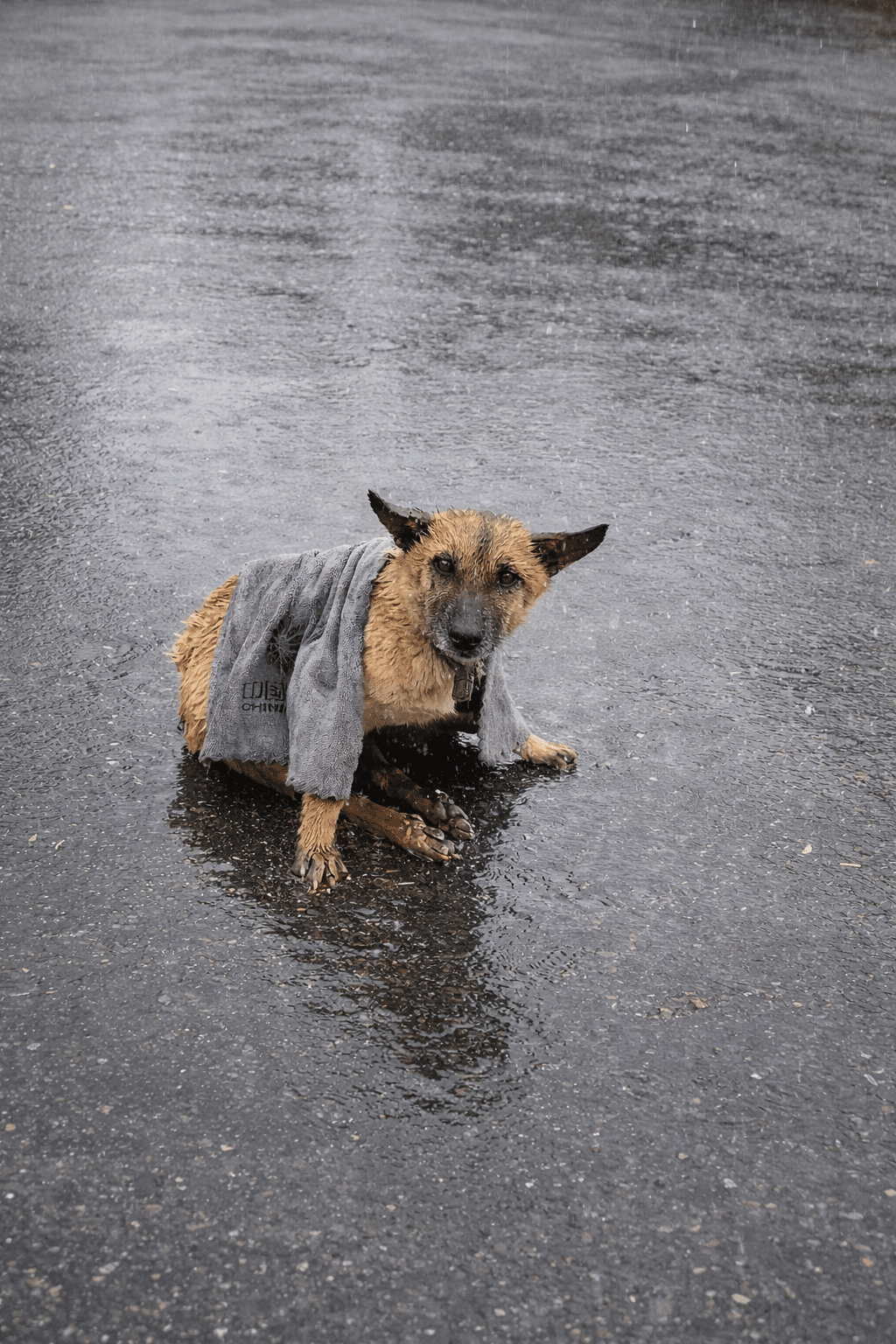
The rain had turned the road into a sheet of gray.
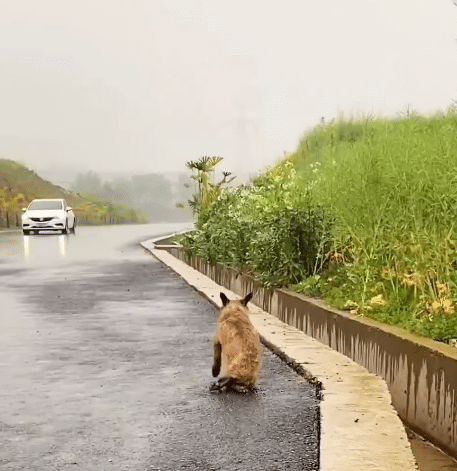
Cars rushed past, spraying water across the pavement, while a small dog struggled forward in the middle of it all.
He was not running.
He could not.
His front legs pulled desperately against the wet asphalt while his hindquarters dragged behind him, almost completely unresponsive. Every few feet, he stopped to gather whatever strength remained before forcing himself forward again.
Vehicles continued passing.
Some came frighteningly close.
Yet the little dog kept moving.
Not because he knew where he was going.
Perhaps only because stopping in the middle of that road felt even more dangerous.
Then one driver noticed him.
And unlike everyone who had already disappeared into the rain, this man chose to stop.
A Small Body Fighting Against the Storm
From a distance, the dog could have been mistaken for debris on the wet road.
But as the man slowed his vehicle, he realized the shape was moving.
The dog was pulling himself forward using only his front legs.
His hind legs remained stretched behind him, scraping against the rough pavement with every movement. The repeated friction had already damaged the skin along his lower body. Fur was missing in several places, and irritated areas showed how long he may have been moving this way.
Whenever another vehicle approached, the dog tried to shift toward the side of the road.
The effort looked exhausting.
He would pull.
Pause.
Then pull again.
Rainwater soaked what remained of his coat.
There was no shelter nearby and no sign of anyone searching for him.
The man could easily have continued driving.
Instead, he parked.
Then he stepped out into the rain.
He approached slowly, knowing an injured animal might react unpredictably when frightened.
The dog watched him carefully.
He did not run because he could not.
But he did not attempt to attack either.
The man held out a small piece of sausage.
For a moment, the dog hesitated.
Then hunger won.
That tiny decision—to accept food from a stranger—became the first step toward a completely different life.
VIDEO: From Dragging Himself Through the Rain to Running on Wheels — Fubao’s Fight for a Second Chance
The Stranger Who Refused to Leave Him There
Once the dog allowed him close enough, the man carefully lifted him from the road.
Up close, his condition was even more concerning.
His lower body showed the consequences of being dragged across hard surfaces. Dirt had worked into damaged skin, increasing the risk of infection. He was exhausted, wet, and clearly in need of medical attention.
The man brought him somewhere safe first.
A clean crate gave the frightened dog a secure place to rest while warm food, towels, and basic wound care were prepared.
Despite everything happening around him, the dog remained remarkably quiet.
He did not snap when his injuries were examined.
He did not struggle violently against the hands trying to clean him.
Instead, he seemed to watch.
Carefully.
As though trying to understand whether these unfamiliar hands represented another danger—or something he had not felt in a very long time.
Safety.
The dog would eventually be named Fubao.
But before anyone could think about his future, they needed to understand what had happened to his body.
The next stop was the veterinary clinic.
The Scans Revealed How Serious His Injuries Were
Veterinary imaging showed that Fubao’s condition went far beyond injuries caused by dragging himself across the road.
He had suffered a spinal fracture.
There were also multiple fractures affecting one of his hind legs, along with significant trauma involving the spinal cord.
Those injuries explained why his back legs were not functioning normally.
For his rescuer, the results were difficult to hear.
There would be no simple treatment followed by a quick return to normal movement.
Fubao would need extended care.
He would need rehabilitation.
He would need help protecting his lower body from additional injuries.
And even with treatment, no one could promise exactly how much function he might eventually regain.
His rescuer understood all of that.
He chose to continue anyway.
Fubao had already survived the road.
Now someone was willing to give him the chance to discover what life beyond it might look like.
Recovery Began With Small, Patient Steps
Fubao’s rehabilitation started carefully.
Because of the severity of his spinal injuries, every treatment had to consider both comfort and safety.
His veterinary team introduced therapies that included laser treatment and acupuncture as part of the rehabilitation process.
There were no overnight miracles.
Some days were simply about keeping wounds clean.
Others were about making sure he ate enough.
Proper nutrition became especially important because Fubao had arrived underweight and weakened by whatever he had endured before being found.
Meals began helping restore his strength.
The damaged skin along his lower body slowly changed as well.
Inflamed areas became less angry.
Scabs formed over places that had once been exposed.
Eventually, thin new fur appeared.
These improvements may have seemed ordinary compared with the dramatic moment of his rescue.
But recovery is often built from ordinary things.
A full meal.
A clean bed.
A wound that looks slightly better than yesterday.
Another night without having to sleep alone in the rain.
Fubao received all of them.
And gradually, his body began responding to the consistency of care.
His Rescuer Had to Build a New Way for Him to Move
Standard rehabilitation exercises were difficult in the beginning.
Fubao could not simply be encouraged to stand and walk like an otherwise healthy dog recovering from a minor injury. His damaged spine and lower body needed support.
So his rescuer created something specifically for him.
Using wood and small wheels, he built a simple rehabilitation frame that could hold Fubao’s body off the ground.
The device accomplished something extremely important.
It allowed him to move without continuously dragging injured skin across rough surfaces.
At first, Fubao did not seem to know what to do with it.
His body trembled as he adjusted to the strange support beneath him.
He tried to balance.
Then he tried again.
Slowly, his front legs began pulling the frame forward.
For perhaps the first time in a long while, movement did not mean grinding his lower body against pavement.
That changed everything.
Within roughly a month, Fubao had gained more than three kilograms.
His skin continued healing.
His strength improved.
And his caregivers began noticing small movements that had not been obvious before.
A slight response in his tail.
A subtle movement in one of his hind legs.
No one treated these signs as a guarantee that he would regain normal use of his legs.
But they were encouraging enough to keep everyone working.
Fubao was stronger.
He was more comfortable.
And, most importantly, he was beginning to participate in life around him.
The Day Wheels Became Freedom Instead of Limitation
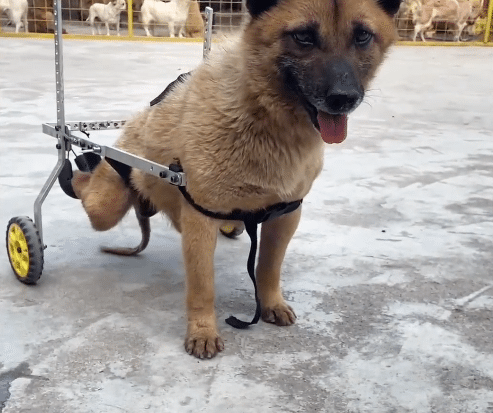
Eventually, Fubao was ready for a proper canine wheelchair.
For many people, seeing a dog placed in a wheelchair can initially feel heartbreaking.
For Fubao, it became the opposite.
It meant freedom.
The first time he moved across open ground with his body properly supported, there was no painful dragging behind him.
His front legs could finally do what they had been trying to do on that rainy highway—
carry him forward.
Only now, the wheels carried the rest of him too.
His posture changed.
He lifted his head.
He began exploring instead of merely surviving.
Grass replaced wet asphalt beneath his wheels.
Open space replaced speeding traffic.
Soon, Fubao encountered other dogs who also used mobility devices.
And something wonderful happened.
They played.
They moved across the ground together, following one another in wide turns and awkward little races.
None of them moved exactly like an able-bodied dog.
That did not seem to matter.
Fubao could chase.
He could investigate.
He could choose where he wanted to go.
The dog who once struggled simply to move out of the path of approaching cars now had control over his direction again.
That may have been one of the greatest gifts his rescuer could give him.
He Did Not Need Four Working Legs to Enjoy His Life
Fubao’s recovery did not become a story in which every injury disappeared.
His spinal trauma remained part of his life.
His mobility was different.
He continued relying on support to move comfortably.
But somewhere along the way, the question changed.
It was no longer:
Will Fubao ever become exactly the dog he might have been before his injuries?
Instead, the people around him began seeing something much more important.
He could still have a good life.
He could enjoy attention.
He could eat eagerly.
He could explore outdoors.
He could interact with other dogs.
He could become excited when someone prepared his wheels.
And he could move through the world without scraping his body painfully against the ground.
Animals do not measure their lives against the version that might have existed.
They respond to the life in front of them.
For Fubao, that life now included people who protected him, equipment that supported him, and enough security to become curious again.
His wheelchair did not erase what happened.
It simply gave him another way forward.
From a Rain-Soaked Highway to a Yard Filled With Possibility
Later footage of Fubao looks almost impossible when compared with the first moments on the road.
The tiny dog who once dragged himself through pouring rain now moves confidently across a yard.
The wheels beneath him turn smoothly.
His front legs carry him with surprising speed.
His head remains raised, watching everything around him.
There is no traffic rushing inches away.
No soaked pavement beneath his wounded body.
No need to pull himself desperately toward the roadside.
He still carries scars.
He still lives with the consequences of serious injuries.
But he no longer faces those challenges alone.
Someone prepares his meals.
Someone checks his body.
Someone helps him into his wheels.
Someone notices when he needs rest.
And each time Fubao moves across the grass, he leaves the image of that flooded highway a little farther behind.
One Driver Changed the Direction of His Life
Fubao’s story did not begin with an extraordinary medical breakthrough.
It began with something much simpler.
A man saw an injured dog.
And stopped.
That decision did not instantly fix Fubao’s spine.
It did not erase his fractures.
It did not guarantee that his back legs would work normally again.
What it did was give him access to everything that came afterward.
Warmth.
Food.
Veterinary care.
Rehabilitation.
Mobility.
Companionship.
And time.
There were likely many cars on that road before Fubao was rescued.
Perhaps some drivers did not notice him.
Perhaps others noticed but did not know what to do.
One person finally chose to pull over.
And because he did, a dog who was dragging himself through the rain was given the chance to move forward in an entirely different way.
Today, when Fubao rolls freely across the yard, it is easy to focus on the wheelchair.
But perhaps the most important part of his story is not the equipment beneath him.
It is the person who first knelt beside him.
Rescue does not always begin with knowing how everything will turn out.
Sometimes it begins with seeing suffering and deciding that walking—or driving—away is no longer an option.
Fubao may never move exactly as other dogs do.
He does not need to.
He has food when he is hungry.
Shelter when the rain comes.
A safe place to rest.
And wheels that carry him toward whatever catches his curiosity next.
Once, he dragged himself through a storm while the world rushed past.
Then one person stopped.
And from that moment forward, Fubao no longer had to face the road alone.


