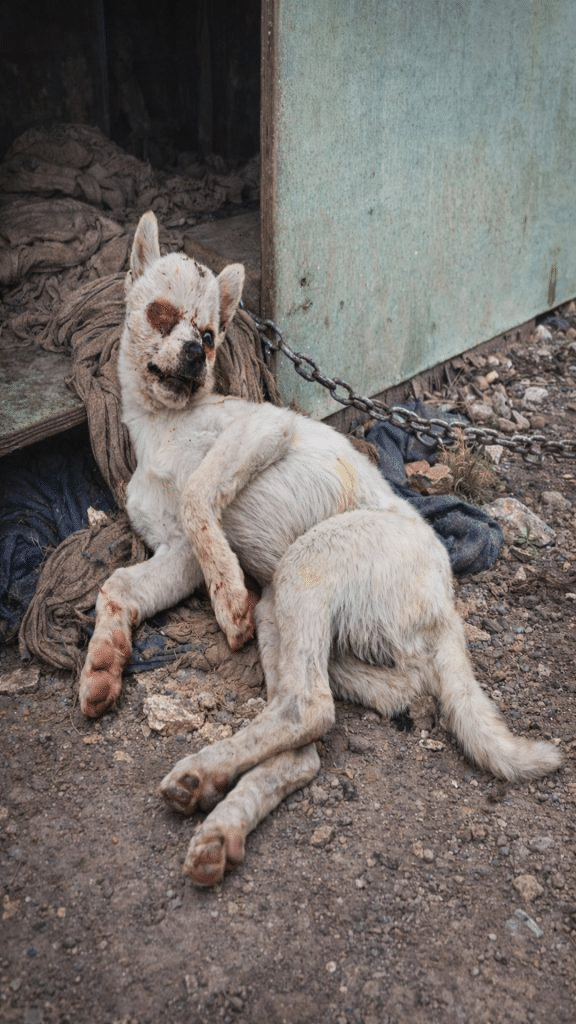
When rescuers first reached Chico, no one was thinking about adoption.
No one was imagining him running through a yard or sleeping peacefully inside a home.
At that moment, the only question was much smaller.
Could he make it through the night?
Chico had suffered serious trauma, and his body was struggling under the weight of it. He was weak, frightened, and in need of immediate veterinary care.
There were no promises.
No easy predictions.
Only a team of people moving quickly because every hour mattered.
Then, the following day, something happened.
Chico opened his eyes.
It was not dramatic.
It was barely a movement.
But for everyone watching him, it was the first sign that the story might not end where they had feared.
Rescue Came When Chico Had Almost Nothing Left
People nearby had heard distressed cries and contacted animal advocates for help.
By the time rescuers arrived, Chico’s condition was serious enough that there was little reason to delay.
He needed medical attention immediately.
His injuries had left him physically overwhelmed, and even ordinary movement appeared difficult.
There was no way to know exactly how recovery would unfold.
The rescuers only knew that leaving him where he was could not be an option.
So Chico was carefully transported for emergency veterinary care.
Inside the clinic, the atmosphere remained cautious.
The team focused first on the basics.
Stabilize him.
Manage his pain.
Help his body get through the immediate crisis.
There would be time later to think about rehabilitation.
For now, survival came first.
VIDEO: Chico’s Journey From Severe Trauma to a Home With the Veterinarian Who Helped Him Heal
The Next Morning, Chico Opened His Eyes
The first night was about observation.
Chico needed rest.
He needed treatment.
And he needed his body to respond.
Then came the next morning.
His eyes opened.
For a healthy dog, it would have been an ordinary movement.
For Chico, it carried far more meaning.
He began reacting gently to familiar voices around him.
His temperature became steadier.
He managed small amounts of food.
None of these things meant that the danger had completely passed.
But together, they showed that Chico was still responding.
His caregivers had something they could build on.
Recovery was possible enough to keep going.
And so they did.
Recovery Was Measured in Inches, Not Miracles
Chico’s body could not be rushed.
The injuries he had suffered meant rehabilitation had to happen gradually.
Doctors and caregivers worked within what he could tolerate.
At first, even standing was difficult.
He needed support.
He needed time to understand how to balance again.
Then came a small improvement.
Chico managed to remain upright for a little longer.
Later, he took a few uncertain steps.
They were not smooth.
They were not fast.
But they were his.
Each new movement showed that strength was returning.
Recovery did not move in a straight line.
There were difficult days.
There were sessions where progress seemed almost invisible.
But the team did not measure Chico against the dog they hoped he might eventually become.
They measured him against yesterday.
One more second standing.
One more step.
One little improvement in coordination.
That was enough.
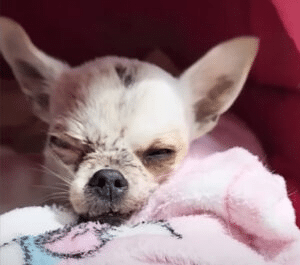
He Also Had to Learn That Touch Could Feel Safe
Chico’s recovery was not only physical.
The people around him understood that medical treatment alone would not answer everything he needed.
He had been through something frightening.
So caregivers approached carefully.
Voices stayed low.
Movements stayed slow.
When Chico appeared uncomfortable, they gave him space.
He was not forced into affection.
Trust had to be allowed to develop.
Over time, Chico began responding differently.
He relaxed more during treatment.
He became less guarded around familiar people.
Then he began leaning into gentle touch.
Those moments mattered because they were choices.
Chico could move away.
Instead, sometimes, he stayed.
The more predictable his environment became, the easier it was for him to understand that these people were there to help.
Food arrived regularly.
Treatment happened gently.
Hands did not have to mean pain.
That lesson took time.
But Chico was learning it.
The Dog Hidden Beneath the Trauma Began to Return
As the weeks passed, the changes became easier to see.
Chico grew stronger.
He became more alert.
His coordination improved.
And the dog who had spent his earliest days focused almost entirely on surviving began noticing more of the world around him.
He recognized familiar faces.
He showed interest when caregivers entered.
He approached treatment sessions with less hesitation.
His personality began emerging little by little.
There was curiosity.
There was affection.
There was a growing willingness to interact.
This was the part of rescue that could not be captured by medical charts alone.
The numbers might show physical improvement.
But the people around Chico could see something else.
He was becoming engaged with life again.
He was no longer simply receiving care.
He was participating in it.
One Veterinarian Became More Than His Doctor
During Chico’s recovery, one person was there through much of the process.
The veterinarian overseeing his treatment watched him change from a critically injured dog into one who was beginning to trust, move, and respond to affection.
At first, their relationship was clinical.
Chico was a patient.
He needed treatment.
She provided it.
But recovery creates countless small moments.
Another examination.
Another therapy session.
Another meal.
Another day when Chico showed a little more confidence.
Over time, familiarity became connection.
Chico recognized her.
He responded to her presence.
And she became increasingly attached to the dog she had watched fight through one difficult stage after another.
The bond did not appear in one dramatic moment.
It grew through repetition.
Care.
Patience.
And time spent together when Chico was at his most vulnerable.
Eventually, the relationship no longer felt temporary.
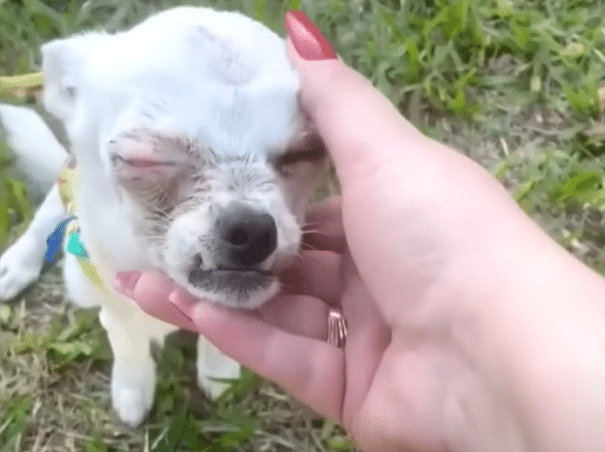
Two Months Later, Chico Went Home With Her
Roughly two months after his rescue, Chico’s life changed again.
This time, there was no emergency vehicle.
No clinic crisis.
No struggle simply to remain stable.
He was ready for a home.
And the veterinarian who had helped guide him through recovery made the decision to adopt him.
The person who had treated him would now become the person waiting for him at home.
For Chico, the transition meant something he had not been able to count on before.
Continuity.
The familiar voice from the clinic did not disappear when treatment ended.
The familiar hands remained.
The care continued.
Only now, it took place somewhere quieter.
Somewhere Chico could rest without being a patient.
He had a home.
He Finally Got to Experience Ordinary Days
Once, Chico’s days were defined by treatment.
Medication.
Therapy.
Careful monitoring.
Gradually, those things stopped being the center of his life.
Ordinary routines replaced them.
Resting.
Eating.
Walking.
Spending time with the person he trusted.
The change may sound simple.
That is precisely what made it meaningful.
A peaceful day can feel unremarkable until you remember where an animal began.
Chico had once been in such serious condition that his caregivers were watching for the smallest response.
An eye opening.
A bite of food.
A steadier temperature.
Now, those moments belonged to the past.
He had room to do something much easier.
Live.
Chico’s Story Was Built From People Who Stayed
It is easy to look at Chico later and focus only on how far he came.
But his recovery did not happen because of one dramatic breakthrough.
It happened because care continued.
Someone responded when help was needed.
Veterinary professionals stabilized him.
People monitored him through the fragile first days.
Therapy continued when progress was slow.
Caregivers gave him space when fear surfaced.
And one veterinarian remained part of his life even after the medical crisis was over.
Chico’s story is not about pretending that suffering disappears once an animal is rescued.
Recovery takes time.
Bodies need time.
Trust needs time.
Sometimes progress is almost too small to notice.
One opened eye.
One careful meal.
One uncertain step.
One moment of leaning into a gentle hand.
Then another.
And another.
Until eventually, those small moments become a completely different life.
Chico did not go from trauma to safety in a single leap.
He got there slowly.
Supported by people who kept showing up.
And in the end, the veterinarian who helped him survive did something even more lasting.
She gave him somewhere to stay.


