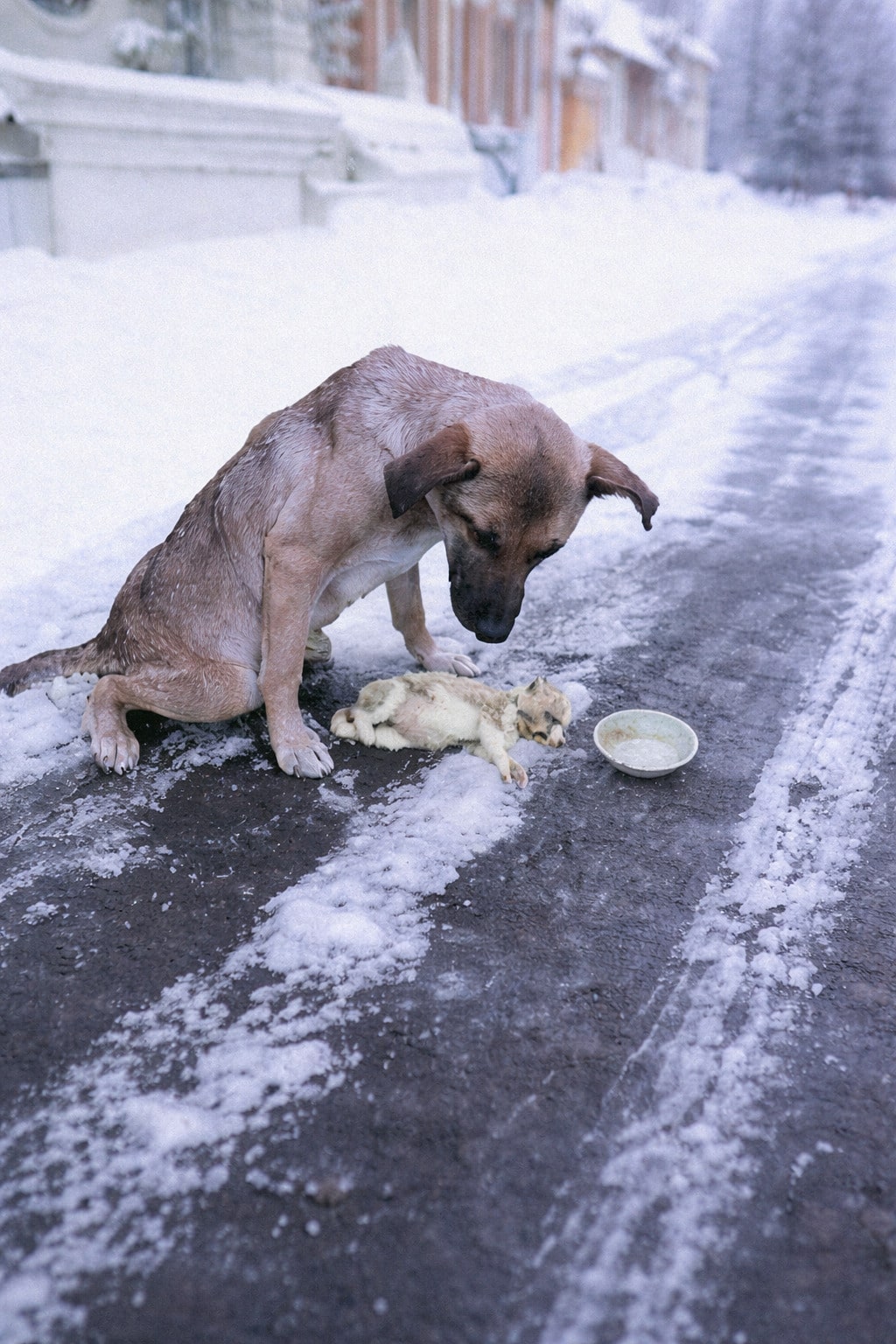
The winter road was already quiet when rescuers found her.
A mother dog lay in the snow, her body trembling from cold and exhaustion.
Her back legs would not move.
Beside her was her puppy.
She had survived a traffic accident, but she had not gone anywhere afterward.
Whether because she could not move or because she stayed close to her baby, Alpha remained there as the temperature dropped around them.
By the time help arrived, both had already endured far too much.
The puppy did not survive.
Alpha was still alive.
Barely.
And what rescuers saw in those first moments made one thing clear:
Getting her out of the snow was only the beginning.
She Had Been Left With No Way to Stand
Alpha’s body was exhausted when the rescue team reached her.
She was cold.
Weak.
Barely responsive.
Her hind legs were not functioning normally, and she could not simply rise and walk away from the road.
The accident had clearly caused more than superficial injuries.
Still, she remained conscious enough to respond when people approached.
The rescuers moved quickly.
There was no reason to keep her outside any longer.
She needed warmth.
She needed imaging.
She needed veterinary care before anyone could understand how much damage had been done.
Alpha was transported to a clinic.
And there, the seriousness of the injury became clearer.
VIDEO: Alpha Couldn’t Move Her Back Legs — Watch Her 60-Day Journey Back to Her Feet
The Exams Revealed a Serious Spinal Injury
Veterinary imaging confirmed significant damage involving Alpha’s spine.
The injury was severe enough to affect movement in her hindquarters.
There were also additional complications visible on examination, making the situation more serious than rescuers had first hoped.
At that point, waiting was not considered the safest option.
Surgery was needed.
The procedure was intended to relieve pressure and stabilize the injured area as much as possible.
But even after surgery, no one could promise what Alpha’s mobility would look like later.
She might improve.
She might regain partial function.
She might remain unable to walk normally.
The medical team could create the best conditions possible.
The rest would depend on how her body responded.
Surgery Gave Her a Chance — Not a Guarantee
Alpha came through the operation.
That was the first major step.
But surgery did not suddenly restore movement to her back legs.
Her spine still needed time.
Her muscles had already weakened.
Her body had also been through cold, trauma, stress, and the loss of her puppy.
So the next stage of care became quieter.
Rest.
Monitoring.
Pain management.
Nutrition.
And then, when she was ready, rehabilitation.
The goal was not to force Alpha onto her feet.
It was to help her body begin moving again without placing more pressure on the injured spine than it could handle.
That meant starting somewhere safer.
Water.
Water Therapy Let Her Move Without Carrying Her Full Weight
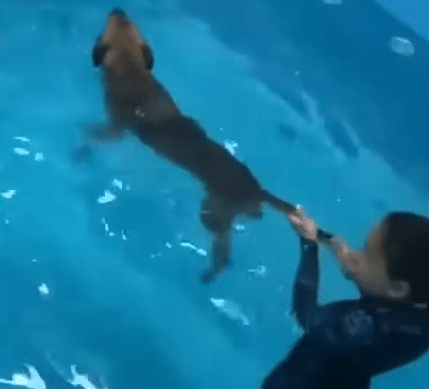
Hydrotherapy became part of Alpha’s rehabilitation.
In water, her body did not have to carry the same load it would on dry ground.
That gave her a chance to practice movement while reducing pressure on her weakened hindquarters.
The first sessions were careful.
Supported.
Controlled.
Alpha remained calm around the people assisting her.
She responded to familiar voices and tolerated the handling required for therapy.
There was no dramatic leap from paralysis to walking.
Only repeated movement.
Small attempts.
Muscles being asked to work again.
One session followed another.
The changes were subtle at first.
But the team kept going.
Then Came Assisted Treadmill Work
As Alpha progressed, rehabilitation became more demanding.
Support straps helped hold part of her weight while she practiced movement on a treadmill.
Her legs still needed guidance.
Balance remained difficult.
But the exercises allowed her to repeat the basic pattern of walking.
Step.
Support.
Adjust.
Repeat.
Meanwhile, other parts of her recovery were moving forward too.
Her appetite improved.
She began gaining weight.
Her overall strength increased.
The dog who had arrived shaking in the snow now had enough energy to participate actively in therapy.
Every session was still work.
But Alpha was no longer simply being stabilized.
She was rebuilding.
Around the Sixth Week, Alpha Stood
Then came the moment everyone had been waiting for.
Around six weeks into recovery, Alpha stood.
Not for long.
Not perfectly.
Her legs trembled.
Her balance was uncertain.
But she was upright.
Without the snow beneath her.
Without the road.
Without someone carrying her entire weight.
For a dog whose hind legs had once been unable to support her, a few seconds of standing represented a major change.
From there, rehabilitation continued.
Daily exercises helped strengthen weakened muscles.
Gentle massage supported mobility.
Assisted walking gave Alpha more opportunities to practice.
One successful stand became another.
Then a few steps.
Then more.
Sixty Days Later, She Was Moving in Ways No One Could Promise at the Beginning
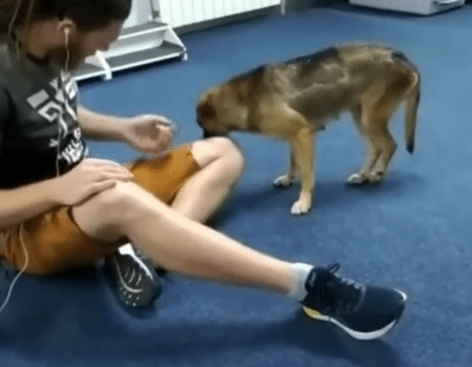
By roughly the two-month mark, Alpha’s progress was difficult to miss.
She could walk.
Then trot.
Then manage short runs.
She could even climb stairs.
None of those things had been guaranteed when she first arrived.
The medical team had known only that the spinal injury was severe and that treatment would take time.
Now Alpha was moving freely enough to explore.
At the rescue center, she interacted with other dogs.
Her tail moved easily.
She greeted familiar people with far more energy than the exhausted dog first carried in from the winter road.
Her recovery had not erased what happened.
It had given her a body capable of moving forward again.
The Most Important Part Was Everything Between the Snow and the Running
Before-and-after images can make recovery look sudden.
Alpha’s was not.
There were many steps between the dog lying in the snow and the dog climbing stairs.
Emergency transport.
Imaging.
Spinal surgery.
Rest.
Hydrotherapy.
Supported treadmill work.
Nutrition.
Weight gain.
Massage.
Repeated exercises.
The first unsteady stand.
Then the first steps that followed it.
Sixty days of care cannot be reduced to one dramatic moment.
Alpha improved because people kept working through the ordinary days too.
The days when she could not stand.
The days when progress was hard to see.
The days when therapy meant repeating the same movement one more time.
Those days built the outcome.
Alpha’s Story Did Not End on the Winter Road
The first chapter of Alpha’s rescue was painful.
A traffic accident.
Snow.
A body that could no longer move normally.
A puppy who did not survive.
Those facts do not disappear because Alpha later recovered.
But they also do not define everything that came afterward.
People stopped.
She reached a veterinary clinic.
Surgeons gave her spine a chance to heal.
Therapists helped her relearn movement.
Caregivers continued through weeks of slow progress.
And eventually, Alpha stood.
Then walked.
Then ran.
The difference between those two versions of her life was not one miracle.
It was sixty days of continued care.
Once, Alpha could not lift her hindquarters from the snow.
Two months later, she was climbing stairs.
And every step she took carried her farther from the road where rescuers first found her.


