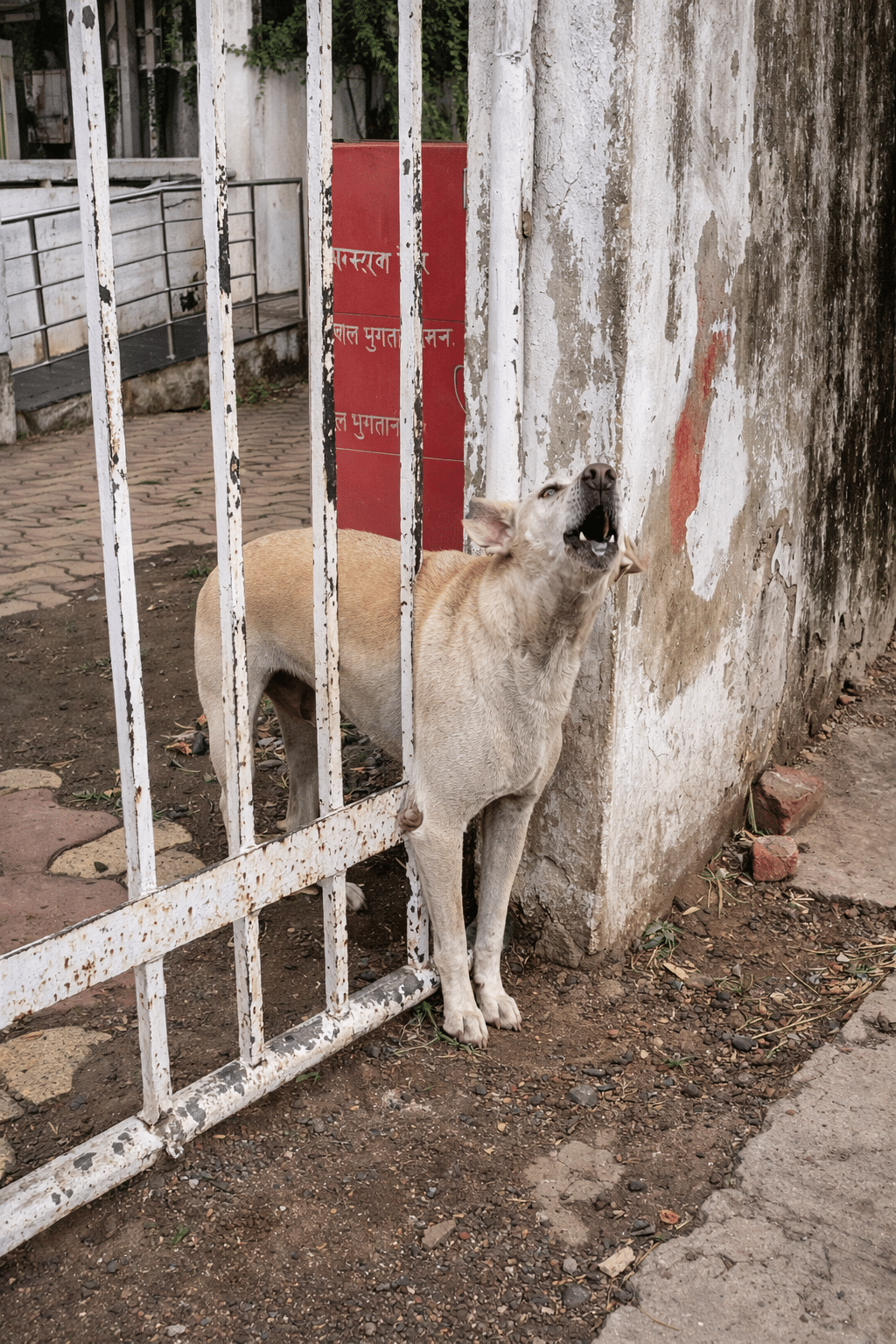
From a distance, almost everything about him said: stay away.
A stray dog stood behind a white metal gate, barking loudly at anyone who came near. His body was tense. His eyes were wide. His teeth flashed whenever someone moved closer.
To an unfamiliar person, it could easily look like aggression.
But there was something wrong with the scene.
The dog was not pacing behind the gate.
He was not guarding anything.
He could barely move at all.
Only when people stepped closer did they finally understand why.
His body was wedged tightly between the metal bars.
The barking was not coming from a dog looking for a fight.
It was coming from a frightened animal who could not free himself.
He Had Somehow Become Trapped Halfway Through the Gate
No one knew exactly how it happened.
Perhaps he had tried to squeeze through the narrow opening while searching for food.
Perhaps something frightened him and he pushed forward too quickly.
Whatever the reason, he had gone far enough through the gate to become stuck.
But not far enough to escape.
His chest and ribs were pressed between the rigid metal bars.
His front legs were trapped on one side.
The rest of his body remained on the other.
When he tried to pull backward, the gate stopped him.
When he pushed forward, there was nowhere for his body to go.
Every attempt seemed to increase his panic.
So the dog used the only defense he still had.
His voice.
He barked repeatedly whenever someone approached.
His body tightened.
His mouth opened.
To anyone who saw only those few seconds, he might have appeared dangerous.
But the closer people looked, the clearer the situation became.
He was scared.
He was stuck.
And he had no idea whether the humans coming toward him intended to help.
Video: Rescuers Approach the Barking Dog and Discover Why He Cannot Move
The Rescue Team Knew They Could Not Simply Grab Him
Staff at the building quickly called for assistance.
Soon afterward, rescuers from Rescue Foundation Gujarat arrived.
The easiest mistake would have been to rush toward the dog and begin pulling.
They did not.
Instead, the team stopped and watched.
They examined how his body was positioned inside the gate.
They observed his reactions.
And they allowed themselves time to understand how frightened he had become.
The dog continued barking.
His eyes followed every movement.
Whenever a person moved closer, his body became visibly tense.
At moments, he showed his teeth.
The rescuers treated those signals seriously.
A trapped animal can react unpredictably, even when people are trying to help.
Pain, fear, and the inability to escape can turn an ordinary touch into something terrifying.
So the team needed a way to protect themselves without making the dog’s panic worse.
They moved slowly.
They kept their voices calm.
And they avoided surrounding him unnecessarily.
The goal was not to overpower him.
The goal was to create enough control to free him safely.
They Used Restraint for Safety, Not Punishment
Because the dog was frightened enough to bite in panic, the rescuers used a humane catch pole.
It allowed them to keep a safer distance while gently controlling the position of his head.
They were not trying to hurt him.
They were trying to prevent sudden movement from injuring either the dog or the people helping him.
A volunteer then carefully placed a soft cloth around his muzzle as a temporary restraint.
For a moment, the scene could have looked alarming to someone unfamiliar with rescue work.
But the reason was simple.
The dog did not understand what was happening.
If pain or fear caused him to snap suddenly, someone could be injured, and the rescue itself might become much more difficult.
The cloth reduced that risk.
Once everyone was safer, the team could work more slowly.
They spoke gently.
Small pieces of food were offered.
The dog was given time to breathe between each movement.
Gradually, the constant barking began to fade.
His body was still tense.
But he was no longer reacting to every movement with the same intensity.
That small change was enough.
Now the rescuers could focus on the hardest part.
Getting him back through the gate.
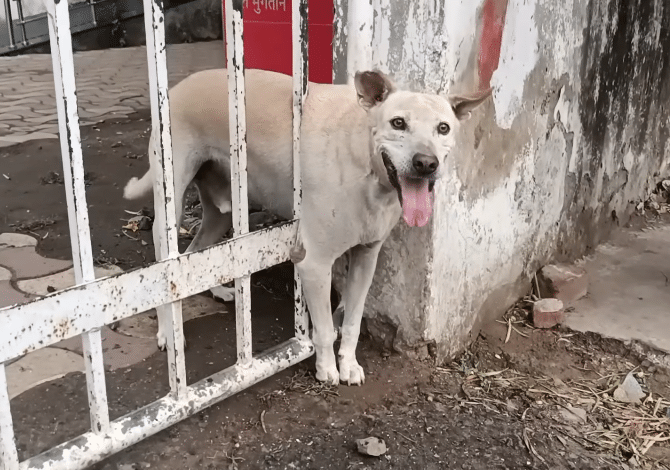
There Was Only One Way Out
The opening that had trapped the dog was extremely narrow.
There was no simple door to open.
No wide gap that could suddenly be created.
The rescuers had to guide his body back through almost the same route he had taken while getting stuck.
That required precision.
His head and front legs had to be positioned carefully.
His body needed to move in the correct direction without placing unnecessary pressure on his ribs.
Nearby people joined the effort.
But nobody pulled wildly.
One wrong movement could frighten the dog again or make his position worse.
So they worked little by little.
A small adjustment.
Pause.
Another movement.
Pause again.
The dog remained restrained while hands carefully guided him.
For several tense moments, nothing seemed to change.
His body was still caught.
The metal was still holding him.
Then his position shifted.
A little more.
Another careful movement.
And suddenly, the pressure released.
His body slipped backward through the bars.
He was free.
The Moment He Was Released, He Ran
There was no dramatic pause.
No instant show of affection.
No dog turning around to calmly thank the people who had just rescued him.
As soon as the restraint was removed and he realized he could move again, he ran.
Fast.
Away from the gate.
Away from the people.
Away from the entire situation.
For some viewers, that reaction might seem surprising.
But freedom does not instantly erase fear.
Only moments earlier, this dog had been trapped in metal, surrounded by unfamiliar humans, restrained, touched, and physically guided out of a frightening position.
He could not understand the rescue in the same way a person watching the scene could.
He only knew that he could finally move.
And his instinct told him to create distance.
So the rescuers let him go.
They did not chase him.
They did not force another interaction.
The immediate emergency was over.
That was enough for the moment.
They Came Back Without Asking Anything From Him
The rescuers did not forget about the dog after freeing him.
Later, they returned to the area.
But this time, there was no catch pole.
No need for restraint.
No attempt to corner him.
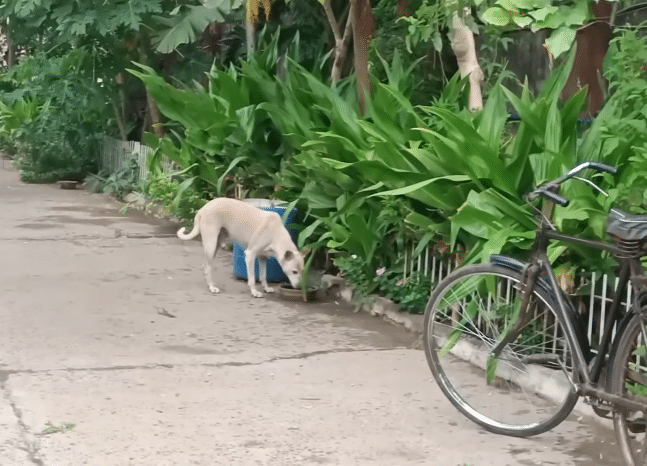
They simply brought food and water.
The supplies were placed in a safer location nearby, giving the dog the choice to approach when he felt comfortable.
That choice mattered.
During the rescue, control had been necessary because his life and safety depended on it.
Now that he was free, the situation was different.
Trust could not be forced.
It had to be offered.
So they gave him space.
Over time, the dog’s behavior appeared to change.
His posture became less rigid.
The intense barking diminished.
He seemed less focused on scanning every movement around him.
There was no single dramatic moment when fear disappeared.
Instead, the tension eased gradually.
A safe distance.
A meal.
Water.
Another peaceful encounter.
For a stray dog accustomed to uncertainty, those quiet experiences could begin to teach something new.
Not every person approaching meant danger.
Fear Can Wear a Very Convincing Disguise
The most memorable part of this rescue may not be the moment the dog slipped free.
It may be the way he looked before anyone understood what was happening.
Loud barking.
Bared teeth.
A tense body.
Those signals can make people immediately label a dog as aggressive.
Sometimes that judgment is necessary for safety.
But it does not always explain the whole story.
This dog could not retreat.
He could not create distance.
His body was physically stuck between metal bars.
So when strangers approached, he used the only warning signals he had left.
He barked.
He showed his teeth.
He tried to make the frightening situation stop.
Once rescuers recognized what was underneath that behavior, their response changed.
They did not punish the barking.
They did not interpret fear as bad behavior.
They protected themselves while still treating the dog gently.
That balance allowed the rescue to succeed.
Video: The Frightened Stray Is Finally Guided Free From the Metal Gate
The Dog Everyone Was Afraid to Approach Only Needed a Way Out
For a few frightening minutes, the white gate had turned into a trap.
The dog’s body could not move forward.
It could not move backward.
People gathered nearby.
His fear increased.
And the more frightened he became, the more dangerous he appeared.
It would have been easy to see only the barking and walk away.
Instead, someone noticed the problem.
Building staff called for help.
The rescue team arrived.
They assessed the situation rather than reacting to the noise.
They used temporary restraint when necessary.
They guided him carefully through the narrow opening.
Then, when he was finally free, they gave him the space to run.
Later, they came back with something simpler.
Food.
Water.
And no demands.
The dog did not need to become affectionate for the rescue to matter.
He did not need to understand what the humans had done.
He only needed them to see beyond the behavior long enough to recognize the truth.
He was not standing behind that gate looking for someone to attack.
He was trapped inside it, terrified and unable to escape.
Sometimes fear looks quiet.
Sometimes it looks like trembling.
And sometimes it arrives with loud barking, exposed teeth, and a desperate warning to stay back.
That is why this dog’s story is worth remembering.
The frightening dog behind the gate was not asking to be judged.
He was asking, in the only way he knew how, for someone to help him get free.


