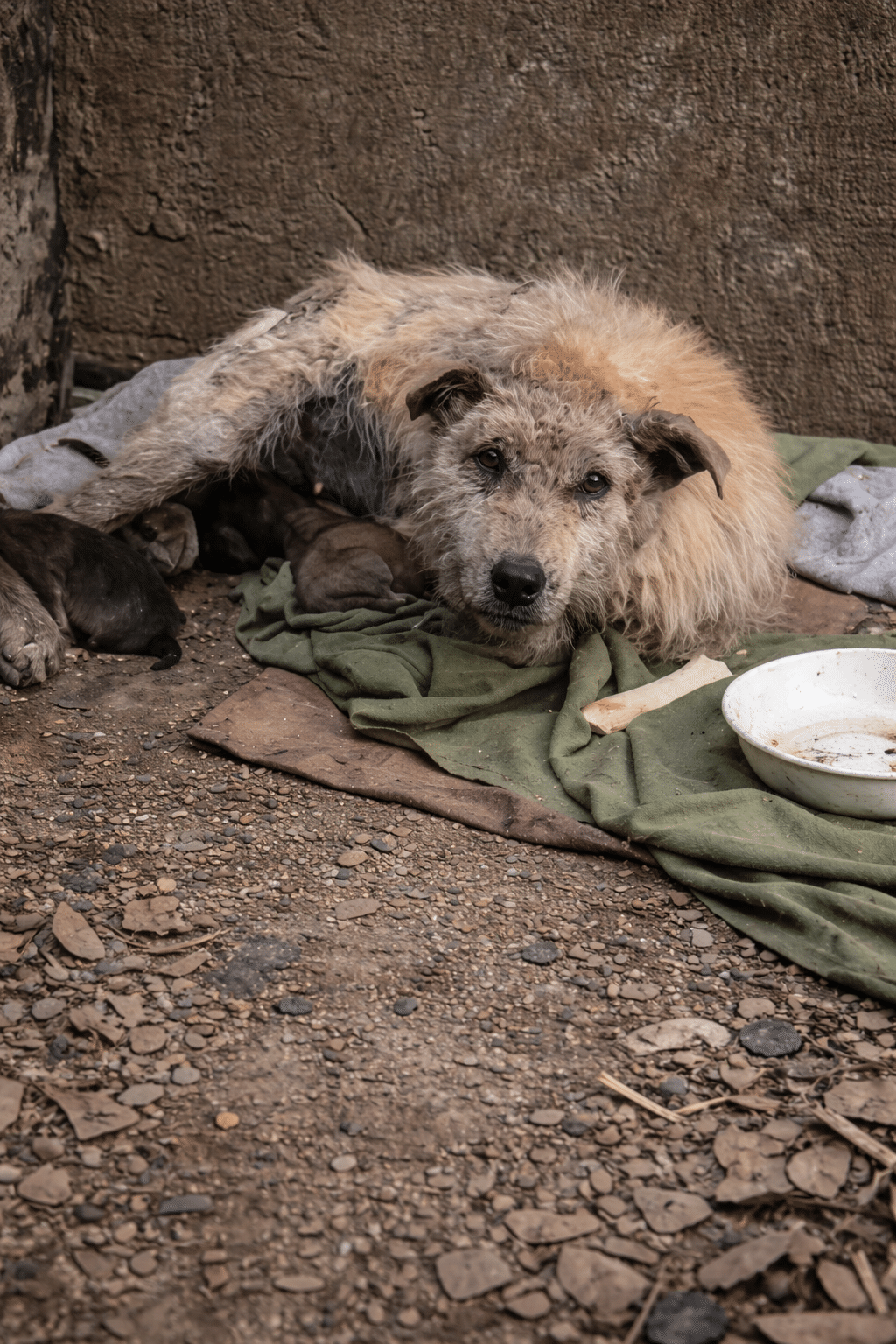
The first time he saw her, she was curled tightly around her newborn puppies on a narrow corner of the street.
There was no bed beneath them.
No fence around them.
No quiet room where a mother could rest after giving birth.
Only concrete, passing noise, and whatever small protection the nearby buildings happened to provide.
The mother dog looked exhausted.
Her body was painfully thin, and large patches of fur were missing from irritated skin. Yet despite her condition, she kept herself wrapped around the tiny puppies beside her.
She had found a place to give birth.
But she had not found safety.
The man who noticed them could have left some food and continued with his day.
Instead, he came back.
Then he came back again.
And that simple decision—to keep returning—would eventually change the future of the entire little family.
He Found a Mother Who Had Almost Nothing Left for Herself
The puppies were still extremely young when the man first noticed them.
They remained clustered close to their mother, depending on her for warmth, protection, and nourishment.
She, meanwhile, looked as though nearly everything she had was being used to keep them alive.
Her frame was thin.
Her coat was patchy.
Areas of exposed skin appeared red and inflamed.
Giving birth and caring for newborn puppies already places enormous demands on a mother dog’s body. For a stray without dependable food or shelter, those demands can become even harder to meet.
Still, she stayed with them.
The street corner may not have been safe, but it was what she had.
The man did not try to grab the puppies immediately.
He did not force the mother away from the spot she had chosen.
He started with something much simpler.
Food.
Fresh water.
Then, as evening approached, he returned with blankets.
He placed them around the family so the puppies would no longer be lying directly against the cold pavement.
The mother watched him closely.
That was understandable.
She had newborns beside her, and an unfamiliar person was entering the small space she had been trying to protect.
But she did not charge toward him.
She did not force him away.
She watched.
And he gave her time.
The next day, he returned again.
Video: A Stray Mother Watches as the Same Stranger Returns Again for Her Puppies
He Didn’t Try to Earn Her Trust in One Afternoon
Trust developed through repetition.
The man began bringing cooked meals and more nourishing food for the mother.
Then he left.
Later, he came back.
Another meal.
More water.
Another quiet visit.
Nothing about his approach demanded anything from her.
She did not have to come toward him.
She did not have to allow touch.
She did not have to behave like a pet.
He simply continued showing up.
That consistency slowly changed the way she responded.
At first, she watched every movement.
Then she became comfortable enough for him to sit closer.
Eventually, he could gently touch her.
The difference was subtle, but important.
A dog caring for newborn puppies has good reason to be cautious about anyone approaching them. Yet this mother gradually allowed the man into the small circle she had created around her babies.
Soon, he was able to touch the puppies too.
He could carefully lift them while their mother remained nearby.
That kind of access had not been demanded from her.
It had been built one visit at a time.
Perhaps the clearest sign came when she began resting more comfortably beside him.
Instead of keeping her head raised to monitor every movement, she could settle down.
She could allow someone else to be present without treating that presence as another problem she needed to manage.
For the man, however, gaining her trust also made something else increasingly difficult to ignore.
Her skin condition was serious.
Food and blankets were helping.
But they were not going to be enough.
The Clinic Revealed Why Her Skin Was Getting Worse
The mother dog and her puppies were eventually taken to a veterinary clinic for a proper examination.
There, the extent of her condition became clearer.
She was diagnosed with a significant case of Demodex mange.
The skin problem was further complicated by fungal and bacterial infections.
That combination helped explain the patchy coat, inflamed areas, and overall poor condition that had been visible when she was first found.
Her body was already under considerable strain.
She had been living as a stray.
She was underweight.
She had recently given birth.
She was nursing puppies.
And now her immune system also had to contend with several skin-related problems at once.
The puppies were still very young, so they also required monitoring while their mother began treatment.
The clinic created a treatment plan designed to address the different problems gradually.
She received injections as part of the mange treatment.
Oral medication was used to address infection.
Topical care helped manage affected areas of skin.
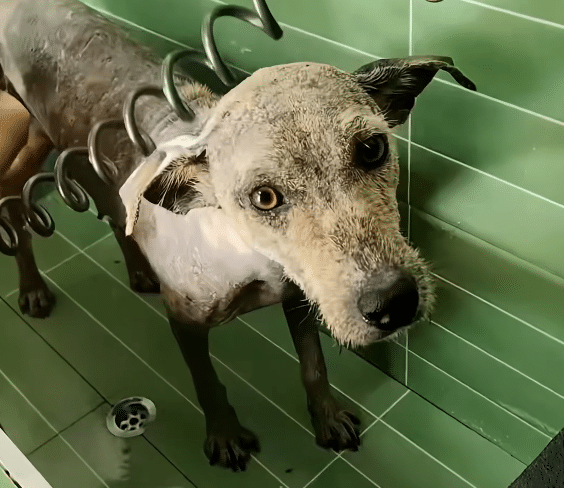
Medicated baths and warm compresses were also included to soothe irritated areas and support healing.
None of those treatments changed her appearance overnight.
The recovery would take time.
But something important had already changed.
For the first time, her condition was being treated instead of simply endured.
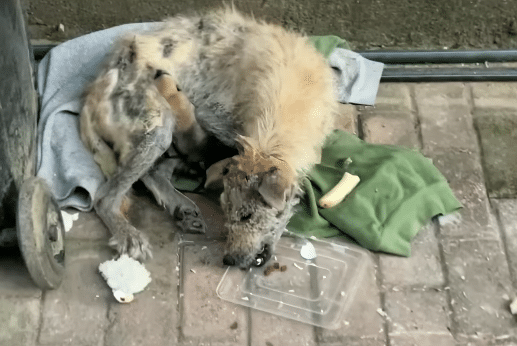
Healing Happened in Small Changes No One Could Rush
The mother remained remarkably cooperative through much of her care.
She had spent her recent life outside and had only gradually begun trusting one man.
Now she was surrounded by clinic staff, unfamiliar smells, medications, bathing, and repeated handling.
Still, she allowed the team to work.
Her treatment became part of a daily rhythm.
Medication.
Skin care.
Food.
Rest.
Time with the puppies.
Then the same process again.
At first, the changes were difficult to see.
Inflamed skin does not suddenly become healthy because one dose of medicine has been given.
Missing fur does not return in a day.
A severely underweight body needs repeated meals before strength becomes obvious.
But the team continued.
And after a little more than two weeks, the difference was no longer subtle.
The redness had begun to decrease.
Damaged areas of skin looked calmer.
New fur was appearing in places that had previously been bare.
Her body also looked stronger.
Regular meals were finally benefiting a dog who had been trying to nourish both herself and an entire litter with very limited resources.
The puppies were changing too.
They were growing.
They looked rounder and more active.
The fragile newborns found on the pavement were beginning to behave more like curious young puppies.
Yet one of the most noticeable changes in their mother had nothing to do with her coat.
She had begun greeting familiar people differently.
Her tail moved when clinic staff approached.
When the man who first found her appeared, her posture was softer.
She no longer seemed to treat every approaching person as something she needed to study carefully before deciding whether her puppies were safe.
Day by day, the need to remain constantly alert was fading.
By Day 23, the Little Family Was Ready to Leave
Recovery did not mean that everything about the mother’s condition had suddenly become perfect.
But by around the twenty-third day, both she and the puppies had made enough progress to begin the next part of their lives.
They were stable.
The puppies were stronger.
Their mother had responded to treatment.
And most importantly, they were still together.
While the little family had been receiving veterinary care, the man had been preparing for their return.
He did not plan to take them back to the same street corner.
Instead, he created a place for them in his own yard.
A simple wooden dog house stood waiting.
Inside was clean bedding.
Nearby were bowls for food and fresh water.
It was not elaborate.
It did not need to be.
Its value came from what the street corner could never provide.
Consistency.
Protection.
A place where the mother did not need to relocate her puppies whenever the environment became uncomfortable.
A place where food would arrive again tomorrow.
A place where someone already knew them and intended to continue caring for them.
When the family arrived, the puppies immediately had a new environment to investigate.
They moved around with the curiosity of young dogs discovering something unfamiliar.
Their mother behaved differently.
She stood near the entrance and watched.
Not frantically.
Not as though she needed to plan an escape.
She simply observed.
For an animal that had recently been raising newborn puppies beside a public street, the quiet scene represented an enormous change.
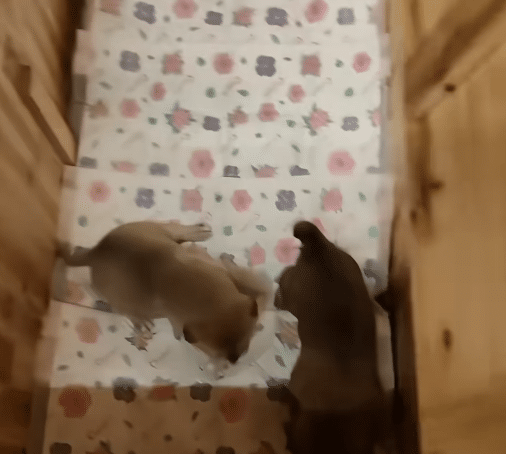
Her Puppies Could Finally Explore Instead of Simply Survive
On the street, nearly every part of the puppies’ early lives depended on their mother.
They needed her warmth.
Her milk.
Her protection.
And she had been trying to provide all of it while dealing with hunger, illness, and an exposed environment.
Now the conditions around them were different.
The puppies could move beyond the tight cluster where they had spent their earliest days.
There was safe space to explore.
There were bowls nearby.
There was shelter available when they became tired.
And their mother no longer had to use every moment watching what passed beside them.
The difference could be seen in the simplest behaviors.
The puppies played.
They investigated their new surroundings.
They moved in and out of the small wooden shelter.
Their world had become larger without becoming more dangerous.
For the mother, that change offered something equally important.
Rest.
She could lie down without being exposed on bare pavement.
She could eat without wondering where the next meal would come from.
Her skin could continue healing without the same constant exposure to street conditions.
And she could remain close to her puppies while another person helped carry some of the responsibility she had handled alone.
The man had not replaced her role as their mother.
He had simply made that role easier to survive.
What Changed Everything Was That He Came Back
There was no dramatic river rescue in this story.
No collapsing building.
No dangerous machinery.
No single moment when a crowd watched someone perform an extraordinary act.
The beginning was much quieter.
A man saw a stray mother with newborn puppies.
He brought food.
Then he returned with blankets.
Then he came back with another meal.
Then another.
Eventually, the mother allowed him closer.
That closeness let him see that she needed more than food.
So he arranged veterinary care.
Treatment addressed the mange and secondary infections.
Regular nutrition helped restore strength.
The puppies received monitoring.
And while all of that happened, he prepared somewhere for them to live afterward.
Each step depended on the one before it.
He could not have taken the mother calmly to the clinic if she had never learned that his presence was safe.
That trust might never have developed if his first interaction had involved grabbing her puppies or forcing her into a vehicle.
Instead, he started with what she could accept.
Food.
Water.
Blankets.
Distance.
Then he returned the next day.
That may be the most important detail in the entire story.
Kindness did not appear once and disappear.
It became a routine.
The Street Corner Was Only the Beginning of Their Story
When the mother dog first appeared beside the buildings, she had already done something remarkable.
She had brought her puppies into the world while dealing with her own poor physical condition.
Then she had kept them together despite having no secure home.
But survival should not have depended entirely on how much more she could endure.
Someone noticed that.
The man did not know everything about her history.
He did not need to.
What mattered was what he could see in front of him.
A thin mother.
Newborn puppies.
Inflamed skin.
An exposed place to sleep.
Needs he could begin addressing immediately.
First came food.
Then warmth.
Then trust.
Then veterinary treatment.
Finally, a safe place waiting for them afterward.
By the end of the story, the mother no longer resembled the exhausted stray curled protectively around newborn puppies on concrete.
Her skin was healing.
Her fur was beginning to return.
Her puppies were stronger and active.
And instead of sleeping beside a street, the family had a wooden shelter prepared specifically for them.
Perhaps most importantly, their future was no longer dependent on whether a stranger happened to leave food nearby that day.
The stranger was no longer a stranger.
He had become the person who kept returning.
That is what changed the story.
Not one enormous gesture.
A series of smaller ones.
One meal.
One blanket.
One veterinary visit.
One safe shelter.
And the decision, again and again, to show up tomorrow.


