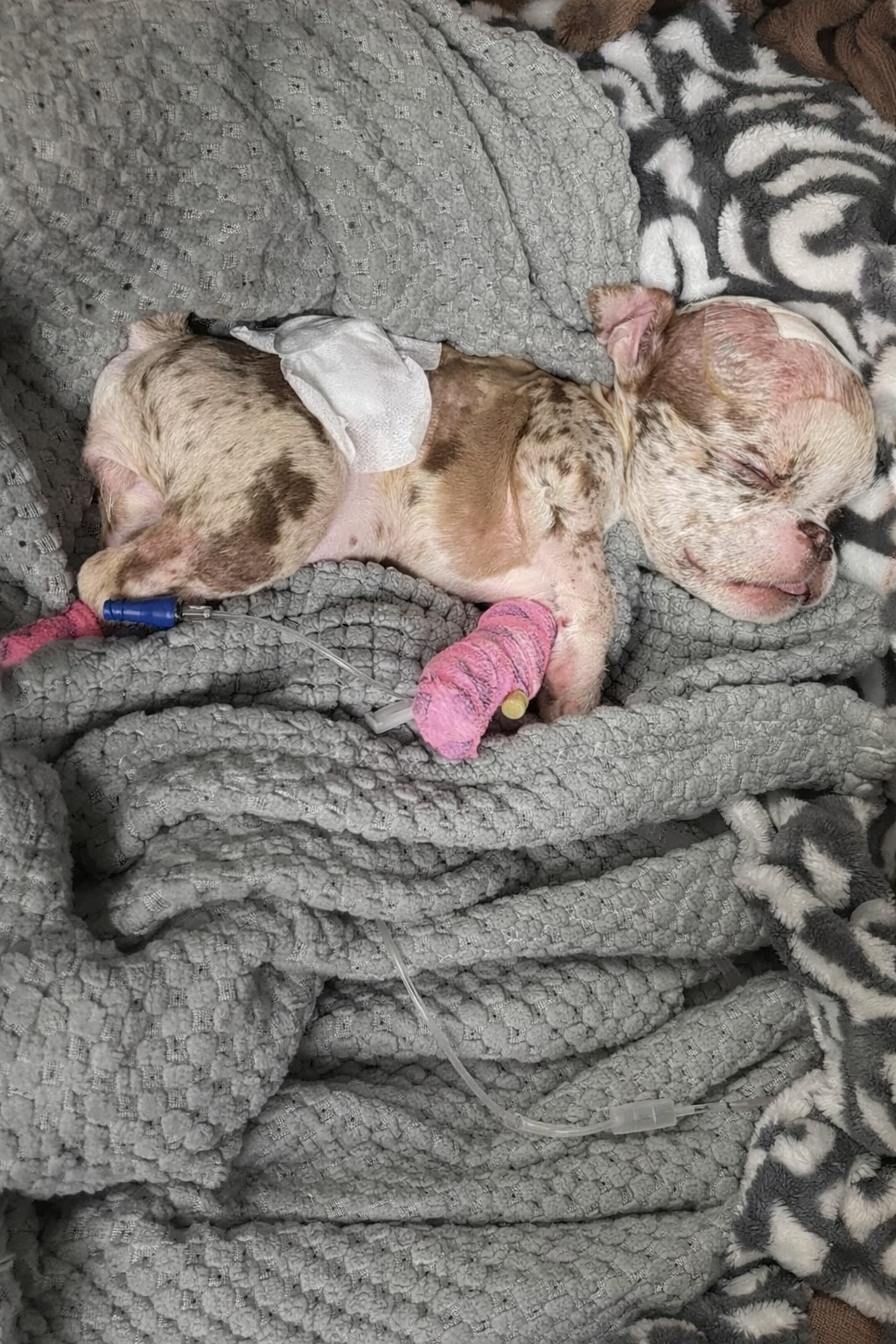
The first video of Tippy was difficult to watch.
She was so small that she barely looked real.
A tiny puppy stood—or tried to stand—on the cold metal floor of a wire crate. Her legs scrambled beneath her. Her head bobbed uncontrollably. Every time she managed to lift herself, her body tipped sideways again.
There was no blanket beneath her.
No soft surface to catch her.
Only metal.
A rescuer received the video late at night and immediately knew something was seriously wrong.
But there was another problem.
The breeder would not surrender the puppy that night.
So all the rescuer could do was wait.
Then, the following day, the phone finally rang.
“Can you take her?”
The answer came immediately.
And the tiny puppy who could barely remain upright was finally on her way to veterinary care.
At the Hospital, Even Basic Survival Had Become a Struggle
The first examinations revealed several immediate concerns.
Tippy had severe hypoglycemia.
She was dehydrated.
And veterinarians strongly suspected hydrocephalus, a condition involving an abnormal accumulation of fluid within the brain.
Despite her weakness, one thing was obvious as soon as food was offered.
Tippy wanted to eat.
She drank eagerly from a bottle, taking in nourishment even though her body still struggled to coordinate simple movement.
Standing remained extremely difficult.
Her legs could not keep her balanced.
Her body repeatedly leaned and tipped to one side.
That characteristic movement eventually inspired her name.
Tippy.
It was a gentle name for a puppy whose tiny body seemed unable to find its center.
Further examination raised another concern.
Veterinarians suspected that abnormalities involving her cerebellum—the part of the brain associated with coordination—might also be contributing to the way she moved.
But Tippy was still extremely small.
Advanced imaging and anesthesia could not simply be rushed.
For the moment, the medical team would have to manage her symptoms, reduce pressure with medication, and watch her closely.
Video: Tippy Begins Her Fight to Move Despite Being Unable to Balance
For a While, Warmth and Food Seemed to Be Enough
Tippy went into foster care.
There, the environment could not have been more different from the metal crate seen in the first video.
She had blankets.
Warmth.
People speaking softly around her.
Regular meals.
And hands ready to steady her whenever her body tipped unexpectedly.
For a brief period, Tippy appeared to settle into that new routine.
She ate eagerly.
She showed interest in play.
She reacted excitedly when familiar people appeared in the morning.
Her coordination was still poor.
She still needed help moving safely.
But those limitations did not prevent her from participating in the world around her.
There were small bursts of play.
Moments of curiosity.
Ordinary puppy behavior appearing between medical concerns.
For the people caring for her, those moments made it easier to hope that medication and supportive care might keep her comfortable while she grew stronger.
Then Tippy’s condition changed.
Suddenly, moving her neck caused her to cry out.
Medication did not resolve the problem.
She returned to the hospital.
Soon after, seizures began.
The questions surrounding her condition could no longer wait.
The CT Scan Finally Showed What Was Happening
Advanced imaging provided the clearest picture the team had seen so far.
The CT scan confirmed hydrocephalus.
It also showed an abnormally small cerebellum.
Cysts were present.
And fluid was extending toward the spinal canal.
The rescuers had known Tippy’s balance problems were serious.
Now they could see the structural abnormalities behind them.
The pressure inside her skull was also measured.
According to the rescue account, normal intracranial pressure in dogs was around 15.
Tippy’s reading was 33.
That number helped explain why her condition had deteriorated so sharply.
The puppy who had been playing in foster care was now dealing with pressure severe enough to demand urgent intervention.
Medication alone was no longer providing enough control.
The medical team needed another way to relieve the buildup.
And because Tippy was still so tiny, every procedure required extraordinary care.
Doctors Drained Fluid Through the Soft Spot on Her Head
The next intervention was intended to relieve the pressure temporarily.
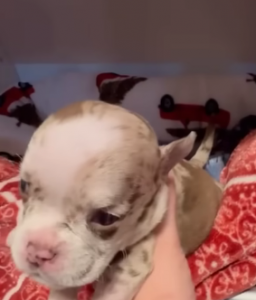
Using the soft spot on Tippy’s head, the medical team carefully drained cerebrospinal fluid.
The effect could be measured almost immediately.
Her pressure fell from 33 to 24.
And Tippy’s condition improved.
The procedure was not a permanent solution.
The fluid could build again.
But it gave her something valuable.
Time.
Time to recover from the immediate crisis.
Time to continue growing.
Time for the team to determine what might give her more lasting stability.
Back at home, movement remained one of Tippy’s biggest challenges.
She wanted to explore.
Her body simply could not coordinate the way she needed it to.
Then a friend named Devin decided to build something specifically for her.
A tiny walker.
Made from pink PVC.
Sized for Tippy’s miniature frame.
The Pink Walker Let Her Discover What Moving Forward Felt Like
The device was simple compared with everything happening inside Tippy’s brain.
Yet its effect on her daily life was enormous.
Supported inside the pink walker, Tippy could finally remain upright more consistently.
Her body did not immediately collapse sideways.
Her legs could practice moving beneath her while the frame helped keep her balanced.
Then came the moment caregivers had been hoping to see.
Tippy stepped onto grass.
She pushed forward.
One movement.
Then another.
For a puppy who had spent so much time tipping over, simply traveling in a straight direction was a major achievement.
Her tail lifted as she moved.
The walker did not cure her neurological problems.
It did not change the abnormalities found on the CT scan.
But it allowed Tippy to experience more independence than her body could provide on its own.
She could participate.
She could explore.
She could move toward people instead of waiting to be carried.
For a while, the little pink frame became part of her new normal.
Unfortunately, the pressure inside her head was still building.
The temporary drainage had helped.
It had not solved the underlying problem.
Tippy needed a longer-term way for the excess fluid to leave her brain.
The Only Long-Term Option Left Was Too Large for Her
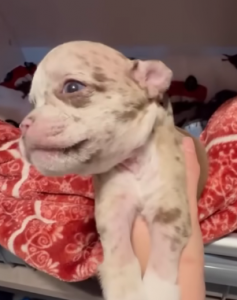
The medical team determined that Tippy needed a shunt.
The device would create a pathway allowing excess fluid to drain from the brain toward the abdomen.
In principle, the plan was straightforward.
In practice, Tippy presented an unusual problem.
She was extremely small.
Standard equipment did not fit her body appropriately.
So a custom-sized shunt had to be ordered.
That meant waiting.
For a puppy whose symptoms could worsen as fluid accumulated again, those days carried obvious uncertainty.
Caregivers continued monitoring her.
Medication and supportive care remained important.
And everyone waited for equipment small enough for the puppy who needed it.
Eventually, the shunt arrived.
Surgery day was scheduled.
Now Tippy faced the biggest procedure of her rescue.
Two Small Incisions Could Change the Rest of Her Life
The surgery involved two areas.
One incision was made near her head.
Another was made near the abdomen.
Between them, the shunt would provide the route needed to redirect excess fluid.
Everything about the procedure had to accommodate Tippy’s size.
The puppy who had once looked almost too fragile to stand now had to tolerate delicate neurological surgery.
The shunt was placed.
Tippy made it through the procedure.
Then came the most important question.
Would it work?
According to the rescue account, her pressure became more stable afterward.
The seizures diminished.
For the first time since her condition had escalated, caregivers were no longer relying only on repeated temporary relief from the fluid buildup.
There was now a system designed to manage it continuously.
Tippy still had neurological abnormalities.
She still had limitations.
But the medical crisis that had repeatedly threatened her had finally become more manageable.
Surgery Didn’t Make Tippy a Typical Puppy — It Gave Her More Room to Live
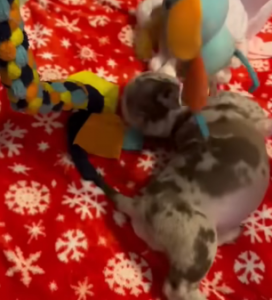
Tippy’s story did not end with her suddenly walking normally.
Her vision remained limited.
Her coordination was still different.
She would continue to need special care.
The shunt was not a way to erase everything shown on the CT scan.
It was a way to give her a better chance at stability.
And once that stability improved, the personality caregivers had already seen became easier to enjoy.
Tippy responded eagerly to familiar voices.
Her ears lifted when people approached.
Her tail moved with enthusiasm.
She remained interested in food, affection, and the activity around her.
The little walker could help when she wanted to move.
People could assist when she needed more support.
Her life might require adaptations that another dog would never need.
But those adaptations allowed Tippy to take part in experiences that once looked almost impossible.
Grass beneath her paws.
Morning greetings.
Play.
Warm blankets.
Being carried when tired.
Moving under her own effort when she could.
The Puppy in the Metal Crate Was Still There — But Her World Had Changed
It is easy to compare Tippy’s first video with the later scenes and focus only on the equipment.
A cold wire crate at the beginning.
A pink walker later.
Then surgery and a shunt.
But the larger transformation came from what surrounded those medical interventions.
At first, Tippy was a tiny puppy struggling alone to remain upright.
Later, every time she tipped, someone was there.
When she could not drink normally, she had a bottle.
When pressure increased, she had veterinary care.
When walking independently was beyond her coordination, someone built a device that matched her size.
When standard medical equipment was too large, the team waited for something made specifically for her.
Tippy did not become valuable because she improved.
Care came first.
Improvement followed where it could.
That distinction is what makes her story memorable.
Her Life Was Never Going to Be Simple — But It Could Still Be Hers
Some animals recover from illness and eventually need little additional care.
Tippy’s path was different.
Her condition could require ongoing attention.
Her coordination might never resemble that of another dog.
Her vision could remain limited.
Those realities did not disappear simply because the operation succeeded.
But neither did they erase everything Tippy could still experience.
She could recognize familiar people.
She could respond to affection.
She could eat with enthusiasm.
She could explore with support.
She could wag her tail.
She could have good days that were not defined entirely by a diagnosis.
When rescuers first saw the late-night video, none of that future was guaranteed.
There was only a tiny puppy wobbling on metal, unable to make her own body cooperate.
The breeder initially would not release her.
Then one phone call changed her direction.
“Can you take her?”
That question led to the hospital.
The hospital led to answers.
The answers led to emergency pressure relief.
A friend built a walker.
A custom shunt was ordered.
Then came surgery.
Tippy survived each step long enough to reach the next one.
Her story is not remarkable because every problem disappeared.
It is remarkable because people continued adapting when the next problem appeared.
Tippy could not change the body she had been born with.
So the people around her changed the world she had to move through.
And the puppy who once could not remain upright on a cold metal floor finally had something far more important than perfect balance.
A chance to keep moving forward.


