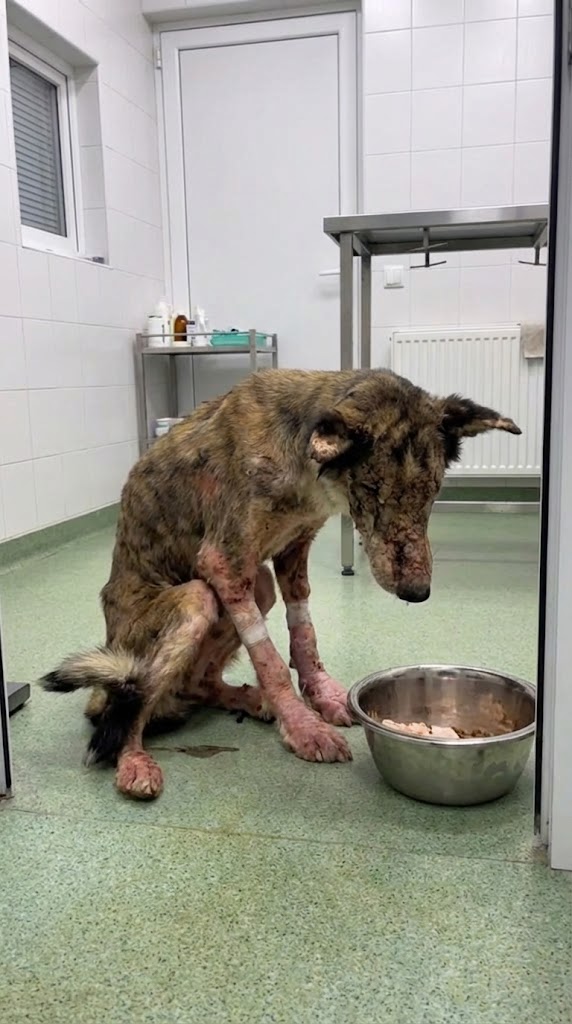
At first, there was almost nothing about him that looked like the Husky he would eventually become.
He was lying weakly on a rural property, his body frighteningly thin beneath a damaged, tangled coat.
Cold air made him tremble.
He had reportedly gone several days without eating.
And across large areas of his skin, a severe parasite infestation had taken hold.
The rescue account estimated that nearly 80 percent of his body had been affected.
Yet somewhere beneath the matted fur, irritated skin, exhaustion, and dehydration was a young Husky whose story had not ended.
The rescuers could not see that version of him yet.
They could only see the dog in front of them.
And he needed help immediately.
Beneath His Coat Was a Much More Serious Problem
The rescuers initially understood that Shua was badly underweight.
Then they began examining his coat.
What they discovered made the situation far more urgent.
Larvae had infested extensive areas of damaged skin.
His coat was tangled and dirty, making it difficult at first to see the full extent of the problem. As rescuers carefully separated the fur and began cleaning him, more affected areas became visible.
The rescue account described widespread skin damage involving much of his body.
Shua was also dehydrated and extremely weak.
His strength had fallen so far that even ordinary movement appeared difficult.
There was no dramatic moment when everything could be fixed at once.
Before anyone could think about fur growing back or Shua walking normally again, they had to accomplish something much simpler.
Get his body clean enough to treat.
Keep him stable.
Give him a chance to make it through the next stage.
VIDEO: Severely Weakened and Almost Unrecognizable, Shua Begins His First Day of Treatment
The First Hours Were About Cleaning and Stabilizing Him
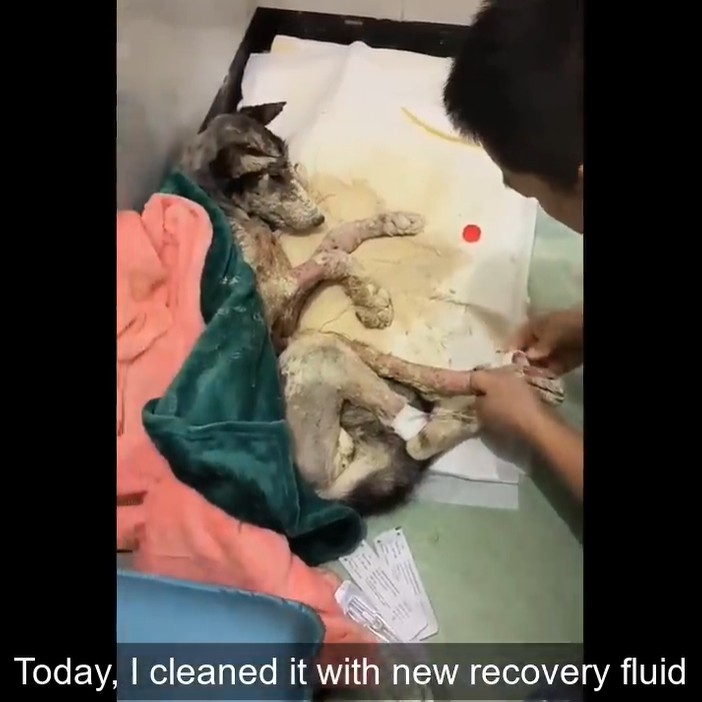
Treatment began with painstaking cleaning.
The affected areas had to be addressed carefully and repeatedly.
According to the rescue account, the team used parasite-control treatment, iodine, and repeated washing while working through Shua’s damaged coat and skin.
It was slow work.
Some areas required attention more than once.
And even after the first major cleaning, his condition was still serious enough to require continued veterinary care.
Fluids were given to support his weakened body.
The team also used topical treatment, including oxytetracycline powder as described in the original rescue account, while monitoring the extensive skin damage.
At this stage, nobody was focused on making Shua look like a beautiful Husky again.
Appearance could wait.
They wanted him comfortable enough to rest.
Hydrated enough to begin recovering.
Strong enough to eat.
And protected while his skin started the long process of repairing itself.
Somewhere during those early days, the dog who had arrived simply as a critical rescue case received a name.
Shua.
From then on, every improvement belonged to him.
Standing Up Became His First Major Challenge
Shua had been weak for long enough that his body could not simply return to normal movement.
When he first tried to rise, his legs trembled beneath him.
Sometimes he managed only a brief attempt before lowering himself again.
His muscles had little strength left.
That meant something most dogs do without thinking—standing—became part of his recovery.
The caregivers supported him when necessary but still allowed him opportunities to try.
One attempt.
Then another.
A few seconds upright.
Then rest.
There was nothing graceful about those early efforts.
But gradually, Shua began bearing more weight.
With food arriving regularly, his energy improved.
His appetite became another encouraging sign.
Each meal provided something his exhausted body had been missing: the fuel to repair damaged tissue and rebuild strength.
Soon his caregivers were no longer watching a dog who barely moved.
They were watching a dog who kept trying to get up.
Then the Sun Revealed Something They Had Barely Noticed Before
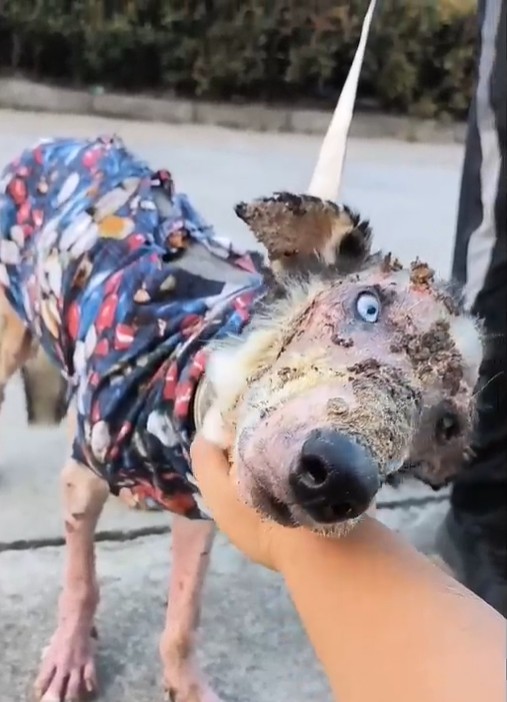
As Shua became stable enough to spend some time outside, one of the most memorable parts of his transformation finally became obvious.
His eyes.
In the difficult first days, there had been too much else demanding attention.
His damaged skin.
His weight.
His dehydration.
His ability to stand.
But in daylight, rescuers could clearly see the striking blue eyes characteristic of the Husky hidden beneath everything he had been through.
They had always been there.
They simply had not been the first thing anyone noticed.
Now they became impossible to miss.
The contrast was remarkable.
Shua’s body was still healing.
His coat was nowhere close to fully restored.
He remained thin.
But when he lifted his face toward the daylight, the dog beneath the illness began becoming easier to imagine.
Not the dog he had been when rescuers arrived.
The dog he might still become.
His Skin Did Not Heal Overnight
Shua’s recovery required patience.
The damaged skin went through visible stages as it repaired itself.
Dry layers formed over previously affected areas.
Those layers gradually loosened and shed.
Beneath them, healthier skin began appearing.
It was not always visually dramatic from one day to the next.
That is often the nature of recovery.
The change becomes obvious only when someone compares weeks rather than hours.
The rescue team continued cleaning and monitoring Shua while making sure he received regular meals and rest.
Gradually, previously damaged areas began closing.
Then something else appeared.
New fur.
At first, it was sparse.
Small sections of coat emerging where the skin had once looked almost bare.
But as the weeks continued, those areas became larger.
Shua was beginning to look less like a medical emergency and more like the Husky rescuers had been hoping to meet.
His Personality Emerged as His Body Became Stronger
Physical recovery revealed something the first photographs could never have shown.
Shua was remarkably gentle.
Despite everything his body had experienced, caregivers did not describe him as aggressive.
As he became stronger and more comfortable around people, he began accepting affection easily.
The shelter team even developed an affectionate nickname for him.
They called him their “warm man.”
It suited him.
Shua seemed to enjoy being close to others.
And one habit became particularly memorable.
He showed a gentle interest in smaller puppies at the shelter.
Caregivers photographed and filmed him resting near them, sometimes allowing the little dogs to curl against his much larger body.
It was an unexpectedly tender image.
The same Husky who had once needed people to carefully tend almost every part of his damaged skin had become calm enough to provide company to animals smaller than himself.
There was no need to claim he understood their histories.
No need to imagine that he was deliberately trying to heal them.
The behavior itself was enough.
Shua liked being close.
And the puppies appeared comfortable close to him.
The Dog Beneath the Damaged Coat Was Finally Visible
As Shua’s fur continued growing, the visual change became extraordinary.
His body filled out.
The outline of his ribs became less prominent.
His coat returned across areas that had once been almost completely exposed.
His movements became steadier.
And those bright blue eyes now sat in the face of a dog who finally looked recognizable as a Husky.
People seeing only the later photographs might never have guessed what his first days in rescue had looked like.
But the caregivers remembered.
They remembered washing away the dirt.
They remembered working through the severe infestation.
They remembered how weak his legs had been.
They remembered the first uncertain attempts to stand.
Recovery had not happened because of one spectacular intervention.
It came from many smaller pieces working together.
Cleaning.
Veterinary treatment.
Fluids.
Food.
Rest.
Skin care.
Time.
And people willing to repeat those things for as long as Shua needed them.
Those Blue Eyes Had Been There From the Beginning
There is something powerful about before-and-after photographs.
They make transformation look almost instantaneous.
One image shows a dog at his lowest point.
The next shows thick fur, bright eyes, and a healthy body.
But Shua’s story existed in the long space between those photographs.
It existed in the first bowl of food he could finish.
The first time he managed to remain standing a little longer.
The first afternoon outside.
The first areas of healthier skin.
The first new strands of fur.
And eventually, the moment when people began noticing his personality before noticing his injuries.
Shua did not suddenly become beautiful when his coat grew back.
The blue eyes that captured everyone’s attention had been present during the hardest days too.
They had simply been hidden beneath a condition that demanded everyone’s attention first.
Today, what people notice about Shua is very different.
The blue-eyed Husky.
The thickening coat.
The gentle expression.
The big dog quietly resting beside smaller puppies.
Those images are far removed from the exhausted animal rescuers first encountered.
But they belong to the same dog.
Shua’s Recovery Was Built One Ordinary Day at a Time
Shua’s story could easily be reduced to its most dramatic details.
Severe neglect.
A widespread parasite infestation.
A dangerously thin Husky.
Then a beautiful transformation.
But doing that would miss the most important part.
Between those two versions of Shua were many ordinary days when no miracle happened.
Someone cleaned his skin.
Someone prepared his food.
Someone checked his wounds.
Someone helped him move.
Someone noticed when he stood a little longer than yesterday.
Then they came back and did it again.
That repetition gave Shua something his body desperately needed.
Time to heal.
Eventually, the dog who once struggled merely to stand was strong enough to walk comfortably through his surroundings.
The coat that had concealed badly damaged skin began looking like a Husky’s coat again.
And the dog who once required constant care became gentle company for others.
His blue eyes make the transformation easy to remember.
But perhaps the most meaningful part of Shua’s story is not what rescuers eventually saw in those eyes.
It is what they did before the beautiful dog beneath the neglect was easy to see.
They stayed.
They treated him.
They fed him.
And they gave his body enough ordinary days to show everyone who Shua had been all along.


