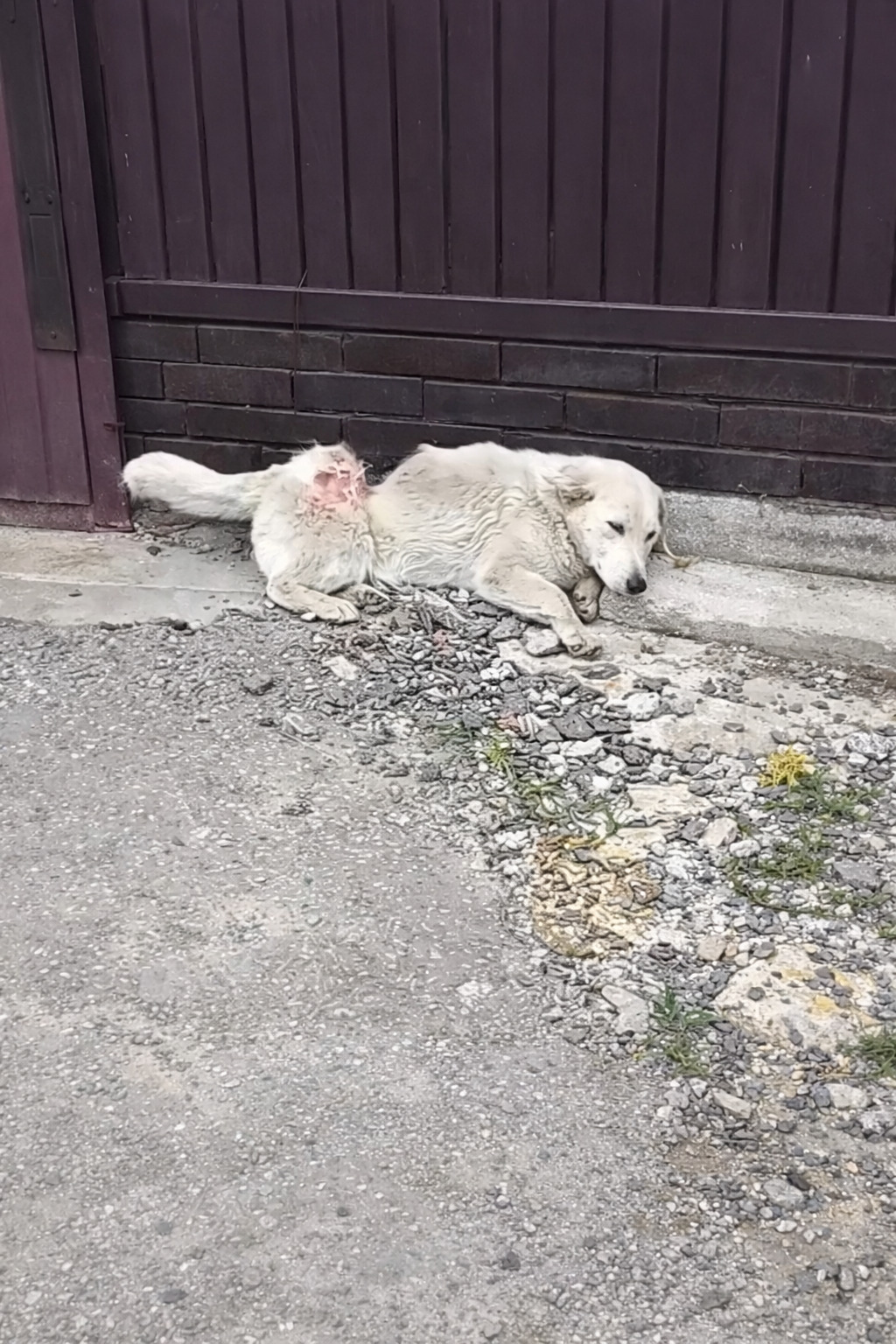
For months, people knew Tosya was somewhere among the garages.
Seeing her was easy.
Reaching her was not.
The small white dog with scattered dark patches had learned exactly how much distance she needed between herself and a human being.
Someone would leave food.
Tosya would wait.
Someone would call gently.
She would watch.
But the moment a person crossed the invisible boundary she had created, the little dog disappeared.
Behind a concrete wall.
Through a narrow opening.
Between rows of aging garages where following her became almost impossible.
Autumn turned into winter.
The ground froze.
Snow arrived.
And still Tosya survived inside that maze of concrete and cold.
People tried repeatedly to help her.
She simply would not allow anyone close enough.
Then, for a period of time, Tosya disappeared completely.
No familiar white figure moving between the buildings.
No quick glimpse from a distance.
Nothing.
Until one phone call brought the rescuers back.
A dog had been injured in the area.
When they arrived, they recognized her immediately.
It was Tosya.
Only this time, she didn’t run.
All Winter, the Garages Became Her Hiding Place
No one could say exactly when Tosya’s life outdoors began.
Her behavior suggested she was accustomed to people in some way, but whatever had happened before she appeared among the garages was not documented in the rescue account.
By autumn, however, she was living alone.
The garage complex gave her something the open streets could not.
Places to hide.
Concrete structures offered at least some protection from wind, while narrow passages made it difficult for anyone to follow her once she decided to escape.
Tosya learned those passages well.
People in the area began recognizing her.
They left food.
Some tried patiently to approach.
But Tosya kept her distance.
If a person remained far enough away, she might stay nearby.
Take one step too close and she was gone.
That became the routine.
Food.
Waiting.
A cautious appearance.
Then another disappearance between the buildings.
When winter came, the situation became more concerning.
The surfaces where Tosya rested were cold.
Temperatures fell.
Yet bringing her indoors remained almost impossible because nobody could safely get close enough.
They could feed her.
They could watch for her.
But they could not convince her to stay.
VIDEO: After a Winter of Hiding Between Garages, Tosya Is Finally Within Reach
Every Attempt Ended the Same Way
The people trying to help Tosya understood that chasing her would likely make everything worse.
So they tried patience instead.
Food was left where she could reach it.
People waited quietly.
Voices remained soft.
Nobody wanted to frighten her farther away from the places where she could still be monitored.
Sometimes Tosya appeared close enough to make rescue seem possible.
Then someone shifted position.
She noticed.
And within seconds, the little white dog vanished again.
It was not necessary to describe Tosya as stubborn.
Her behavior showed something simpler.
She was highly cautious around people.
Whatever the reason, distance appeared to make her feel safer.
That meant her rescuers had to work on her terms.
For weeks, progress remained limited.
Then even those distant sightings stopped.
Tosya was gone.
At first, people hoped she had simply moved to another part of the garage complex.
Then days passed.
No Tosya.
More time went by.
Still nothing.
The uncertainty was worse than watching her run away.
At least when she ran, they knew she was alive.
Then the rescue team received a call.
A small dog had reportedly been attacked nearby.
They hurried to the location.
And there she was.
This Time, Tosya Couldn’t Simply Disappear
The dog at the scene was unmistakable.
Small body.
White coat.
Dark patches.
Tosya.
But something was different.
The dog who had spent months avoiding every attempt to get close was injured.
Her usual escape was no longer so easy.
For the rescuers, this created an opportunity—but not an easy one.
Pain can make even a gentle animal defensive.
Tosya was already wary of people before she was hurt.
Now strangers were approaching while she was frightened and uncomfortable.
The team slowed everything down.
No sudden grabbing.
No group rushing toward her.
No unnecessary pressure.
Several people worked together carefully, controlling the space around Tosya while trying not to push her into panic.
She trembled.
She watched their movements.
And for the first time after months of failed attempts, the rescuers finally managed to reach her.
They could touch her.
Lift her.
Carry her away from the garage complex.
Tosya had spent an entire winter making sure nobody could catch her.
Ironically, the moment she most needed help was also the moment she finally became reachable.
At the Clinic, the Extent of Her Injuries Became Clear
Tosya was taken for veterinary care.
Once she could be examined properly, the team discovered multiple wounds across her body.
Some appeared recent.
Others had already begun showing signs of infection.
Treatment started immediately.
The wounds were cleaned.
Medication was provided.
Her condition was monitored.
For the first time in months, Tosya no longer had to decide where she would hide before darkness came.
She did not have to search for shelter between slabs of concrete.
She did not have to wait for people to leave before approaching food.
But the rescuers still hoped there might be another explanation for why she had been living alone.
Perhaps Tosya had an owner.
Perhaps someone had been searching for her.
The clinic checked for a microchip.
None was found.
There was no identification linking Tosya to a family through the scan.
Whatever life had existed before the garage complex, the rescue team had no immediate way to reconnect her with it.
So their attention turned toward what they could control.
Treating the dog in front of them.
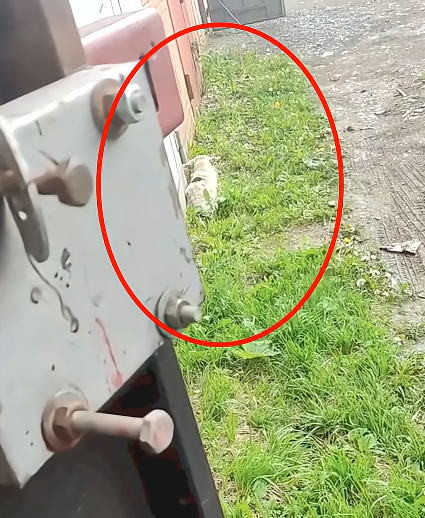
Her First Warm Bed Did Not Require Her to Trust Anyone Yet
That first night indoors was very different from the nights Tosya had spent outside.
There was soft bedding beneath her.
Warmth around her.
Food and water nearby.
And people checking on her injuries.
But nobody expected Tosya to suddenly become affectionate simply because she had been rescued.
Months of avoiding human contact would not disappear in a few hours.
She remained watchful.
Hands approaching her could make her tense.
Movement around the room held her attention.
Her instinct still seemed prepared for the possibility that she might need to get away.
The caregivers respected that.
Treatment happened when necessary.
Beyond that, Tosya was given room to observe.
No one demanded that she climb into a lap.
No one surrounded her hoping for an emotional reaction.
No one treated affection as something she owed them because they had brought her inside.
Instead, they gave her a much simpler experience.
A quiet room.
A warm bed.
And a night in which she did not need to hide between garages.
Her Wounds Healed Faster Than Her Caution
Over the following days and weeks, Tosya’s physical condition improved.
Medication helped control infection.
The wounds began closing.
Regular food supported her recovery.
Rest gave her body time to repair itself.
Those changes were relatively easy to see.
Trust was harder to measure.
At first, Tosya continued tracking nearly every movement around her.
A hand reaching too quickly could make her pull away.
Unfamiliar activity kept her alert.
Her caregivers responded by becoming predictable.
They entered quietly.
They spoke softly.
They allowed Tosya to watch them before moving closer.
When she was comfortable accepting touch, they touched her gently.
When she needed distance, they did not turn the moment into a contest.
Day after day, the same pattern repeated.
And slowly, Tosya’s reactions began changing.
She tolerated caregivers remaining closer.
Then she began accepting gentle contact more readily.
She lifted her head when familiar voices called her name.
The little dog who had once disappeared the moment someone approached was learning that she no longer needed an escape route from every interaction.
One Day, She Stopped Looking for Somewhere to Hide
There was no single dramatic moment when Tosya suddenly trusted everyone.
The change accumulated gradually.
Another quiet meal.
Another safe night.
Another person approaching without chasing her.
Another gentle touch followed by nothing frightening.
Over time, Tosya’s posture became less tense.
Her coat looked cleaner and healthier as her body recovered.
Her wounds faded.
And the constant readiness to flee became less obvious.
She began participating more in what was happening around her rather than simply monitoring it from a safe distance.
For the people who remembered the garage complex, this was one of the most meaningful parts of her transformation.
Outside, Tosya had always been calculating distance.
How close was the nearest person?
Where was the next gap between the buildings?
Could she reach it before someone reached her?
Now she did not need to make those calculations every minute.
She had learned the layout of a very different environment.
Where the bed was.
Where food appeared.
Which voices belonged to familiar caregivers.
Which hands moved slowly.
Safety became something Tosya could experience repeatedly instead of something she had to create by running away.
Then Someone Offered Her More Than a Temporary Safe Place
As Tosya’s health improved and her comfort around people grew, another possibility became realistic.
A permanent home.
The rescue account eventually reaches a scene that would have seemed almost impossible during the winter.
Tosya is outside again.
But there are no concrete garages surrounding her.
No frozen hiding place.
No rescuers trying to determine how close they can get before she runs.
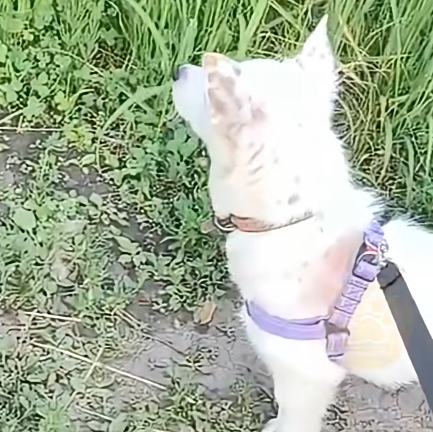
Instead, Tosya is walking beside her new owner.
A purple leash rests against her neck.
Trees line the path.
Daylight filters through the leaves.
And Tosya walks openly beside a person.
The leash itself is an ordinary object.
For this particular dog, it represents an extraordinary contrast.
Months earlier, simply getting within arm’s reach of Tosya had seemed nearly impossible.
Now she was voluntarily moving through the world beside someone.
Not disappearing behind the next wall.
Not waiting for the person to turn away.
Walking together.
The Purple Leash Says More Than a Perfect Ending Ever Could
It would be easy to describe Tosya’s story as a transformation from fear to complete trust.
Reality is usually more complicated.
A dog who has spent months avoiding people may continue to have cautious moments.
New places can still feel unfamiliar.
Trust can continue developing long after adoption.
Tosya did not need to become fearless for her rescue to be successful.
She needed a life in which fear no longer controlled every decision.
That is what makes the final images so meaningful.
The physical distance is small.
A little dog.
A person beside her.
A leash connecting them.
But emotionally, it represents the entire distance Tosya traveled.
From the garage complex where nobody could touch her—
to a veterinary clinic where treatment became possible—
to a warm bed—
to familiar hands—
and finally to a person she could walk beside.
The dog who once survived by disappearing had learned that sometimes staying close could be safe too.
Tosya’s Winter Ended Long Before the Weather Changed
For months, rescuers could only watch Tosya from a distance.
They could leave food.
They could hope she returned tomorrow.
They could try again.
But Tosya always decided when the interaction ended.
Usually, it ended with a flash of white fur disappearing between concrete walls.
Then she vanished entirely.
When rescuers finally saw her again, it was because something had gone wrong.
She was injured.
She needed medical attention.
And for once, running away was no longer an option.
What initially looked like another terrible chapter became the opening that allowed her life to change direction.
She was brought to a clinic.
Her wounds were treated.
No microchip connected her to an identifiable owner.
So the people who had spent months trying to reach her stayed involved.
They offered food.
Warmth.
Medication.
Space.
And patience.
Eventually, Tosya stopped treating every nearby person as someone she needed to escape.
Her wounds closed.
Her body recovered.
And a family welcomed her into a life beyond the garage complex.
There is no need for a dramatic final claim that Tosya forgot the winter.
She probably didn’t need to forget anything.
She simply needed enough new experiences to discover that her future did not have to look like her past.
Today, the most memorable image of Tosya is no longer a small white shape disappearing behind cold concrete.
It is a little dog walking beneath the trees.
A person beside her.
A purple leash between them.
And nowhere she needs to hide.


