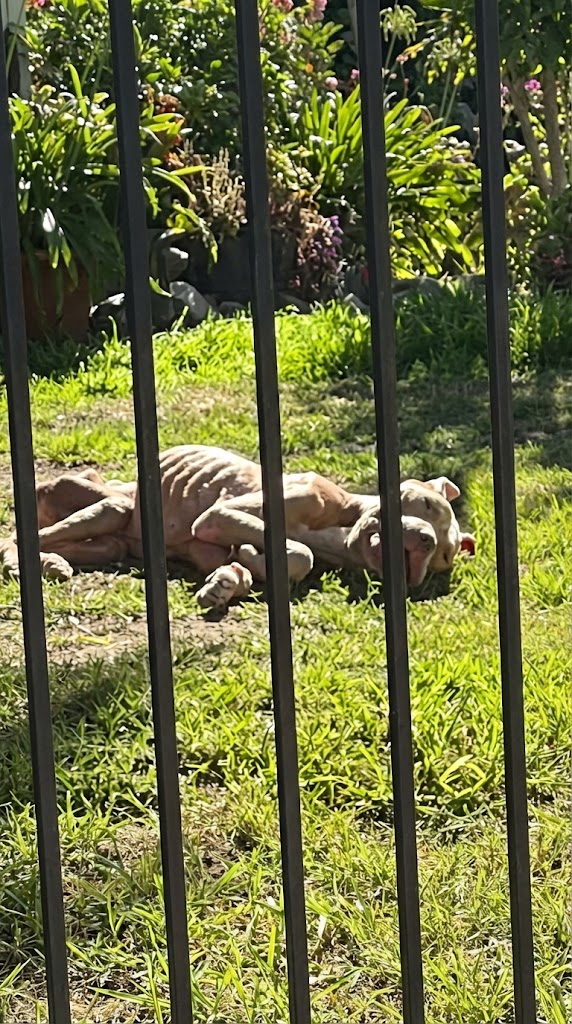
Behind an ordinary fence in Highland, California, a dog was becoming thinner by the day.
His name was Gator.
From a distance, he was still recognizable as a Pit Bull. Up close, however, his body told a much more troubling story.
His ribs stood out sharply.
His hips were prominent.
His legs looked too thin to support the frame they carried.
Gator spent much of his time in the yard, tethered and surrounded by dirt, while concern about his condition gradually spread beyond the property.
When people began asking questions, one description reportedly followed him again and again.
Aggressive.
It was presented as an explanation for why handling him was difficult.
There were also claims that Gator was eating normally and that an unexplained illness was responsible for his appearance.
But the rescuers who eventually reached him could see that whatever had caused his condition, he urgently needed medical attention.
And when they finally came close enough to meet the dog behind the label, the encounter did not unfold the way they had been warned it might.
The Dog Behind the Fence Was Barely Holding Himself Up
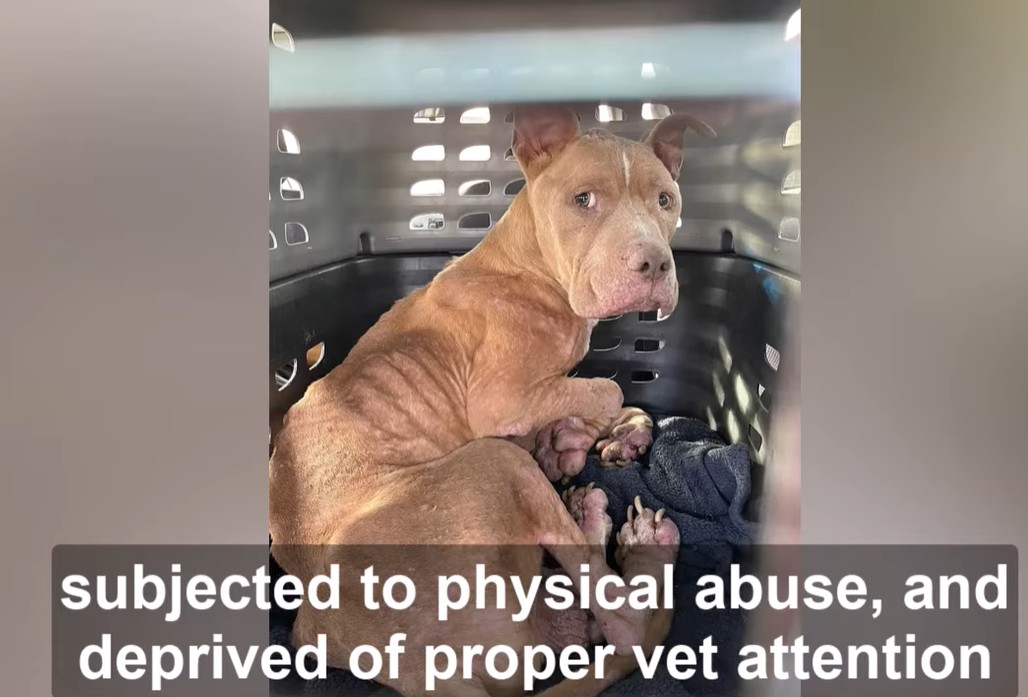
By the time rescuers reached the property, photographs of Gator’s condition had already drawn attention.
The dog in those images was extraordinarily thin.
His body had lost nearly all of the padding that should have protected his bones and joints.
He moved slowly.
Even lifting his head appeared to require effort.
The rescue team had been told that Gator could be difficult or aggressive.
That meant they still had to approach carefully.
Any dog in pain, frightened, or physically compromised can react unpredictably.
But the animal they encountered did not charge toward them.
He did not display the strength of a dog eager to fight.
He appeared exhausted.
The rescuers could not diagnose the reason for his weight loss by looking at him through the yard.
They could only see that waiting longer was not a reasonable option.
According to the rescue account, there was initially resistance to surrendering Gator, and an unidentified illness was suggested as an explanation for his condition.
Eventually, with outside intervention and authorization to remove him, rescuers were able to take Gator from the property.
The chain stayed behind.
Gator went directly to veterinary care.
VIDEO: Rescuers Were Warned Gator Was “Aggressive” — Then They Finally Met Him
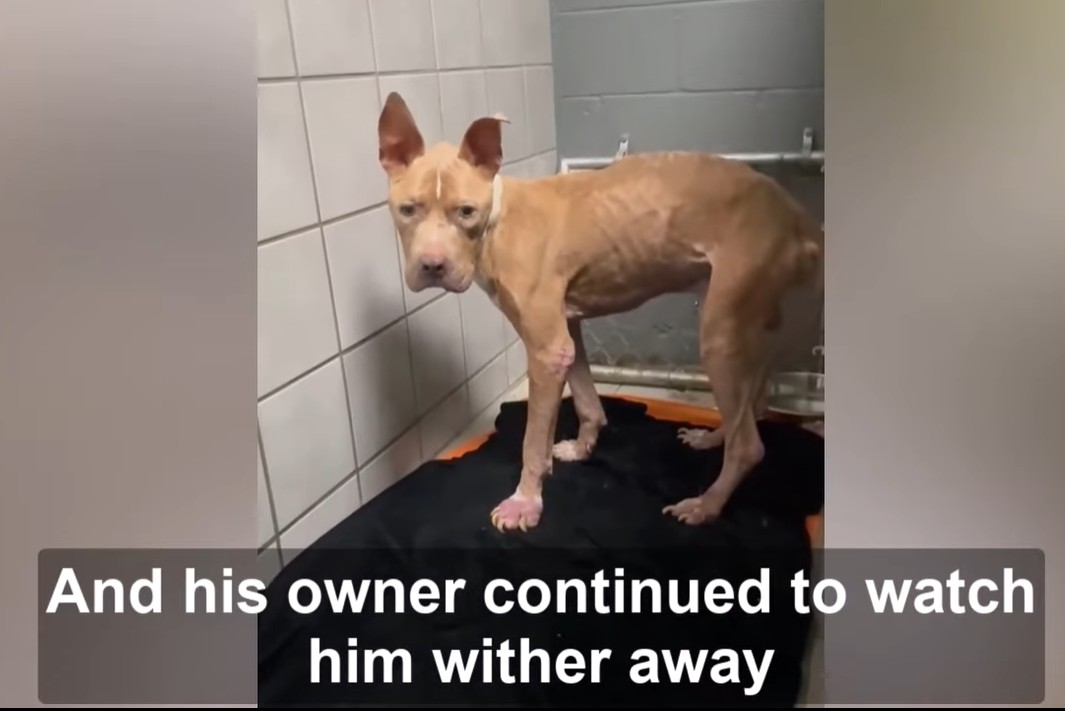
His Body Condition Score Was Just 1 Out of 9
The veterinary assessment put a number on what rescuers had already seen.
Gator reportedly received a Body Condition Score of 1/9.
On the commonly used nine-point body condition scale, that represents an extremely underweight animal with very little remaining body fat or muscle coverage.
But his low weight was not the only concern.
His paws were inflamed and uncomfortable.
His ears showed significant infection.
His skin also required treatment.
After a long period in poor condition, rebuilding Gator’s health would need to happen carefully.
A severely underweight dog cannot simply be given unlimited food and expected to recover overnight.
Nutrition has to be managed.
Underlying medical problems have to be investigated.
Infections have to be addressed.
And the animal’s response needs to be watched closely.
For Gator, the first stage was not about transformation.
It was stabilization.
Food in appropriate amounts.
Medical treatment.
A clean place to rest.
And people close enough to notice if anything changed.
The Dog Called “Aggressive” Began Leaning Toward Gentle Hands
The rescuers remained cautious during Gator’s first days of treatment.
They had been warned about his behavior.
He was also uncomfortable, weak, and surrounded by unfamiliar people.
Yet as staff members began caring for him, another side of Gator became visible.
He accepted handling.
He allowed people to clean him.
He tolerated examination and treatment.
And as he became familiar with the veterinary team, he began leaning toward gentle contact.
That did not prove every previous report about his behavior was false.
Dogs can behave differently in different environments, particularly when pain, fear, confinement, or stress are involved.
But the behavior rescuers personally observed was clear.
In their care, Gator was not behaving like the uncontrollably dangerous dog they had expected to meet.
He was weak.
He was cautious.
But he could also be gentle.
The staff began wrapping him in blankets after treatment, creating what some described affectionately as a little “cocoon” around his thin body.
During bathing and handling, Gator sometimes trembled.
There were many possible reasons for that—weakness, stress, unfamiliar surroundings, discomfort.
The caregivers did not need to decide exactly which one explained every reaction.
They simply continued moving slowly.
Over time, Gator became more comfortable with them.
Gaining Weight Was Only One Part of the Recovery
Food helped.
Rest helped.
Treatment helped.
But recovery did not move in a perfect upward line.
After roughly two weeks of hospitalization, Gator had begun showing more energy.
His body was stronger than it had been on arrival.
His interest in people was growing.
Yet his paws and skin continued creating problems.
The inflammation did not simply disappear as his nutritional condition improved.
Veterinary testing, including cultures described in the rescue account, revealed a chronic dermatological problem that was difficult to treat.
Gator required more specialized care.
That meant dermatology consultations and adjustments to his treatment plan.
This part of the story mattered because it showed why his recovery took so long.
The dramatic photographs of his thin body were only the most visible problem.
Underneath them were infections and skin issues that required continued medical attention.
Even as Gator gained strength, some conditions demanded patience.
The team could not rush them.
They could only keep treating him and watch how his body responded.
The Numbers Changed Slowly, Then His Personality Did Too
As the weeks passed, Gator began filling out.
The sharp outline of his ribs became less extreme.
His muscles slowly returned.
Standing and moving required less effort.
But the changes people remembered most were not always the ones measured on a scale.
Gator started seeking attention.
He leaned into people who approached him calmly.
He became easier to handle.
The hospital staff learned more about what he enjoyed and what made him comfortable.
The dog who had initially entered the clinic as an emergency case began having ordinary moments.
Resting after a meal.
Watching people come through the room.
Enjoying a gentle touch.
Showing interest in his surroundings.
Those moments signaled that his world was becoming larger than treatment tables and medications.
For the rescuers, it also made the original label attached to him harder to reconcile with the dog they now knew.
Instead of repeating that Gator had “proven” everyone wrong, they could simply point to what was happening in front of them.
This dog was capable of trust.
And increasingly, he was choosing to interact with the people around him.
Sixty Days of Care Changed What His Future Looked Like
Gator remained under intensive care for approximately 60 days.
Two months.
Long enough for dozens of meals.
Repeated veterinary checks.
Skin treatment.
Ear treatment.
Specialist appointments.
Rest.
And gradual rebuilding of a body that had arrived in a severely depleted condition.
At the beginning, nobody could responsibly promise how quickly he would recover.
By the end of those two months, his medical team believed he was stable enough for the next stage.
Not a return to the yard where he had been found.
A foster home.
For Gator, that transition mattered.
A hospital had saved and stabilized him.
A foster home could begin showing him what ordinary domestic life looked like.
Beds instead of treatment areas.
Household routines instead of constant clinical procedures.
More time simply being a dog.
He was still a rescue with a medical history.
But he no longer needed every hour of his life organized around crisis care.
Leaving the Clinic Did Not Mean Everything Was Suddenly Perfect
Rescue stories often compress recovery into two photographs.
Before.
After.
Gator’s case took far more than that.
Sixty days of treatment did not erase his medical history.
Skin problems can require continued monitoring.
Weight needs to be maintained carefully after severe emaciation.
Behavior can continue evolving as a dog moves from one environment to another.
A foster home was therefore not the end of Gator’s story.
It was the next stage.
What had changed was the kind of problems he was facing.
At the beginning, the questions were immediate.
Would he stabilize?
Would he eat?
Could his infections be brought under control?
Would his skin respond to treatment?
Later, the questions became different.
How would he settle into a home?
What routines would help him?
What kind of permanent placement might eventually suit him?
That change alone showed how far he had come.
The dog whose body once demanded emergency attention was finally healthy enough for people to begin planning a future rather than simply protecting the present.
Gator’s Story Is Stronger Without Guessing What Happened Behind the Fence
There is an understandable temptation to look at Gator’s first photographs and decide exactly why he became so thin.
The rescue account included conflicting claims about his condition and care.
Concerned observers saw an extremely underweight dog.
The person responsible for him reportedly described him as aggressive and suggested illness played a role.
Veterinary examination later documented severe emaciation along with other medical issues.
Those facts are enough.
The story does not need invented conversations or assumptions about what another person was thinking.
What happened after rescuers reached Gator can be described clearly.
He was removed from the property.
He entered veterinary care with a Body Condition Score reported as 1/9.
His paws and ears required treatment.
His skin condition proved persistent enough to need specialist attention.
He stayed under medical care for around 60 days.
And during that time, caregivers repeatedly observed a dog who could accept and seek gentle human contact.
Then he became well enough to leave the clinic for foster care.
That is already a remarkable distance to travel.
The Dog Once Seen Through a Fence Finally Walked Into a Different Life
Gator’s first chapter in this story was defined by limitation.
A yard.
A tether.
A body with almost no reserves left.
A reputation that made people expect one kind of dog before they ever touched him.
His next chapter looked very different.
Veterinary staff knew him by name.
Meals arrived regularly.
His infections were treated.
Specialists worked on the skin problems that refused to resolve easily.
His weight improved.
And people had the opportunity to discover his behavior for themselves rather than relying only on a label.
After approximately two months, Gator walked out of the clinic and into foster care.
Not magically healed.
Not somehow untouched by what came before.
But stable enough to begin living somewhere designed around recovery rather than survival.
Perhaps that is the most important thing Gator’s story leaves behind.
A photograph can make people stop.
A label can make them hesitate.
But neither tells the entire story of an animal.
Sometimes you have to get close enough to see what is actually there.
The rescuers who approached Gator had been told to expect aggression.
What they found was an extremely weak dog in urgent need of care.
Then, as his body recovered, they found something else.
A dog willing to lean toward the hands helping him.
Sixty days later, the fence and chain were no longer the boundaries of Gator’s world.
He had somewhere new to go.
And for the first time in this story, the next place waiting for him was not another treatment room.
It was a home.


