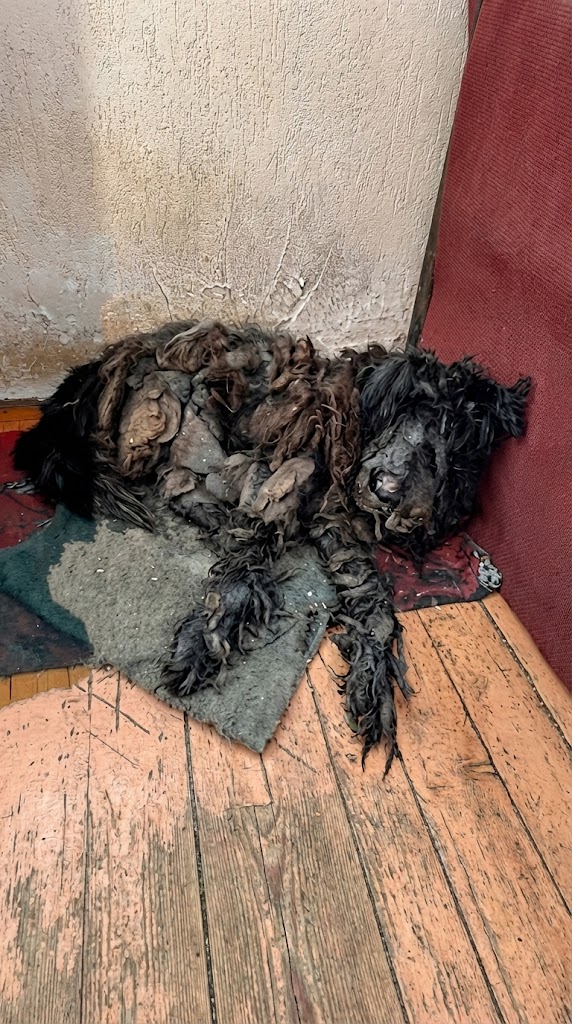
For months, Chekia stayed near the entrance of an old building.
People came and went.
Doors opened and closed.
Life continued around him.
But Chekia remained.
According to the rescue account, he had once belonged to someone and was later left behind. After that, the dog lingered in the same area, surviving as best he could while waiting near the place he knew.
Then his condition became far more serious.
At some point, a heavy industrial adhesive was poured over much of his body.
The substance soaked into his already tangled coat and hardened.
By the time rescuers found him, fur and glue had fused into thick, rigid sections that restricted his movement and covered large areas of his body.
Even part of his face had been affected.
Chekia no longer simply needed food and shelter.
He needed people willing to remove a hardened shell without causing even more damage underneath.
The Dog Outside the Building Had Almost Stopped Moving
When rescuers first saw Chekia up close, his condition was difficult to understand at a glance.
His coat no longer moved naturally.
Large sections had become stiff.
The hardened material pulled at his fur and skin whenever he tried to change position.
Walking was difficult.
Cleaning himself was nearly impossible.
And because so much of his coat had been sealed beneath the adhesive, caregivers were concerned about what was happening to the skin underneath.
Chekia remained quiet as people approached.
The rescuers could not know exactly what he remembered about human contact or why he reacted the way he did.
They only knew that he needed help quickly.
Trying to tear the hardened material away outside could have injured him further.
So instead of attempting a rushed cleanup, they transported Chekia to veterinary care.
There, the real work could begin.
VIDEO: Chekia Is Found Trapped Beneath a Hardened Layer of Glue
Removing the Hardened Coat Could Not Be Rushed
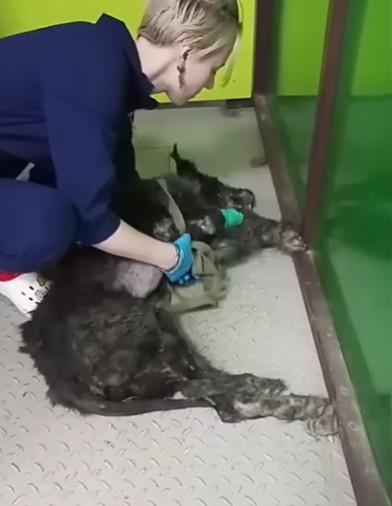
At the clinic, caregivers faced an unusual challenge.
The glue had bonded tightly with Chekia’s fur.
Simply pulling it away was not an option.
The coat had to be clipped and separated little by little, with constant attention to the fragile skin underneath.
Some areas came away more easily.
Others required much slower work.
The rescuers described the material as having hardened almost like a shell around him.
Each section removed gave Chekia slightly more freedom of movement.
But it also revealed the condition of the skin beneath.
Areas that had been hidden required cleaning and treatment.
The process took time.
There was no dramatic moment when the entire layer suddenly fell away.
Chekia’s body emerged gradually.
One section.
Then another.
Then another.
Until the dog underneath became visible again.
His Face Revealed One of the Most Serious Injuries
The adhesive had not affected only Chekia’s back and body.
Part of his face had also been involved.
According to the rescue account, one eye had been seriously damaged after glue and matted material accumulated around the area.
The veterinary team carefully worked around his face, where even a small mistake could create additional injury.
As the hardened fur was removed, one eye became clearly visible again.
The other had suffered far more severe damage.
The exact sequence of how the injury developed was not documented in detail, but Chekia eventually retained vision through only one eye.
For the caregivers, the discovery changed the goals of treatment.
They could not undo everything that had happened.
They could protect what remained.
They could treat infection.
They could reduce discomfort.
And they could help Chekia adjust to life with limited vision.
That was enough to keep moving forward.
The First Days Afterward Were Still Uncertain
Removing the hardened material did not mean Chekia was suddenly healthy.
His body had been under significant stress.
During the first days of treatment, he ate very little.
His temperature was elevated.
Blood testing reportedly showed that his liver function was also affected.
So the clinic continued monitoring him closely.
Medication.
Fluids and supportive care as needed.
Wound management.
Food offered in amounts he could tolerate.
And rest.
The caregivers also kept interaction calm.
There was no expectation that Chekia should immediately seek affection simply because the glue was gone.
He had just endured hours of handling and treatment.
What he needed most was time for his body to respond.
For several days, progress remained cautious.
Then the medical numbers began moving in the right direction.
By Day Seven, His Skin Was Beginning to Close
Around the seventh day, caregivers began seeing encouraging changes.
The damaged areas were healing.
Wounds that had required constant attention were beginning to close.
Chekia’s condition was not completely resolved, but the direction was finally positive.
His appetite started improving.
He became more responsive to the people around him.
And his body appeared more comfortable now that the weight and restriction of the hardened coat were gone.
These were the kinds of changes that mattered during recovery.
Not one spectacular transformation.
A little more food.
A better night of rest.
Healthier-looking skin.
More interest in what was happening around him.
Each improvement gave the team another reason to continue.
On Day Ten, His Bloodwork Brought Better News
By approximately the tenth day, another important result arrived.
According to the rescue account, Chekia’s liver values had returned to the normal range.
That was a significant improvement from the worrying results recorded earlier in his treatment.
For the first time, the team could begin looking beyond the immediate crisis.
His skin was healing.
His general condition was improving.
His bloodwork was moving in a healthier direction.
The next challenge became rehabilitation.
Chekia had spent so much time moving under the restriction of the hardened material that his strength had declined.
Walking normally would take time.
But now he had something he had not possessed when rescuers first found him.
Freedom of movement.
One Eye Was Lost, but His Mobility Began Returning
Chekia’s vision remained limited to one eye.
That was part of his new reality.
But the rest of his body continued improving.
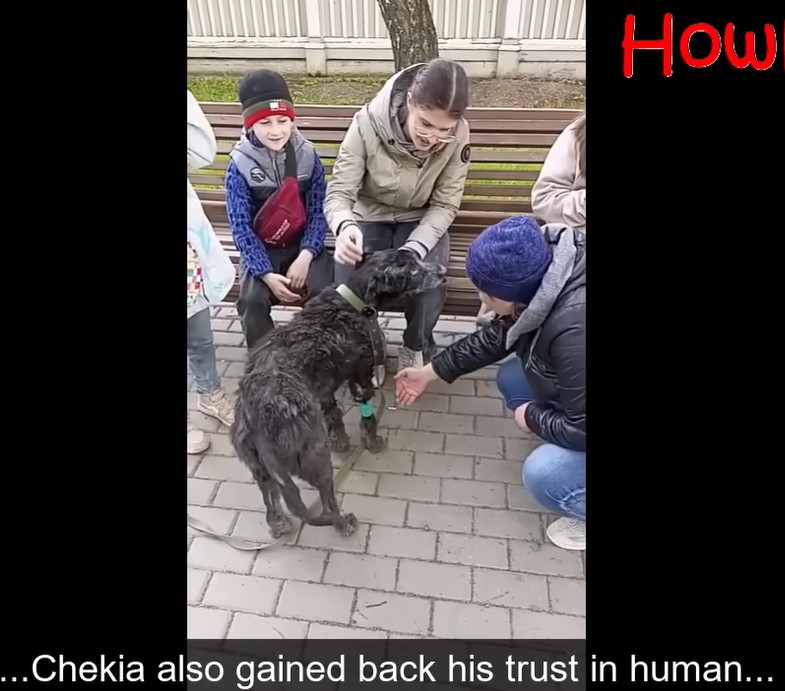
As the skin healed and his strength returned, caregivers encouraged gentle movement.
At first, Chekia walked cautiously.
His legs needed time to become stronger.
Then the steps became steadier.
He explored more.
He moved with less hesitation.
Eventually, according to the rescue account, Chekia was able to run and play.
The contrast was striking.
The dog once restricted by a rigid coat of hardened adhesive could now move freely through open space.
He did not need to become physically perfect for that change to matter.
He simply needed enough strength and comfort to live like a dog again.
A New Home Became the Final Change
As Chekia recovered, another person entered his story.
A woman chose to give him a permanent home.
For Chekia, it meant another transition.
But this one looked very different from the circumstances in which rescuers had first found him.
He now had someone responsible for his meals.
Someone watching his health.
Someone providing a safe place to sleep.
And someone who understood that one functioning eye did not make him less deserving of an ordinary life.
The dog who had once remained outside an old building no longer needed to stay near a doorway hoping for shelter.
He had one.
Chekia Did Not Need His Past Erased
It would be easy to frame Chekia’s recovery as though everything painful disappeared once he was rescued.
It did not.
One eye could not be restored.
His skin required days of treatment.
His liver needed time to recover.
His muscles had to regain strength.
And some details of what happened before rescuers found him may never be fully known.
But rescue did not need to erase the past to change the future.
The hardened material was removed piece by piece.
His wounds began closing.
His bloodwork improved.
Walking became easier.
Then came running.
Playing.
And eventually, a home.
That progression tells Chekia’s story more clearly than any imagined thoughts could.
When rescuers first reached him, his body was trapped beneath something rigid enough to limit nearly every movement.
Days later, that shell was gone.
Weeks later, Chekia was moving under his own strength again.
The most memorable image of his story does not have to be the dog covered in hardened glue.
It can be the dog who came afterward.
One eye watching the world.
Four legs moving freely.
And a home waiting when he was ready to rest.


