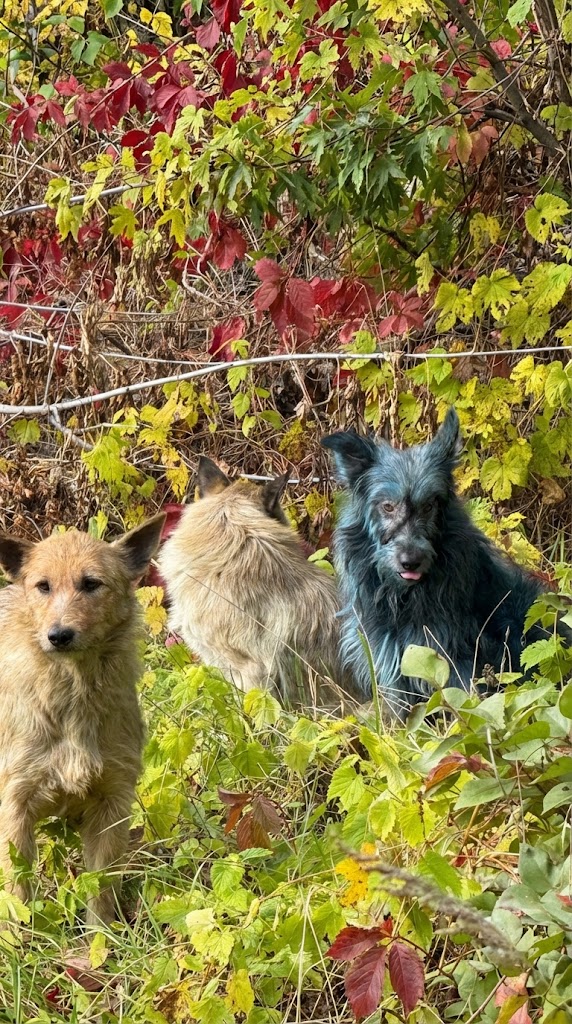
Chernobyl is the kind of place where almost any strange image feels believable.
Empty buildings.
Rusting structures.
Restricted roads.
Radiation that cannot be seen.
And dogs still living among the remains of communities evacuated decades ago.
So when photographs began circulating of dogs with unusually bright blue fur inside the Chernobyl Exclusion Zone, people immediately reached for the most unsettling explanation.
Radiation.
Mutation.
A visible sign that the disaster of 1986 was somehow still transforming the animals that remained behind.
The photographs certainly looked strange enough.
Against the gray landscape, the blue-coated dogs seemed almost unreal.
But the people actually working with these animals began looking more closely.
And the explanation they suspected was far less dramatic than the internet imagined.
The Blue Dogs Looked Like Something Out of Science Fiction
The dogs of the Chernobyl Exclusion Zone already carry a story unusual enough without changing color.
According to the account, many are descendants of domestic animals left behind when residents evacuated after the 1986 nuclear disaster.
Generations later, dogs still roam parts of the restricted region.
Then several of them appeared with blue fur.
Not a subtle gray-blue shade.
A color noticeable enough to immediately attract attention online.
In almost any other location, people might have assumed paint, dye, or industrial residue.
Inside Chernobyl, however, the setting changed the way people interpreted the photographs.
Could radiation have caused it?
Were these dogs developing some previously unseen mutation?
The mystery spread quickly because the location made the most frightening explanation sound almost plausible.
But unusual color alone was not evidence of genetic change.
The rescue teams working in the area needed something more concrete.
VIDEO: Blue Dogs Are Spotted Inside the Chernobyl Exclusion Zone
Rescuers Began Looking for a Simpler Explanation
Teams associated with Clean Futures Fund were already familiar with the dogs living inside the exclusion zone.
Their work brought them into direct contact with the animals rather than relying only on photographs circulating online.
When the blue dogs appeared, the color surprised them too.
But the animals themselves reportedly remained alert and active.
That detail mattered.
Nothing about the strange coat color automatically proved that the dogs were ill or undergoing some extraordinary biological change.
According to the account, veterinarians and rescuers began considering whether something in the environment had simply stained the fur.
Eventually, attention turned toward a much less mysterious possibility.
A leaking portable toilet or similar sanitation equipment containing a colored chemical substance.
The suggestion was that the dogs had rolled in, rubbed against, or otherwise come into contact with material containing blue dye.
In other words, the color may have been on the dogs.
Not inside them.
The “Mutation” Theory Was Never Necessary
Dr. Jennifer Betz, identified in the account as one of the people familiar with the dogs, explained that the blue coloration appeared consistent with a substance adhering to the coat.
That distinction completely changed the story.
A dyed coat can look extraordinary.
It does not require genetic mutation to explain it.
And dogs, of course, are not famous for avoiding unpleasant-smelling or dirty substances simply because humans would prefer them to.
Anyone who has watched a perfectly clean dog enthusiastically roll in something questionable will understand how quickly an unusual material can become distributed across fur.
The Chernobyl setting made the photographs feel ominous.
The behavior behind them may have been much more ordinary.
A dog found something on the ground.
The dog rolled in it.
The fur changed color.
The internet supplied the apocalypse afterward.
But the Dogs Themselves Are Part of a Much Bigger Story
The blue fur may have had a relatively mundane explanation.
The existence of the dogs does not.
The source describes a population of roughly 500 dogs living within or around the Chernobyl Exclusion Zone.
Many are believed to descend from pets left behind during the evacuation following the nuclear accident.
Those animals had to survive in a landscape transformed almost overnight.
Homes emptied.
People disappeared.
Human food sources changed.
Winters continued arriving.
Over generations, the dogs adapted to living in an environment with far less ordinary human care than their domestic ancestors would have known.
Some remained near areas where workers and visitors still appeared.
Others formed loose groups.
Their continued presence turned them into one of the most visible animal populations associated with Chernobyl.
Life Inside the Exclusion Zone Is Still Difficult
The blue photographs were unusual.
The daily challenges facing the dogs are much more ordinary.
Food.
Weather.
Disease.
Injury.
Reproduction without consistent veterinary control.
According to the account, workers entering parts of the zone still use protective equipment and radiation monitoring devices because environmental risks remain.
For dogs, however, survival also depends on problems familiar to stray populations almost everywhere.
Winter temperatures can be severe.
Food availability varies.
Parasites and infectious disease can spread among animals living in groups.
And without sterilization programs, new litters add more puppies to an already difficult environment.
That is why rescue efforts in the region focus on practical needs rather than the mystery surrounding viral photographs.
Vaccinations.
Sterilization.
Medical care.
Monitoring.
And food.
Scientists Have Studied These Dogs for a Different Reason
The Chernobyl dog population has also attracted scientific attention.
The source states that genetic studies have found that dogs living around Chernobyl are distinguishable from other dog populations in Eastern Europe.
That finding is interesting.
But it should not automatically be translated into the claim that radiation created a new type of dog.
Populations can become genetically distinct for many reasons.
Isolation.
Limited breeding groups.
Geography.
Population history.
Selection pressures.
Radiation exposure may be one question researchers investigate, but the existence of genetic differences alone does not establish that radiation caused every difference observed.
That distinction is especially important when dramatic photographs begin circulating online.
The blue dogs looked unusual.
Their color, according to the explanation given by rescuers, did not appear to represent a genetic mutation.
Volunteers Have Been Returning Since 2017
The dogs living in the exclusion zone are not completely without human support.
According to the account, veterinary and volunteer programs have operated in the region since around 2017.
Their work has included vaccinating animals, sterilizing dogs and cats, tagging them, monitoring health, and treating medical problems.
The source reports that more than 1,000 dogs and cats have received some form of treatment through these efforts.
That kind of work matters because the problems facing free-roaming animals rarely disappear after one rescue visit.
Vaccination programs help reduce disease.
Sterilization helps control population growth.
Tagging allows teams to recognize animals they have already treated.
Regular monitoring helps identify dogs whose condition has changed.
It is slow work.
Often repetitive.
And far less visually dramatic than photographs of bright blue dogs.
But it is the work that actually changes the animals’ daily lives.
Sometimes the Most Important Supply Is Simply Food
Veterinary care is only one part of the effort.
Dogs need to eat every day.
That means rescue teams and volunteers also bring food into areas where the animals gather.
The source describes journeys involving checkpoints, restricted areas, and regions where radiation levels have to be monitored.
Yet people continue making those trips.
They arrive with supplies.
Dogs begin appearing from around abandoned structures.
Food is distributed.
Then the teams leave and eventually return again.
There is something striking about the simplicity of those encounters.
Chernobyl is remembered globally for one of history’s most serious nuclear disasters.
But for a dog waiting near an abandoned building, the immediate concern may be much smaller.
Is there food today?
Is this person safe?
Will they return?
Lady Became Famous for the Wrong Reason — and the Right One
One of the blue-coated dogs mentioned in the story was known as Lady.
Photographs of Lady and other unusually colored dogs spread because they looked like evidence of something extraordinary.
That was the wrong reason to assume the images mattered.
The blue coloring was expected to fade, wash away, or disappear naturally as the coat changed.
But the attention surrounding those photographs did something useful.
It reminded people that the dogs were still there.
Long after the emergency evacuation.
Long after Chernobyl became history for much of the world.
Long after abandoned homes became tourist images and documentary footage.
Animals continued living in that landscape.
Their needs did not disappear because public attention moved elsewhere.
The Blue Will Fade — The Larger Story Will Not
Eventually, the dogs’ unusual color should disappear if the explanation described by rescuers is correct.
Rain can wash away some residue.
Bathing can remove more.
New fur eventually replaces old fur.
The blue dogs will stop being blue.
But Chernobyl’s dog population will remain.
That is what makes the viral mystery only the beginning of the story.
The most important question was never whether radiation had magically turned dogs blue.
It was why hundreds of dogs were still living inside and around one of the world’s most famous abandoned regions decades after the original disaster.
And what people were doing for them now.
Volunteers continue arriving.
Veterinarians continue treating animals.
Food continues being carried through checkpoints.
Dogs continue appearing from around buildings that have been empty of ordinary family life for decades.
The photographs of blue fur caught people’s attention because they looked impossible.
The truth was less spectacular.
And perhaps more meaningful.
These were still dogs.
Curious enough to roll in something they probably shouldn’t.
Dependent on food.
Vulnerable to illness.
Able to recognize familiar caregivers.
Living ordinary animal lives inside an extraordinary place.
Chernobyl changed the landscape around them.
It created generations of questions scientists are still studying.
But the strange blue coat that made them famous appears to have had a much simpler explanation.
Sometimes the most unsettling image does not hide a mutation.
Sometimes it hides an ordinary dog—
covered in something blue—
waiting for the next person carrying food.


