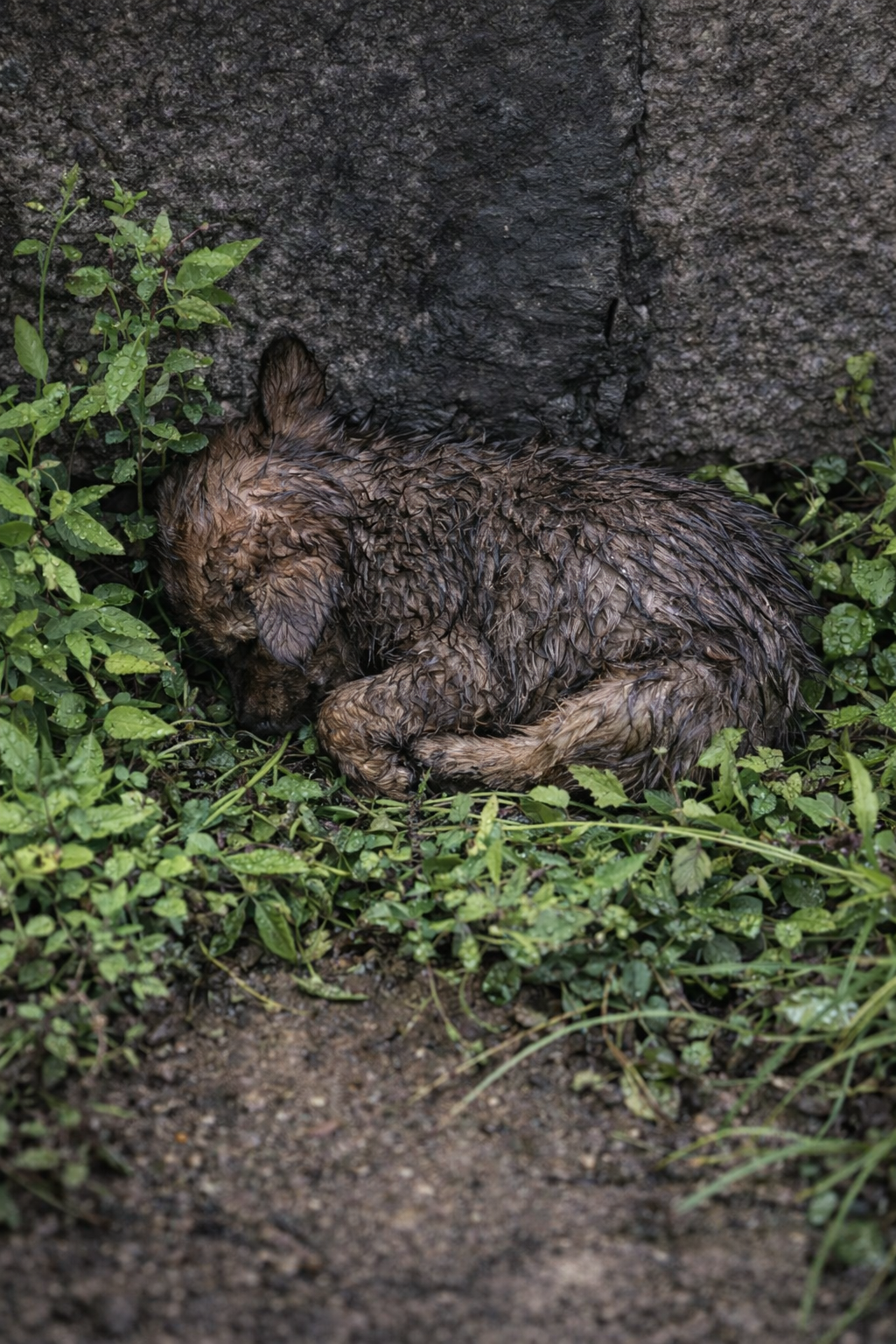
The workday was almost over when someone noticed a small shape in the grass beside the road.
At first, it was easy to mistake him for a puppy simply resting.
He wasn’t barking.
He wasn’t wandering around looking for food.
He wasn’t even trying to move.
He just lay there quietly, watching the people who had suddenly appeared in front of him.
When the rescuers stepped closer, the puppy tensed.
His body seemed to shrink toward the ground, as though staying very still might make him safer.
Then they saw his back legs.
And the reason he had been lying there became painfully clear.
He wasn’t choosing to stay in the grass.
He could not get up.
He Tried to Make Himself Smaller
The rescuers approached carefully.
Every unfamiliar sound seemed to make the puppy more nervous. Footsteps, voices, hands reaching toward him—none of it appeared familiar or comforting.
But he didn’t have the strength to run.
His hind legs were badly injured, leaving him unable to stand normally or search for food on his own.
Whatever had happened before the rescuers found him, his condition had already reduced his world to one small patch of roadside grass.
So they did not rush him.
They stayed low.
They spoke quietly.
And when it was finally time to lift him, they supported his little body as gently as possible.
There was no dramatic struggle.
The puppy simply allowed himself to be carried.
A cardboard box was lined with warm clothing, creating a soft temporary bed.
For the first time that evening, he was no longer lying exposed beside the road.
He was surrounded by warmth.
And someone was staying with him.
VIDEO: Both Back Legs Failed Him — Watch the Little Roadside Puppy Begin Learning to Walk Again
Morning Brought the Answer Everyone Feared
The following morning, the puppy was taken to a veterinary clinic.
There was still hope that perhaps rest, food, and medication might be enough.
The X-rays showed otherwise.
Both hind legs had suffered serious injuries.
This was not something that could simply be watched for a few days in the hope that it would improve on its own.
The puppy needed surgery.
For such a small animal, the road ahead suddenly looked enormous.
There would be an operation.
Pain management.
Careful monitoring.
Rehabilitation.
And then the slow process of discovering how much movement could return.
No one could skip directly to the happy ending.
The rescuers could only deal with the next step in front of them.
First, they needed to help him through surgery.
Surgery Was Only the Beginning
The operation addressed the immediate physical problem, but everyone involved understood that repairing injured legs was only one part of recovery.
After surgery, the puppy needed time.
Three days passed before his condition was considered stable.
Those first days were quiet ones.
There was no running.
No playful puppy energy.
No sudden transformation.
His body was recovering from both the original injuries and the medical treatment required to help him.
The rescuers focused on the simple things.
Keeping him comfortable.
Making sure he ate.
Watching his condition.
Giving him somewhere warm to rest.
And waiting.
Sometimes rescue stories seem to turn around in a single dramatic moment.
This one didn’t.
His recovery happened in pieces.
A little more strength.
A little less discomfort.
A little more willingness to move.
Each change was small enough that someone could easily have overlooked it.
But the people caring for him noticed every one.
Twelve Days Later, the First Major Progress Appeared
By approximately twelve days after surgery, the rescuers reported that nearly seventy percent of the damage had healed.
It was encouraging news.
But the puppy still had work ahead of him.
Bones and tissue could heal while muscles remained weak.
A dog that had spent time unable to use his hind legs could not simply wake up one morning and move as though nothing had happened.
Strength had to be rebuilt gradually.
Balance had to return.
Movement had to become familiar again.
So rehabilitation became part of his daily routine.
The rescuers combined regular physical exercises with gentle supportive care.
Warm herbal treatments were used to help relax tight muscles.
Medicinal leaf baths were part of the routine as well.
And each day, the puppy was encouraged to use his body a little more.
Sometimes the rehabilitation sessions had an audience.
Household cats would linger nearby, watching curiously as the little patient worked through another round of exercises.
It was an ordinary domestic scene.
A recovering puppy.
A patient caregiver.
A few curious cats.
Yet those quiet sessions were slowly rebuilding a life.
Learning to Move Could Not Be Rushed
At first, improvement did not mean walking normally.
It meant trying.
Supporting himself for a little longer.
Shifting his weight.
Moving a leg that had once seemed useless.
Repeating exercises even when progress was almost impossible to see from one day to the next.
The rescuers didn’t expect perfection from him.
They simply kept giving him opportunities to become stronger.
Some days were better than others.
That is often the reality of rehabilitation.
An animal may seem stronger one morning and more tired the next.
A movement that appears easy one day may require more effort later.
So instead of measuring his recovery hour by hour, the team watched the larger pattern.
Week by week, he was improving.
His body became stronger.
His movements became more controlled.
And the frightened puppy who once lay motionless beside the road began paying more attention to the world around him.
The Wheelchair Gave Him Something He Had Lost
During recovery, mobility support helped the puppy move while his back legs continued gaining strength.
A wheelchair allowed him to explore without forcing his healing body to do more than it was ready for.
And movement changed more than his physical condition.
Suddenly, the world was larger again.
He could go from one place to another.
He could investigate his surroundings.
He could follow the people caring for him.
He could behave more like a curious young dog rather than a patient confined by injury.
The wheelchair was not a symbol of defeat.
It was a bridge.
It gave him freedom while his body continued catching up.
Meanwhile, the exercises continued.
So did the warm therapies.
So did the careful daily attention.
Nobody knew exactly how far his recovery would go.
They only knew that he kept trying.
And because he kept trying, they kept helping.
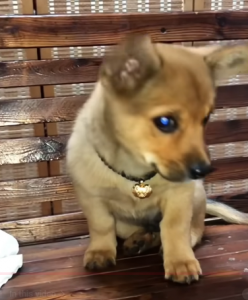
Four Months Changed Everything
Four months is a long time in the life of a young puppy.
For this one, those months were filled with repetition.
Exercise.
Rest.
Food.
Rehabilitation.
More exercise.
Small victories.
Occasional setbacks.
Then another attempt.
Gradually, something remarkable happened.
He began relying less on the wheelchair.
His legs were becoming strong enough to support him.
His balance improved.
His steps became more confident.
Eventually, the mobility device he had once depended on was no longer necessary.
The puppy could move on his own.
And then walking became something even better.
Running.
The little dog who had once been unable to rise from a patch of roadside grass was now moving through the house under his own power.
He explored.
He played.
He followed whatever caught his curiosity.
The change wasn’t confined to his legs.
His entire appearance seemed different.
His coat became healthier and shinier.
His posture changed.
The uncertainty in his expression gradually gave way to the bright curiosity of a young dog who finally had energy to spare.
He no longer looked like a puppy waiting helplessly for someone to notice him.
He looked like a puppy with somewhere to go.
The Most Important Part Was That Someone Stayed
It would be easy to describe his recovery as a miracle.
But doing so would leave out the part that mattered most.
His transformation took months.
It required veterinary treatment.
It required surgery.
It required rehabilitation repeated day after day.
It required someone to notice subtle improvements that might have seemed insignificant to anyone else.
And above all, it required consistency.
The puppy could not understand X-rays.
He did not know why surgery was necessary.
He had no idea what percentage of his injuries had healed after twelve days.
What he could understand was much simpler.
Food appeared.
Hands supported him.
A warm place was waiting when he became tired.
When he struggled to move, someone helped him try again.
And the next morning, those people were still there.
That reliability became part of his healing too.
He No Longer Watches the World From the Grass
Today, the puppy lives safely with the rescue family who cared for him through his recovery.
The wheelchair is no longer part of his daily life.
He runs.
He plays.
He explores.
Ordinary things for many dogs.
Extraordinary things for the little puppy once found lying motionless beside a road.
There was no single moment when everything became perfect.
His life changed through hundreds of smaller moments.
Someone noticing him in the grass.
Someone approaching slowly instead of frightening him.
A cardboard box filled with warm clothes.
A trip to the veterinary clinic.
An operation.
Three days of waiting for stability.
Twelve days of early healing.
Daily rehabilitation.
Warm treatments.
A wheelchair that allowed him to move while his legs grew stronger.
And four months of people refusing to decide that progress was taking too long.
His story began with a puppy who couldn’t stand.
It ends very differently.
Now he can choose where he wants to go.
And whenever he takes off running, there is something quietly beautiful about remembering where he started.
Not because he defeated everything alone.
But because on one ordinary evening, someone saw a small dog lying beside the road—
and didn’t keep walking.


