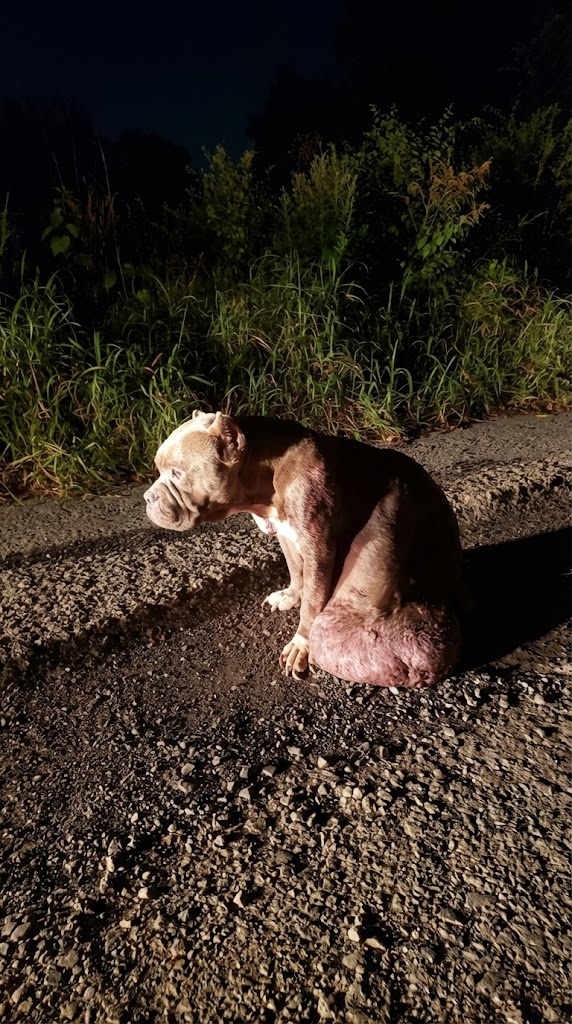
Cars kept passing.
The dog barely moved.
She sat near the edge of a busy road, lifting her head whenever another vehicle approached, then settling again when it disappeared into the distance.
From far away, she might have looked like a tired stray waiting for somewhere to go.
Then rescuers saw what was hanging beneath her body.
A massive tumor.
It was so large that it nearly touched the ground, adding an extraordinary amount of weight to every movement she tried to make.
Walking was difficult.
Running was out of the question.
And simply staying where she was, beside moving traffic, placed her in danger.
No one at the scene knew how long she had been living like this.
They only knew she needed help immediately.
The Weight Beneath Her Was Impossible to Ignore
When rescuers approached, the true size of the mass became even harder to comprehend.
It was not a small growth that had recently appeared.
It dominated the lower half of her body.
Every attempt to shift her position meant moving that weight too.
The dog remained remarkably calm while rescuers prepared to take her to safety.
There was no way to know exactly what she had experienced before being found.
There was no reliable history.
No medical record available at the roadside.
No explanation for how the tumor had been allowed to grow so large.
Those questions would have to wait.
The priority was getting her to a veterinary clinic.
Because whatever the cause of her past, her condition now had become a medical emergency.
VIDEO: A 15-Pound Tumor Had Taken Over Her Body — Magnolia’s Rescue Changed Everything
Surgery Offered Hope, but It Carried Serious Risk
At the clinic, the veterinary team examined the dog carefully.
The tumor was enormous.
Removing it would not be simple.
Large masses can involve significant blood vessels and surrounding tissue, which meant surgery carried a real risk of severe bleeding.
The team had to weigh two difficult realities.
Operating could be dangerous.
Leaving the tumor in place offered little hope for a comfortable future.
After evaluating her condition, the veterinarians decided to move forward.
The dog was prepared for surgery.
The room became quiet and focused.
This was not a procedure anyone could rush.
The team worked carefully, separating the mass while protecting as much healthy tissue as possible.
Hour after hour, they continued.
Then, at last, the tumor came free.
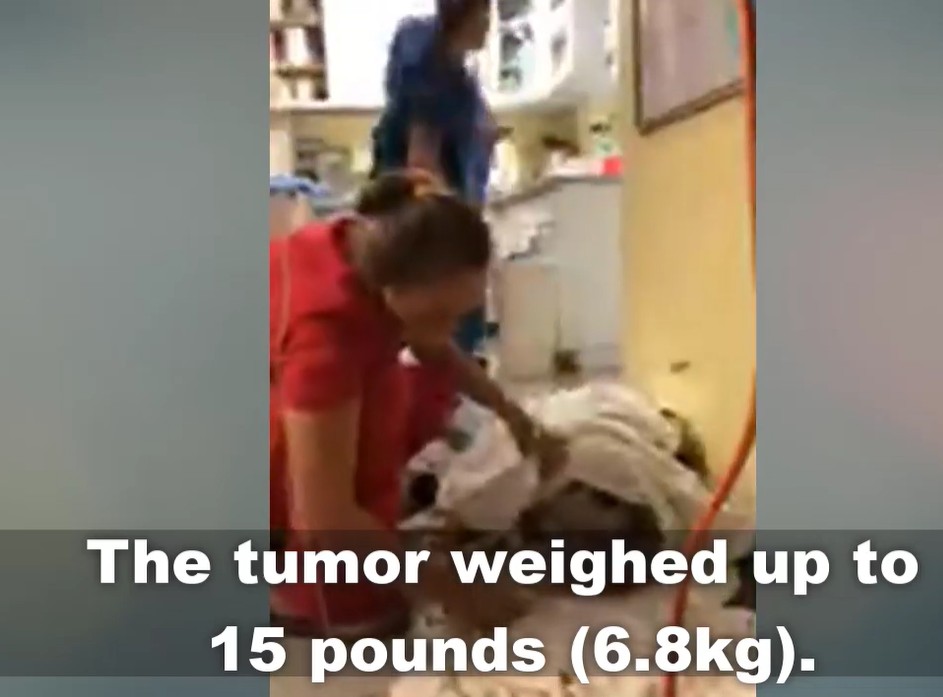
When it was weighed, the number stunned everyone.
15 pounds — approximately 6.8 kilograms.
For a dog already weakened by her condition, that was an enormous burden to carry.
Now, for the first time in a long while, it was gone.
Six Hours Later, She Began to Wake
The surgery was over.
But recovery had only begun.
For roughly six hours, Magnolia remained under the effects of anesthesia and sedation while the team monitored her closely.
Then small signs of awareness returned.
Her eyes began to open.
Her breathing remained steady.
She started responding to the people around her.
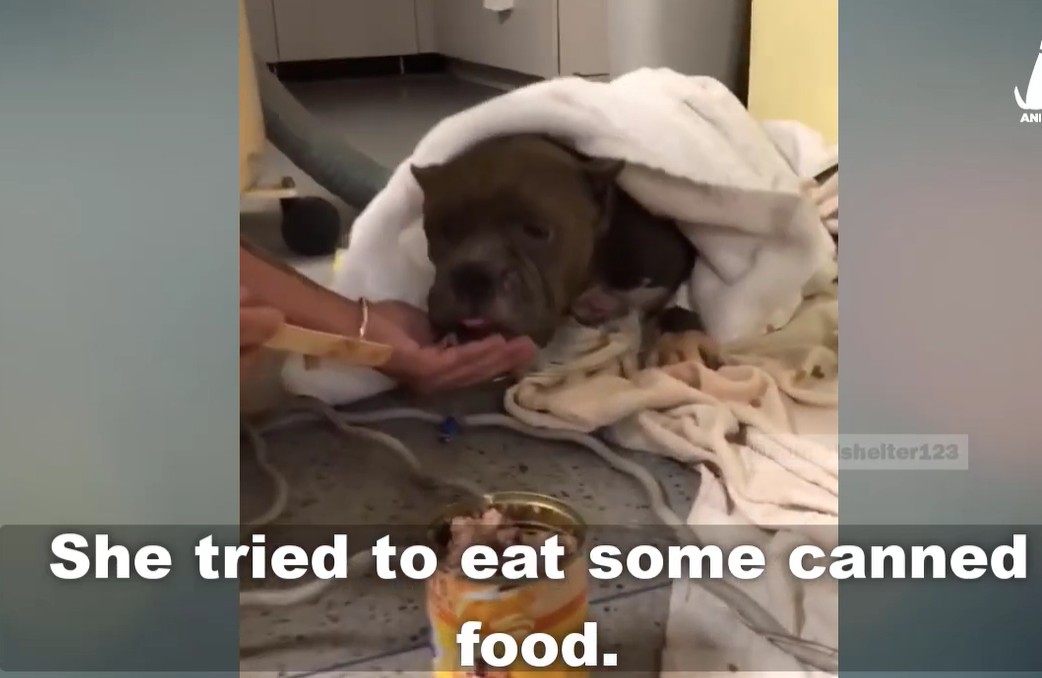
One of the first things caregivers noticed afterward was her appetite.
When food was offered, she ate eagerly.
The reaction suggested that her body had been running on very limited reserves.
There was no need to invent a complicated explanation.
A dog recovering from major surgery was hungry.
And now, food was available.
That simple meal became one of the first ordinary comforts of her new life.
They Gave Her the Name Magnolia
Until then, she had been the dog from the roadside.
The dog with the enormous tumor.
The emergency case.
But rescue eventually requires looking beyond the condition that brought an animal through the door.
So the team gave her a name.
Magnolia.
It was a gentle name for a dog whose first days in care had been anything but gentle.
From then on, caregivers were no longer discussing only “the mass” or “the surgery.”
They were caring for Magnolia.
A dog with preferences.
A personality.
A future that could now extend beyond the enormous weight she had been forced to carry.
Five Days Later, She Tried to Stand
During the first days after surgery, Magnolia remained quiet.
Her body had experienced a major operation.
The surgical site needed time.
Her strength had to return gradually.
Then, about five days later, she stood.
The movement was cautious.
Her balance looked different.
For so long, her body had compensated for an enormous mass hanging beneath her.
Now that weight was suddenly gone.
Walking required adjustment.
She took careful steps.
Paused.
Then tried again.
The rescuers stayed close, watching her movement without rushing her.
There was no need to make her walk farther than she was ready to go.
Simply standing after what she had endured was enough.
And with each passing day, her movements became easier.
She Had to Learn What a Lighter Body Felt Like
The physical difference after surgery was dramatic.
Fifteen pounds no longer pulled against her body.
But that did not mean Magnolia instantly moved like a healthy dog.
Muscles adapt to the way a body has been forced to carry weight.
Balance changes.
Movement patterns become habits.
Magnolia needed time to adjust.
At first, she moved carefully.
Then her steps became steadier.
She began exploring more of the space around her.
Instead of remaining almost motionless, she could choose where she wanted to go.
For the rescue team, that was one of the most rewarding changes.
The dog who had been almost anchored beside the road was beginning to move simply because she could.
Three Weeks Revealed a Different Dog
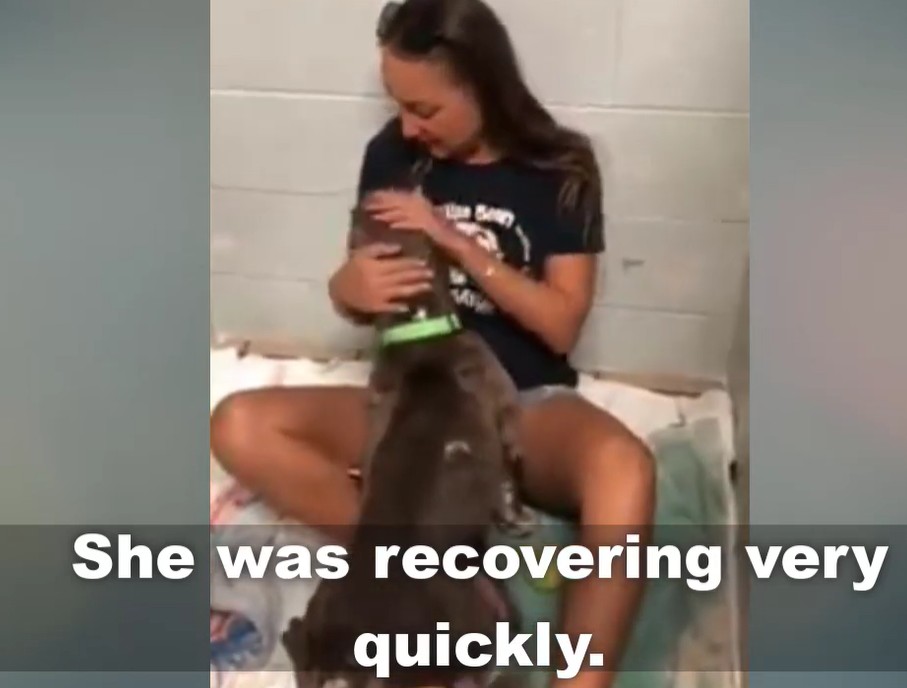
By approximately three weeks into recovery, Magnolia’s condition had improved dramatically.
Her health indicators had returned toward normal.
Her energy increased.
And her personality became easier to see.
She was affectionate.
Attentive.
Interested in the people around her.
Rather than remaining withdrawn, Magnolia began approaching caregivers.
She accepted affection willingly.
She leaned into contact.
Her expression appeared brighter and more relaxed than during those first frightening hours after rescue.
The physical transformation was obvious.
But the behavioral change mattered just as much.
Once the urgent medical crisis had passed, Magnolia finally had room to be something other than a patient.
She could simply be a dog.
Her Past Remained Mostly Unknown
The team tried to learn more about where Magnolia had come from.
They hoped someone might recognize her.
Perhaps there would be records.
Perhaps an explanation.
But no clear history emerged.
And that left difficult questions unanswered.
A tumor of that size does not develop instantly.
It had likely been growing for a substantial period of time.
But without reliable information about Magnolia’s earlier life, rescuers could not know exactly where she had lived, who had cared for her, or how she eventually reached the roadside.
Rather than allowing speculation to define her story, they focused on what they knew.
She had been found.
She had received treatment.
She had survived major surgery.
And she was recovering.
Sometimes those facts are enough.
She Was No Longer Defined by the Tumor
Before surgery, it was nearly impossible to look at Magnolia without noticing the mass first.
It changed her silhouette.
Her movement.
The way strangers understood her condition.
Afterward, something important shifted.
People began noticing Magnolia before they noticed what had happened to her.
They saw the way she approached caregivers.
The way she enjoyed affection.
The growing confidence in her movements.
The ordinary pleasure she took in food, attention, and being somewhere safe.
Her medical condition had shaped a difficult chapter of her life.
It did not have to become her entire identity.
That may be one of the most meaningful parts of rescue.
An animal enters care known for an injury, illness, or crisis.
With time, that label begins to disappear.
The “dog with the giant tumor” becomes simply Magnolia.
The Heaviest Thing She Carried Is Gone
The image of Magnolia beside the road is difficult to forget.
A quiet dog.
Passing cars.
A mass so large that even basic movement had become difficult.
Then came a chain of decisions that changed everything.
Someone stopped.
Someone brought her to a clinic.
Veterinarians accepted the risk of a difficult operation.
A 15-pound tumor was removed.
Six hours later, Magnolia began waking.
Five days later, she stood.
Three weeks later, the frightened medical case looked increasingly like a healthy, affectionate dog beginning a new chapter.
There was no way to return the time she had spent carrying that weight.
No one could answer every question about her past.
But rescue did not require solving every mystery.
It required changing what came next.
Magnolia once sat beside the road carrying a burden almost impossible to ignore.
Today, that burden is gone.
And instead of waiting beside traffic with nowhere safe to go, she can finally move forward under her own strength—
one lighter step at a time.


