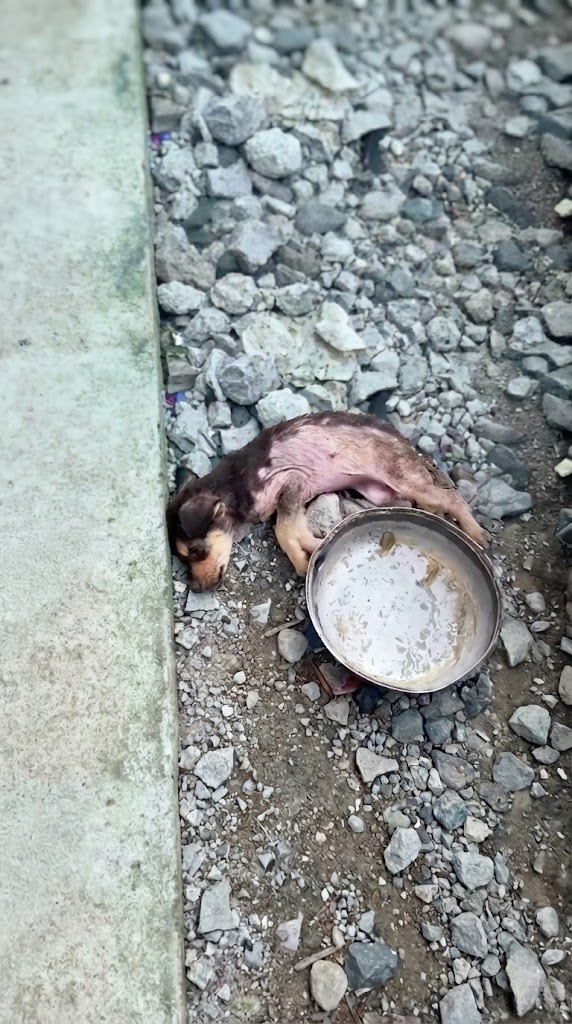
The neighbor knew something was wrong before she even reached the doorstep.
A tiny puppy was lying beside an empty bowl.
He was not sleeping.
His body was shaking violently, caught in repeated convulsions that he seemed too weak to control.
Within a short time, he lost consciousness.
There was no way to know exactly how long he had been there or everything that had happened before the neighbor found him.
But one thing was obvious.
This puppy needed help immediately.
By the time rescuers arrived, he was barely responsive.
They lifted his small body carefully and rushed him toward the veterinary clinic.
There was no time to wonder what his future might look like.
First, they had to get him through the next few hours.
His Fever Was Dangerously High
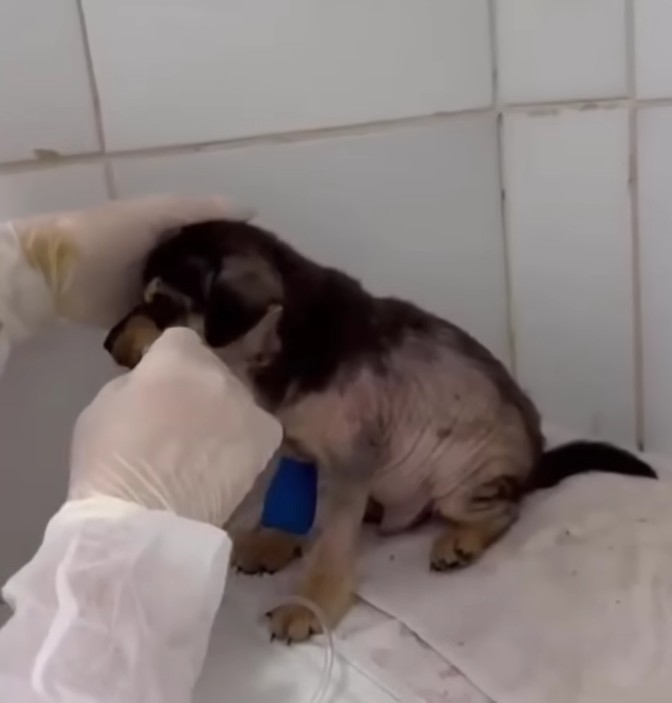
At the clinic, the veterinary team began working immediately.
The puppy’s temperature was alarmingly high.
He had already been through convulsions and loss of consciousness, and his weakened condition made every additional problem more serious.
Treatment began with stabilization.
Fluids.
Medication.
Monitoring.
Rest.
For roughly two days, the goal was simply to bring his condition under control.
There was no dramatic recovery overnight.
The team watched his temperature.
They monitored his responses.
They waited for his small body to begin doing some of the work on its own.
Then, gradually, the puppy became more alert.
And when he finally woke fully enough to notice the world around him, one thing captured his attention immediately.
Food.
VIDEO: Found Unconscious Beside an Empty Bowl — Toninho’s Five-Month Transformation
The First Thing He Wanted Was a Meal
When food was offered, the puppy ate eagerly.
He did not need encouragement.
The bowl emptied quickly.
For rescuers, his appetite was both encouraging and revealing.
This was a body that needed nourishment.
Once he was stable enough for a more complete examination, other problems became easier to see.
His skin was badly inflamed.
Large areas were red and irritated.
Much of his fur was missing.
The condition had clearly been affecting him for some time.
And there was another challenge that would eventually require a different kind of care.
According to the veterinary team, Toninho showed signs consistent with what they described as hyperactivity syndrome.
He could become intensely excited and had difficulty regulating his behavior when overstimulated.
The diagnosis meant his recovery would not be only about skin, nutrition, and physical strength.
He would also need structure.
Patience.
And people willing to understand that some behaviors would take much longer to change.
Thirty Days Later, He Finally Left the Clinic
Toninho remained under veterinary care for about a month.
During those 30 days, treatment focused on stabilizing his health and addressing the problems affecting his skin and body.
Progress came gradually.
His condition became more manageable.
His energy improved.
And eventually, he was well enough to leave the clinic.
That was when the next part of his recovery began.
His rescuer brought him home.
For Toninho, the change was enormous.
Instead of a clinical space, there was now a household.
Instead of a treatment kennel, there was something simple waiting for him.
A bed.
Soft.
Warm.
His own place to lie down.
Watching him settle onto it became one of those moments that stays with a rescuer.
Nothing extraordinary happened.
Toninho simply rested.
But after everything that had brought him there, ordinary comfort suddenly felt important.
Living in a Home Was Something He Had to Learn
Physical safety did not automatically make Toninho an easy dog.
He remained highly energetic.
He could become overstimulated.
Sometimes he reacted sharply.
Interactions with other dogs were not always smooth.
His caregiver also reported that he had been separated from his biological mother when he was very young—around one month old.
Whatever combination of early experiences and individual temperament shaped his behavior, one thing was clear in daily life:
Toninho needed consistency.
He followed his caregiver closely through the house.
When she moved from one room to another, he was often nearby.
Even during moments when he had created complete chaos, he stayed close afterward.
That became especially obvious during cleanup.
Sometimes His Room Looked Like a Small Storm
Toninho had energy to spare.
There were days when bedding was pulled apart.
Objects were chewed.
His room could end up looking as though a tiny storm had passed through it.
Training required patience.
Punishing the behavior would not teach him how to regulate himself.
So his caregiver focused on routines.
Clear boundaries.
Appropriate outlets for energy.
Calm repetition.
And, whenever possible, avoiding situations that pushed him beyond what he could handle.
Then came one behavior she noticed again and again.
While she cleaned the mess he had made, Toninho often stayed close to her legs.
He watched.
He followed.
He did not disappear to another room.
No one could know precisely what he was thinking.
But his need to remain near familiar people was easy to observe.
And rather than pushing him away, his caregiver allowed trust to build through those ordinary moments.
His Skin Began Telling a Different Story
While Toninho worked on learning household routines, his physical recovery continued.
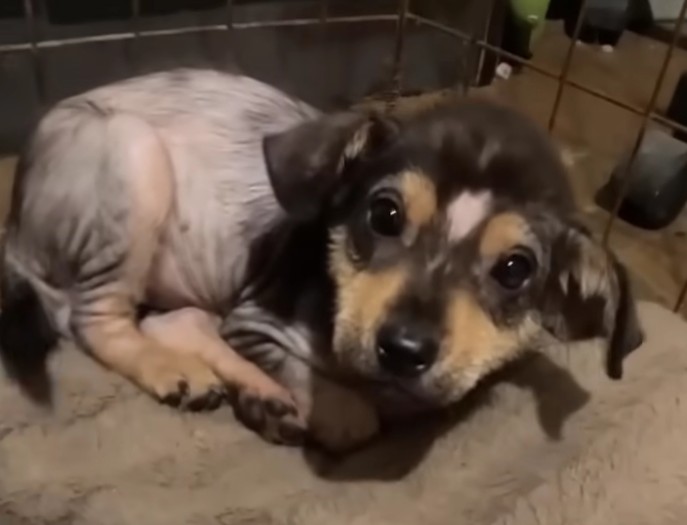
The inflamed areas gradually became calmer.
Healthy skin replaced the irritated patches.
Then his coat began returning.
At first, the fur was thin.
Later, it became fuller and healthier.
The puppy who had arrived with widespread hair loss slowly began looking completely different.
His changing appearance provided an easy way to see how far he had come.
But his caregiver was watching for another type of progress too.
Could he calm himself more easily?
Could he interact with other dogs without immediately becoming overwhelmed?
Could excitement remain excitement instead of turning into chaos?
Those answers took longer.
Around the Third Month, He Began to Settle
By approximately three months into recovery, Toninho’s behavior had started to change.
The hyperactivity had not simply vanished.
He was still energetic.
Still mischievous.
Still capable of turning an ordinary room into a project for his caregiver.
But he was becoming easier to redirect.
His reactions became less intense.
He could settle more readily after becoming excited.
The routines that had been repeated day after day were beginning to make sense to him.
He knew where he slept.
He knew meals would return.
He recognized the people around him.
And because his environment had become predictable, he had more opportunities to practice calmer behavior.
This kind of recovery is difficult to capture in a single photograph.
Growing fur is visible.
Learning emotional regulation happens more quietly.
But for the person living beside Toninho every day, the difference was unmistakable.
Then He Started Making Friends
Another important change followed.
Toninho had not always interacted comfortably with other dogs.
His excitement could escalate quickly, and he sometimes struggled to manage those encounters.
Over time, however, he began learning a different way to socialize.
He played.
He shared space.
He began forming more positive relationships with other dogs around him.
The progress was not about turning Toninho into an entirely different personality.
That was never the goal.
He was still lively.
Curious.
Strong-willed.
Sometimes hilariously difficult.
What changed was his ability to live inside that personality without every burst of excitement becoming a problem.
He was learning how to be Toninho in a world that finally gave him enough guidance to succeed.
Five Months Later, the Tomato Incident Said Everything
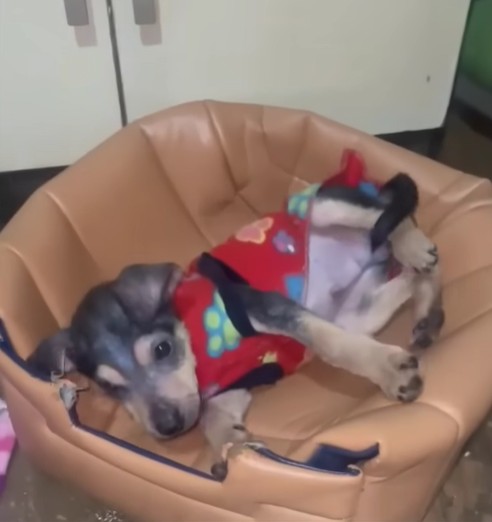
By the fifth month, Toninho barely resembled the puppy from the doorstep.
His coat had grown back.
His physical health had recovered.
His behavior had become much more manageable.
And the puppy once found unconscious beside an empty bowl had developed a very clear mischievous streak.
One day, he stole a tomato.
His caregiver noticed and tried to take it back.
Toninho had other plans.
He darted around the house, carefully staying just far enough away to keep his prize.
The scene turned into a ridiculous chase.
A dog.
A tomato.
And one very determined human following behind.
It was the kind of ordinary household nonsense that once seemed impossible.
Months earlier, everyone had been worried about whether Toninho would stabilize.
Now the problem was convincing him to surrender stolen produce.
Sometimes progress looks exactly like that.
He Never Had to Leave Again
By then, the question of where Toninho would go had already answered itself.
He was staying.
Permanently.
The rescuer who brought him home after 30 days at the clinic became his family.
Not because Toninho had become perfect.
He hadn’t.
He could still be mischievous.
He still required patience and structure.
He still had a personality large enough to fill the house.
But family is not reserved for animals who never cause trouble.
Toninho belonged because someone had made room for all of him.
The energetic parts.
The difficult parts.
The affectionate parts.
And the ridiculous tomato-stealing parts too.
The Empty Bowl Is Only the Beginning of His Story
It is easy to remember Toninho by the way he was found.
A tiny puppy.
A cold doorstep.
An empty bowl.
Convulsions.
Then unconsciousness.
But rescue gave his story another set of images.
A veterinary team getting his fever under control.
The first eager meal after he woke.
Thirty days of medical care.
A soft bed in a real home.
Skin slowly healing.
Fur growing back.
Months of patient training.
The first successful friendships with other dogs.
And finally, a healthy young dog racing around a house with a stolen tomato.
That last image may be the most important one.
Toninho did not become special because he survived something difficult.
He was already worth helping.
What changed was that somebody finally acted like it.
Today, the empty bowl is gone.
So is the cold doorstep.
Toninho has meals, a bed, routines, companionship, and a family that knows exactly how mischievous he can be.
And after everything that happened at the beginning of his story, he no longer has to wonder whether there will be a place for him tomorrow.
There will.
It is home.


