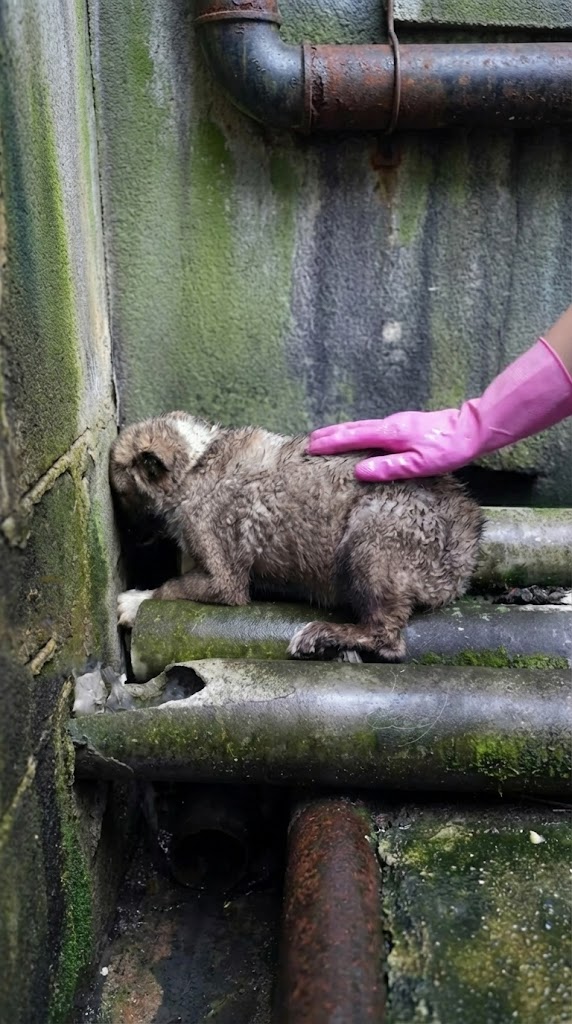
The rain had been falling for hours when someone finally noticed him.
A tiny puppy was crouched beside a rough stone wall, his fur completely soaked and his small body drawn tightly into itself.
But the most striking thing was not how wet he was.
It was the way he had turned his face toward the wall.
He was not looking around for a way out.
He was not approaching anyone who passed.
He simply pressed his head against the stone and stayed there while the storm continued around him.
Neighbors later said faint cries had been heard through the rain.
The puppy seemed to be calling out, but no mother came.
No familiar person appeared.
By the time rescuers reached him, he had already spent a long, cold night outside.
They would eventually name him Dymok.
But first, they had to convince him that the hands reaching toward him were not another reason to be afraid.
The Puppy Who Would Not Look Up
When rescuers approached, Dymok immediately became tense.
He tried to move away.
His body wanted distance even though his strength was nearly gone.
Hunger and exhaustion had left him weak, and the rain had soaked him through. He could still attempt to flee, but he did not have the energy to go far.
So the rescuers slowed down.
No chasing.
No sudden movements.
No attempt to force affection from a puppy who clearly did not understand what was happening.
They spoke quietly and approached in small steps.
Eventually, they were close enough to lift him.
Only then did they begin to see how much help he might need.
Dymok was extremely thin.
His belly looked unusual.
There were marks and discoloration on his abdomen that concerned the team.
And even after he was wrapped and moved away from the rain, his body remained tense around unfamiliar people.
The storm was no longer the only problem.
Video: Found With His Face Against a Wall, the Frightened Puppy Is Finally Lifted Out of the Rain
His Stomach Revealed Another Part of the Story
Dymok was taken for veterinary care.
The examination raised immediate concerns about his swollen stomach.
It was not simply the rounded belly of a puppy who had recently eaten.
According to the account surrounding his rescue, Dymok had swallowed stones, pieces of plastic, and other objects he had encountered outside.
Whatever had led him to ingest them, those objects now presented a serious medical problem.
The veterinary team had to focus first on making sure his digestive system was safe and that the material inside him could be addressed appropriately.
For rescuers, the discovery changed the way they looked at the little dog they had just carried in from the rain.
His problems had not begun that evening.
The storm had only made him visible.
His physical condition suggested he had already been struggling before anyone found him beside the wall.
Fear Followed Him Indoors
Bringing Dymok inside did not immediately make him comfortable around people.
New rooms frightened him.
Sudden noises caused visible reactions.
Unexpected touch made his body tense.
The staff understood that pushing him too quickly could make things worse.
So they adjusted their approach.
Voices stayed soft.
Movements remained predictable.
Instead of surrounding him with attention, caregivers gave him room to observe.
The goal was not to make Dymok affectionate overnight.
It was to show him, repeatedly, that nothing bad happened when people entered the room.
A hand could place down food and move away.
A person could sit nearby without reaching for him.
A door could open without someone dragging him somewhere frightening.
Safety had to become something Dymok experienced rather than something people expected him to understand.
That would take time.
Giving the Puppy a Name
Until that point, he had mostly been described by what had happened to him.
The puppy in the rain.
The frightened puppy by the wall.
The puppy with strange objects in his stomach.
Rescuers wanted him to have something else.
A name.
They called him Dymok.
According to the rescue account, the name was chosen to represent bravery—an appropriate description for a puppy who had endured the night outside and was still trying to keep going.
The name also gave caregivers a simple way to begin building familiarity.
“Dymok.”
The same word before a meal.
The same word spoken gently when someone entered.
The same word connected to calm routines instead of danger.
Names do not magically repair fear.
But routine can.
And Dymok was beginning to have one.
Then the Camera Footage Changed What They Knew
While Dymok received care, rescuers continued trying to understand how such a young puppy had ended up alone beside the wall during a storm.
A nearby security camera provided an answer.
The footage reportedly showed a man walking through the rain while carrying the puppy.
He approached the area.
Placed Dymok down.
Then walked away.
The discovery meant Dymok had not simply wandered there by accident.
He had been left.
According to the account provided by rescuers, the man had found the puppy days earlier but later abandoned him after Dymok became ill.
The footage could not explain what Dymok understood about that moment.
No one could know exactly what went through his mind after the person disappeared.
But the behavior rescuers had observed afterward was clear enough.
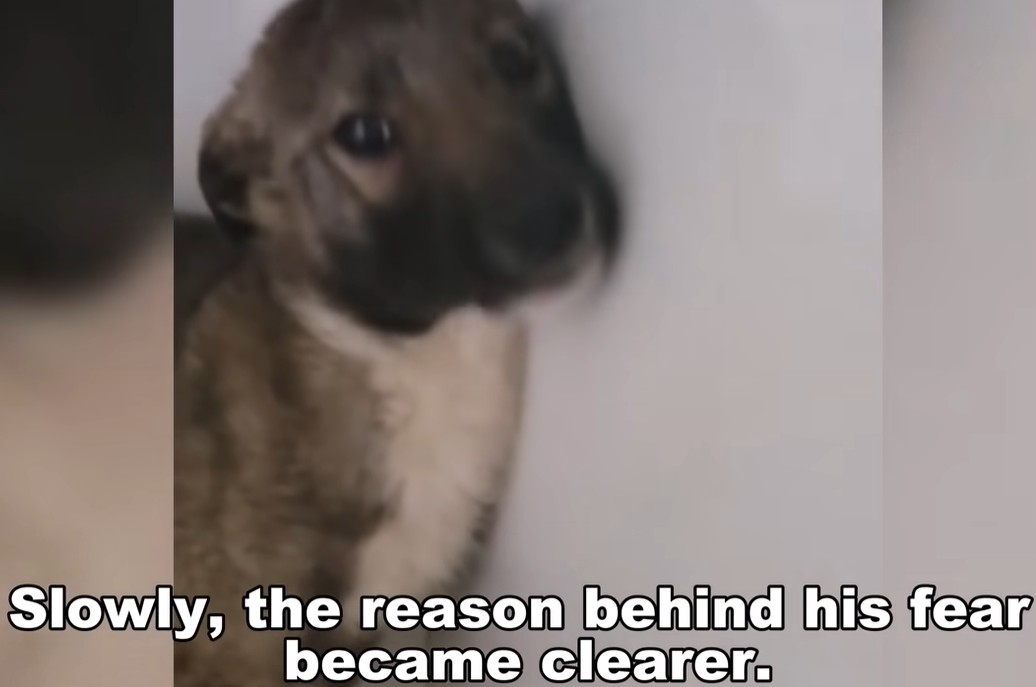
He was frightened.
He avoided people.
And when he was found, he had turned his face toward the wall while remaining alone in the rain.
That was what the team had to work with now.
Not speculation about every moment of his past.
The puppy in front of them.
The First Evening Brought a Small Victory
Medical treatment continued, but Dymok also needed something ordinary.
Food.
On his first evening in care, a meal was placed in front of him.
There was no guarantee he would eat.
Stress alone can make frightened animals refuse food, and Dymok had already been through transportation, examination, handling, and an entirely unfamiliar environment.
But after some hesitation, he began.
Then he finished the meal himself.
For the people caring for him, it was a meaningful sign.
Eating meant his body was willing to engage.
It meant he had enough strength and interest to accept something being offered to him.
Afterward, Dymok settled down.
His breathing became more regular.
Eventually, he fell asleep.
The puppy who had spent the previous night exposed to the rain was now dry, fed, and resting somewhere protected.
No one pretended that one meal had fixed everything.
But it was a beginning.
Learning From Dogs Who Were Not Afraid
As Dymok became medically more stable, another part of his rehabilitation began.
Socialization.
The shelter gave him opportunities to spend time around calm, well-adjusted dogs.
This proved useful.
Larger dogs could have frightened him at first.
Instead, gentle companions showed him through their own behavior that the environment was safe.
They moved comfortably around people.
Accepted touch.
Rested without constantly watching the room.
Played.
Dymok could observe all of this without anyone demanding that he imitate it.
Gradually, he began participating more.
Curiosity started replacing some of the hesitation.
He followed.
Watched.
Sniffed.
Eventually, played.
For a puppy whose earliest visible behavior had been hiding his face against a wall, these small acts of engagement showed how much his world was expanding.
Trust Came in Pieces
Dymok’s recovery was not a single dramatic transformation.
It came in small pieces.
One meal.
One peaceful nap.
One step toward another dog.
One moment when a hand reached toward him and he did not pull away.
He learned which voices belonged to the people who fed him.
He became more familiar with daily routines.
He started to understand when it was time to rest, eat, or go outside.
Touch became less frightening.
Attention became easier to accept.
His posture changed.
Instead of constantly trying to make himself smaller, he began moving with more confidence.
He looked around.
He followed activity.
He engaged.
The puppy was still Dymok.
But fear was no longer controlling every interaction.
Seven Months Changed What People Saw
Months passed.
Seven, according to the rescue account.
By then, the image of the soaked puppy beside the wall felt very far away.
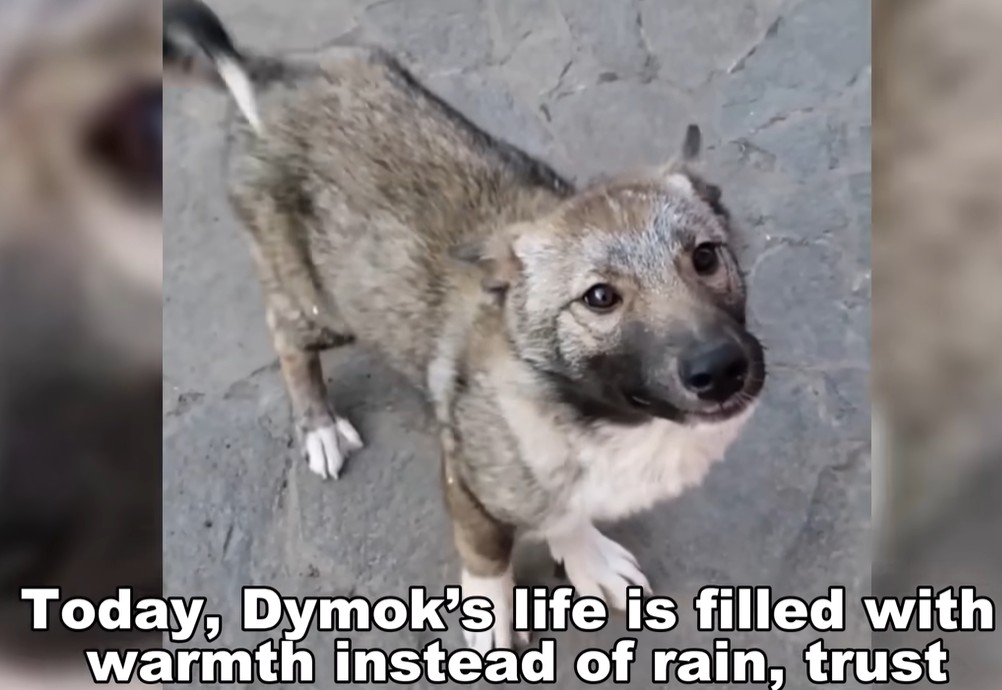
Dymok had grown.
His body was healthier.
His behavior had changed.
He was calmer around people and more confident in familiar surroundings.
Those who met him later would not experience only the frightened puppy rescuers had first found.
They would meet a young dog capable of interacting, playing, and forming connections.
Interest in adopting him began to appear.
Families contacted the rescue.
That brought a different challenge.
Finding the right home.
Rescue had taken Dymok away from immediate danger.
A permanent family would determine what came next.
Waiting for the Right Kind of Home
For a dog with Dymok’s history, adoption was not simply about finding someone who liked his photograph.
His new family needed to understand that confidence had taken time to build.
New surroundings could still require adjustment.
Different people, noises, routines, and expectations might temporarily bring some uncertainty back.
What mattered was patience.
The same quality that had helped Dymok recover in the first place.
Eventually, a family was chosen.
When the day came for him to leave the shelter, it carried mixed emotions for the people who had watched him change.
They had met Dymok when he would barely face the world.
Now they were watching him walk toward one of the biggest changes of his life.
A home of his own.
The Wall Became Part of His Past
Today, the image of Dymok pressing his face against the stone wall remains the most difficult part of his story.
It is powerful because almost nothing is happening in it.
No dramatic struggle.
No chase.
No loud confrontation.
Just a wet puppy turned away from the world.
But that image no longer represents his entire life.
There were other moments afterward.
Dymok eating.
Dymok sleeping safely.
Dymok meeting other dogs.
Dymok accepting touch.
Dymok becoming curious.
Dymok growing confident enough to leave the shelter with a family.
Those moments deserve equal space in his story.
Because rescue did not erase the night in the rain.
It simply made sure that night was not where his life stopped.
A Puppy Does Not Need to Forget in Order to Move Forward
People often describe rescued animals as though they completely forget what happened once they are safe.
No one can know that.
What caregivers can see is something more practical.
A frightened dog can have new experiences.
Enough calm meals can make food feel predictable.
Enough gentle interactions can make touch easier.
Enough peaceful nights can teach the body that sleep does not always need to be guarded.
Enough consistency can make a strange place feel familiar.
That is how Dymok changed.
Not because someone erased his past.
Because people gave him enough better experiences to build something new beside it.
The Life Beyond the Rain
Dymok’s story began, for rescuers, beside a wall on a stormy night.
A small puppy.
Soaked fur.
A frightened posture.
A face turned away.
Seven months later, the picture looked entirely different.
He had received medical care.
His body had recovered.
His interactions with people and other dogs had changed.
And a family had chosen to bring him home.
The distance between those two versions of Dymok was built through hundreds of ordinary moments.
Meals.
Rest.
Veterinary care.
Quiet voices.
Patient hands.
Other dogs showing him how to relax.
People returning day after day.
That is the part of rescue that matters most.
The first moment saves an animal from danger.
Everything afterward teaches that animal what safety can become.
Once, Dymok pressed his face into a cold wall while rain fell around him.
Now there is no reason for him to hide there.
He has warmth.
He has care.
He has people who expect to see him when they wake up.
And most importantly, he finally has somewhere to turn toward instead of somewhere to hide.


