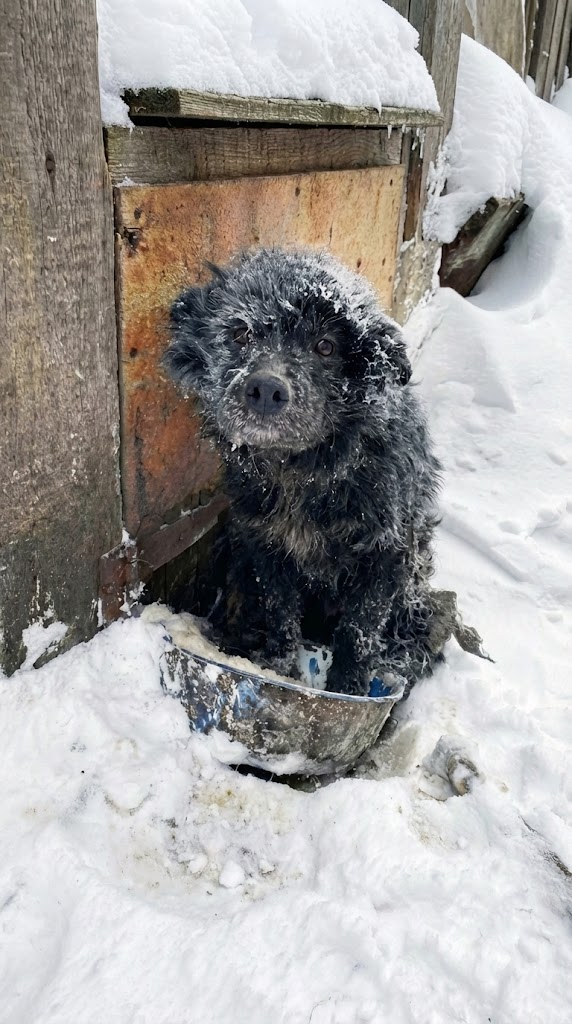
At first, the sound could have been mistaken for the wind.
A thin whimper.
Then silence.
Then another.
It was late, bitterly cold, and the streets of Chelyabinsk had already disappeared beneath winter darkness. Most people were indoors, away from the wind and snow.
But somewhere outside, a dog was still awake.
His name was Nakiyu.
He had been tied near a small shed, exposed to temperatures low enough to turn the ground beneath him into solid ice.
A house stood nearby.
Warmth was only a short distance away.
Nakiyu could not reach it.
By the time two people passing through the area noticed his cries, his situation had become far more serious than simply being cold.
His paws would not move.
His body barely lifted.
And when rescuers tried to help him stand, they discovered something terrifying.
Nakiyu was not merely lying on the frozen ground.
Parts of his body had frozen to it.
The Cry Someone Finally Followed
The couple might easily have continued walking.
The sound was faint enough to disappear beneath the winter air.
But something made them stop.
They listened again.
There it was.
A weak, repeated whimper coming from somewhere near the buildings.
They followed it until they found Nakiyu.
The dog was lying low against the ground, his body almost motionless.
Snow surrounded him.
The chain attached to him limited how far he could move, and the frozen surface beneath him had become another kind of restraint.
Nakiyu did not leap toward the strangers.
He did not have the strength.
He remained pressed against the ice while they tried to understand how long he had been there and how badly the cold had affected him.
The couple reportedly attempted to get help from the nearby property.
When no immediate response came, the situation could not simply be left until morning.
Every additional minute outside meant more exposure.
The man returned with a tool capable of cutting the chain.
One cut finally separated Nakiyu from what had been holding him in place.
But removing the chain did not free the dog completely.
His body still had to be carefully separated from the frozen ground.
VIDEO: Nakiyu Was Frozen to the Ground in Subzero Cold — Until Someone Heard His Faint Cry
Even After the Chain Was Cut, He Could Not Get Up
Nakiyu was far too weak to walk away.
His legs barely responded.
His abdomen had been exposed to the frozen surface for so long that the cold had affected areas beyond his paws.
Moving him too quickly risked causing additional pain or injury.
So the rescuers worked carefully.
The goal was no longer simply to take a dog indoors.
They were dealing with a medical emergency.
Nakiyu needed controlled warmth.
Fluids.
Veterinary assessment.
And protection from further exposure.
He was eventually lifted from the ground and transported away from the place where he had been found.
For the first time that night, the wind could no longer reach him.
But once the ice began to melt away, the true extent of his condition became clearer.
At the Clinic, the Cold Was Only Part of the Problem
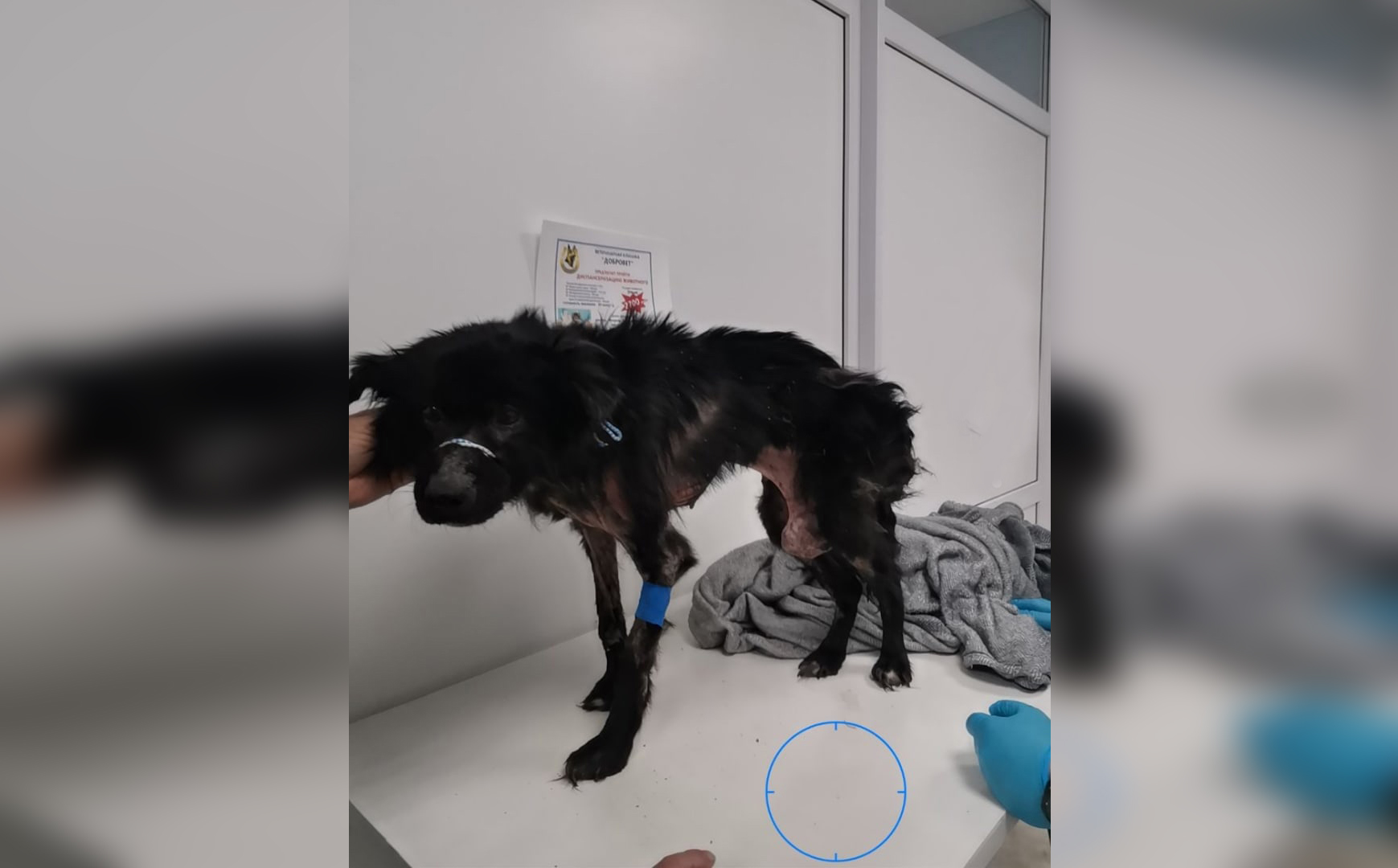
Nakiyu was taken to the “Give Life” veterinary clinic, where the team began examining him.
The findings were serious.
His paws showed extensive frostbite.
His tail and underside had also been affected by prolonged exposure to extreme cold.
He was severely dehydrated.
He was undernourished.
And he was too weak to support himself normally.
Veterinary staff began warming him gradually.
With severe cold exposure, treatment has to be handled carefully. Bringing body temperature up is only one part of the process; damaged tissue, dehydration, circulation problems, infection risk, and overall weakness also have to be addressed.
Warm water was used to help free remaining ice and clean his coat.
As his body became visible beneath the snow and frozen fur, additional concerns appeared.
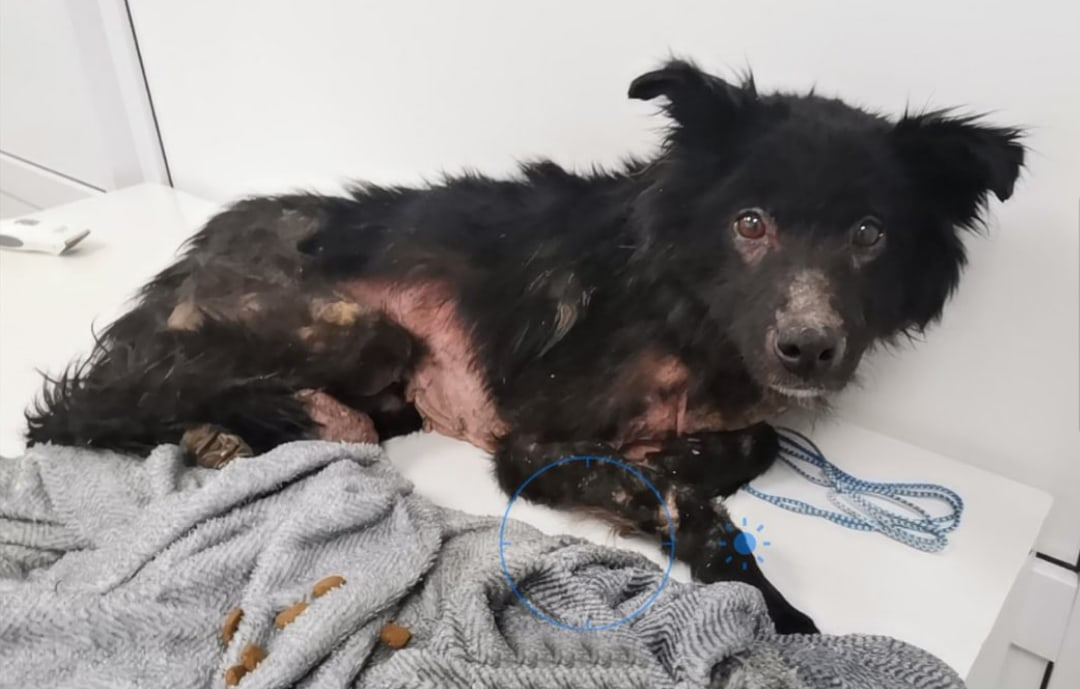
There were old skin wounds.
Parasites.
Signs that his difficulties had not begun only on the night he was found.
Nakiyu appeared to have been struggling for some time.
The winter had simply pushed an already vulnerable body toward collapse.
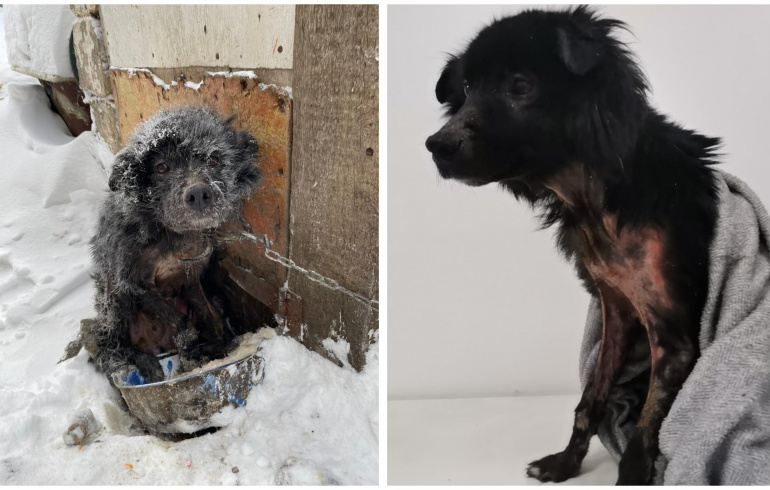
His Paws Had Taken the Worst of the Cold
Frostbite occurs when tissue is exposed to extreme cold long enough for normal blood flow to become severely compromised.
For Nakiyu, the areas closest to the frozen ground had suffered greatly.
His paws had remained in direct contact with the ice.
His underside had been pressed against the surface.
His tail had little protection from the cold surrounding him.
The veterinary team monitored those areas closely while treating his broader condition.
Antibiotics were used as part of his care.
Supportive treatment helped address dehydration and weakness.
The original account also describes transfusions and warming therapy as veterinarians worked to stabilize him.
No one could promise how quickly he would recover.
At that stage, the first goal was much simpler.
Keep him alive.
Keep him warm.
Give his body enough support to make it through the next hours.
Then the next day.
Then the one after that.
Warmth Did Not Immediately Make Him Feel Safe
Nakiyu had escaped the freezing weather.
But his behavior suggested that safety was still unfamiliar.
Fast movements could make him tense.
Unexpected touch sometimes caused him to pull back.
He watched people carefully before relaxing around them.
No one needed to invent a story about exactly what he was thinking.
His body language was enough.
This was a dog who needed time.
So caregivers approached him slowly.
Hands came from where he could see them.
Voices remained quiet.
Food appeared without pressure.
Bedding stayed beneath him.
No chain tightened around his neck when he tried to shift position.
And most importantly, the warmth did not disappear.
For a dog recovering from serious physical trauma, those predictable moments mattered.
Treatment repaired what medicine could repair.
Routine began addressing something different.
Trust.
The First Signs of Recovery Were Small
Nakiyu did not transform overnight.
At first, progress appeared in details.
He rested more deeply.
His breathing became steadier.
He began showing greater interest in food.
His eyes followed caregivers when they entered.
With proper nutrition and continued treatment, some of the weakness began to ease.
Then came movement.
A body that had once been unable to lift itself from the ice began trying to stand again.
The effort was cautious.
His paws had suffered badly, and he needed time to regain strength.
But every attempt mattered.
One step meant he could shift his weight.
Another meant his muscles were beginning to respond.
A few more meant he was no longer completely dependent on someone carrying him from place to place.
Recovery often looks unimpressive when viewed moment by moment.
There is no dramatic soundtrack.
No instant transformation.
Only repetition.
Clean bedding.
Another meal.
Another veterinary check.
Another wound cleaned.
Another night indoors.
But those ordinary things slowly changed Nakiyu’s body.
He Would Not Be Sent Back to the Chain
As Nakiyu became more stable, one question became impossible to avoid.
What would happen after the clinic?
Recovery means very little if an animal is eventually returned to the same conditions that placed him in danger.
The people caring for Nakiyu did not want that to happen.
Whatever circumstances had led to him being tethered outside during severe winter weather, the priority now was finding a safer future.
Nakiyu needed shelter appropriate for the climate.
Continued medical care.
Regular food.
And an environment where his movement would not be restricted beside frozen ground.
A decision was made.
He would not return to the chain.
For a dog whose world had recently been measured by the radius of a tether, that decision changed almost everything.
He was about to discover what ordinary freedom felt like.
The Dog Who Had Been Frozen to the Ground Learned to Rest Indoors
At first, indoor life seemed unfamiliar.
A soft sleeping place.
Heat coming from inside the room.
People moving around without threatening him.
Meals appearing on schedule.
Nothing about those things should be remarkable for a household dog.
For Nakiyu, they were new enough to require adjustment.
He did not immediately behave like a dog who had always known comfort.
He watched.
He waited.
He sometimes hesitated before accepting touch.
But slowly, the tension began leaving his body.
He discovered that lying down did not mean waking up covered in snow.
He could sleep without pressing himself against a frozen surface.
He could stretch.
Change position.
Walk toward water.
Move toward another part of the room simply because he wanted to.
These freedoms were small.
Together, they created an entirely different life.
His Coat Returned as His Strength Did
As the weeks passed, Nakiyu became increasingly difficult to recognize as the dog found outside that winter night.
His nutrition improved.
His strength returned.
Damaged areas continued healing.
His coat began filling in again.
He became more responsive to the people around him.
Where there had once been hesitation, curiosity began appearing.
Where his body had once been almost completely still, there was movement.
The greatest transformation was not that every mark vanished.
Some experiences leave lasting effects.
The important change was that Nakiyu no longer had to face cold, hunger, or injury without help.
If he became uncomfortable, someone noticed.
If his condition changed, someone could respond.
If winter returned, he had protection from it.
That is what rescue gave him.
Not a rewritten past.
A different future.
Extreme Cold Can Become Dangerous Far Faster Than People Realize
Nakiyu’s case also carries a practical reminder.
Dogs have fur, but fur does not make every dog capable of safely enduring extreme winter temperatures.
Risk varies by breed, size, age, body condition, coat type, health, wind exposure, moisture, available shelter, and many other factors.
A thin or sick dog can become vulnerable especially quickly.
Wind removes body heat.
Wet fur loses insulating ability.
Frozen ground pulls heat from the body.
And a tethered dog may not be able to seek better shelter even when instinct tells him to move.
Adequate winter care therefore means more than leaving food nearby.
Animals exposed to cold need access to appropriate shelter.
Dry bedding.
Water that has not frozen.
Enough nutrition to maintain body condition.
And regular observation to make sure conditions have not become dangerous.
Nakiyu had reached a point where he could no longer solve the problem himself.
He could not simply walk somewhere warmer.
That was why a faint cry in the darkness mattered so much.
The Warmth He Needed Was Never Complicated
When rescuers first saw Nakiyu, saving him required urgent veterinary care.
Later, keeping him safe depended on surprisingly ordinary things.
A room protected from the wind.
A dry place to sleep.
Food.
Water.
Medical attention.
Freedom from the tether that had limited his movement.
None of those things were extraordinary.
Together, they were enough to give him an entirely different life.
The contrast between Nakiyu’s two worlds could hardly have been greater.
One contained ice beneath his body.
The other contained a soft bed.
One left him unable to move away from the cold.
The other allowed him to choose where he rested.
One night began with a faint whimper nearly disappearing into the winter.
Later nights ended with Nakiyu sleeping quietly indoors.
That transformation began because two people did something very simple.
They heard a sound.
And instead of assuming someone else would deal with it, they followed it.
He No Longer Has to Watch Winter From the Wrong Side of Safety
The image of Nakiyu frozen against the ground is difficult to forget.
But it is only one image.
It is not his entire life.
There are other images now.
Nakiyu resting indoors.
Nakiyu standing.
Nakiyu eating.
Nakiyu surrounded by warmth rather than snow.
Nakiyu learning that a hand reaching toward him can bring comfort.
His recovery did not erase the night he was found.
It gave that night an ending no one could have predicted while he was still lying against the ice.
Once, winter had reduced his world to a chain, frozen earth, and the faint hope that someone might hear him.
Someone did.
The chain was cut.
The ice released him.
Veterinarians gave his body a chance to recover.
And eventually, Nakiyu reached a place where warmth was no longer something visible through the distance.
It surrounded him.
He could lie beside it.
Sleep in it.
Wake up inside it.
And when winter came again, he would never have to wonder whether he was allowed to come in.


