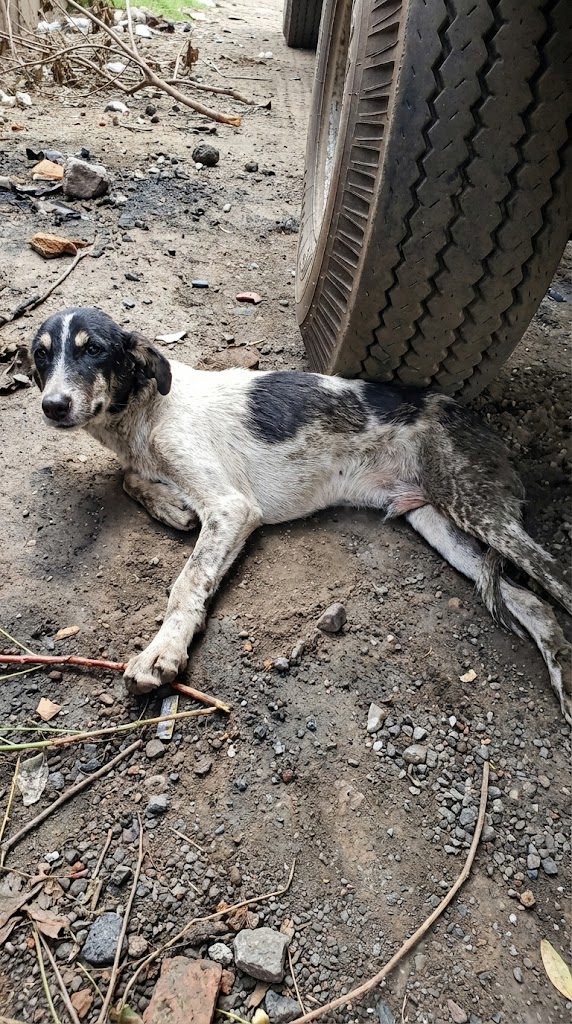
The puppy was lying beneath a parked truck, almost hidden by the shadow.
Cars passed nearby.
People moved through the street.
But he could not follow any of them.
His back legs were no longer carrying him.
Every attempt to move seemed to end in the same place—his small body pressed against the dirt, unable to lift itself far enough to escape.
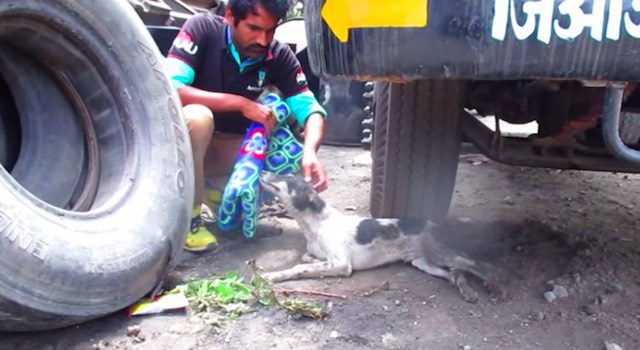
Then rescuers from Animal Aid Unlimited approached.
They expected the puppy to shrink away.
He had been injured, frightened, and left alone in a place filled with noise and movement.
But before anyone touched him, something unexpected happened.
His tail moved.
Slowly at first.
Then again.
The puppy could not stand.
He could barely change position.
Yet as the rescuers came closer, his tail continued tapping gently against the ground.
It was the first sign that beneath all that pain was a little dog still willing to respond to kindness.
Soon, they would call him Oreo.
And his fight to walk again was about to begin.
He Had Crawled Beneath the Truck Because There Was Nowhere Else to Go
Oreo had reportedly been struck by a passing vehicle.
After the impact, he somehow managed to drag himself away from the open road and beneath a parked truck.
The space offered shade and a small measure of protection.
But it could not help him stand.
His rear legs remained largely unresponsive.
The rescuers could see immediately that this was more than a minor injury.
Oreo stayed low against the ground.
When he tried to shift himself, his front legs did most of the work while the rest of his body followed awkwardly behind.
Still, the little tail continued moving whenever someone spoke to him.
The contrast was difficult to ignore.
His body was telling the rescuers that something was seriously wrong.
His behavior was telling them that he had not completely withdrawn.
They moved slowly and carefully.
When Oreo was finally lifted, he cried out.
The sound made the extent of his pain impossible to miss.
Every movement had to be controlled.
His body needed support.
And there was no time to wait and see whether he would improve on his own.
He needed veterinary care.
VIDEO: Oreo Couldn’t Stand — But His Tail Still Wagged When Rescuers Reached Him
The X-Ray Explained Why Every Movement Hurt
At the hospital, the veterinary team began examining Oreo.
His inability to use his back legs raised immediate concern about damage to the pelvis, spine, or surrounding nerves.
X-rays provided a clearer answer.
His pelvis was badly fractured.
For such a young puppy, the injury was severe.
The damage made standing difficult and caused significant pain whenever his body shifted.
At that stage, Oreo could not use his hind legs normally.
He needed rest.
Pain management.
Careful positioning.
And time for the injured area to stabilize.
The team could not simply encourage him to walk.
Too much movement could interfere with healing.
The puppy who had survived by dragging himself beneath a truck now had to do something completely different.
He had to stay still.
For a growing puppy, that would not be easy.
But before rehabilitation could begin, Oreo first needed to become comfortable enough to eat, sleep, and allow his body to recover.
Food Was Nearby — But Oreo Wanted the People Beside Him
One of the most memorable moments came shortly after Oreo arrived.
Food was placed within reach.
Given his condition, everyone expected hunger to get his attention.
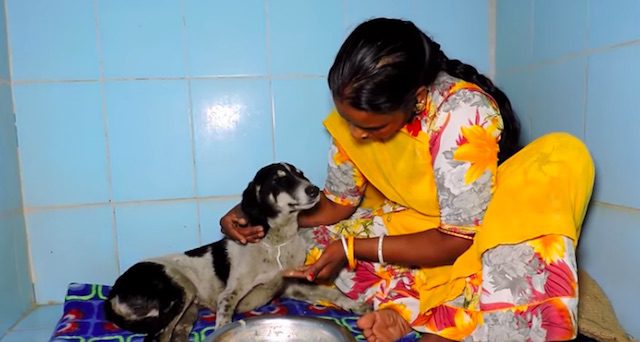
Instead, Oreo seemed more interested in the people around him.
He turned away from the food and leaned his head toward the hands touching him.
The rescuers did not need to assign a human emotion to the behavior.
What they could clearly see was that physical contact helped him settle.
Gentle hands rested beside his face.
Voices stayed calm.
No one disappeared when he became uncomfortable.
Oreo relaxed against them.
For a puppy lying in pain, reassurance became part of his care.
The food would still be there when he was ready.
For that moment, the team allowed him to remain close.
Eventually, he began eating.
But the pattern continued.
Oreo quickly became a puppy who noticed people.
He watched his caregivers.
He responded to touch.
And whenever someone approached his bed, that tail often started moving again.
His pelvis was badly injured.
His trust in people, however, seemed surprisingly intact.
Recovery Meant Weeks of Doing Almost Nothing
The treatment plan demanded patience.
Oreo needed strict rest while the fracture healed.
That meant no running.
No jumping.
No chasing people across the room.
No puppy games that could put pressure on the injured pelvis.
His world became deliberately small.
Soft bedding supported his body.
Caregivers repositioned him carefully.
Meals and water were kept close enough that he did not need to struggle toward them.
When it was appropriate, gentle physical therapy was introduced.
The exercises were simple.
His limbs were carefully moved.
Muscles were encouraged to remain flexible.
His body was supported in ways that minimized strain on the healing injury.
At first, Oreo had little choice but to cooperate.
He was too weak and uncomfortable for much else.
But as the days passed, something changed.
The puppy trapped inside the injured body began making himself known.
He became more alert.
More interested.
More playful.
And suddenly, physical therapy was no longer quite so serious.
His Personality Returned Before His Legs Did
As Oreo’s pain decreased, the rehabilitation sessions began looking different.
He started interacting with the hands working with him.
Sometimes he pushed at them with his paws.
Sometimes he tried to turn the exercises into play.
His tail moved more enthusiastically.
The puppy who had once remained almost motionless beneath the truck now seemed eager to participate in everything happening around him.
His caregivers had to remind themselves that feeling better did not mean the fracture had finished healing.
Oreo would have happily done more than his body was ready for.
So the routine continued.
Rest.
Therapy.
Meals.
Observation.
Then more rest.
There were no shortcuts.
The team needed the bones to heal properly before allowing him the freedom his personality was beginning to demand.
And while the physical progress remained gradual, Oreo’s behavior offered encouragement.
He was engaged.
He wanted attention.
He wanted to play.
He was no longer simply enduring each day.
He was becoming a puppy again.
Then His Back Legs Began to Join the Fight
The earliest improvements were subtle.
A small movement.
A change in how Oreo held himself.
A little more strength when caregivers supported his body.
Then came attempts to bear weight.
At first, he could not remain upright for long.
His legs were still weak after weeks of limited use.
Balance had to be relearned.
The healing pelvis needed time to tolerate the pressure.
But Oreo kept trying.
Caregivers supported him gently.
They allowed him to feel the ground beneath his paws without forcing more than his body could handle.
One attempt became another.
Gradually, he stayed upright longer.
Then came a moment everyone had been hoping for.
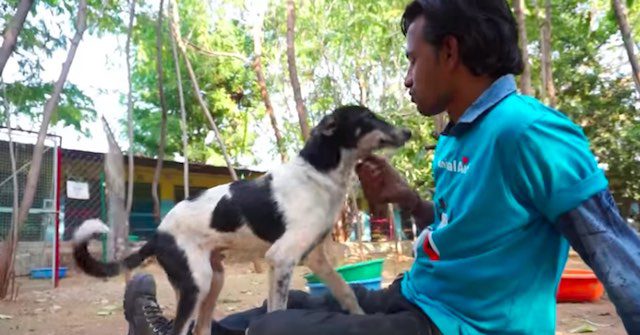
Oreo stood.
Not perfectly.
Not for long.
But all four paws were beneath him.
For the puppy once unable to pull his rear body out from beneath a truck, simply standing represented an enormous change.
No one rushed him forward.
The next step would come when he was ready.
And eventually, it did.
One Step Became Several — Then Oreo Started Moving on His Own
Walking returned slowly.
Oreo’s first steps were cautious.
His balance was uncertain.
The rear legs that had once seemed completely useless needed time to rebuild strength and coordination.
At first, a few steps were enough.
Then he rested.
Later, he tried again.
Day by day, the distance increased.
The puppy who once needed everything placed beside him could now move toward what interested him.
Food.
People.
Toys.
The freedom to choose where he wanted to go began returning.
Then the cautious walk became more confident.
His pace increased.
He started playing.
Eventually, running became possible again.
The transformation was striking not because it happened suddenly, but because everyone remembered where it had begun.
A puppy lying beneath a truck.
A shattered pelvis.
Back legs that would not carry him.
Now Oreo was moving through the world on his own.
The recovery everyone had hoped for had arrived one careful step at a time.
The Tail That Wagged on the First Day Never Really Stopped
Looking back, the most unforgettable part of Oreo’s rescue may not be the day he walked again.
It may be the moment rescuers first found him.
He was unable to stand.
Movement hurt.
He did not know the people approaching him.
Yet his tail moved.
That small response became a thread running through his entire recovery.
When caregivers entered, Oreo noticed.
When hands came close, he leaned toward them.
When therapy became uncomfortable, his playful personality still found ways to appear.
And when his legs finally grew strong enough to carry him, he seemed determined to use every bit of freedom they gave him.
Oreo’s recovery was not created by affection alone.
He needed veterinary care.
Rest.
Pain management.
Physical therapy.
Time for fractured bones to heal.
But kindness gave all of that treatment a place to happen.
The puppy did not have to recover alone.
Someone stayed beside him during the still days.
Someone supported him through the first attempts to stand.
Someone waited while one shaky step became two.
Today, Oreo is far removed from the injured puppy beneath the truck.
He runs.
He plays.
He seeks attention.
And the legs that once could not reach a bowl placed only a short distance away now carry him wherever curiosity leads.
His story began with an injury that took away his movement.
It continued because people gave him enough time to get it back.
And through it all, that little tail kept reminding everyone that Oreo was still very much there.


