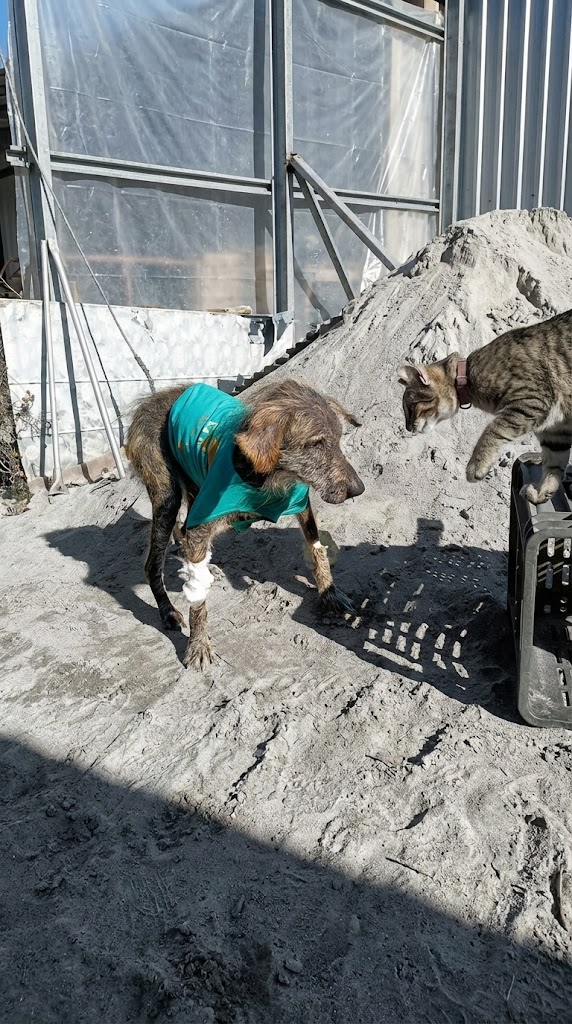
The dog barely seemed aware that people had stopped beside him.
On a freezing street in Manali, his thin body lay exposed to the cold, covered by a patchy coat that offered almost no protection.
Much of his fur was gone.
His skin was damaged by severe mange.
His ribs and hips stood sharply beneath a body that had been deprived of proper nourishment for far too long.
Then there was the trembling.
At first glance, it might have seemed like an obvious reaction to the winter air.
But when volunteers from Manali Strays reached him and began checking his condition, they realized something was terribly wrong.
The dog was shivering in the cold.
Yet his body was burning with fever.
He was barely responsive as rescuers knelt beside him.
There was no attempt to run.
No defensive growl.
Almost no energy left for anything beyond breathing.
They named him Trumpad.
No one yet knew how much time he had.
They only knew they could not leave him on that road.
He Was Too Weak to Get Himself Out of the Cold
Trumpad’s condition suggested that his suffering had not begun that morning.
Severe mange had already taken a major toll on his skin and coat.
Without healthy fur, the winter air reached his body easily.
At the same time, prolonged malnutrition had left him with very little body mass to protect him from the cold.
His strength appeared almost completely depleted.
When rescuers approached, Trumpad did not resist being handled.
That calmness was not necessarily reassurance.
A critically ill dog may simply lack the energy required to respond.
The volunteers moved carefully.
His skin was sensitive.
His body was fragile.
Even lifting him required attention to how little strength remained in his limbs.
Once he was in their arms, the contrast between the freezing street and what waited ahead could not have been greater.
A clinic.
Blankets.
Heat.
Fluids.
People watching his condition instead of passing by.
Trumpad had reached help.
Now everyone had to find out whether his body still had enough strength to respond.
VIDEO: Trumpad Was Found Barely Responsive in the Cold — Rescuers Rushed Him Into Emergency Care
His Temperature Revealed How Serious the Crisis Had Become
At the clinic, the veterinary team immediately began evaluating him.
Trumpad was dangerously ill.
His temperature was extremely high.
The fever placed additional strain on a body already weakened by severe malnutrition and dehydration.
His skin condition was also extensive.
Mange can cause intense irritation and hair loss, and in a severely weakened animal, damaged skin may leave the body even more vulnerable to secondary problems.
Trumpad needed stabilization before anyone could think about a longer recovery.
Intravenous fluids were started to address dehydration and support his system.
Medication was given to help manage the fever and other symptoms.
Then he was wrapped in blankets and placed close to a heater.
The goal was not dramatic.
It was immediate.
Get fluids into him.
Protect him from the cold.
Control what could be controlled.
Give his exhausted body a chance.
For the first several hours, there was little anyone could do except provide treatment and watch.
His breathing.
His temperature.
His responsiveness.
Every small change mattered.
Trumpad had survived long enough to reach the clinic.
But arriving at safety did not mean the danger had passed.
The Next Two Days Brought Another Serious Warning
Trumpad remained extremely weak.
Then another symptom appeared.
Bloody diarrhea.
For the rescuers and veterinary team, it was deeply concerning.
His digestive system was struggling at the same time the rest of his body was trying to recover from dehydration, fever, malnutrition, and severe skin disease.
Trumpad also refused food for nearly two days.
Normally, a warm meal can become one of the first encouraging moments in a rescue dog’s recovery.
With Trumpad, the bowl remained largely untouched.
His body simply was not ready.
The team continued supporting him through fluids and medication while monitoring his condition closely.
There was no way to rush appetite back.
No way to tell his body that it had finally reached somewhere safe and should immediately begin healing.
Recovery does not work on emotion.
The body responds when it can.
So the volunteers waited.
They adjusted his care.
They kept him warm.
They cleaned him when necessary.
And they made sure the dog who had been alone on the street was no longer facing each difficult hour by himself.
The first night passed.
Then another.
Trumpad was still there.
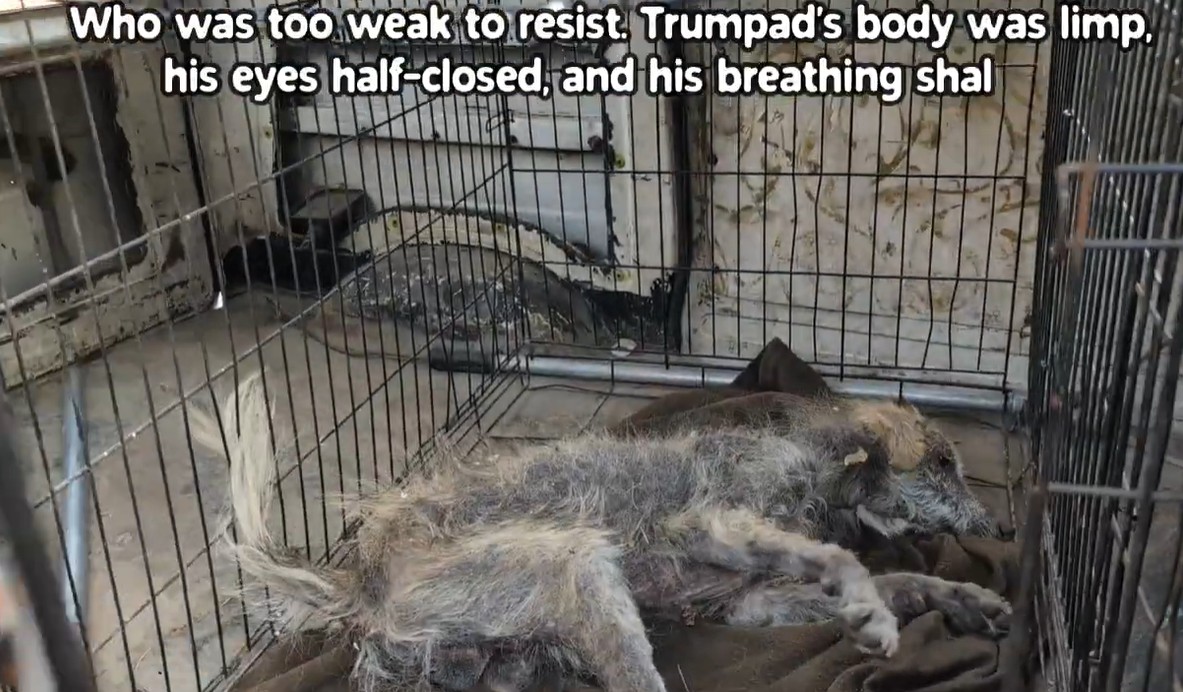
On the Third Day, Something Finally Improved
By the third day, the team noticed a change.
The bloody diarrhea began to ease.
It was not a complete recovery.
Trumpad was still severely compromised.
His skin remained damaged.
His body remained frighteningly thin.
He still needed intensive care.
But after two days dominated by uncertainty, even a small improvement carried enormous weight.
For a moment, cautious hope entered the room.
Perhaps his treatment was beginning to work.
Perhaps the fluids were giving his system enough support.
Perhaps his body could stabilize long enough for nutrition and treatment to start rebuilding what had been lost.
Nobody wanted to celebrate too early.
Critically ill animals can improve temporarily and then decline again.
Still, the third day mattered.
Trumpad had arrived barely responsive.
Now one of his most alarming symptoms seemed to be improving.
The rescue team continued exactly as before.
Medication.
Warmth.
Monitoring.
Gentle care.
There was no reason to change the plan simply because one sign looked better.
His body still had a long way to go.
And the greatest challenge was that no one knew how much damage had already occurred before he was found.
His Illness Had Progressed Too Far
The improvement did not last.
Despite the treatment, Trumpad’s condition remained extremely fragile.
The combination of prolonged malnutrition, dehydration, severe mange, fever, gastrointestinal illness, and overall physical weakness had placed enormous stress on his body.
There are rescue stories in which the first signs of improvement lead to appetite.
Then standing.
Then walking.
Then a completely different life.
Trumpad’s story did not follow that path.
His body could not recover from everything it had endured.
The team had reached him.
They had taken him off the road.
They had started treatment.
They had given fluids.
They had managed his symptoms and kept him warm.
For a brief period, there had even been a reason to hope that stabilization might become recovery.
But medicine cannot always reverse damage that has developed over a long period.
Trumpad died.
For the people caring for him, the loss was difficult precisely because they had invested so much hope in every tiny improvement.
The third day had suggested a possibility.
Then that possibility disappeared.
Rescue had not been enough to save his life.
But it had changed something important about the way his life ended.
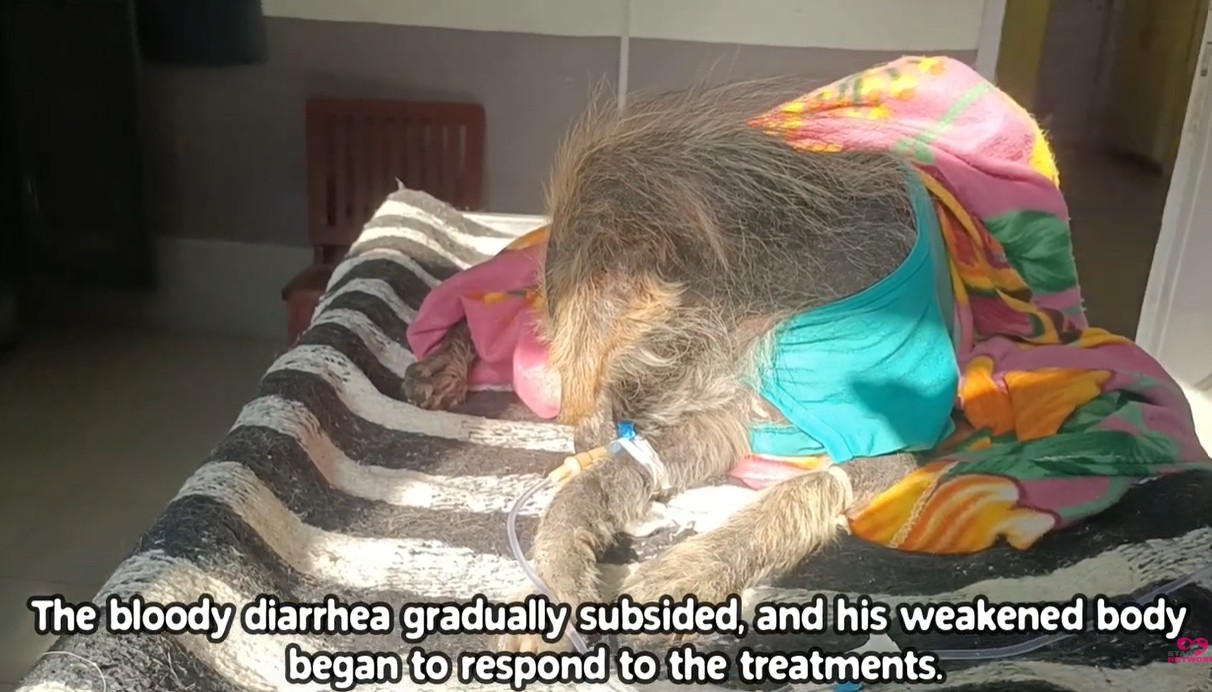
His Final Days Were Nothing Like the Street Where He Was Found
Trumpad did not spend his final days lying exposed to the winter.
He was indoors.
His body was wrapped in blankets.
There was heat beside him instead of freezing air.
When dehydration became dangerous, fluids were available.
When fever threatened him, someone measured it and responded.
When his condition changed, people noticed.
None of those things could guarantee survival.
But they mattered.
Sometimes animal rescue is described only through successful transformations.
A skeletal dog becomes healthy.
A frightened dog learns to play.
A paralyzed puppy walks again.
Those stories deserve to be told.
But they are not the only form rescue takes.
Sometimes an animal arrives too late for a complete recovery.
Sometimes the work becomes less about creating years of future life and more about making sure the remaining hours or days contain comfort.
That does not make the rescue meaningless.
Trumpad’s outcome was heartbreaking.
But imagine the alternative.
The same fever.
The same dehydration.
The same damaged skin.
The same failing strength.
Only outside.
Alone.
Without anyone recognizing how seriously ill he had become.
The volunteers could not give him the ending they wanted.
They could give him a different place in which to reach it.
Saving an Animal Is Not Always the Same as Keeping It Alive
Trumpad’s story challenges one of the easiest assumptions to make about rescue.
We naturally want every intervention to end in survival.
We want the dog to eat.
Stand.
Gain weight.
Grow fur.
Find a family.
When that happens, the transformation feels complete.
But rescue workers do not get to choose the condition in which an animal arrives.
They can only respond to what is in front of them.
For Trumpad, that meant treating a dog whose body had already been pushed to an extreme point.
The fact that he died does not mean the fluids were pointless.
It does not mean the blankets were pointless.
It does not mean controlling his fever or staying beside him was pointless.
Those actions still reduced suffering.
They still provided care.
They still meant that when his condition worsened, someone was there to respond.
There is dignity in that.
Not the kind that needs to be turned into a dramatic speech.
Simply the dignity of a living creature being treated as though his comfort matters.
Trumpad received that in his final days.
And sometimes, that is the most honest form of rescue anyone can offer.
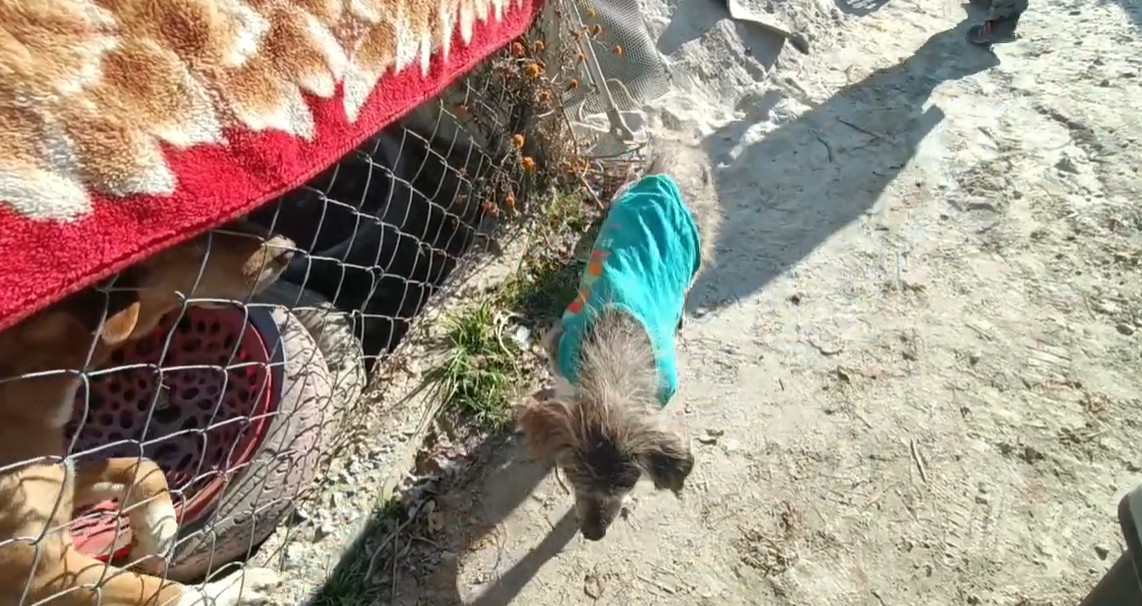
Trumpad’s Story Is Also About the Animals Still Outside
The most painful part of Trumpad’s case is how advanced his condition had become before help arrived.
Mange does not usually transform a healthy coat into extensive hair loss in a single afternoon.
Severe malnutrition develops over time.
A body becomes weaker gradually.
An animal loses weight.
Skin problems worsen.
Movement slows.
The ability to withstand cold decreases.
Eventually, a stray that once walked through the streets may simply lie down.
That is why noticing animals earlier matters.
A dog does not need to be near collapse before intervention becomes worthwhile.
A change in body condition matters.
Severe hair loss matters.
Persistent skin irritation matters.
An animal becoming too weak to search for food matters.
Trumpad was found at the point where multiple problems had converged.
The volunteers did everything they reasonably could once he reached them.
His story leaves behind a difficult question:
How many animals are still outside today, not yet as sick as Trumpad—but moving in the same direction?
Finding them sooner can make the difference between rehabilitation and end-of-life care.
He Was Seen Before It Was Completely Over
Trumpad did not receive the long second chapter everyone wanted for him.
There is no final scene of him running across a yard.
No adoption photograph.
No healthy coat months later.
No family waiting at a doorway.
His story is shorter.
A freezing road.
A critically ill dog.
Rescuers who stopped.
A clinic.
Blankets.
Fluids.
Medication.
Three uncertain days.
A brief improvement.
And then goodbye.
That may not be the ending people hope to read.
But it is still worth telling.
Because the value of compassion cannot be measured only by whether it defeats death.
Sometimes it gives an animal years.
Sometimes months.
Sometimes only a few days.
Trumpad received days.
Days in which his condition was taken seriously.
Days in which people watched over him.
Days in which cold pavement was replaced by blankets and warmth.
The volunteers could not undo everything that had happened to his body before they found him.
They could only make sure that from the moment they lifted him from the road, he was no longer being overlooked.
And they did.
Trumpad’s life ended far sooner than anyone wanted.
But it did not end where his rescuers found him.
It ended surrounded by care.


