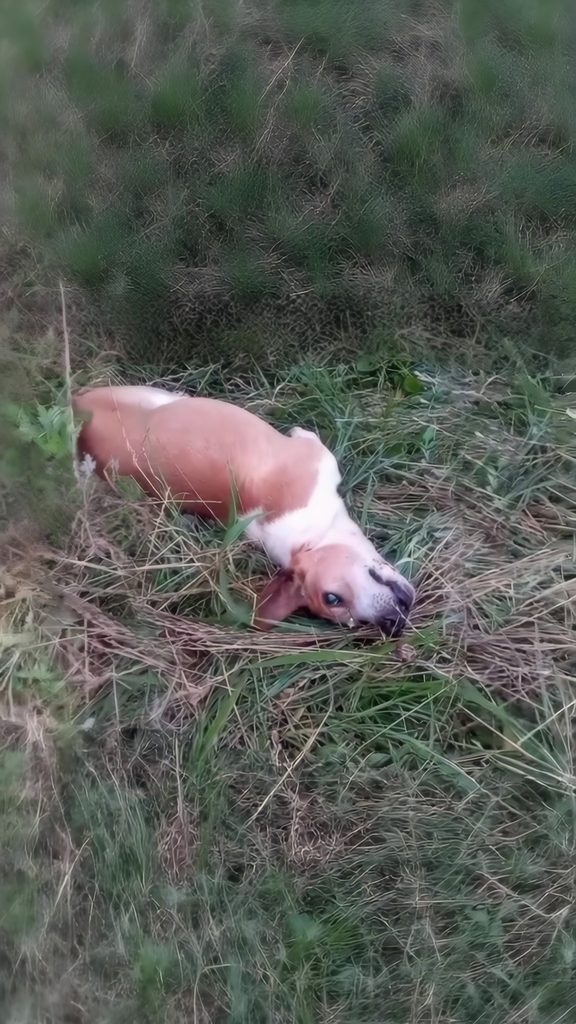
Tito was lying in the grass when someone finally noticed him.
He was small.
Almost motionless.
And badly injured.
A car had reportedly struck him earlier, leaving him with severe trauma to his head and jaw. Instead of being taken immediately for treatment, Tito had been moved away from the road and left nearby.
By the time strangers found him, he was barely responding.
His breathing was shallow.
His body trembled.
He could not stand.
And something else had changed forever.
Tito could no longer see.
The little dog had survived the impact, but the world around him had gone dark.
No one standing beside him knew whether he would make it through the next few hours.
Still, Tito was breathing.
That was enough.
The strangers wrapped him carefully, lifted him from the grass, and carried him toward help.
For the first time since the accident, someone had decided not to leave him behind.
Tito Arrived at the Clinic With Almost Nothing Left
At the emergency clinic, the severity of Tito’s injuries became clearer.
His head had taken a significant impact.
His jaw was badly damaged.
He was in shock.
His mobility was severely affected, and he could not support himself normally.
Most concerning of all was the loss of vision.
Tito was now completely dependent on sound, touch, and the people around him.
The veterinary team focused first on stabilization.
Pain needed to be controlled.
His breathing had to be monitored.
His body had to be kept warm.
He needed assistance with basic care because he could not simply stand up, walk to a bowl, or reposition himself normally.
There was no dramatic promise that Tito would recover.
The first goal was much smaller.
Get him through the day.
Then the night.
Then see what the next morning brought.
Veterinary staff and rescuers stayed close.
When they spoke, Tito sometimes responded with tiny movements.
When a familiar hand rested against him, his breathing occasionally seemed to settle.
Those responses did not guarantee anything.
But they showed that Tito was still reacting to the world around him.
And that was enough reason to keep going.
VIDEO: Tito Lost His Sight After the Accident — But His Smallest Movements Gave Rescuers Hope
The First Signs of Progress Were Almost Too Small to Notice
Tito’s recovery did not begin with walking.
It did not begin with eating independently.
At first, progress meant movements most people would barely notice.
A paw shifting when someone called him.
His head turning slightly toward a voice.
A calmer breath when a caregiver stayed beside him.
Then, one morning, Tito lifted his head.
It was only a small movement.
But for people who had spent days watching him lie almost completely still, it felt enormous.
The little dog who had been found barely breathing was beginning to interact with his surroundings again.
His body still needed extensive care.
He required help eating.
He needed assistance staying comfortable.
Every change of position had to be handled carefully because his injuries remained painful.
Nothing about recovery was fast.
And nothing could restore the vision he had lost.
That realization gradually changed the question surrounding Tito.
At first, everyone had asked:
Would he survive?
Now another question emerged.
If he survived, could he learn to live without sight?
A Blind Dog Has to Learn the World Differently
For Tito, recovery meant more than healing from physical injuries.
The accident had changed how he would experience everything around him.
He could no longer look toward a person entering a room.
He could not see a doorway.
He could not visually avoid furniture or judge how far away an object might be.
But dogs do not experience the world through sight alone.
Tito still had hearing.
Scent.
Touch.
Memory.
As his physical condition improved, those senses became increasingly important.
Caregivers began noticing how carefully he listened.
A familiar voice could draw his attention.
Footsteps told him where someone was standing.
He learned the scents of people who spent time with him.
Gentle contact helped him understand when someone was close.
Slowly, the dark world surrounding Tito became less unpredictable.
A room could be memorized.
A voice could become familiar.
A hand touching his shoulder could serve as guidance.
The same dog who once lay motionless after the accident began moving again.
Carefully.
Tentatively.
One step at a time.
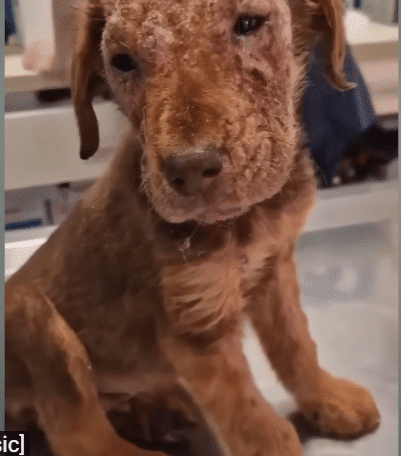
Tito Learned to Trust What He Could Hear and Feel
As the weeks passed, Tito became more confident.
He did not regain sight.
Instead, he became better at using everything he still had.
He recognized familiar people before they touched him.
He learned the rhythm of daily routines.
He began understanding where food appeared and where safe resting places were located.
When someone called him, Tito could orient himself toward the sound.
When hands reached for him gently, he leaned closer rather than immediately pulling away.
This kind of progress did not happen because fear simply disappeared.
It came from repetition.
The same people returned.
Food arrived regularly.
No one forced Tito to move faster than he was ready for.
When he became confused, someone guided him.
When he grew tired, he was allowed to stop.
Over time, the environment stopped feeling entirely unfamiliar.
Tito could not see the people caring for him.
But he could learn them.
The sound of a voice.
The scent of clothing.
The rhythm of footsteps.
Those details became landmarks in his new world.
His Body Healed Faster Than His Search for a Home
Eventually, Tito became medically stable enough that survival was no longer the central concern.
He had made it through the critical stage.
His injuries had healed enough for him to move more independently.
He had adapted remarkably well to blindness.
But another challenge remained.
Tito needed a permanent home.
Adopting a blind dog can feel intimidating to people unfamiliar with special-needs animals.
There are practical considerations.
A consistent environment matters.
Unexpected obstacles may need to be minimized.
A blind dog may require additional guidance in unfamiliar spaces.
Some people saw those responsibilities and moved on.
Days passed.
Then weeks.
Then months.
Tito waited.
He continued living around the people who cared for him.
He learned routines.
He remained affectionate.
He responded to familiar voices.
His body had recovered from the accident as much as it could.
Yet the family meant to take him home had not appeared.
The wait eventually stretched to 469 days.
More than a year.
For 469 days, Tito lived safely—but without the permanent home everyone hoped he would find.
After 469 Days, Someone Finally Saw More Than His Blindness
Then a family heard about Tito.
They learned what had happened.
The accident.
The loss of sight.
The long recovery.
And the hundreds of days he had already spent waiting.
They did not stop at the word blind.
They wanted to meet him.
For Tito, a first meeting could never work in the same way it might for a sighted dog.
He could not watch someone approaching from across the room.
He could not study facial expressions.
He had to learn new people through sound, scent, and touch.
So the meeting was allowed to happen slowly.
The family spoke to him.
They let Tito approach at his own pace.
He listened.
His ears moved toward their voices.
Then he stepped closer.
His tail began to wag.
Eventually, Tito pressed his face into their hands.
There was no need for anyone to tell him what a permanent home meant.
He only knew what was happening in that moment.
These people felt safe enough to approach.
Safe enough to touch.
Safe enough to remain close.
After 469 days, Tito had finally met the people willing to make that feeling permanent.
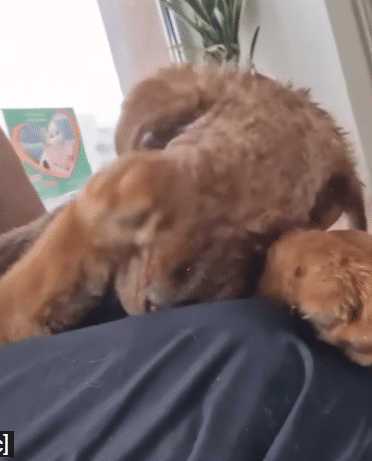
A New Home Required Patience, Not Perfection
Moving into a home was another adjustment.
The shelter or rescue environment had become familiar to Tito.
He knew the sounds.
The layout.
The people.
A new house meant learning another map from the beginning.
But this time, Tito did not have to figure it out alone.
His family helped him learn where things were.
Food.
Water.
Beds.
Doorways.
Open spaces.
They guided him calmly through unfamiliar areas and gave him time to memorize his surroundings.
Furniture was not simply an object Tito could see and avoid.
He had to learn that it was there.
A room became understandable through repeated movement.
Step.
Pause.
Listen.
Smell.
Remember.
Before long, confidence began replacing hesitation.
Tito started moving through his home with greater ease.
Familiar voices helped him locate his people.
Their footsteps told him who was nearby.
The house that had once been completely unfamiliar became predictable.
Safe.
His.
The Dog Left in the Grass Became Someone’s Family
Tito’s life today bears little resemblance to the scene where his story began.
He is no longer lying beside a road waiting for someone to notice that he is still alive.
He no longer depends on strangers passing by at exactly the right moment.
There are people expecting him now.
People who know how he moves.
People who understand when he needs guidance.
People whose voices he recognizes before they even reach him.
Tito still cannot see.
That part of the accident did not change.
But blindness is only one fact about him.
It does not describe the way he leans toward familiar hands.
It does not describe the confidence with which he moves through spaces he knows.
It does not describe the tail that responds when his family speaks.
And it certainly does not describe the 469 days he waited without losing his ability to connect with people.
Tito did not need his eyesight restored in order to build a meaningful life.
He needed treatment.
Patience.
Consistency.
And eventually, a family willing to adapt alongside him.
Tito Never Needed Someone to Fix Everything
There was no way to undo the accident.
No treatment could give Tito back the exact life he had before that day.
His blindness remained permanent.
The scars remained part of his history.
But rescue does not always mean returning an animal to the person they used to be.
Sometimes it means helping them build a good life with what remains.
That is what happened to Tito.
Strangers stopped when he needed someone.
Veterinary staff cared for him when his condition was critical.
Caregivers helped him understand a world without sight.
And eventually, a family waited long enough for him to learn their voices, their scent, and their touch.
Tito’s journey lasted far longer than the dramatic first days after the accident.
The hardest part may not have been the moment he was found.
It may have been everything that followed.
Learning to move.
Learning to trust.
Learning a world he could no longer see.
Waiting 469 days.
Then beginning again in a new home.
That is why Tito’s story matters.
Not because he became the same dog he was before the accident.
He didn’t.
He became a dog who discovered he could still navigate, connect, trust, and belong without sight.
Once, Tito lay in the grass while the world moved around him.
Now, when he hears the voices of his family, he knows exactly which direction to go.
And after 469 days of waiting, he no longer has to wonder whether someone is coming back for him.


