Behind a neighborhood restaurant, where people came and went without thinking much about what happened beyond the kitchen doors, a tiny puppy had learned how to survive.
He stayed nearby because food sometimes appeared there.
A scrap.
A leftover bite.
Something dropped by a passerby.
He was small, thin, and far too young to be navigating life alone, but people who noticed him remembered one thing clearly.
His tail still wagged.
Then one day, that familiar little puppy disappeared from his usual spot.
When he was finally found, he was hiding behind the restaurant.
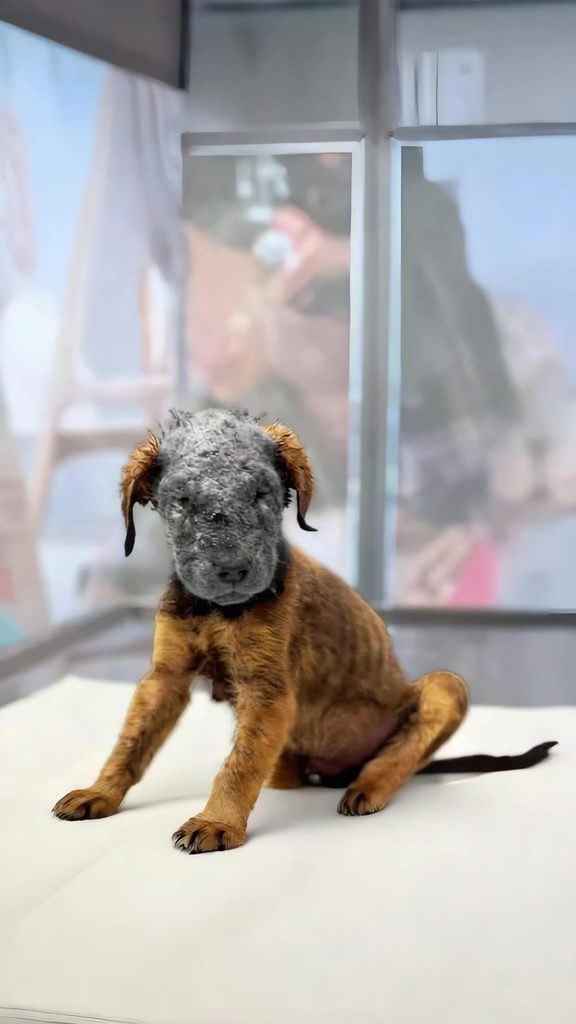
His face was swollen.
His fur was thin and patchy.
His eyes were sealed shut.
And the puppy who once approached people for scraps was now lying quietly, badly injured and unsure of what would happen next.
Rescuers received the call and came quickly.
They did not yet know that saving Nemo from those first injuries would be only the beginning.
He Was Hiding Where Almost No One Could See Him
Nemo had tucked himself away behind the building.
Whether he had chosen the spot because it felt safer or simply because he no longer had the strength to move farther, no one could know.
What rescuers could see was enough.
He was underweight.
His face had been seriously affected by an injury reportedly connected to an accident near the restaurant.
His eyes were swollen shut, leaving him unable to properly see the people approaching.
The team moved slowly.
A puppy in pain may panic when unfamiliar hands come close, especially when he cannot see clearly enough to understand what is happening.
But Nemo did not try to run.
He remained where he was as rescuers spoke softly and reached toward him.
A clean towel was wrapped around his little body.
Once supported, he seemed to settle.
There was no need to assign complicated emotions to the moment.
His response was visible enough.
He stopped struggling.
His body relaxed slightly.
And he allowed the rescuers to carry him away.
The puppy who had survived behind the restaurant finally had somewhere else to go.
VIDEO: Nemo Was Found Hiding Behind a Restaurant With His Eyes Sealed Shut
The First Days Were About Pain Relief, Fluids, and Rest
At the shelter clinic, Nemo’s condition required immediate attention.
His wounds needed to be cleaned carefully.
His small body was weak and depleted.
He needed fluids, medication, and pain management before anyone could think about what his long-term recovery might look like.
Everything was done slowly.
His skin was sensitive.
His face had already experienced significant trauma.
Even simple handling had to be gentle.
The team focused on making him comfortable enough to rest.
At first, Nemo did not have much energy.
There were times when eating seemed difficult.
He slept often.
When awake, he mostly watched—or tried to respond to the sounds around him while his swollen eyes remained closed.
Yet one small behavior kept appearing.
Whenever a caregiver approached, Nemo’s tail sometimes moved.
Only a little.
A faint wag from a puppy who had very little strength to spare.
It was not proof that he understood everything happening around him.
But it showed that human presence had not become something he completely rejected.
So the team kept returning.
Medication.
Cleaning.
Food when he could manage it.
A warm place to sleep.
Then the same routine again the next day.
Slowly, Nemo Began Looking Like a Puppy Again
Healing came in pieces.
The changes were small enough that someone seeing Nemo every hour might barely notice them.
Then a few days would pass, and suddenly the difference became clear.
His appetite improved.
He became more alert.
His body started holding onto the nutrition it desperately needed.
His wounds began healing.
The swelling around his face gradually decreased.
Then came one of the most important moments of his early recovery.
Nemo opened his eyes.
After days in which swelling had kept them closed, he could finally look at the people who had been caring for him.
The change made his entire face seem different.
He began following movement.
Watching caregivers.
Responding more actively when someone entered.
As his physical discomfort eased, more of his personality emerged.
Nemo was affectionate.
Curious.
Interested in the people around him.
The frightened puppy behind the restaurant was slowly giving way to the young dog he might have been all along.
For the rescue team, it finally felt as though the worst might be behind him.
Then Nemo stopped eating.
Just as He Improved, Nemo Became Sick Again
The change happened quickly.
One morning, Nemo showed little interest in food.
His energy dropped.
The puppy who had recently begun becoming brighter and more engaged suddenly looked weak again.
After everything his body had already endured, the setback was worrying.
Veterinary testing provided the answer.
Parvovirus.
For a young puppy, parvovirus can become extremely serious.
It can cause severe gastrointestinal illness, dehydration, weakness, and a rapid decline in animals whose immune systems are not yet fully developed.
Nemo was already recovering from another major medical crisis.
Now his body had to fight something entirely different.
He was placed in isolation.
Fluids became essential.
Medication and supportive treatment continued while the team monitored him closely.
The playful personality that had only just started emerging seemed to disappear beneath exhaustion.
Some days, Nemo barely wanted to lift his head.
The rescuers could not force his body to recover.
They could only provide the support it needed while waiting to see whether he would respond.
So once again, the routine became very simple.
Watch.
Treat.
Hydrate.
Keep him comfortable.
And return when another hour passed.
For Several Days, Nobody Knew Which Way His Body Would Turn
Parvovirus recovery can feel painfully slow because improvement often comes through tiny signs.
The rescue team watched Nemo constantly.
Was he more alert?
Was he drinking?
Could he keep fluids down?
Would he respond when someone spoke?
There were no guarantees.
At times, Nemo remained almost completely still.
Yet when volunteers sat close and touched him gently, he sometimes responded.
A small movement.
A slight shift of his head.
Occasionally, the faintest tail wag.
Those gestures did not mean the danger had passed.
But they reassured the people around him that Nemo was still engaging with his surroundings.
Days passed this way.
Quietly.
Caregivers entering and leaving the isolation area.
Fluids being checked.
Medication given.
Bowls offered and removed.
Everyone hoping for a sign that Nemo’s body was beginning to turn the corner.
Then one morning, something was different.
Nemo pushed himself upward.
His legs were unsteady.
But he stood.
And this time, standing was only the beginning.
The Morning Nemo Walked to His Bowl Changed Everything
Once upright, Nemo took a few tentative steps.
The caregivers watched without rushing toward him.
He moved toward his water.
And drank on his own.
A little later, he showed interest in food.
For a puppy fighting parvovirus, those simple actions carried enormous meaning.
He wanted to drink.
He wanted to eat.
His body finally appeared ready to participate in recovery again.
From that morning forward, Nemo’s progress became steadier.
His appetite improved.
Energy returned.
He spent less time lying completely still and more time paying attention to what was happening around him.
The medical team remained cautious.
One good morning did not erase the illness.
Treatment still had to continue.
His body still needed time to rebuild what had been lost.
But the atmosphere had changed.
Nemo was no longer simply enduring treatment.
He was beginning to act like a recovering puppy.
And once his strength returned enough for play, an entirely different version of Nemo appeared.
A Small Pool Revealed the Puppy Hidden Beneath the Illness
As Nemo recovered, his personality became impossible to miss.
He was curious about everything.
He wanted attention.
He explored.
He played.
His coat improved as his overall health returned.
The thin body began filling out.
And the little tail that had moved weakly during his earliest days now seemed to have far more energy.
One of Nemo’s favorite discoveries was a small kiddie pool.
For a puppy whose recent life had revolved around treatment rooms and isolation, splashing in water was beautifully ordinary.
He stepped in.
Moved through the water.
Played.
Splashed.
Then came back for more.
Nothing about the scene looked like the puppy rescuers had found behind the restaurant.
There were no sealed eyes.
No body hiding against the wall.
No need to conserve every bit of energy.
Nemo finally had enough strength to waste some of it on fun.
That may be one of the clearest signs of recovery in a young dog.
Not simply eating.
Not merely standing.
But feeling well enough to do something with no purpose other than enjoyment.
Nemo Survived Two Battles — Now He Needs the Ordinary Life of a Puppy
Nemo’s story changed direction more than once.
First came the injured puppy hiding behind a restaurant.
Then emergency treatment.
His wounds began healing.
His eyes opened.
Everyone thought he was moving toward safety.
Then parvovirus arrived and placed his life at risk again.
For several days, the question returned:
Would Nemo have enough strength left?
He did.
Today, the puppy who once needed a towel wrapped around his fragile body is stronger, healthier, and far more interested in play than survival.
His eyes are open.
His appetite has returned.
His body has filled out.
He seeks affection and responds enthusiastically to the people around him.
What Nemo still needs is not another dramatic rescue.
It is something much more ordinary.
A permanent home.
Regular meals.
Safe places to sleep.
Toys.
People who expect him to be there tomorrow.
Perhaps that is the most meaningful ending a rescue story can have.
Not a miracle.
Normal life.
Nemo has already experienced enough extraordinary hardship for one small puppy.
He survived the injury that left him hiding behind the restaurant.
He survived the days when his eyes were sealed shut.
He survived parvovirus after his first recovery had barely begun.
Now the little dog who once lived from scrap to scrap has the opportunity to discover a world where food arrives every day and kindness does not disappear when the clinic doors close.
When rescuers first carried Nemo away, they could not promise him any of that.
They could only promise the next hour of care.
Then the next.
That was enough.
Hour by hour became day by day.
Day by day became recovery.
And the tiny puppy once hidden behind a restaurant finally reached the point where his story no longer needs to be about surviving.
It can simply be about living.


