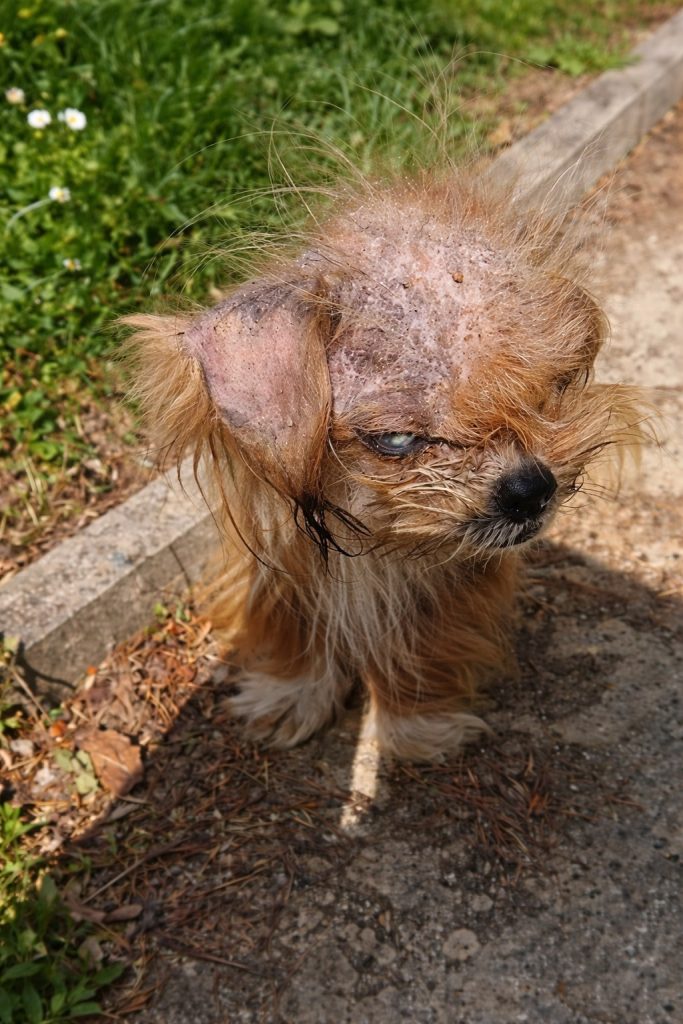
Before anyone called him Frodo, he was simply the thin dog wandering through the streets.
His coat was patchy.
His skin looked red and irritated.
Parasites had taken advantage of a body already weakened by life outside, and one of his eyes was visibly infected.
Still, Frodo kept moving.
He searched for food.
Found places to rest.
Stayed out of the way when people passed.
From a distance, he could have been mistaken for another stray who had somehow learned to survive.
Up close, it was obvious that survival was becoming harder every day.
His body needed more than another meal.
His skin needed treatment.
His eye needed veterinary attention.
And the longer those problems continued, the less strength Frodo had left to deal with any of them.
Then a few local residents stopped seeing him as part of the background.
They looked closer.
And that decision changed everything.
One Look Was Enough to Know Frodo Needed More Than Food
The people who noticed Frodo could see that leaving a bowl of food would not be enough.
His skin was in poor condition.
Large areas of fur had thinned or disappeared.
Parasites were affecting his already fragile body.
The problem with his eye looked especially concerning.
Frodo needed someone with experience.
So the residents contacted Klaudija Sigurnjak, a rescuer known for helping animals in difficult circumstances.
When Klaudija reached Frodo, she saw the same things everyone else had noticed.
But she also saw a dog who was still responsive.
Still moving.
Still capable of being helped.
The first challenge was getting close enough to do that.
Frodo had survived outside by being cautious.
An unfamiliar person suddenly reaching toward him could easily make him retreat.
So Klaudija did not rush.
She allowed him to watch.
She kept her movements controlled.
She gave him space to decide whether coming closer felt safe.
The process was quieter than the dramatic rescues people often imagine.
No chase.
No struggle.
Just a frightened dog and someone willing to move at his pace.
Eventually, the distance between them became small enough for Frodo’s rescue to begin.
VIDEO: Frodo Was Thin, Sick, and Losing His Fur — Then Someone Finally Refused to Walk Away
Trust Had to Come Before Everything Else
Getting Frodo away from the street was only the first step.
He still did not know what the people around him intended to do.
New environments brought unfamiliar smells.
Doors closed behind him.
Hands reached toward areas of his body that were already uncomfortable.
Veterinary care was necessary, but that did not mean Frodo immediately understood it as help.
Klaudija treated his caution as something reasonable rather than something to overcome by force.
She spoke gently.
Approached from where he could see her.
Stopped when his body became tense.
Then tried again later.
That consistency mattered.
Frodo began recognizing her voice.
He started allowing her to remain closer.
A hand near his face no longer automatically made him pull away.
Small changes like those created the foundation for everything that followed.
Medication could treat his skin.
Veterinary care could address his eye.
Food could rebuild his body.
But daily life would remain stressful if Frodo constantly believed he needed to protect himself from the humans providing those things.
So trust was allowed to grow slowly.
And Frodo began to learn that these hands were not asking anything from him.
They were trying to make him more comfortable.
The Veterinary Exam Revealed How Much His Body Had Been Carrying
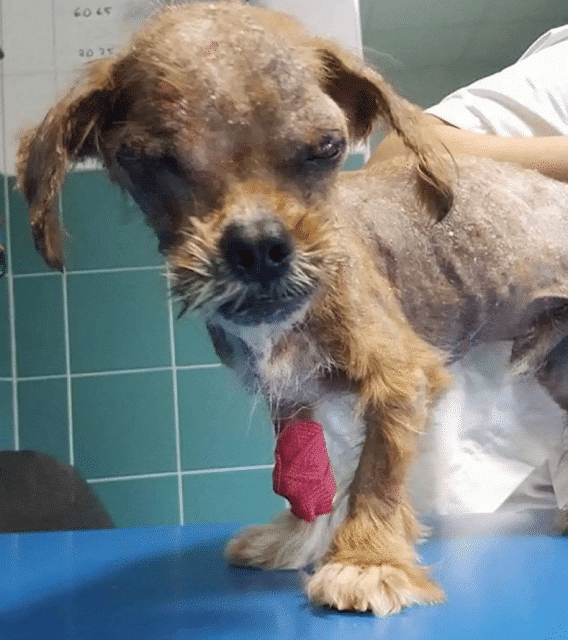
At the clinic, Frodo finally received a full evaluation.
Parasites had weakened him.
His damaged skin needed ongoing treatment.
The eye infection was particularly severe.
Veterinarians attempted to determine what could be saved and what would give Frodo the best chance of living without continued discomfort.
One eye was too badly damaged.
It could not be preserved.
Removing an eye is never a decision made simply because an animal looks different.
For Frodo, the procedure was necessary because the damaged eye had become a source of ongoing pain and medical concern.
His other eye, fortunately, responded to treatment.
Frodo would still be able to see.
That meant the goal shifted.
The team no longer needed to wonder whether they could save both eyes.
They needed to help Frodo recover comfortably with one.
His skin also required continued attention.
Treatment for parasites had to continue.
Medication needed time to work.
Nutrition had to rebuild a body that had spent too long surviving with too little support.
There was no single procedure that would transform him.
Frodo needed weeks of ordinary, consistent care.
That work began as soon as he left the treatment table.
Losing One Eye Did Not Stop Frodo From Moving Forward
The days after surgery required patience.
Frodo needed rest while the surgical site healed.
His remaining eye had to be monitored.
His skin still required treatment.
At first, much of his routine revolved around medical needs.
Medication.
Cleaning.
Meals.
Sleeping.
Then the same things again.
But Frodo adapted.
Dogs generally rely on more than vision alone to understand their surroundings, and having one healthy eye still gave him substantial visual ability.
Once the discomfort from the damaged eye was gone, Frodo could focus on everything else happening around him.
He watched familiar people enter.
He became more interested in food.
His posture began relaxing.
And slowly, his behavior around affection changed.
Frodo stopped maintaining as much distance.
When Klaudija reached toward him, he increasingly allowed the contact.
Then came moments when he did more than simply tolerate it.
He leaned closer.
A tail that had once stayed low began moving.
He started seeking interaction instead of merely accepting it.
The missing eye was visible.
But the most important changes were happening everywhere else.
His Fur Grew Back as His Strength Returned
Physical recovery became easier to see as the weeks passed.
The angry redness of Frodo’s skin began settling.
Areas that had looked bare started showing signs of new hair.
His coat became healthier.
His body filled out.
Regular nutrition gave him energy that had been missing when he lived outside.
The transformation did not happen all at once.
One photograph might show only a small difference.
A few weeks later, the contrast became obvious.
The dog who had once looked frail and uncomfortable was becoming stronger.
But appearance told only part of the story.
Frodo also began recognizing routine.
He learned when meals arrived.
He understood where he could sleep.
He became familiar with the voices around him.
He no longer had to spend each day searching for the next place where he might find food or safety.
That predictability appeared to change the way he carried himself.
His body became less tense.
His movements became more confident.
And the tail wag that once appeared only occasionally became increasingly common.
The healthy coat returning to his body was easy to photograph.
The trust returning to his behavior was harder to capture.
But for the people caring for him, it mattered just as much.
The Dog Beneath the Illness Finally Started to Show Himself
Once Frodo no longer spent most of his energy dealing with discomfort, his personality became much clearer.
He was gentle.
Affectionate.
Curious.
He enjoyed attention.
He liked being near familiar people.
Short walks became part of his routine.
Rest was no longer something he took because exhaustion forced him to stop.
He could simply lie down because he felt comfortable.
Those distinctions mattered.
On the street, nearly everything Frodo did served a purpose connected to survival.
Find food.
Avoid danger.
Locate somewhere to sleep.
Protect painful areas of his body.
After rescue, his world expanded.
He could investigate something simply because it smelled interesting.
He could approach a person because he wanted affection.
He could eat without worrying that there would be nothing tomorrow.
He could sleep long enough to truly rest.
The transformation also changed how people saw him.
At first, it was impossible not to notice the missing fur, damaged eye, and thin body.
Now those were becoming details in a much larger picture.
Frodo was no longer simply a sick stray.
He was a dog with preferences.
Habits.
People he recognized.
And an obvious capacity for companionship.
That mattered because the next stage of his journey required finding someone who could see him the same way.
Then Marko and His Wife Saw the Dog Frodo Had Become
Once Frodo was healthy enough, the search for a permanent home began.
His story was shared.
People learned where he had come from and how much progress he had made.
Eventually, it reached Marko Duspara and his wife.
They were interested not simply in Frodo’s transformation photos, but in the dog he had become.
They met him.
Spent time around him.
Saw the gentle behavior his caregivers had come to know.
Frodo had already learned that some humans could be trusted.
Now he needed to learn two new people.
Once again, nothing needed to be rushed.
He could approach.
Observe.
Become familiar with their voices and scents.
And gradually understand that they were becoming part of his routine.
The connection developed.
Marko and his wife decided Frodo belonged with them.
That meant leaving the rescue environment he had finally learned to trust.
For many dogs, adoption is not simply an instant happy ending.
A new home means new rooms.
New sounds.
Different schedules.
Different people.
Frodo needed time to learn all of it.
Fortunately, his new family gave him exactly that.
Soon, the unfamiliar house began becoming home.
The Dog Once Wandering Alone Became an Irreplaceable Part of a Family
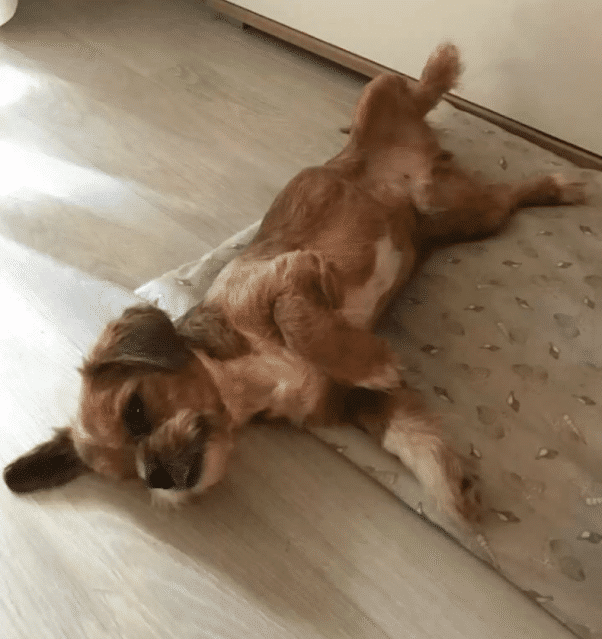
Today, Frodo looks remarkably different from the dog first noticed on the streets.
His coat is healthy.
His body is stronger.
He moves with confidence.
The absence of one eye is visible, but it does not prevent him from exploring, playing, or enjoying the people around him.
He runs.
He investigates.
He rests comfortably in a home where his presence is expected.
And according to Marko, Frodo has brought enormous happiness into their lives.
That may be the most meaningful part of his story.
Rescue is often described as a one-way act.
A person saves an animal.
But relationships rarely stay that simple.
Frodo once needed people to provide everything he could not provide for himself.
Veterinary treatment.
Food.
Safety.
Patience.
Eventually, he became something entirely different to the people around him.
A companion.
A source of affection.
A family member whose absence would now be deeply felt.
The stray dog once easy to overlook had become impossible for his family to imagine living without.
Frodo Only Needed Someone to See Past the Condition He Was In
Frodo’s story did not change because one person performed a miracle.
It changed because several people did ordinary things at the right time.
Someone noticed that the thin stray was getting worse.
Someone made the call.
Klaudija came.
Veterinarians treated him.
One painful eye was removed so that he could live more comfortably.
His skin received treatment.
Parasites were addressed.
Food returned consistently.
Then Marko and his wife opened their home.
No single step created the entire transformation.
Together, they changed the direction of Frodo’s life.
That is why the earliest images of him tell only part of the story.
They show what illness and life on the street had done to his body.
They do not show the affectionate dog waiting underneath.
They do not show the tail wagging for familiar people.
They do not show him exploring his home.
They do not show a family who now considers him irreplaceable.
When Frodo was first found, people could easily have defined him by what seemed wrong.
The skin.
The parasites.
The damaged eye.
The thin frame.
But those conditions were temporary parts of his life, not his identity.
One eye could not be saved.
Frodo could.
And once someone finally stopped long enough to see that difference, everything that came afterward became possible.


