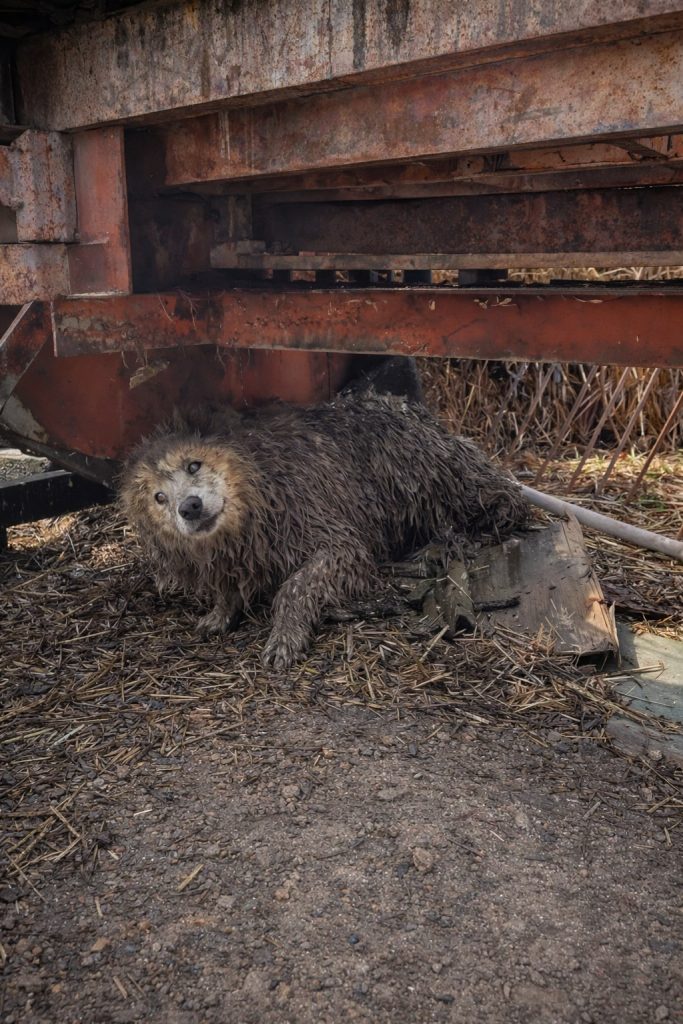
The chain was the first thing rescuers noticed.
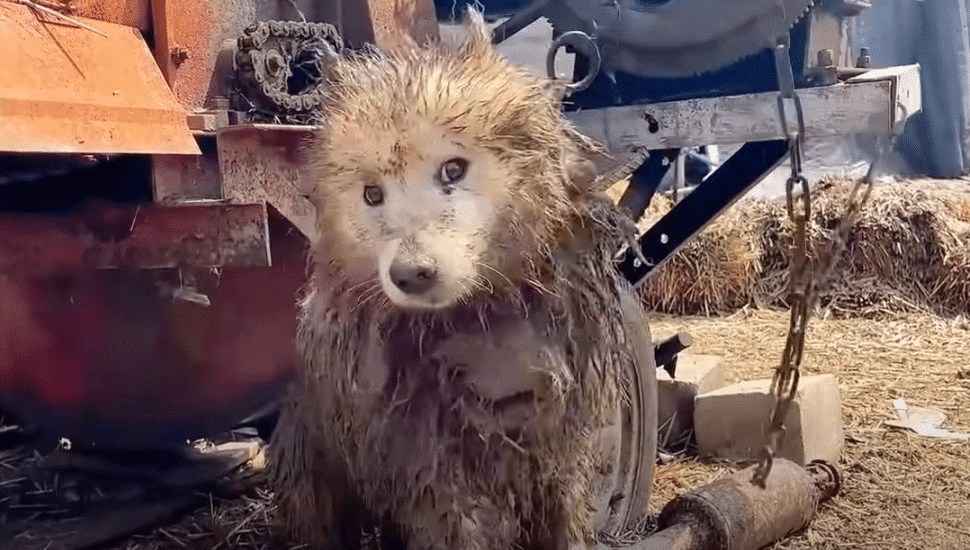
It stretched from a wooden post across a patch of dirt to a white dog standing at the edge of its reach.
He was a Samoyed.
A breed usually associated with thick white fur and an open, gentle expression.
But there was very little softness in the scene in front of them.
His coat was dirty and tangled.
His body looked painfully thin beneath the heavy fur.
Around him were weeds, bare ground, and an empty farm that offered almost nothing resembling a proper home.
No comfortable bed.
No secure shelter.
No familiar person waiting nearby.
Just a small circle of ground defined by the length of a chain.
When the rescuers moved toward him, the dog immediately stiffened.
Then he growled.
A moment later, he snapped in warning.
They stopped.
This was not going to be a rescue solved by walking forward and unclipping a chain.
Before he could be freed, he first needed to believe that the people approaching him were not another threat.
His Entire World Had Shrunk to the Length of a Chain
No one involved could say with certainty how long the Samoyed had been living this way.
What they could see was the condition he was in when they arrived.
His coat, once meant to protect him, had become tangled with dirt.
His body condition was poor.
He appeared to have gone without consistent care for long enough that the neglect was visible even beneath his thick fur.
Food did not seem dependable.
Neither did water.
And there was no sign of a person actively caring for him at the farm.
The rescuers understood that getting him away from the property mattered.
But the dog’s defensive behavior made one thing equally clear.
Forcing the situation could make it worse.
A frightened dog on a chain has very few options.
He cannot create much distance.
He cannot choose another hiding place.
If someone approaches too quickly, warning them away may be the only control he has left.
So when he growled, the team listened.
They backed away.
They gave him space.
And instead of trying to remove the chain immediately, they began with something simpler.
Food.
Fresh water.
And time.
VIDEO: He Was Chained Alone on a Farm — Rescuers Had to Earn His Trust Before They Could Set Him Free
The First Days Were Spent Keeping Their Distance
The rescuers placed bowls within reach.
Then they stepped back.
The Samoyed watched them carefully.
His body remained tense.
His eyes followed every movement.
He did not rush toward the food while people stood close.
Only after they created enough distance did hunger begin to outweigh caution.
He approached.
Ate.
Drank.
Then watched them again.
The rescuers returned later.
The same routine followed.
Food.
Water.
Calm voices.
No sudden attempt to grab him.
Then they left enough space for him to make his own choice.
This continued over several visits.
From the outside, very little seemed to be happening.
The dog was still chained.
He was still wary.
There was no dramatic breakthrough.
But repetition was doing something important.
The same people returned.
They brought what he needed.
They did not punish him for growling.
They did not rush forward when he ate.
They respected the distance he asked for.
Slowly, their arrival became more predictable.
And predictability began replacing some of the fear.
One Day, He Stopped Backing Away
The first meaningful change was not a tail wag.
It was not affection.
It was simply stillness.
A rescuer moved closer than before.
The Samoyed noticed.
His body tightened.
But this time, he did not immediately retreat to the end of the chain.
The person stopped before pushing him too far.
Then waited.
The dog remained where he was.
On another visit, the distance became smaller.
Eventually, a hand could move close enough for him to investigate without the situation turning into another defensive reaction.
The progress was fragile.
One sudden movement could still make him tense.
A new sound could still bring the old caution back.
But trust rarely arrives as one dramatic decision.
It forms through experiences that keep ending safely.
Someone steps closer.
Nothing bad happens.
A hand appears.
Then stops when he becomes uncomfortable.
Food arrives.
No one takes it away.
The same pattern repeats.
And the dog begins gathering evidence.
Perhaps these people are different.
That was the opening the rescuers had been waiting for.
Then the Chain Finally Came Off
The moment happened quietly.
The Samoyed allowed one of the rescuers to approach the attachment point of the chain.
No one celebrated too early.
He was still cautious.
His body was still sensitive to movement.
The rescuer worked slowly.
Then the restraint that had limited his world finally came loose.
The chain fell away.
For the first time since the team had met him, the dog was no longer attached to the wooden post.
There was no dramatic sprint across the farm.
No instant burst of joy.
He simply stood there.
His body appeared to relax.
The physical restraint was gone.
But the habits formed around it would take much longer to disappear.
Freedom itself can be unfamiliar to an animal who has spent too much time confined.
Now the Samoyed had space.
But he still needed to learn what to do with it.
The rescuers carefully prepared him for transport.
The farm was behind him.
The next part of recovery would happen somewhere safer.
Under the Dirty Coat Was a Dog Who Needed Time
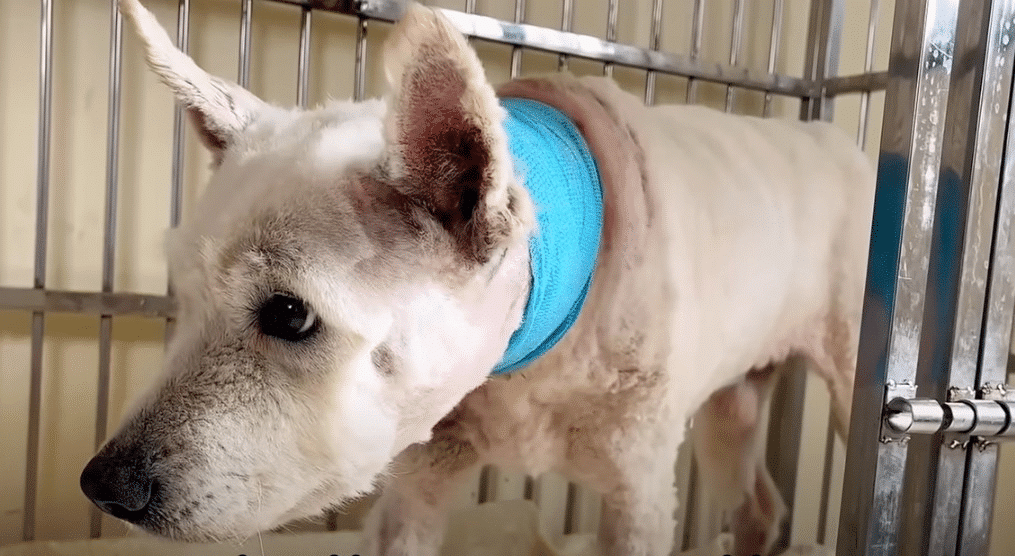
At the shelter, the team began dealing with the physical effects of neglect.
His coat needed cleaning.
Tangles had to be handled carefully.
The skin beneath required attention.
And because he was underweight, regular nutrition became an important part of the recovery plan.
The first bath was not simply a cosmetic change.
For a dog already uncomfortable with touch, grooming meant unfamiliar hands moving over much of his body.
So the staff went slowly.
They spoke calmly.
They paused when he became tense.
No one expected him to enjoy everything being done.
The goal was to make the experience manageable.
Even after the chain was gone, the Samoyed sometimes flinched when people touched him.
That reaction reminded the caregivers that physical rescue and emotional recovery do not happen at the same speed.
His body had reached safety.
His nervous system had not yet fully learned that.
So the shelter built another routine.
Meals at predictable times.
A clean place to rest.
Quiet interactions.
Space when he wanted it.
Gentle handling when care was necessary.
Nothing dramatic.
Just the same safe experiences repeated until they became familiar.
The First Tail Wag Was Small Enough to Miss
For a while, progress was measured in tiny changes.
The Samoyed no longer watched every caregiver with the same level of tension.
He remained in the same space when familiar people approached.
He became more comfortable during routine care.
Then one morning, a caregiver entered and noticed something different.
His tail moved.
Only slightly.
A brief wag.
It was easy to miss.
But for the people who remembered the growling dog at the end of a chain, that movement meant a great deal.
It did not mean every fear had disappeared.
It did not mean he suddenly trusted everyone.
It meant that in that moment, the arrival of a familiar human had become associated with something positive.
After that, more changes followed.
He began showing curiosity toward toys.
He explored instead of remaining in one guarded position.
He accepted touch from people he recognized.
And his tail wagged more often.
The frightened dog had not vanished.
He simply no longer needed to control every interaction through fear.
His Body Began Changing Along With His Behavior
Regular meals gradually restored weight and strength.
His coat improved as dirt and tangles were addressed.
The white fur began looking more like the coat people expect to see on a healthy Samoyed.
But the visible transformation was only part of the recovery.
His posture changed too.
He carried less tension.
He moved around with greater confidence.
He became more willing to approach caregivers instead of waiting for them to close the distance.
Some interactions even began with him seeking attention.
That was a major change from the dog who had once snapped when someone came too close.
Importantly, nobody had forced that affection out of him.
The shelter had simply created enough safe days for him to decide that closeness could be worthwhile.
He was still allowed boundaries.
If he wanted space, people respected it.
If he approached, hands were available.
That choice mattered.
For so long, the chain had decided exactly how far he could go.
Now the dog could decide for himself.
The Farm Became Part of His Past, Not His Whole Story
Months later, the Samoyed looked remarkably different.
The chain was gone.
The thin body had filled out.
His coat was brighter.
His movements were more confident.
And familiar people were no longer greeted primarily with warning.
He could relax around them.
Seek affection.
Explore.
Rest without remaining constantly alert.
The transformation did not happen because one person walked onto the farm and instantly convinced a frightened dog to trust again.
It happened because the rescuers were willing to slow down.
They understood that removing the chain was important—but not enough.
The dog also needed to experience people who respected his fear.
People who returned when they said nothing at all.
People who brought food and did not demand affection in return.
People who allowed trust to grow without forcing it.
That is what eventually changed the Samoyed’s world.
Once, everything available to him existed inside the radius of a chain attached to a wooden post.
Now he can move where he chooses.
Approach when he wants.
Walk away when he needs space.
And rest without wondering whether anyone will return.
The chain was the first thing rescuers saw.
But it is no longer the most important thing about him.
What matters now is the dog who emerged after it was removed.
Gentle.
Curious.
Increasingly confident.
And finally free to decide how close he wants to come.


