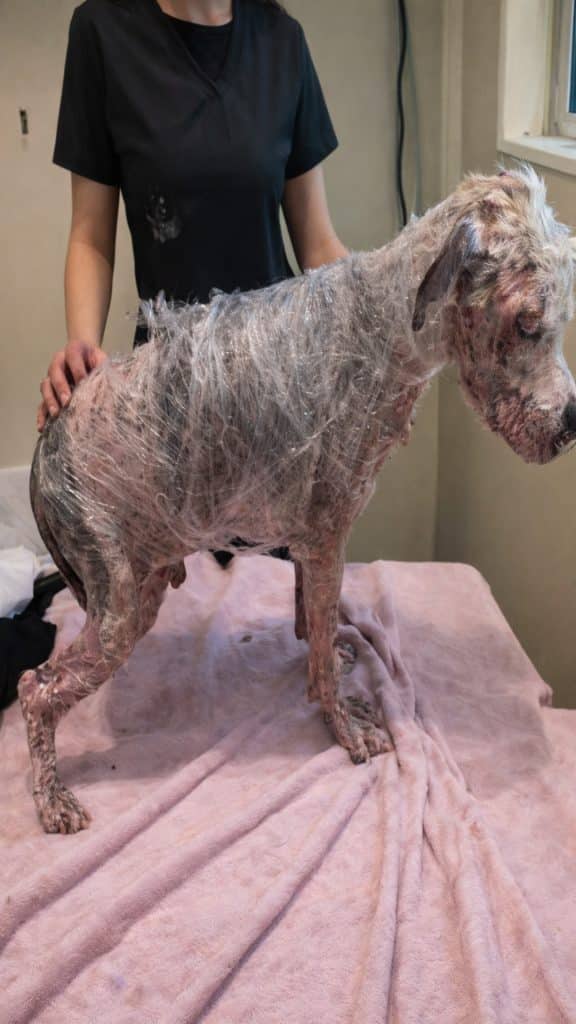
At first, Sinclair barely moved.
He lay curled against the ground in a quiet stretch of open land, his body pressed close to the earth as if he were trying to disappear into it.
There was no collar.
No shelter.
No person nearby calling for him.
Large patches of fur were gone.
His skin looked sore and inflamed.
Several wounds had been left untreated long enough to become impossible to ignore.
And yet the dog remained almost perfectly still.
Not because there was nothing wrong.
Because he looked as though he had very little energy left to spend.
Later, rescuers would call him Sinclair.
Much later, another family would give him an entirely different name.
But before any of that, he was simply a tired dog alone in a field, waiting for someone to notice that he was still there.
Then a voice reached him.
Sinclair lifted his eyes.
It was a small response.
But it was enough.
His Body Showed That This Had Not Happened Overnight
Up close, Sinclair’s condition looked even more serious.
His skin was irritated across large areas of his body.
Fur had disappeared in patches.
Open and healing wounds suggested that some problems had been present for a significant amount of time.
His frame looked weakened.
His movements were cautious and economical.
He did not waste energy.
Every step appeared measured.
The rescuers could not know exactly how long he had been living this way.
They could not know where he had come from or what events had led him into that field.
What they could see was that he needed more than one meal and a temporary place to sleep.
His skin needed treatment.
The wounds needed proper care.
His body needed nutrition.
And after surviving alone, he also needed an environment where nobody expected him to become relaxed simply because help had arrived.
The rescue team approached carefully.
Sinclair followed their voices with his eyes.
He was exhausted, but aware.
That mattered.
There was still a dog inside the worn-down body paying attention to what happened next.
VIDEO: Sinclair Was Found Alone in a Field — His Recovery Would Take Far More Than One Rescue
At Pearl’s Place, the First Goal Was Simply to Let Him Rest
Sinclair was brought into the care of Pearl’s Place.
No one expected an immediate transformation.
The first priorities were basic.
Keep him comfortable.
Give him food.
Create a quiet place to sleep.
Begin addressing the medical problems that had been neglected.
For a dog who had apparently spent so much time in survival mode, rest itself was part of treatment.
Sinclair slept often during the early days.
He ate, but slowly.
He moved when he needed to and then settled again.
There was no pressure for him to interact.
No expectation that he should immediately greet caregivers with affection.
The team created a routine around him instead.
Meals arrived consistently.
Voices remained calm.
Hands approached carefully.
His resting area stayed quiet.
That predictability began changing something important.
Out in the field, Sinclair had been responsible for every part of his own survival.
Now food appeared without searching.
Rest did not have to be interrupted by danger.
And when his wounds needed attention, someone was there to notice.
For the first time in an unknown amount of time, Sinclair could spend his energy on recovery instead of simply getting through the day.
Healing Began With Baths, Wound Care, and Small Meals
Sinclair’s treatment required patience.
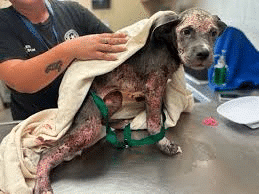
Medicated baths were used to soothe his irritated skin.
Topical care helped address damaged areas and wounds that needed attention.
Nutrition became equally important.
A weakened dog cannot rebuild skin, muscle, and coat without enough consistent food.
So recovery happened in layers.
Treat the skin.
Clean the wounds.
Feed the body.
Let him rest.
Then repeat.
At first, the changes were subtle.
Sinclair slept through much of the day.
He was not suddenly playful.
His coat did not return overnight.
But caregivers began noticing small differences.
He finished more of a meal.
He stood a little longer before lying down.
His steps looked steadier.
He lifted his head to observe activity around him.
Each change was modest on its own.
Together, they showed that his body was beginning to respond.
The people caring for Sinclair did not need one dramatic moment to prove that he was getting better.
They watched the quiet signs instead.
A dog who had once seemed almost part of the field was becoming increasingly present in the room.
Trust Returned More Slowly Than His Strength
Physical treatment could be scheduled.
Trust could not.
As Sinclair’s body became stronger, caregivers began noticing how carefully he still watched people.
That made sense.
Whatever his earlier history had been, he had arrived needing time before human contact could feel completely ordinary.
So no one forced affection.
Caregivers allowed him to control distance whenever possible.
They used soft voices.
Slow movements.
Gentle handling.
If Sinclair wanted to watch from farther away, he could.
If he chose to come closer, someone was there to receive him.
That freedom mattered.
Day after day, the same safe patterns continued.
People entered.
Nothing frightening followed.
Hands approached.
They stopped when necessary.
Meals arrived.
Rest remained uninterrupted.
The guarded expression began to soften.
His body looked less tense.
Then came one of those tiny moments that seems insignificant until someone remembers where a dog started.
Sinclair’s tail moved.
A small wag.
Not constant.
Not dramatic.
But voluntary.
He was beginning to respond to people as something other than a possible threat.
New Fur Was Only One Part of the Transformation
Weeks passed.
The condition of Sinclair’s skin improved.
Wounds closed.
Areas that had been bare began showing new hair.
His body filled out as nutrition restored some of what had been missing.
The physical transformation became obvious enough that photographs could capture it.
But the behavioral change was just as important.
Sinclair began taking short walks.
At first, he moved carefully.
The world outside his resting area still contained unfamiliar sounds and smells.
But each calm outing gave him another safe experience.
His head lifted higher.
He began investigating scents rather than simply moving through the environment cautiously.
Curiosity returned.
Then came playful moments.
Small ones at first.
A brighter expression.
More engagement with familiar people.
A willingness to linger nearby.
The exhausted dog found in the field was starting to show traits that had been difficult to see beneath discomfort.
Gentleness.
Interest.
Quiet affection.
Confidence.
He was not becoming a different dog.
He was finally becoming healthy enough for people to see who had been there all along.
Eventually, the Question Was No Longer Whether He Would Recover
As Sinclair continued improving, veterinary follow-ups confirmed steady progress.
His condition was being managed.
His strength had returned.
His coat was fuller.
He no longer looked like a dog whose entire day revolved around conserving energy.
That shifted the goal.
At first, everyone had focused on immediate care.
Could he eat?
Could his wounds heal?
Could his skin improve?
Could he become comfortable?
Now the question was different.
Where would Sinclair go from here?
He needed something Pearl’s Place could not permanently replace.
A home.
A family willing to see beyond the way he had looked when he was found.
People who understood that the dog in front of them was more than a rescue photograph.
Sinclair was affectionate.
Calm.
Increasingly confident.
And ready for a life defined by routine rather than recovery.
Then a family came forward.
They saw what his caregivers had already learned.
The frightened, exhausted dog from the field had become a companion.
And they wanted him to become part of their home.
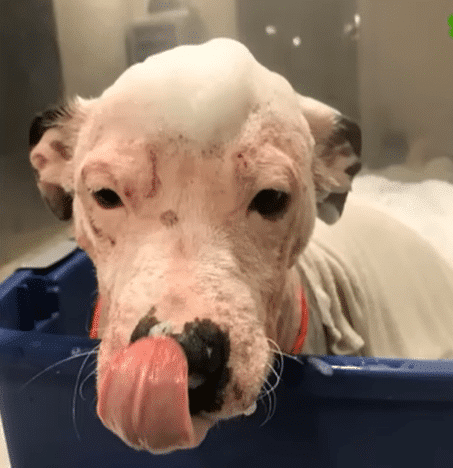
Sinclair Left Rescue With a New Name: Casper
Adoption marked another major transition.
The dog who had learned one set of safe routines now had to adjust to another.
A different home.
Different rooms.
New sounds.
New people.
A new daily rhythm.
His adoptive family gave him something else too.
A new name.
Casper.
The name represented more than a cosmetic change.
It marked the beginning of a chapter in which his identity no longer centered around rescue.
Casper had a home.
A soft place to rest.
Meals that appeared every day.
People who expected him to be part of their routine.
The marks of his earlier condition did not vanish from history.
They simply stopped being the most important thing about him.
Now his days could include ordinary experiences.
Resting comfortably.
Walking with people he knew.
Exploring without having to search for survival necessities.
Accepting affection without wondering what came next.
The field where he had been found remained part of his story.
But it no longer determined the shape of his future.
The Dog Who Barely Moved in the Field Finally Had Somewhere to Stay
Casper’s transformation was not created by one dramatic rescue moment.
It was built slowly.
Someone noticed him.
Someone approached.
Pearl’s Place took him in.
Caregivers treated his skin.
Cleaned his wounds.
Fed him consistently.
Waited while he learned that hands could be gentle.
Walked beside him when he became strong enough to explore again.
Then a family opened their home.
None of those actions alone tells the whole story.
Together, they changed everything.
When Sinclair was first found, he seemed almost motionless against the ground.
His damaged skin and thin body made it easy to focus only on what had gone wrong.
But rescue revealed something else.
He still responded to a gentle voice.
He could learn routines.
He could become curious.
He could trust.
He could form connections.
And eventually, he could belong somewhere.
The dog in the field had not been empty of hope or personality.
Those parts of him had simply been buried beneath exhaustion.
Care brought them back into view.
Today, he is no longer the anonymous dog lying alone in open land.
He is Casper.
He has a name spoken by people who expect him to answer.
A place where food is not uncertain.
A place where rest is safe.
A place he does not have to leave tomorrow.
For a dog once found with nothing around him but open ground, that may be the most meaningful transformation of all.
He no longer has to wait for someone to find him.
He is already home.


