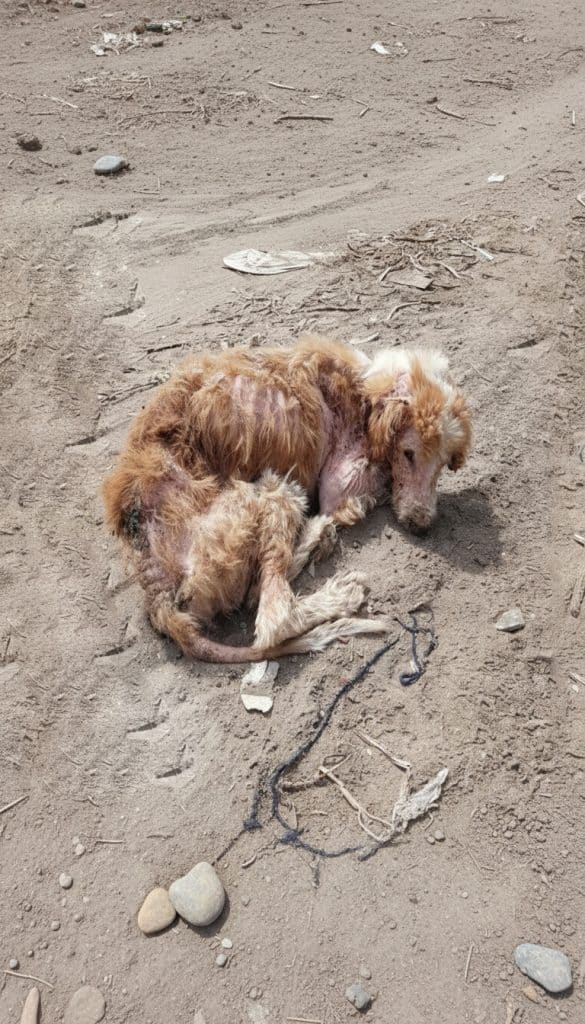
Charlie was only two years old.
He should have been running, exploring, and discovering the world with the restless energy of a young dog.
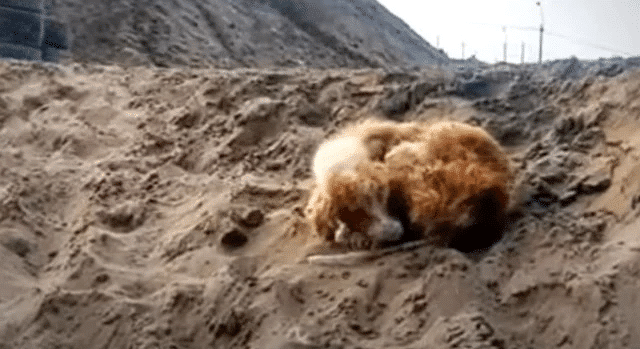
Instead, he lay curled against the ground on a lonely hillside.
His body was painfully thin.
His skin showed the effects of prolonged neglect.
And the strength that should have carried him forward seemed almost completely gone.
People noticed him.
Some slowed down.
Some looked.
But for a while, no one stepped close enough to change what was happening.
Charlie remained where he was, exposed to the wind and too weak to do much more than wait.
Then one person stopped.
They did not know whether Charlie would recover.
They only knew that leaving him there was no longer an option.
That decision became the beginning of everything that followed.
The Young Dog Who Could Barely Keep Going
Up close, Charlie’s condition was even more concerning.
He was severely underweight.
His body appeared exhausted.
His skin was unhealthy, and his movements were slow and limited.
There was none of the easy curiosity usually associated with a young dog.
Charlie seemed to be conserving whatever energy remained.
Even breathing looked tiring.
No one could know exactly how long he had been living this way.
What rescuers could see was enough.
Charlie had gone without consistent care for far too long.
He needed more than a meal and somewhere warm to sleep.
He needed veterinary help.
So the person who had finally stopped lifted Charlie out of the place where he had been waiting and brought him toward safety.
For the first time in an uncertain stretch of his life, someone else was taking responsibility for what happened next.
VIDEO: Charlie Was Found Too Weak to Rise — Watch What Happened Over the Next 100 Days
At the Clinic, the Situation Became More Serious
The veterinary team quickly realized that Charlie’s weakness was not simply the result of missing a few meals.
His condition required urgent medical attention.
Examinations revealed severe anemia.
His body had become so depleted that nutrition alone would not provide the immediate support he needed.
The first days therefore became less about visible transformation and more about stabilization.
Charlie rested.
The medical team monitored him.
Treatment began.
Everyone waited to see how his weakened body would respond.
Then, on the second day, the veterinarians made an important decision.
Charlie received a blood transfusion.
For such a fragile dog, it was a significant stage of treatment.
There was still no guarantee that recovery would be simple.
His body had endured too much for anyone to expect an instant turnaround.
But Charlie had been given something he had not had on that hillside.
A real opportunity to recover.
Day Four Brought the First Reason for Hope
The early period of Charlie’s treatment was quiet.
He spent much of his time resting because his body needed every bit of energy it could preserve.
There were no dramatic leaps forward.
No sudden transformation.
Instead, progress appeared through details.
His breathing became calmer.
His eyes appeared more alert.
He began noticing movement around him.
By the fourth day, the veterinary team could see that Charlie was responding to treatment.
It was still far too early to call him recovered.
He remained weak.
He still required close care.
But something was changing.
The dog who had arrived looking completely depleted was beginning to engage with his surroundings.
Sometimes that is how recovery first appears.
Not through running.
Not through playing.
But through a tired dog opening his eyes and paying attention again.
By Day Ten, Charlie Was Looking Back at the World
Treatment continued.
Medication supported his recovery.
Nutritious meals began giving his body the resources it had been missing.
Rest gave those resources time to work.
And by the tenth day, the difference was becoming easier to see.
Charlie lifted his head more often.
He reacted when familiar caregivers entered.
Voices that once seemed to pass around him now caught his attention.
He watched.
He listened.
He became interested.
Then came one of those moments that might appear ordinary anywhere else.
Charlie’s tail moved.
Just a little.
For the people caring for him, that small wag meant a great deal.
Only days earlier, nearly every movement had seemed difficult.
Now he had enough energy to respond to someone standing beside him.
His body was rebuilding.
And his relationship with the people around him was changing too.
Human Hands Began to Mean Something Different
Charlie had spent enough time in uncertainty that trust could not be expected immediately.
His caregivers did not force it.
Instead, trust grew through repetition.
Food arrived.
Medication was given.
A familiar person returned.
Hands touched him gently.
Nothing bad followed.
Then the same thing happened the next day.
And the next.
Over time, Charlie began reacting differently to the people around him.
He no longer seemed interested only in conserving his strength.
He started welcoming attention.
His posture became less withdrawn.
Familiar caregivers could approach without causing the same hesitation.
What changed was not simply Charlie’s physical condition.
His daily experiences were changing what human presence meant to him.
People were no longer just something happening around him.
They had become associated with food, comfort, treatment, and safety.
Weeks Later, a Different Dog Began to Appear
As the weeks passed, Charlie’s improvement became much more visible.
His appetite strengthened.
His body began filling out.
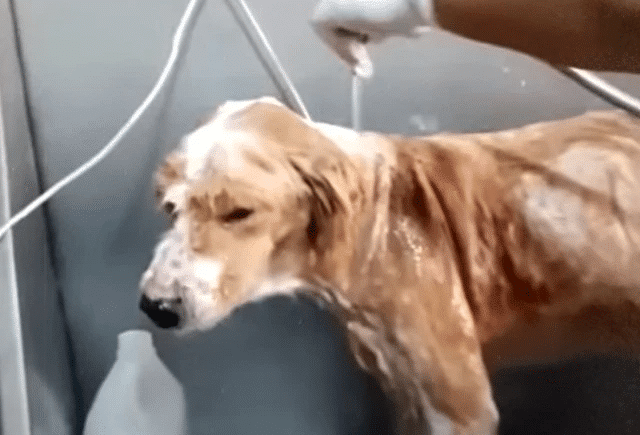
His coat looked healthier.
He moved with greater stability.
But those physical changes revealed something else.
Personality.
Charlie started greeting caregivers.
He became interested in interaction.
He showed excitement when familiar people entered.
The dog who had once lain nearly motionless on a hillside now wanted to participate in what was happening around him.
Curiosity returned.
So did playfulness.
There were still reminders of how far he had come.
Recovery from severe neglect does not erase everything overnight.
But Charlie was no longer spending every moment simply trying to conserve enough strength to continue.
He had energy left for something more.
He could enjoy being a dog.
Nearly Three Months Later, Charlie Found a Friend
Close to three months into his recovery, Charlie reached another milestone.
This one had nothing to do with medication.
He became close to another dog at the clinic.
The relationship developed naturally.
They spent time together.
They played.
They rested near one another.
For Charlie, companionship marked another important change in his life.
He was no longer isolated.
His world now included not only caregivers, food, and medical treatment, but another dog beside him.
Watching the two together made the contrast with Charlie’s first days especially striking.
The dog who had once been curled alone against cold ground was now moving around with a companion.
There was interaction.
There was play.
There were ordinary moments that would have seemed impossible when Charlie first arrived.
Day 100 Showed Just How Far He Had Come
By the hundredth day of care, Charlie looked dramatically different from the dog rescued from the hillside.
His eyes were brighter.
His body was stronger.
His movements had become confident.
He responded to the people around him.
He played.
He interacted.
He showed the personality that severe weakness had hidden during those first days.
The transformation was striking enough to be seen in his appearance.
But what Charlie could now do mattered just as much.
He could walk without every movement appearing exhausting.
He could greet familiar people.
He could spend time with another dog.
He could experience a day without using all of his energy merely to survive it.
One hundred days earlier, Charlie had been waiting for someone else to make the first move.
Now he was moving toward life on his own.
His Recovery Began With One Person Who Stopped
It would be easy to look at Charlie after 100 days and focus only on the transformation.
The healthier body.
The brighter eyes.
The playful young dog who finally appeared.
But none of those moments happened by themselves.
Before the transfusion, someone had to stop on that hillside.
Before the medication, someone had to bring him to the clinic.
Before Charlie could gain weight, someone had to make sure meals kept arriving.
Before he could trust people, those people had to return consistently.
His recovery was built from a chain of decisions.
One person noticed.
Someone acted.
Veterinary professionals treated him.
Caregivers continued showing up.
And Charlie responded little by little.
That is what turned a single rescue into a 100-day journey.
Charlie Finally Had Enough Strength to Enjoy Being Young
Charlie was only two years old when he was found.
For part of his young life, his world had been reduced to survival.
By the end of his recovery journey, that was no longer true.
He could play.
He could seek attention.
He could enjoy companionship.
He could move around with confidence rather than exhaustion.
The dog lying alone on that hillside had not suddenly become a different animal.
The young, social dog people eventually came to know had been there all along.
Weakness had simply hidden him.
Medical care gave his body time to recover.
Consistent kindness gave him space to become comfortable.
And patience allowed his personality to return at its own pace.
Charlie began his story almost motionless against the ground while people passed nearby.
One hundred days later, the same dog was standing stronger, interacting with those around him, and sharing his days with a new canine friend.
His transformation did not begin with anything complicated.
It began because someone finally looked at a struggling dog—
and decided that looking was not enough.


